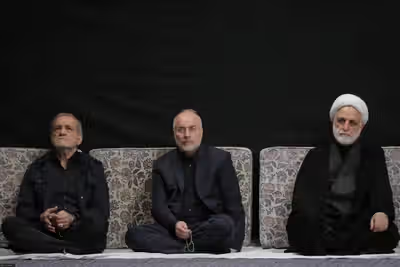
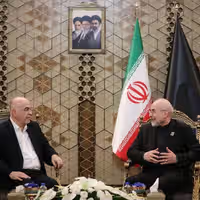
A senior Iranian lawmaker dismissed the reimposition of United Nations sanctions under the snapback mechanism as illegal and largely symbolic, saying it would not bring new pressure on Tehran.
Alireza Salimi, a member of parliament’s presiding board, told local media the move was aimed at creating “psychological pressure” on Iran but would have only a short-term impact.
“In practice, nothing new has happened, since the same sanctions already existed,” he said, adding that Western powers had violated the 2015 nuclear deal from the outset and sought to limit Iran’s missile and nuclear capabilities.
A senior Iranian lawmaker said the activation of the UN sanctions snapback mechanism by the United States and Europe was intended to foment unrest inside Iran.
Ahmad Rastineh, spokesman for parliament’s cultural committee, said on Tuesday that European powers were acting as “obedient servants” of Washington.
He urged the government to formally end nuclear talks, halt cooperation with the UN nuclear watchdog and repeated that the Islamic Republic seeks the “elimination” of Israel.
Iranian Foreign Minister Abbas Araghchi said Tehran had exchanged messages with the United States both directly and indirectly during his trip to New York, but concluded that negotiations with Washington remain futile.
“Messages were exchanged with the Americans both directly and indirectly,” Araghchi told reporters before leaving New York. “It ultimately became clear and certain that talks with the US are a complete dead end,” he added.
Iran’s Javan daily, affiliated with the Revolutionary Guards, said the reimposition of United Nations sanctions through the snapback mechanism had not surprised Tehran but exposed what it called the “barbarism” and “unreliability” of the West.
The newspaper wrote that Western powers “never settle for less than absolute superiority over non-Western nations” and described international agreements as tools for domination rather than commitments.
It argued that reliance on Western promises is misguided, invoking critiques from philosophers such as Martin Heidegger and Edward Said to suggest that Western culture is inherently exploitative.
“The sanctions and activation of the snapback mechanism reveal again that Western civilization is rooted in treachery and domination,” it said.
The prospect of war involving Iran was “unlikely,” the semi-official Mehr news agency reported on Monday, dismissing rumors as “enemy propaganda.”
“There is no evidence of military activity in the region,” Mehr cited an informed source as saying, adding that recent movements of aerial refueling aircraft were related to pressure on Russia and “not a cause for concern.”
The source urged citizens to follow only official news outlets and avoid spreading rumors, stressing that Iran’s armed forces “are fully prepared to defend the country’s borders.”

Curbs to prenatal screenings and abortions in Iran’s 2021 Youth Population law have contributed to the doubling of Down syndrome births, according to a report by Shargh newspaper.
The current rate is about one in 700 births, compared to one in 1,000 in developed countries, it reported, and Down syndrome rates in Iran have risen from 1.2% to 2.9%.
The law, officially titled the Youthful Population and Family Support Act, was ratified in late 2021 and implemented in 2022. It seeks to raise fertility rates to 2.5 children per woman amid declining population growth, which currently stands at about 0.7%.
The law restricts abortions, prenatal screenings and contraceptives while offering incentives for marriage and childbearing.
Midwives in health centers are barred from requesting or discussing prenatal screenings, and legal obstacles have made voluntary pregnancy terminations nearly impossible, the report said.
Abortion now requires both a medical commission and judicial approval even in cases of confirmed fetal abnormalities under the justification of “intolerable hardship.”
These restrictions have pared back screening visits, with a 20–30% decline in Tehran and a 50% decline in less-privileged provinces, contributing to more chromosomal disorder births, according to Shargh.
“There are an estimated 120,000 individuals with Down syndrome currently living in Iran,” said Pourandokht Bonyadi, head of the Iran Down Syndrome Charity Foundation.
Underground abortion market
While the law has failed to significantly raise birth rates, it has fueled an underground abortion market.
Iran’s judiciary announced last week that a person in Hormozgan province had been sentenced to death for performing 140 illegal abortions. The case is under Supreme Court review.
“Out of 12,000 annual forensic medicine referrals for pregnancy termination, 8,000 involve fetal abnormalities, but 2,000 are rejected due to procedural issues or late referrals,” said Mohammad Akrami, president of the Iranian Medical Genetics Association.
Experts warn the law’s restrictive measures could have long-term social and healthcare consequences, urging policymakers to reconsider the legislation to curb rising disability rates and the spread of illegal abortions.
Incentives but limited results
Alongside restrictions, the law provides incentives to encourage fertility, including marriage loans, child allowances, housing loans for young couples, tax breaks for parents, employment priority for families and expanded health and transportation subsidies.
Despite these measures, the law has not produced the intended rise in fertility. According to official media, the rate of population decline has slowed by about 20% over the past seven years, but fertility has only stabilized at 1.6 children per woman, far below the 2.5 target.