Iran seeks Belarus help to restore air defenses, Ukraine intelligence says
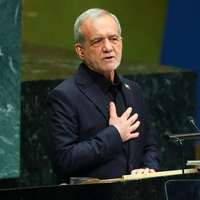
Belarusian President Alexander Lukashenko welcomes Iranian President Masoud Pezeshkian during an official ceremony at the presidential palace in Minsk, August 20, 2025.
Iran has asked Belarus for assistance in restoring its damaged air defense and electronic warfare systems following the June conflict with Israel, Ukraine’s Foreign Intelligence Service said.
“Unlike Russia, Belarus is less restricted by sanctions in the military-technical sphere and could become a channel for restoring Iran’s defense capabilities,” the intelligence agency said in a statement, according to The Kyiv Independent.
The report said the request was raised during President Masoud Pezeshkian’s recent visit to Minsk, where he met Belarusian leader Alexander Lukashenko.
While official discussions focused on trade and investment, Ukrainian intelligence said Tehran sought covert support for defense needs.
“Iran plans to use Belarus as another channel to access sanctioned goods,” the statement said. “For Minsk, this presents the prospect of participating in projects that go far beyond the officially announced topics.”
Both countries are close allies of Moscow. Iran has supplied Russia with drones and missiles used in attacks on Ukraine, while Belarus allowed Russian forces to use its territory to stage operations.
Pezeshkian’s August 20 visit to Belarus highlighted Tehran’s “Look East” strategy of closer alignment with Russia, China and their sanctioned allies.
Iranian state-linked outlets framed the trip as defiance of Western pressure and a “clear message against unilateralism and sanctions.”
Pezeshkian’s August 20 visit to Belarus highlighted Tehran’s “Look East” strategy of closer alignment with Russia, China and their sanctioned allies.
Iranian state-linked outlets framed the trip as defiance of Western pressure and a “clear message against unilateralism and sanctions.”
Belarus, like Iran, is under heavy sanctions and has faced sharp isolation over its support for Moscow in Ukraine.
Iran entered the June war with a fragmented mix of Russian S-300s, Chinese batteries and its own Bavar-373 systems, supported by short-range platforms like Raad, Khordad and Azarkhsh, but with poorly integrated radars.
Israeli strikes on June 13 destroyed or disabled about 120 systems — a third of Iran’s arsenal — including long-range units, aided by Mossad drone attacks inside Iran. For much of the 12-day conflict, Israeli jets, including F-35s, struck targets nationwide with little resistance.
Tehran admits some defenses were damaged but says pre-positioned reserves quickly replaced them.
By August, state media said defenses were rebuilt and “multiple times stronger,” while Western and Israeli sources said radars remain compromised and vulnerable to suppression.
Amnesty International accused Iranian authorities on Friday of “destroying vital evidence” of crimes against humanity by converting a section of Tehran’s main cemetery containing graves of executed dissidents into a parking lot.
“This is another grim reminder of systemic impunity for the mass executions of the 1980s,” Amnesty Iran said on X, adding that the graves in Lot 41 of Behesht-e Zahra cemetery were being bulldozed with official permission.
“By destroying them, authorities are concealing evidence of their crimes and hampering the rights to truth, justice and reparations.”
Tehran’s deputy mayor Davoud Goudarzi admitted last week that the plot had been cleared to provide parking for visitors to nearby graves, saying permission was granted by provincial authorities.
Lot 41 contains the remains of members of opposition groups, including the Mujahedin-e Khalq Organization (MEK), as well as Baha’is and others executed in the early years after the 1979 revolution.
Rights groups and families of the victims say the site is a crime scene that requires forensic preservation.
“Destruction of these graves is a serious human rights violation as it hinders future investigations into the mass executions carried out by the Islamic Republic,” Shahin Milani of the Iran Human Rights Documentation Center told Iran International this week.
Lot 41, long known as the “section of the executed” or “curse-land,” has been under tight surveillance for decades.
Authorities have previously destroyed or desecrated headstones of victims from the 1980s and of more recent unrest, including the 2022 protests.
Amnesty renewed its call for Iran to “stop the destruction and desecration of graves” and to respect families’ rights to bury their loved ones with dignity.
The Pentagon dismissed its intelligence chief after his office said June airstrikes on Iran’s nuclear sites only modestly set back the program, contradicting President Donald Trump’s statement that it had been “obliterated,” officials said Friday.
Lt. Gen. Jeffrey Kruse, who had led the agency since early 2024, was dismissed by Defense Secretary Pete Hegseth after a preliminary report found the strikes set back Iran’s nuclear program by only a few months, according to two people familiar with the decision and a White House official.
Trump had declared the operation a sweeping victory. “The Iranian nuclear program was completely and fully obliterated,” the US president said after the strikes.
The US carried out the operation in June, deploying more than 125 aircraft and a guided missile submarine against three Iranian nuclear sites. Trump described the attacks as a “spectacular military success.”
But the early analysis by US Defense Intelligence Agency, delivered to top officials in the days after the operation, concluded that Iran’s program could recover more quickly than the administration said.
"This damage has not been minor—serious harm has been done to our facilities,” he said in an interview with the state broadcaster.
Trump has a history of dismissing government officials when he disagrees with their data or analysis. In early August, following a disappointing jobs report, he dismissed the official responsible for the data.
The dismissal of the DIA chief caps a week of sweeping changes within the Trump administration, affecting both the intelligence community and military leadership.
The Office of the Director of National Intelligence—which oversees coordination among 18 intelligence agencies, including the DIA—also announced plans to significantly reduce its staff and budget.
Before becoming director of the DIA, Kruse served as the military affairs advisor to the director of national intelligence and previously held roles including director of intelligence for the coalition against the Islamic State.
A Lebanese opposition figure has urged his government to expel Iran’s envoy in Beirut after senior Iranian official Ali Larijani reaffirmed Tehran’s backing for Hezbollah, deepening the controversy over Iran’s role in Lebanon.
Elie Mahfoud, head of the Change Movement, said on X that Larijani’s comments amounted to “shamelessly operating Hezbollah’s militia” and called on the Lebanese government to “immediately cut relations with the Islamic Republic of Iran and expel its ambassador and diplomatic staff.”
The remarks came after Larijani, secretary of Iran’s Supreme National Security Council, said in an interview with Supreme Leader’s website that Hezbollah was created by Lebanese themselves in response to Israeli occupation, but acknowledged Iran had provided and would continue to provide support.
“We do not deny that we helped; we say openly that we helped and we will help,” Larijani said.
He described Hezbollah as “a national asset for Lebanon,” stressing that the group had rebuilt after suffering losses and retained strong resolve among its younger members.
“I saw their leadership and their youth determined,” he said, citing his recent visit to Beirut where he met Hezbollah leader Sheikh Naim Qassem.
Larijani rejected accusations that Tehran controls Hezbollah, saying the group acts independently.
“They are connected to us because they are our brothers, not because they take orders,” he said. He added Iran respected Lebanon’s sovereignty, saying: “Our approach is not to impose. We believe Lebanon’s government must be strong, just as Iraq’s and Saudi Arabia’s should be strong.”
The interview followed Larijani’s trip to Beirut earlier this month, which drew official protests from Lebanese leaders who told him no group should bear arms outside the authority of the state. President Joseph Aoun said at the time that reliance on foreign backing was unacceptable.
Lebanon’s newspaper Nidaa al-Watanreported this week that Hezbollah had become “a tool of Iranian influence,” warning that the movement’s weapons threatened both national sovereignty and regional stability.
The paper described Lebanon as “a hostage to regional power struggles” and accused Iran of using Hezbollah to project influence beyond the country’s borders.
Hezbollah, founded in 1982 with help from Iran’s Revolutionary Guards, is Lebanon’s most powerful military force and has repeatedly fought Israel.
The Lebanese cabinet earlier this month ordered the army to devise plans to disarm the group, prompting sharp criticism from Tehran.
On Thursday, Lebanon began implementing the plan to disarm Palestinian factions in refugee camps, starting with the handover of weapons from Burj al-Barajneh camp in Beirut to the army, the prime minister’s office said.
The move, part of a wider push to establish a state monopoly on arms under a US-backed truce with Israel, is expected to extend to other camps in the coming weeks.
Larijani dismissed such moves, arguing Hezbollah’s arms were the product of Lebanese resistance. “People will not surrender. Why should they? To whom?” he said. “Hezbollah emerged when Israel occupied Beirut. That history cannot be erased.”
Earlier in August, Hezbollah leader Qassem warned that moves to strip the group of its weapons risk plunging Lebanon into war, vowing that the Iran-backed movement would not surrender its arsenal despite a recent government decision to disarm it.
Iran has established arms production facilities in several countries but will not disclose their names for now, Defense Minister Aziz Nasirzadeh said in a televised interview Friday night.
“We have built weapons factories in some countries, but for now we will not announce which ones,” Nasirzadeh said.
Iran had tested “new warheads in the past year that are both advanced and maneuverable,” he added.
His remarks came as Iran’s navy test-fired cruise missiles at surface targets in the Gulf of Oman and northern Indian Ocean during large-scale exercises on Thursday. The maneuvers followed joint Iran-Russia drills known as Casarex 2025 in the Caspian Sea a month earlier.
Since 1979, US sanctions have limited Iran’s access to modern weaponry, driving reliance on indigenous designs and adaptations of older systems.
‘Israel could not stop missiles if war lasted 15 days’
If the June conflict had stretched to 15 days, Israeli forces would have been unable to intercept any Iranian missiles, Iran’s defense minister added, arguing this forced Israel to seek a US-brokered ceasefire.
“If the war had gone 15 days, in the last three days the Israelis would not have been able to hit any of our missiles.”
Iran did not use its Qassem Basir missile, he added, calling it “the most precise weapon.”
The Qassem Basir missile is an Iranian medium-range ballistic missile unveiled in May. Iran says the missile has a range of about 1,200 kilometers and features enhanced guidance and countermeasure resistance.
Last week, Nasirzadeh said Israel’s defense systems – including the US-made THAAD and Patriot batteries, the Iron Dome and Arrow – had been unable to stop most of the projectiles.
“In the early days, about 40% of our missiles were intercepted, but by the end of the war, 90% were striking their targets,” he said. “This showed that our experience was growing while the defensive power of the other side was decreasing.”
Israel's military says that the interception rate for missiles and drones during the 12-day war was about 90%.
The war between Iran and Israel erupted after Israeli strikes on June 13 killed senior Iranian commanders and nuclear scientists, as well as damaging air defense and nuclear sites. Iran said 1,062 people were killed, including 786 military personnel and 276 civilians.
Iran’s retaliatory missile and drone barrages killed 31 civilians and an off-duty soldier in Israel. The conflict ended with a US-brokered ceasefire on June 24.
Iran and Russia have stepped up coordination as European powers threaten to trigger the reimposition of UN sanctions on Tehran, officials said on Friday, days before an end-August deadline to activate the snapback mechanism.
Iranian Foreign Minister Abbas Araghchi and his Russian counterpart Sergei Lavrov discussed the issue in a phone call late Friday, according to a statement from Iran’s foreign ministry.
The ministers rejected what they called the legal and moral authority of France, Britain and Germany – the so-called E3 – to use the “snapback” mechanism under the 2015 nuclear accord.
“The European states, given their repeated violations of the JCPOA and alignment with US actions against Iran’s nuclear facilities, have neither the legal nor the moral authority to activate this mechanism,” Araghchi said, referring to the Joint Comprehensive Plan of Action, the 2015 deal between Tehran and world powers.
Russia’s envoy to international organizations in Vienna, Mikhail Ulyanov, issued a similar warning earlier this week, saying the E3 were themselves in breach of Resolution 2231 and therefore could not legitimately trigger the snapback clause.
Writing on social media, he invoked principles of good faith in international law, arguing that a party violating obligations cannot simultaneously invoke rights under the same accord.
The “snapback” provision, embedded in Resolution 2231, allows any JCPOA signatory to restore pre-deal UN sanctions without a new vote if Iran is deemed non-compliant. Such a move would reinstate global arms embargoes, missile restrictions and other measures lifted in 2015.
European officials have warned that unless Iran resumes nuclear talks promptly and offers concrete concessions, they may act before the end of August.
Axios and the Wall Street Journal reported Friday that recent discussions between Iran and the E3 made no progress, with diplomats describing a combative call in which Araghchi questioned the Europeans’ right to invoke snapback.
Iran has rejected European proposals to extend the deadline, insisting the resolution should expire as scheduled on October 18.
“We had an agreement that was supposed to be completed within 10 years; it’s not meant to be extended repeatedly. This is just rule-twisting, and we do not accept it,” former parliament speaker Ali Larijani said on Friday.
China has also submitted a note to the UN Security Council opposing the measure, warning that reviving sanctions would risk “catastrophic and unpredictable” consequences. Beijing blamed the current deadlock on US and European non-compliance with the JCPOA rather than Iran’s actions.
Araghchi has acknowledged that snapback could inflict heavy economic damage but said it would not mark “the end of everything,” adding that Tehran has held preventive consultations with Russia and China.
“Diplomacy remains on the table if Iran’s rights and interests are respected,” he told state media.
Talks between Iran and the E3 are due to resume in Vienna on Tuesday at the level of deputy foreign ministers.