A new billboard in Tehran depicts Israeli Prime Minister Benjamin Netanyahu kneeling to an ancient Persian emperor with the caption in Farsi, "From the beginning of time, real men have always forced the unmanly to kneel."
Tehran is embracing the very nationalism it suppressed for much of its existence in the wake of a punishing 12-day war with Israel and the United States, signaling authorities' keenness to drum up unity among a weary populace.
From murals of Cyrus the Great to patriotic songs at Shia mourning ceremonies, Tehran is now leaning into pre-Islamic imagery it once viewed as anathema.
An ancient rock face relief at Naqsh-e Rostam shows Emperor Shapur on horseback compelling the captive Roman Emperor Valerian to kneel.
For a theocracy built on the rejection of monarchy and secular nationalism, the shift is a dramatic reversal, but one analysts say could reflect desperation, not strength.
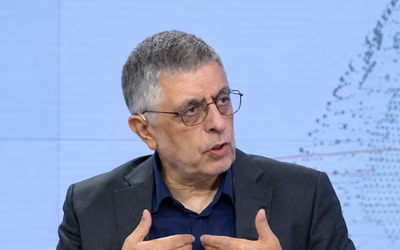
“The total failure of the Khomeinism and Islamism as a sort of transnational ideology has meant that if there's anything to fall back upon, it’s version of nationalism,” said historian and author Arash Azizi.
“They understand it's a very foolish game to try to rule Iran and not be beholden to this Iranian patriotic idea that is so widely held," he said on this week's episode of Eye for Iran podcast.
A statue of a mythical archer Arash is erected at a Tehran square following a 12-day war with Israel.
Behnam Ben Taleblu of the Foundation for Defense of Democracies called the move political, not ideological. “This is not an organic phenomenon,” he said.
“It’s the state trying to create more political room for itself by co-opting elements of society by simply changing the discourse of security.”
The shift has accelerated in the aftermath of Iran’s 12-day war with Israel, which exposed serious weaknesses in the country’s military and cyber infrastructure.
A banner depicting the mythical archer Arash likens Iranian missiles to his legendary arrows.
No street protests occurred during or after the conflict, but nationwide strikes earlier this year pointed to simmering discontent, and Tehran appears eager to forestall any unrest.
Back to the future
Among the most visible signs of the change in tone was Supreme Leader Ayatollah Ali Khamenei’s invitation to his eulogist to perform a patriotic ballad during a July 5 mourning ceremony usually dominated by religious chants.
Jonathan Harounoff, Israeli diplomat and author of Unveiled - A Book About Protests in Iran in 2022 - said Tehran's move was fueled by desperation.
“The Islamic Republic for the past 46 years has tried to expunge, tried to minimize and tried to supplant (pre-Islamic history) with this new version of history,” he said.
“Now that the regime has its back against the wall... you see a very clear attempt not to lose the people of Iran," Harounoff added. “I think many observers saw right through it. It was an attempt of trying to save face.”
Nationalistic to the core
But Tehran’s nationalist turn is unlikely to succeed, according to Professor Mehrzad Boroujerdi of Missouri University of Science and Technology, who has studied the Islamic Republic's uneasy relationship with Iranian identity since its inception.
“The regime has tried to de-emphasize any type of the iconography and symbols of Iranian nationalism ... the unease with pre-Islamic traditions like Nowruz, Charchand Besuri and others have continued,” he said. “And yet, Iranians' infatuation with those symbols ... continues to this day.”
Boroujerdi argues this tension has existed since the 1979 revolution, when Ayatollah Khomeini tried to replace Iranian identity with pan-Islamic ideology—and largely failed. “Despite the animosity toward the state that average citizens have,” he said, “Iranians... remain nationalistic to the core.”
Even Iran’s own power brokers, Azizi said, have begun to shift their rhetoric. “They make their arguments almost purely on the basis of Iranian national interest,” he said. “Transnationalist Islamist Khomeini theology has been such a total defeat".
At the funeral of two young men recently killed by security forces, mourners spontaneously broke into chants of Ey Iran—a patriotic anthem once sidelined by the Islamic Republic.
“There is no rally-around-the-flag effect,” Taleblu said. “And if you do see a rally, it's short lived and it's not as sticky.”
You can watch the full episode of Eye for Iran on YouTube or listen on any major podcast platform like Spotify, Apple, Amazon Music and Castbox.
Moderate voices in Tehran are warning that the public’s quiet endurance of Israeli strikes should not be mistaken for support for the Islamic Republic, and that reconciliation—if still possible—will require drastic change.
During the 12-day war with Israel, many inside Iran stood by their country under fire, moderates argue—but not by its ruling establishment.
“If anyone assumes that public support stems from satisfaction with the status quo, they are making a strategic mistake—one that could discourage the people and embolden the enemy,” prominent reformist Saeed Hajjarian told Ham-Mihan daily.
Hajjarian emphasized that the wartime unity was born of “patriotism, not nationalism,” and warned it may not be sustainable.
“Nationalism is the product of a state that genuinely cares about its nation,” Hajjarian said. “We have not yet reached that stage. The state must win the hearts of the people.”
Some exiled opposition groups had anticipated mass unrest during the conflict. It did not transpire, moderates say, due to fear, exhaustion, and alienation from both the state and its challengers—not support for the Islamic Republic.
Call for concessions
Ali Soufi, another senior reformist, said the burden now lies with the ruling establishment.“Just as the people and political factions stepped in unconditionally, the system must not turn a blind eye—it must carry out reforms.”
A key demand is the release of political prisoners. From Mir Hossein Mousavi—still under house arrest—to jailed figures like Mostafa Tajzadeh, their continued detention is seen as a barrier to unity.
In a recent statement, Mousavi renewed his call for a referendum to convene a constitutional assembly, arguing Iran’s current political structure no longer represents all of its people.
Political analyst Ahmad Zeidabadi warned that unity forged under external threat cannot survive if critics remain silenced. Days later, Tajzadeh’s sentence was extended by another five years, bringing his total to 17.
Public skepticism runs deep
It remains unclear how much traction these reformist demands have among ordinary Iranians. In recent protest waves, a popular slogan has been: “Reformist, hardliner, the game is over.”
For many, the chant reflects rejection of the entire political spectrum, including moderates.
Reformists point out that even long-detained Green Movement leaders joined the call to defend the country during the war. Their gesture, they argue, shows reconciliation is still possible—but only if the state takes bold steps.
While reformists frame prisoner releases as a national imperative, many Iranians appear more focused on daily hardship, corruption, and social restrictions.
Independent analysts echo this gap, warning of widespread “chronic distrust.”
“Unless the government addresses discrimination, injustice … corruption, lack of transparency, and social inequality … national cohesion will remain fragile and conditional,” political analyst Hadi Alami Fariman wrote in Arman Melli.
Even some within the establishment are issuing similar warnings.
“The mistaken belief should never arise among our officials that ‘whenever an attack occurs, the people will still be present on the scene,’” conservative politician Abolghasem Raoufian cautioned.
Any new nuclear deal must meet what Iran describes as fair and balanced terms, Foreign Minister Abbas Araghchi said Friday, after a call with European ministers who urged Tehran to return to talks before the end of August or face the possible return of UN sanctions.
“It was the US that withdrew from a two-year negotiated deal, coordinated by the EU in 2015, not Iran,” Araghchi wrote on X after a joint teleconference with the foreign ministers of France, Britain, Germany, and the EU’s top diplomat. “And it was the US that left the negotiation table in June this year and chose a military option instead, not Iran.”
“Any new round of talks is only possible when the other side is ready for a fair, balanced, and mutually beneficial nuclear deal,” he added.
Araghchi warned the EU and E3 powers to abandon “worn-out policies of threat and pressure,” referring specifically to the “snapback” mechanism, which he said they have “absolutely no moral and legal ground” to invoke.
EU urges immediate return to talks
A day earlier, a French diplomatic source said European ministers had pressed Araghchi to return to negotiations “immediately” during the same call. They also warned that if Iran does not make concrete progress toward a deal by the end of August, France, Britain and Germany would trigger the snapback mechanism, reimposing all UN sanctions.
The snapback, created under UN Security Council Resolution 2231, lets any party to the 2015 nuclear deal restore UN sanctions if Iran is found non-compliant. If no resolution is passed within 30 days to extend sanctions relief, all previous measures return automatically.
Tehran accuses US of using diplomacy as cover for war
Iranian state media reported Thursday that senior officials believe Washington is using diplomatic overtures to buy time for military preparations. “Our intelligence indicates Washington seeks talks to prepare for war, not peace,” an unnamed Iranian official told Press TV. The official also accused the US of trying to weaken Iran in advance of a broader regional conflict and said new talks would require firm guarantees.
US says Trump remains open to diplomacy
Despite last month’s joint US-Israeli strikes on Iran’s nuclear sites, the Trump administration says it expects Iran to resume talks. “He has believed and continues to believe that diplomacy will work here,” State Department spokeswoman Tammy Bruce said Thursday. “They should be very grateful that President Trump is as generous of a man as he is.”
Still, US officials acknowledge there is currently “no prospect” for a quick return to negotiations, according to a senior official cited by journalist Laura Rozen.
Hardening Iranian position
Iran’s parliament and senior diplomats have said new talks cannot begin without clear preconditions, including guarantees against further military action. Araghchi and others have also demanded that any future agreement address issues such as Israel’s nuclear arsenal and accountability for the recent war.
Belgium’s parliament passed a resolution early Friday backing efforts to designate the Revolutionary Guards (IRGC) as a terrorist organization on the EU list, with lawmaker Darya Safai calling the move a strong political signal.
Safai, who led the years-long push, said the resolution was approved at 2:30 a.m. with 135 votes in favor, 14 abstentions, and none opposed. “Today is the day that justice will be served, a day that the victims of this regime will always remember as a victory against their murderers,” she wrote on X.
"My resolution to designate the Islamic Revolutionary Guard Corps (IRGC) of the Iranian regime as a terrorist organization was approved today in the Belgian Parliament," Safai added.
She said the resolution not only calls for the EU to designate the IRGC but also urges “the unconditional and immediate release of Ahmadreza Djalali” and an end to executions by Iranian authorities. Djalali, a Swedish-Iranian academic arrested in Iran in 2016, was sentenced to death on espionage charges, which he denies.
Safai described the IRGC as “a murder machine that not only wages war against the Iranian people in Iran, but also spreads terror and murder throughout the region through its proxies.” In an earlier post, she said the IRGC is involved in terrorism, arms trafficking, and support for groups such as Hezbollah, Hamas and the Houthis, and accused it of fueling conflicts in Iraq, Syria, Libya, Afghanistan, and Ukraine.
The new Belgian government, led by Bart De Wever, reaffirmed that position in its coalition agreement, which said "The government advocates for the inclusion of the Iranian Islamic Revolutionary Guard Corps on the European Union's list of terrorist organizations."
The IRGC, a powerful branch of Iran’s armed forces, was designated a terrorist organization by the United States in 2019 under President Donald Trump. The US and Canada have urged their European allies to follow suit.
A month after Israeli strikes exposed deep infiltration of Iran’s security apparatus, the debate dominates headlines almost daily—yet no meaningful investigation has been launched, and no serious action appears underway.
Revolutionary Guards-affiliated Fars News has blamed foreign-based betting websites and other digital platforms for leaking information that allegedly enabled Israel to assassinate more than 30 senior IRGC commanders.
Officials have also accused Afghan refugees of acting as Israeli agents, deporting over a million in what UN officials describe as one of the largest expulsions in recent memory.
But many insiders are now challenging these deflections with growing force.
“When we talk about infiltration, we shouldn’t just look for people who look different from us,” former foreign minister Mohammad Javad Zarif said in an interview with the state-run IRNA.
“We should ask: who is echoing Israel’s narrative? Who is pushing that policy? Who is trying to divide the people?”
“Not just a spy, but an organization”
Dozens of people have been arrested as alleged operatives behind assassinations and drone attacks since the strikes began on June 13.
Several have been executed after summary trials, and more remain on death row, according to Iran’s intelligence minister.
Zarif warned that infiltration has evolved beyond isolated actors.
“We’re now facing not just a spy, but an organization—an organization with personnel, ideas, and psychological influence,” he said.“We need to understand where this infiltration comes from. What allowed them to locate and strike our commanders—not just once, but again and again?”
On social media, blame has increasingly turned inward—particularly toward surviving Revolutionary Guards commanders.
Users have questioned whether high-ranking officers, including Quds Force leader Esmail Qa’ani and former national security chief Ali Shamkhani, betrayed the locations of fellow commanders.
Accusations of treason have spread with growing boldness, fueled by the absence of transparent explanations. Bizarre theories—such as officials suggesting Israel summoned supernatural beings—have satisfied no one.
“Who has access to secrets?”
“The authority responsible for identifying espionage is crucial,” Saeed Hajjarian, one of the architects of Iran’s Ministry of Intelligence, told the moderate daily Ham-Mihan.
“Counterintelligence is a specialized field, and I still don’t understand why it has been divided between two intelligence agencies.”
Hajjarian criticized the superficial handling of the issue and the growing tendency to scapegoat.
“Right now, people are being branded as infiltrators far too casually,” he warned.
“A real infiltrator stays quiet when needed and speaks up when it counts ... Those who change ideology overnight, convert dramatically or shift allegiances shouldn’t be trusted.”
Even some establishment figures have pushed back on the official narrative.
“This problem predates the war—it just became more visible because of it,” hardline cleric Seyyed Reza Akrami, a five-term parliamentarian, told Arman Melli.
“We must identify which of the country’s senior managers are truly committed to national progress—and which have placed personal gain above the nation’s interests.”
Echoing widespread online sentiment, Akrami posed a blunt question: “Did Afghan refugees have access to classified intelligence? Absolutely not. Were they involved in policymaking? Again, no.”
The International Basketball Federation (FIBA) is facing mounting criticism for removing a video showing the women's team from Iran dancing in celebration after Iranian authorities deemed it “un-Islamic” and formally demanded its removal.
The clip, posted earlier this week during the Asia Cup Division B tournament in China, was deleted just two hours later.
Iranian officials had cited in their complaint with FIBA a breach of the Islamic Republic’s codes of conduct.
“Red lines exist only for women. Men can express their happiness however they wish," sports journalist Saeedeh Fathi told Iran International TV, adding that the incident shows how “even a simple expression of joy by women is intolerable” to the Islamic Republic.
Iranian-American activist Masih Alinejad accused FIBA of enabling state repression.
“You can’t claim to represent international sport while bowing to the demands of a gender apartheid regime,” she posted on X. “This is not ‘respect for culture’—it is complicity with the Islamic Republic.”
Tehran defends move
Hassan Moezzifar, secretary of Iran’s Basketball Federation, confirmed that FIBA removed the clip following a formal request on July 14.
“This was an unprofessional act by FIBA,” he told sports outlet Haft-e Sobh. “They published the video without coordination. If they had reached out, we would have explained our protocols and avoided the issue.”
Moezzifar insisted the players would not face punishment, but reiterated that such displays conflict with Iran’s Islamic regulations.
Dancing as resistance
In Iran, public dancing—especially by women—is officially banned and often labeled as moral corruption. Solo female singing is also prohibited.
Despite these restrictions, dancing and singing have become quiet forms of resistance.
Videos of women dancing in public—sometimes with headscarves, often without—routinely circulate on social media. Many appear spontaneous and receive encouragement from onlookers, challenging the state’s claim that such acts offend societal values.
It remains unclear whether the basketball players’ celebration was a deliberate act of defiance or simply a moment of joy. Either way, the state’s reaction—and FIBA’s compliance—has sparked a new round of public debate over gender, joy and control.
Athletes under pressure
Iranian athletes have increasingly used international platforms to protest state repression. During the Women, Life, Freedom protest movement of 2022–2023, many players refused to sing the national anthem.
In August 2023, after a win over Mongolia, most of Iran’s women’s basketball team remained silent during the anthem. But more recently, footage of the same team singing and saluting the flag during their July 2025 match against Singapore was widely broadcast by Iranian state media.
Similar footage of the women’s soccer team during a tournament in Vietnam showed players giving a military-style salute—interpreted by the state as proof of restored loyalty.