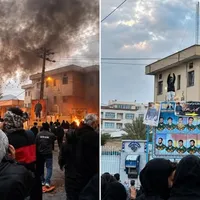
The Iran-focused human rights group HRANA reported that Israeli attacks on Iran since Friday killed 215 people and wounded nearly 700, mostly civilians. Over 50 were confirmed to be military personnel, it added, saying figures were preliminary.
Both sides appeared far from ending their volleys of fire which started when Israel launched a surprise attack on Thursday which killed some of Iran's top military leadership and attacked bases and nuclear sites.
Iranian missiles killed at least 10 people in Israel and injured 200 overnight, the country's paramedics service reported. 35 people were unaccounted for in an attack on Bat Yam south of Tel Aviv, the Times of Israel reported.
Throughout Saturday Israeli attacks hit Iran's defense ministry, Tehran's Shahran oil depot, buildings in in the capital and the Fajr Jam oil refinery - the country's largest.
Crucially, Israel hit part of Iran's South Pars gas field, according to Iranian media, halting 12 million cubic meters of gas production. Also struck was Iran’s Organization of Defensive Innovation and Research, known by its Persian acronym SPND, a key hub of Iran's nuclear program.
The Israeli military announced it had hit 150 targets across Iran.
The United Kingdom and France called for calm, while US Defense Secretary Pete Hegseth told Fox News President Donald Trump still hoped for a reconciliation: "President Trump continues to say to Iran: hey! You have an option for peace."
Israel's initial salvo killed the head of Iran's Revolutionary guards, armed forces chief, air force commander, a top intelligence figure and several nuclear scientists.
Air strikes late on Friday targeted an oil refinery in Tabriz, Tehran's Mehrabad airport and a military base in Kermanshah.
Israel's military spokesperson said the target of the airport attack were ready-to-launch missiles had been stored in underground facilities.
The UN nuclear watchdog said Saturday that no damage was observed at Iran’s Fordow Fuel Enrichment Plant or the Khondab heavy water reactor, a day after it said an attack on the Natanz nuclear facility caused extensive damage above ground.
Brigadier General Abolfazl Shekarchi, spokesman for Iran’s Armed Forces General Staff, said the missile strikes on Israel were intended to hit military targets but blamed Israeli electronic countermeasures for pushing them off course into civilian areas.
“If some of our missiles hit residential areas, it was because Israel created interference to prevent the missiles from striking military targets,” Shekarchi was quoted as saying by Iranian state media.
Iran signals canceling US talks
Iran said on Saturday it may withdraw from upcoming negotiations with the United States, citing Israel’s ongoing military strikes and accusing Washington of complicity in the escalation.
Foreign Minister Abbas Araghchi told EU foreign policy chief Kaya Kallas that continuing talks with Washington was “unjustifiable” while Israeli attacks were underway, according to Iranian state media.
Earlier in the day, Foreign Ministry spokesperson Esmail Baghaei signaled Iran was not immediately scuppering its nuclear negotiations but accused Washington of colluding with Israel in its campaign.
“It is still unclear what decision we will make by Sunday regarding the upcoming talks,” Baghaei said in remarks carried by state media.
Baghaei accused Israel of acting with at least a green light from Washington, saying, “It is inconceivable that Israel could commit such adventurism and warmongering in the region without coordination or conscious approval from the United States.”
Warnings, calls for calm
Iran formally notified the United States, United Kingdom and France that it plans to launch extensive attacks against Israel and warned that any country assisting in repelling these strikes will face retaliation.
According to Iranian state media, Tehran said that all regional bases of what it called "collaborating governments," including military installations in Persian Gulf countries and naval vessels in the Persian Gulf and Red Sea, would be targeted by Iranian forces if those countries intervene.
After a muted reaction following Israel's initial attacks on Friday local time, Western leaders began sounding notes of caution on Saturday.
British Foreign Secretary David Lammy held separate phone calls with Israeli Prime Minister Benjamin Netanyahu and Iranian Foreign Minister Abbas Araghchi on Saturday, urging both sides to exercise restraint as the combat persisted.
Pope Leo XIV called for a safer world free from nuclear threats, urging "responsibility and reason."
International Atomic Energy Agency chief Rafael Grossi told the United Nations on Friday that an Israeli attack on Iran's Natanz nuclear facility destroyed an area where highly enriched uranium was produced.