Judiciary chief Gholamhossein Mohseni-Ejei slammed what he described as false statements of peace by powerful Western leaders, indirectly targeting US President Donald Trump without naming him.
“That bully says he wants to create peace through power—what power? What peace?” Ejei said at the International Conference on Resistance Diplomacy.
“You are supporting a criminal who uses food, water, and medicine as weapons against the people of Gaza.”

President Masoud Pezeshkian rejected statements by Donald Trump during his recent Middle East visit, saying Washington—rather than Tehran—has sown instability across the region.
“Trump says we are the danger. Are we the danger, or the one who speaks of peace? Did we assassinate [Hamas leader] Ismail Haniyeh?” Pezeshkian said at the Tehran Dialogue Forum.
“Terrorists are the ones calling others terrorists,” he added, accusing the US of projecting its own record of violence onto Iran.

Iran’s Foreign Minister Abbas Araghchi said Tehran is seeking a “fair and balanced” agreement rooted in the Non-Proliferation Treaty that upholds Iran’s nuclear rights and ensures comprehensive sanctions relief.
“We want a fair and balanced agreement—one that is framed within the NPT, respects Iran’s nuclear rights, and guarantees the full and tangible lifting of sanctions,” Araghchi said at Tehran Dialogue Forum on Sunday.
He added that any outcome must address the economic pressure imposed on ordinary Iranians.
“Sanctions that have directly targeted our people must be lifted in a real and measurable way.”
Araghchi added that such a resolution would serve broader strategic aims: “We believe a genuine agreement can secure the interests of all parties and help reinforce peace, security, and stability in the region.”


Iran’s Revolutionary Guards and Azerbaijani special forces began a joint military exercise in Nagorno-Karabakh on Sunday in a rare display of bilateral military cooperation in the South Caucasus region.
The Aras or Araz-2025 drill, named after the border river Aras, is being held in areas reclaimed from Armenia by Azerbaijan during its 2020 military operation and will continue through May 21, according to officials from both countries.
Iran’s delegation, including senior commanders from the Islamic Revolutionary Guard Corps (IRGC) Ground Forces, crossed into Azerbaijan via the Bileh Savar border in Iran’s Ardabil province.
Brigadier General Vali Madani, IRGC’s deputy ground forces operations commander and the joint drill’s lead officer, said the exercise aims to bolster border security and enhance coordination in response to potential regional threats.
The drill comes amid ongoing peace efforts between Azerbaijan and Armenia following decades of conflict over Nagorno-Karabakh. Iran, which shares borders with both countries, has voiced support for a permanent peace agreement.
Iranian officials say such cooperation contributes to regional stability. "This exercise is a significant step toward strengthening mutual trust and security along shared borders," Madani said.
A previous joint exercise between Iranian and Azerbaijani special forces took place in December 2023 in Iran’s Ardabil province.
Tehran has expressed support for the peace deal framework agreed in March between Armenia and Azerbaijan, which includes Armenia’s recognition of Azerbaijani sovereignty over Karabakh.
Iran has also positioned itself as a mediator and supporter of post-conflict reconstruction and regional development.
However, the relationship between the two sides has undergone friction in recent years, including Tehran's anger at Baku's opening an embassy in Tel Aviv two years ago, and more recently, regarding the two nations' growing economic and military ties.
Earlier this year, Kamal Kharrazi, chairman of Iran’s Strategic Council on Foreign Relations and a top adviser to Supreme Leader Ali Khamenei, warned Azerbaijan about its growing ties with Israel.
“Countries should take their neighbors’ sensitivities into consideration,” Kharrazi told Hikmet Hajiyev, assistant to the president of Azerbaijan for foreign policy affairs, in a January meeting in Tehran.
Only in December, Azerbaijani President Ilham Aliyev had condemned comments by Hassan Ameli, the Friday Prayer leader of Ardabil, who accused Baku of collaborating with Israel.
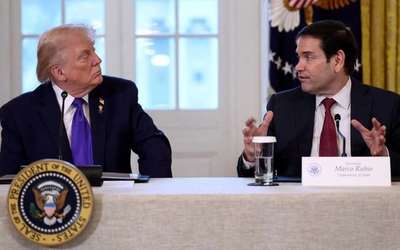

Iran has sentenced three people to death over their alleged roles in two deadly attacks at the Shah Cheragh shrine in the southern city of Shiraz in 2022 and 2023, the judiciary’s Mizan news agency reported on Sunday.
The three were convicted of “corruption on earth” and “assisting in armed rebellion,” charges that carry the death penalty under Iran’s Islamic law.
The judiciary described them as key coordinators in the planning and logistics of the attacks, which killed a total of 15 people, according to official figures.
Five others received prison terms ranging from five to 25 years. Two were identified as members of the Islamic State militant group, also known as Daesh.
The shrine, a prominent religious and tourist site, was targeted twice in less than a year. Iranian authorities previously executed two people connected to the first attack in October 2022.
In the second attack in August 2023, the main perpetrator was identified as Rahmatullah Nowruzov, a Tajik national. Authorities arrested multiple foreign nationals in connection with that incident.
Iranian officials have attributed the attacks to extremist groups.
The nuclear dispute with Europe should not be allowed to define Iran’s vulnerability, former diplomat Nosratollah Tajik told Khabar Online.
“What happened Friday [in Istanbul] was not a formal, structured negotiation but rather political consultations,” Tajik said about Tehran negotiations with three European countries, adding that Iran aims to keep Europe engaged to prevent it from triggering the snapback mechanism.
He said Tehran seeks parallel channels with global players in case talks with Washington collapse, but insisted "Europe lacks the will or capacity to confront the US independently."