Former diplomat warns Europe’s snapback power must not become Iran’s Achilles’ heel
The nuclear dispute with Europe should not be allowed to define Iran’s vulnerability, former diplomat Nosratollah Tajik told Khabar Online.
“What happened Friday [in Istanbul] was not a formal, structured negotiation but rather political consultations,” Tajik said about Tehran negotiations with three European countries, adding that Iran aims to keep Europe engaged to prevent it from triggering the snapback mechanism.
He said Tehran seeks parallel channels with global players in case talks with Washington collapse, but insisted "Europe lacks the will or capacity to confront the US independently."
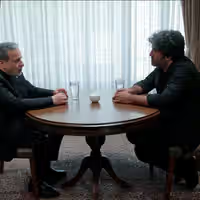
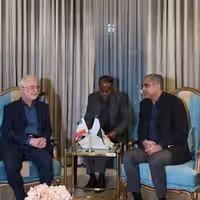
ranian negotiators Abbas Araghchi (center left), Foreign Minister, and Majid Takht-Ravanchi (right), engage in high-level diplomatic talks.
European powers pressed for a formal seat at the table and new enforcement mechanisms during recent nuclear talks with Iran, according to reporting by conservative daily Farhikhtegan.
At Friday’s meeting in Iran’s consulate in Istanbul, European envoys demanded inclusion in the negotiating framework and proposed a clause dubbed “snapback-plus,” reported the daily saying that it would allow them to unilaterally reimpose sanctions if they deemed Iran noncompliant—regardless of US-Iran terms.
“This request was non-technical, illegal, and couched in inappropriate language,” Farhikhtegan wrote.
Iran’s former president Mohammad Khatami voiced rare public backing for ongoing diplomatic efforts, urging officials to maintain dialogue not only with the international community but also with the Iranian public.
“Dialogue that is now underway in foreign relations to resolve fundamental problems is truly commendable and deserves support,” Khatami said.
“I hope the crucial matter of dialogue—with the world and with our own people—will be pursued as a strategic approach and yield positive results,” added Khatami. "Iran is not only not the leading or superior power in the region in terms of science, economy, politics, and security, but many of our rivals have significantly surpassed us."
British Prime Minister Keir Starmer is under increasing pressure from across the political spectrum to officially ban Iran’s Islamic Revolutionary Guard Corps (IRGC), especially after several Iranian nationals were arrested in two separate anti-terror operations in Britain.
A cross-party group of more than 550 MPs and peers have signed a letter calling on the government to label the IRGC a terrorist organization. The signatories include prominent figures such as former Labour leader Lord Neil Kinnock, ex-Conservative Party leader Sir Iain Duncan Smith, and former home secretary Suella Braverman.
The appeal comes shortly after British counter-terrorism police charged three Iranian nationals with offences under the National Security Act, alleging they acted on behalf of Iran’s intelligence service and carried out surveillance targeting Iran International journalists.
The men — Mostafa Sepahvand, 39, Farhad Javadi Manesh, 44, and Shapoor Qalehali Khani Noori, 56 — were arrested at their homes in London on May 3 and charged on Friday.
All three are accused of engaging in conduct likely to assist a foreign intelligence service between August 14, 2024 and February 16, 2025, in breach of Section 3 of the National Security Act 2023. The foreign state involved is Iran, police said.
Tory MP Bob Blackman who coordinated the letter, said "Iranian terrorism has reached our soil. A serious terror plot, involving several Iranians, was recently thwarted in the UK."
“Our ally, the US, rightly designated the IRGC as a terrorist entity several years ago. While the regime has never been weaker, we must set aside all wrong-headed political and diplomatic calculations and proscribe the IRGC as a terrorist entity — an action long overdue.”
The lawmakers argue that allowing the IRGC to operate without restriction sends the wrong message to authoritarian governments. “Appeasing this faltering regime betrays democratic values, emboldens its repressive policies, and undermines global security as Tehran continues its nuclear ambitions and terrorism,” the letter said.
The letter called for firm action against the Revolutionary Guards, saying “the IRGC should be designated as a terrorist organization.”
The UK government has not formally banned the IRGC, but it has imposed sanctions on its members and entities.
Iranians did not pitch the regional nuclear consortium proposal, but it was rather presented to Tehran by another party, Iran's state-run English newspaper Tehran Times quoted informed sources as saying.
"Iran has no issues with sharing its knowledge or products with regional countries. We responded positively to the suggestion but clarified that even if such an alliance were formed, we would not relinquish domestic enrichment in favor of receiving enriched uranium from another country," the report said.
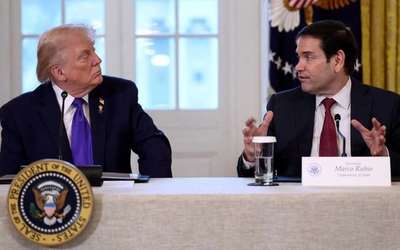
"The ultimate goal here is to have an Iran that does not have a nuclear weapon or the ability to threaten its neighbors, particularly Israel," US Secretary of State Marco Rubio told CBS News' Face The Nation.
On Iran's insistence on maintaining its uranium enrichment, Rubio said, "If you're able to enrich at any level you've now are basically able to enrich at weapons grade very quickly."
"That's just a fundamental fact, and everyone knows it, and that was the problem with the Obama deal," he added.
Rubio said the end goal here is that Iran can never have a nuclear weapon. "And the president's preference, because he doesn't like war, is to achieve that through a peaceful negotiation."
"In fact, the president's preference is not- not only that Iran not pursue nuclear weapons, but that Iran be a rich, peaceful and prosperous country where its people can be happy. He wants them to have a better future. He has said this, he's a builder, not a bomber."