Iran open to nuclear consortium idea but won't halt enrichment - state daily


Iranians did not pitch the regional nuclear consortium proposal, but it was rather presented to Tehran by another party, Iran's state-run English newspaper Tehran Times quoted informed sources as saying.
"Iran has no issues with sharing its knowledge or products with regional countries. We responded positively to the suggestion but clarified that even if such an alliance were formed, we would not relinquish domestic enrichment in favor of receiving enriched uranium from another country," the report said.
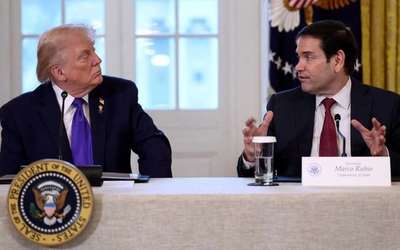
"The ultimate goal here is to have an Iran that does not have a nuclear weapon or the ability to threaten its neighbors, particularly Israel," US Secretary of State Marco Rubio told CBS News' Face The Nation.
On Iran's insistence on maintaining its uranium enrichment, Rubio said, "If you're able to enrich at any level you've now are basically able to enrich at weapons grade very quickly."
"That's just a fundamental fact, and everyone knows it, and that was the problem with the Obama deal," he added.
Rubio said the end goal here is that Iran can never have a nuclear weapon. "And the president's preference, because he doesn't like war, is to achieve that through a peaceful negotiation."
"In fact, the president's preference is not- not only that Iran not pursue nuclear weapons, but that Iran be a rich, peaceful and prosperous country where its people can be happy. He wants them to have a better future. He has said this, he's a builder, not a bomber."

Reporters Without Borders (RSF) has condemned the mass termination of over 500 employees and contractors at Voice of America including those in its Persian service, calling the move a threat to the safety of journalists who may now face deportation.
The Paris-based organization warned that some VOA staffers, particularly those on US work visas, could be forced to return to authoritarian countries where they risk arrest or worse due to their journalism.
The wave of terminations follows an executive order signed by President Donald Trump on March 14 dismantling the US Agency for Global Media (USAGM), which oversees VOA.
Since April 8, the order has led to sweeping layoffs and programming cuts across USAGM-funded media outlets, causing severe disruptions in news coverage—particularly in regions where VOA is one of the few reliable sources of independent reporting.
“While VOA employees await the decision of the en banc review in the appeals court, Donald Trump and Kari Lake have taken advantage of the slow pace of the proceedings to force through a mass termination, causing irreparable damage before the full appeals panel has had a chance to weigh in,” said Clayton Weimers, RSF’s North America executive director.
“We are deeply concerned that a number of these journalists could be forced to return to authoritarian countries where they would face arrest or worse. We cannot allow that to happen.”
According to RSF, termination notices were issued on May 15, with contracts set to end on either May 23 or May 30. Once their employment ends, it said, affected journalists on visas will have only 30 days to either leave the country or seek alternative options such as asylum or new sponsorship.
RSF and a coalition of VOA staff and unions filed an emergency motion on March 21, arguing the move violated the First Amendment.
A federal judge granted a preliminary injunction on April 22, briefly allowing journalists to resume work. However, on May 3, a court of appeals blocked the return of VOA teams. RSF says it will appeal that decision.

Bakery workers staged coordinated protests across multiple Iranian cities on Saturday, calling for urgent government intervention amid soaring operational costs and unpaid subsidies.
Demonstrations were reported in Isfahan, Ahvaz, Birjand, Kermanshah, Qom, Shahinshahr and Mashhad, where bakers voiced frustration over the economic strain threatening their businesses and livelihoods.
Protesters held banners reading, “We are bakers, not slaves. Hear our voice,” and chanted, “Enough with the promises, our tables are empty.”
Footage verified by Iran International showed bakers in Mashhad returning their card readers in protest. In Qom, one baker said he had ceased baking for days, citing nearly a month of uncompensated labor: “I worked 27 days for nothing. The old saying goes, whether it’s a donkey or a fool, it’s still working.”
Bakers cite the failure of the government’s integrated system, delays in promised subsidies under President Masoud Pezeshkian’s administration, and steep rises in fuel, insurance, and raw material costs.
Some complained of repeated power outages that destroyed large batches of dough. One video showed a baker smearing spoiled dough on his face in protest over the blackouts.
The protests follow weeks of similar actions outside governorate and municipal offices. In several rallies, demonstrators chanted for the resignation of what they called “incompetent officials.”
On May 7, Gilan governor Hadi Haghshenas acknowledged that current bread prices were unsustainable for producers. “Given the increase in labor wages and utility costs, a price adjustment is reasonable,” he said, adding that a working group would soon finalize a decision on revised rates.
The unrest underscores deepening tensions over basic commodities in Iran, where inflation and subsidy mismanagement continue to fuel economic discontent. Bakers say that without immediate relief, Iran’s most essential staple may soon be priced—or simply unavailable—beyond the reach of ordinary households.

Hjiab enforcement in Iran is evolving in strange new ways, Gissou Nia, an international human rights lawyer and director of the Strategic Litigation Project at the Atlantic Council think tank, told the Eye of Iran podcast.
Even after a stringent new bill on the subject stalled in parliament last year, authorities are looking for age-old and high-tech ways to police women's appearance.
The law was delayed due to significant public opposition and the authorities' likely reluctance to confront more protests like the nationwide Woman, Life, Freedom movement in 2022 which it suppressed using deadly force.
But far from being thwarted, the theocracy's enforcement apparatus is evolving in subtle but palpable ways.
An official push for citizen-led policing is empowering individuals to report on women deemed in violation of the state's morality codes. The law envisions business owners facing heavy fines or even closure if patrons of their establishments are reported and found non-compliant.
"That's economically prohibitive, especially in an environment where the economy is doing so poorly due to mismanagement, corruption, global isolation from the financial system and all things," Nia said.
"It really weaponizes people against one another. And it does it around financial incentives, which is very destructive because people need to live," she added. "It's very sinister when people are turned against one another and that really decays the fabric of a society."
The tattling has moved into cutting-edge technology, Nia added, with people being able to report women not wearing hijab inside their cars via an app.
"The other thing that was happening with cars is that there was an app that the regime put out and basically you could report if you saw a hijabless woman in a car," Nia said. "In terms of tech, nobody wants Big Brother watching them."
The official Nazer, or watcher, app allows people who are generally already registered as collaborating with the police or paramilitary basij forces to register and report alleged morality transgressions.
Nuclear deal, women's rights
Protesters and backers of Iran's 2022 protests remain skeptical about the prospect of a nuclear deal between Tehran and Washington, Nia said.
"When we see the victims and survivors of Woman Life Freedom - people who paid the ultimate price to really exercise their rights on the streets, many of them are not keen on the deal."
"They very explicitly believe that this is the wrong direction, that this will extend a lifeline to the regime, and they're wondering why they made those sacrifices," she added.
The standoff over Iran's disputed nuclear program has long usurped the human rights situation in the country in the minds of foreign governments and news organizations, Nia lamented, pushing the prospect of meaningful change ever farther away.
"Once the sort of headiness of the Woman Life Freedom Movement and the desire of governments to engage faded after a three-month intense period, six months total ... then there wasn't a view towards a long-term strategy," she said.
"The attention economy is tight."

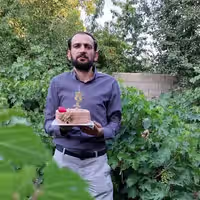
Iran’s judiciary has upheld the death sentence of underground singer Amir Hossein Maghsoudloo, known as Tataloo, while confirming that formal appeals are under review and could delay or halt the execution.
Judiciary spokesman Asghar Jahangir said on Saturday that the Supreme Court has validated the ruling for insulting the Prophet of Islam, making it executable.
“Given the petitions filed by defense lawyers, including a request for clemency and repentance, the sentence may be suspended pending review,” he said.
Following backlash from social media users and celebrities over his death sentence, Iran's Judiciary chief agreed to review the death sentence against the controversial underground singer under Article 477, which allows for a case to be reexamined if the verdict contradicts Islamic law, Tataloo's lawyer Majid Naghshi told Fars News Agency.
“It’s a one-time legal procedure,” Naghshi said. “This is a step forward, though no final decision has been issued.”
Tataloo was initially acquitted of blasphemy charges, but a Tehran prosecutor challenged the verdict. A parallel court issued the death sentence after a retrial, and the Supreme Court later confirmed it.
Tataloo is simultaneously serving a 10-year sentence for “encouraging corruption and vice” in Tehran’s Fashafuyeh prison. According to judiciary-linked outlets, the charges stem from his social media activity, which allegedly promoted immoral behavior, gambling, and sexual content.
The 37-year-old artist was once courted by state-linked figures: he performed a pro-nuclear anthem in 2015 and appeared alongside presidential candidate Ebrahim Raisi in 2017.
However, he was later cast out as a corrupting influence. He relocated to Istanbul in 2018, where his online conduct drew criticism, including posts inviting underage girls to join a “Sultan’s Palace.” Instagram removed his account in 2019 for misogynistic content and promoting child marriage.
He was arrested by Turkish police in December 2023 after Iran’s consulate in Istanbul accused him of harassment. He was later extradited and detained at the Bazargan border.
Tataloo’s case has galvanized a wide range of Iranian public figures. Rapper Toomaj Salehi, footballer Mehdi Taremi, actress Sahar Ghoreishi and bodybuilder Hadi Choopan all condemned the sentence.
His legal team maintains that the execution order followed “extralegal severity” and that the original acquittal was improperly reversed. The final ruling now hinges on whether the judiciary finds the current sentence incompatible with Sharia.