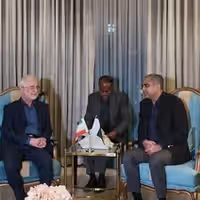
Iran’s former president Mohammad Khatami voiced rare public backing for ongoing diplomatic efforts, urging officials to maintain dialogue not only with the international community but also with the Iranian public.
“Dialogue that is now underway in foreign relations to resolve fundamental problems is truly commendable and deserves support,” Khatami said.
“I hope the crucial matter of dialogue—with the world and with our own people—will be pursued as a strategic approach and yield positive results,” added Khatami.
"Iran is not only not the leading or superior power in the region in terms of science, economy, politics, and security, but many of our rivals have significantly surpassed us."


British Prime Minister Keir Starmer is under increasing pressure from across the political spectrum to officially ban Iran’s Islamic Revolutionary Guard Corps (IRGC), especially after several Iranian nationals were arrested in two separate anti-terror operations in Britain.
A cross-party group of more than 550 MPs and peers have signed a letter calling on the government to label the IRGC a terrorist organization. The signatories include prominent figures such as former Labour leader Lord Neil Kinnock, ex-Conservative Party leader Sir Iain Duncan Smith, and former home secretary Suella Braverman.
The appeal comes shortly after British counter-terrorism police charged three Iranian nationals with offences under the National Security Act, alleging they acted on behalf of Iran’s intelligence service and carried out surveillance targeting Iran International journalists.
The men — Mostafa Sepahvand, 39, Farhad Javadi Manesh, 44, and Shapoor Qalehali Khani Noori, 56 — were arrested at their homes in London on May 3 and charged on Friday.
All three are accused of engaging in conduct likely to assist a foreign intelligence service between August 14, 2024 and February 16, 2025, in breach of Section 3 of the National Security Act 2023. The foreign state involved is Iran, police said.
Tory MP Bob Blackman who coordinated the letter, said "Iranian terrorism has reached our soil. A serious terror plot, involving several Iranians, was recently thwarted in the UK."
“Our ally, the US, rightly designated the IRGC as a terrorist entity several years ago. While the regime has never been weaker, we must set aside all wrong-headed political and diplomatic calculations and proscribe the IRGC as a terrorist entity — an action long overdue.”
The lawmakers argue that allowing the IRGC to operate without restriction sends the wrong message to authoritarian governments. “Appeasing this faltering regime betrays democratic values, emboldens its repressive policies, and undermines global security as Tehran continues its nuclear ambitions and terrorism,” the letter said.
The letter called for firm action against the Revolutionary Guards, saying “the IRGC should be designated as a terrorist organization.”
The UK government has not formally banned the IRGC, but it has imposed sanctions on its members and entities.

Iranians did not pitch the regional nuclear consortium proposal, but it was rather presented to Tehran by another party, Iran's state-run English newspaper Tehran Times quoted informed sources as saying.
"Iran has no issues with sharing its knowledge or products with regional countries. We responded positively to the suggestion but clarified that even if such an alliance were formed, we would not relinquish domestic enrichment in favor of receiving enriched uranium from another country," the report said.
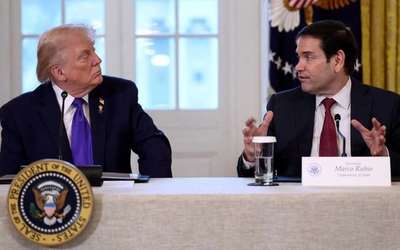
"The ultimate goal here is to have an Iran that does not have a nuclear weapon or the ability to threaten its neighbors, particularly Israel," US Secretary of State Marco Rubio told CBS News' Face The Nation.
On Iran's insistence on maintaining its uranium enrichment, Rubio said, "If you're able to enrich at any level you've now are basically able to enrich at weapons grade very quickly."
"That's just a fundamental fact, and everyone knows it, and that was the problem with the Obama deal," he added.
Rubio said the end goal here is that Iran can never have a nuclear weapon. "And the president's preference, because he doesn't like war, is to achieve that through a peaceful negotiation."
"In fact, the president's preference is not- not only that Iran not pursue nuclear weapons, but that Iran be a rich, peaceful and prosperous country where its people can be happy. He wants them to have a better future. He has said this, he's a builder, not a bomber."

Reporters Without Borders (RSF) has condemned the mass termination of over 500 employees and contractors at Voice of America including those in its Persian service, calling the move a threat to the safety of journalists who may now face deportation.
The Paris-based organization warned that some VOA staffers, particularly those on US work visas, could be forced to return to authoritarian countries where they risk arrest or worse due to their journalism.
The wave of terminations follows an executive order signed by President Donald Trump on March 14 dismantling the US Agency for Global Media (USAGM), which oversees VOA.
Since April 8, the order has led to sweeping layoffs and programming cuts across USAGM-funded media outlets, causing severe disruptions in news coverage—particularly in regions where VOA is one of the few reliable sources of independent reporting.
“While VOA employees await the decision of the en banc review in the appeals court, Donald Trump and Kari Lake have taken advantage of the slow pace of the proceedings to force through a mass termination, causing irreparable damage before the full appeals panel has had a chance to weigh in,” said Clayton Weimers, RSF’s North America executive director.
“We are deeply concerned that a number of these journalists could be forced to return to authoritarian countries where they would face arrest or worse. We cannot allow that to happen.”
According to RSF, termination notices were issued on May 15, with contracts set to end on either May 23 or May 30. Once their employment ends, it said, affected journalists on visas will have only 30 days to either leave the country or seek alternative options such as asylum or new sponsorship.
RSF and a coalition of VOA staff and unions filed an emergency motion on March 21, arguing the move violated the First Amendment.
A federal judge granted a preliminary injunction on April 22, briefly allowing journalists to resume work. However, on May 3, a court of appeals blocked the return of VOA teams. RSF says it will appeal that decision.

Bakery workers staged coordinated protests across multiple Iranian cities on Saturday, calling for urgent government intervention amid soaring operational costs and unpaid subsidies.
Demonstrations were reported in Isfahan, Ahvaz, Birjand, Kermanshah, Qom, Shahinshahr and Mashhad, where bakers voiced frustration over the economic strain threatening their businesses and livelihoods.
Protesters held banners reading, “We are bakers, not slaves. Hear our voice,” and chanted, “Enough with the promises, our tables are empty.”
Footage verified by Iran International showed bakers in Mashhad returning their card readers in protest. In Qom, one baker said he had ceased baking for days, citing nearly a month of uncompensated labor: “I worked 27 days for nothing. The old saying goes, whether it’s a donkey or a fool, it’s still working.”
Bakers cite the failure of the government’s integrated system, delays in promised subsidies under President Masoud Pezeshkian’s administration, and steep rises in fuel, insurance, and raw material costs.
Some complained of repeated power outages that destroyed large batches of dough. One video showed a baker smearing spoiled dough on his face in protest over the blackouts.
The protests follow weeks of similar actions outside governorate and municipal offices. In several rallies, demonstrators chanted for the resignation of what they called “incompetent officials.”
On May 7, Gilan governor Hadi Haghshenas acknowledged that current bread prices were unsustainable for producers. “Given the increase in labor wages and utility costs, a price adjustment is reasonable,” he said, adding that a working group would soon finalize a decision on revised rates.
The unrest underscores deepening tensions over basic commodities in Iran, where inflation and subsidy mismanagement continue to fuel economic discontent. Bakers say that without immediate relief, Iran’s most essential staple may soon be priced—or simply unavailable—beyond the reach of ordinary households.