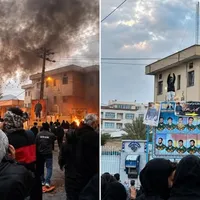
As the fire from the Rajaei Port explosion entered a second day, Islamic Republic-affiliated organizations and media marked Sunday, as “Transportation Safety Day,” including for the nation’s ports.
The blast at Rajaei Port on Saturday halted operations at the key southern hub, knocking out 57 percent of Iran’s nominal loading and unloading capacity. The port plays a critical role in trade and the transport of oil products.

The governor of Hormozgan has declared three days of public mourning in the province.
In connection with the Rajaei Port explosion and the resulting deaths and injuries of citizens, the Governor of Hormozgan announced three days of public mourning.

The fire at Rajaei port was largely contained but efforts to extinguish the remaining 20 percent were ongoing, Fatemeh Mohajerani, Iran’s government spokeswoman, said in a post on X.
"The situation is under control," she said, adding that several injured individuals were airlifted to Shiraz and Larestan.
Tehran City Council chairman Mehdi Chamran told domestic media that a team of 30 firefighters with foam and essential equipment was dispatched from Tehran to assist operations.
Iran's nuclear program is merely the tip of the iceberg in the broader spectrum of disagreements between Tehran and the West, the former head of the country's atomic energy organization said on Sunday.
Fereydoun Abbasi, who previously led the Atomic Energy Organization of Iran (AEOI), said that the way Western powers approach the nuclear issue will significantly determine the trajectory of these multifaceted disputes.
Speaking to Iranian media, Abbasi cautioned against relying on information about ongoing negotiations that emerges through the press. "One cannot rely on the data that comes out about the negotiations from the media," he said, suggesting that the full scope of discussions remains behind closed doors.
Beyond the nuclear file, Abbasi highlighted a range of contentious issues that contribute to the strained relationship between Iran and Western nations. "Missile discussions, the region, human rights, women's rights – all are subjects of disagreement," he added.

Tehran’s major newspapers offered divergent accounts of the explosion at Shahid Rajaei Port. Reformist-leaning Ham-Mihan warned of possible “treachery” from insiders, writing that “the simultaneity of the blast and US-Iran talks is unlikely to be coincidental.”
In contrast, conservative outlets Kayhan, Vatan-e Emrooz, and Javan blamed poor container safety, linking foreign “saboteurs” to speculation. Kayhan urged official findings before spreading “baseless narratives,” Authorities have yet to announce conclusive findings on the cause of the explosion.
What exploded in Iran's Rajaei port on Saturday "was sodium perchlorate, a major ingredient in solid fuel for missiles," the New York Times reported citing a person with ties to Iran’s Islamic Revolutionary Guard Corps (IRGC) who spoke on condition of anonymity to discuss security matters.