Revolutionary Guards take full control of blast-hit port, sources say


As of 3 pm on Saturday, the Islamic Revolutionary Guard Corps (IRGC) intelligence forces have taken full control of the Shahid Rajaei Port area, including port facilities and adjacent customs buildings, Iran International has learned.
Sources indicate that even the port's security guards and customs protection personnel have been denied access to these zones.
Reports also suggest that IRGC forces are preventing vehicle owners from retrieving their cars parked in the limited-access parking areas of the Shahid Rajaei port and customs facilities.
In the city of Bandar Abbas, even in eastern districts far from the port, air pollution levels are so high that residents widely report the smell of burning and nasal irritation.
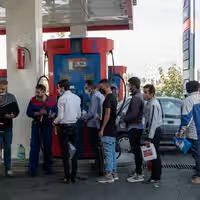
The eastern and northern exit routes from Bandar Abbas are experiencing heavy traffic due to a significant exodus of residents.
According to local citizens, the initial explosion caused ground tremors that many mistook for a major earthquake.
Israel's denial of playing any role in Saturday morning’s explosions in southern Iran is part of the country’s usual and routine practice, an Israeli source told Iran International.
Earlier, the Jewish state's Channel 12 cited Israeli officials as saying the country was not involved in the explosion.
Iran has yet to announce the cause of the explosion which has left over 700 injured and at least five dead, according to official figures.

The number of fatalities in Saturday's explosion at Shahid Rajaei port in southern Iran is in the dozens, local sources told Iran International.
Earlier Iran’s state broadcaster IRIB reported that only four individuals were killed in the blast.
The figures announced officially account only for those who were in the surrounding areas, not at the heart of the explosion, a source familiar with the situation told Iran International.
A source close to the family of one of the victims, who shared images and videos from the site with Iran International, said: "Why does the Islamic Republic insist on claiming that no one was killed or that the number of deaths is low?"
Hundreds have been injured, and hospitals lack the capacity and resources to treat them, a family member of an injured person told Iran International, speaking outside a hospital in Bandar Abbas and sharing video footage.
Another Iran International viewer sent a video showing the body of a coworker lying among trucks at the site.
Germany’s foreign ministry told Iran International that it welcomes the ongoing dialogue between the United States and Iran.
It said the US and the three European countries – France, Germany, and the United Kingdom (E3) – share a common goal of preventing Iran from developing or acquiring nuclear weapons.
“As the E3, we are in close contact with both the United States and Iran on this matter,” the ministry added.

The man who shot dead two Iranian Supreme Court judges in a rare assassination of top officials in January has been identified as Farshid Asadi, a 31-year-old court service aide, a source familiar with the matter told Iran International.
Asadi, originally from Razan in Iran's Western Hamedan Province, worked at the Supreme Court in Tehran providing refreshments to judges and staff, said the source who spoke on condition of anonymity due to the sensitivity of the matter.
The assailant was initially assigned to the court’s fifth floor but was later relocated to the first floor after Judge Mohammad Moghiseh moved his office there.
On January 18, veteran judges Moghiseh and Ali Razini were shot and killed inside the Supreme Court building in central Tehran. The incident shocked the judiciary and remains largely unexplained by authorities.
The two clerics were central figures in Iran's theocratic establishment who had handed down death sentences and other harsh punishments on dissidents for decades. Supreme Leader Ali Khamenei led their funerals.
Their deaths marked a rare attack on senior officials as discontent over political repression and economic malaise festers in Iran.
The source told Iran International that Asadi first entered the room of a security guard and injured him before proceeding to the judges’ office. There, he shot Razini once, killing him instantly. As Moghiseh attempted to flee, Asadi fired again, striking him in the hand and then fatally in the back, piercing his heart.
Asadi, the source added, also intended to target another senior judicial figure, Mahmoud Toliyat, a former Revolutionary Court judge, but changed his mind for unknown reasons. He then turned the weapon on himself and died at the scene.
The full name, age and intended third target of the attacker was not previously reported.
Initial reporting by state-affiliated media suggested the attacker may have been an outsider or “armed infiltrator.” However, conflicting accounts followed, with judiciary-linked outlets later confirming the assailant was employed inside the court complex.
Following the shooting, several of Asadi’s relatives—including his father, uncle, maternal uncle, and two female cousins—were detained at different times by Iran’s Ministry of Intelligence, the source told Iran International.
It remains unclear how many are still in custody.
Separately, former political prisoner Bijan Kazemi has been held incommunicado for over 100 days in connection with the case. Authorities are reportedly attempting to extract a confession linking Kazemi to the firearm used in the attack. Asadi’s father is under pressure to admit involvement, the source added.
Judges Razini and Moghiseh, both clerics, were widely known for their roles in high-profile security cases and for issuing harsh sentences against political dissidents.
They were also involved in the mass execution of political prisoners in 1988, a chapter heavily criticized by human rights organizations.
Iran's Supreme Leader has sent a direct message to his Chinese counterpart vowing a steady commitment to their strategic partnership no matter the outcome of ongoing nuclear talks with the US, a source familiar with the matter told Iran International.
Foreign Minister Abbas Araghchi is traveling to Beijing on Tuesday with Ali Khamenei’s letter to Xi Jinping, a diplomatic source familiar with the message told Iran International.
“In his message to Xi, the Supreme Leader said Iran’s ‘Look to the East’ policy is a foundational pillar of its foreign relations and will not be altered by any rapprochement with Washington.”
According to the diplomatic source, Khamenei’s message also referenced Iran’s cautious opening up to diplomacy and economic cooperation with the West following a 2015 nuclear agreement, telling Xi that such a change in orientation would not be repeated.