Iran's supreme leader Ali Khamenei meeting with senior armed forces personnel, Tehran, Iran, March 13, 2025
Cautious statements from some Iranian officials and a paucity of disclosures by the tightly-controlled media on ongoing talks with the United States suggests an official desire to control the public discourse on the hyper-sensitive dossier.
Still, Iranian officials appear to have been willing to share information with Russian and Chinese counterparts.
While foreign ministry officials have openly expressed a desire to maintain secrecy about the talks' contents, they have coordinated closely with Russian and Chinese counterparts on their progress.
The Revolutionary Guards-linked newspaper Javan reported on Wednesday that Iranian Foreign Minister Abbas Araghchi's decision to withdraw from a preplanned online meeting at the Carnegie Endowment in New York on Saturday earlier in the week was a "calculated move aimed at controlling the narrative surrounding the Iran-US talks."
"Iran has no intention to negotiate in public," Aragchi said in a post on X on Monday.
Araghchi accused unnamed "special Interest groups" of "attempting to manipulate the course of diplomacy by smearing negotiators and pressuring the US administration to adopt maximalist demands."
While he emphasized that his focus was on "Iran's thoughts and objectives in the talks," he has not provided any substantive explanations to the Iranian public about these goals.
Officials have only vaguely mentioned their primary aim of lifting sanctions.
Araghchi also cited his concerns about the format of the Carnegie Endowment discussion, explaining that he feared his keynote address might turn into "an open Q&A."
Following this, the Carnegie Endowment expressed regret, noting that changes to the agreed format meant they had to cancel Araghchi's attendance.
Seeking a Controlled Narrative
Meanwhile, the Javan newspaper quoted a source saying Tehran is intent on crafting a "controlled narrative" to bolster its position in the talks.
"Iran understands the impact of public perceptions on diplomatic outcomes," the source added. "Avoiding a public platform strengthens its stance and demonstrates its commitment to achieving diplomatic results."
Promoting a Dominant Narrative
This aligns with remarks made by Iranian Government Spokeswoman Fatemeh Mohajerani on April 22, who described Iran's approach to presenting a "dominant narrative" about the negotiations.
"We aim to offer the first narrative after every round of talks," she added. "Consequently, many media outlets have adopted Iran's perspective following statements by Foreign Ministry Spokesman Esmail Baghaei immediately after the meetings."
Mohajerani portrayed this as a method of managing media coverage in the interest of transparency and accurate information dissemination. However, her assertion about transparency contradicted Baghaei's earlier comments on April 21.
"Details about the negotiations are not meant to be disclosed to the media," he said.
US-Iran talks are set to get trickier as the two foes thrash out technical details deciding the limits to Iran's nuclear activity and the scope of inspections, a former senior US negotiator told Eye for Iran.
Richard Nephew, former US deputy special envoy for Iran during part of Joe Biden's presidency, said the level of trust between President Donald Trump and his special envoy Steve Witkoff augured well for the talks.
Still, as the negotiations are set for their third round on Saturday and first set of technical talks, the devil may be in the technical details.
"We haven't yet really seen a pretty clear sense of consistency or attention to detail on the technical side," he said in an interview with the podcast.
"Nuclear talks in general, but absolutely these, which have a 22-year history at this point, definitely could use a little bit more of the technical, a little more of the expert practitioner side," he added.
The ability of inspectors to understand and access the Iranian nuclear program which has advanced far further beyond levels reached when previous nuclear deal will also be key to success, Nephew said.
"That job is harder now than it was in the past. There's a lot less that is known about Iran's current centrifuge production activities than was known at the time. There are more hidden sites. There are storage locations."
Nephew was Washington's lead sanctions expert in the team which inked the 2015 agreement, from which Trump withdrew in 2018 during his first term.
That decision means it will not just mean the US side will be seeking commitments from Iran, he said, but Tehran will want to be sure Washington will not promptly withdraw again.
"I think the biggest thing, and this is the thing the Iranians have been looking for, and I think it's also part of the US approach here too, is guarantees for performance going forward. And I think for the Iranian, this is obviously a very serious issue because the United States did withdraw in the past."
'Talks are no reward'
While Tehran's staunchest critics have criticized US-Iran nuclear talks as legitimizing an irredeemable enemy, Nephew said diplomacy should be seen as a strategic tool and not a reward.
“I have to smile when I hear about diplomacy being seen as a reward. I couldn't disagree more with that,” Nephew said. “Diplomacy is a national security and foreign policy tool. If you see diplomacy as a tool, then you can't also see it simultaneously as a reward.”
In a recent interview with the Washington Free Beacon, maverick Democratic Senator John Fetterman deployed salty language to advocate ending talks and bombing Iranian nuclear sites.
“Waste that shit,” Fetterman said. “You’re not going to be able to negotiate with that kind of regime that has been destabilizing the region for decades already.”
Nephew argued that diplomacy paired with rigorous verification and inspections remains the best path while acknowledging that diplomacy was no panacea.
“You can’t put all your chips on diplomacy,” he said, emphasizing the need for a credible military contingency in the background. But a strike, he warned, wouldn’t be quick or clean.
“A military option would, at a minimum, create chaos across what remains of the Iranian nuclear program,” he explained. “If I'm sitting in Tehran after US military strikes, after I've lost Hezbollah, Hamas, Shia militia groups, and similar assets, it's hard to imagine the regime saying, ‘Yes, let’s make strategic concessions now.’”
You can watch the full interview with Richard Nephew on YouTube, or listen on any major podcast platform like Spotify, Apple, Amazon or Castbox.
To signal and justify possible nuclear concessions in ongoing US talks, Iran's Supreme Leader has once again alluded to a historic concession by a Shi'ite Muslim leader to buy time against a stronger foe.
The reference was the same deployed by the wily 86-year-old theocrat to justify Iran's agreement to a landmark 2015 nuclear deal.
Speaking Thursday at a modest religious gathering in his office on Thursday, Supreme Leader Ali Khamenei recalled how the second Shia Imam, Hasan ibn Ali—seen by Shia Muslims as a paragon of just leadership—signed a controversial peace treaty with hated foe Mu'awiya in 661 CE.
The treaty, Khamenei said, was a calculated move to safeguard the long-term interests of Islam.
Although he made no direct mention of the ongoing nuclear negotiations with the United States, the allusion is almost certainly a subtle endorsement of diplomacy.
“Some people would come forth with complaints and objections when Imam Hasan made peace with Mu’awiya … it is temporary. The Imam has been recorded as saying that this incident, this domination of heresy and hypocrisy, is not meant to be permanent,” Khamenei said.
Khamenei’s tone marks a shift from early February, when he dismissed engagement with US President Donald Trump as “unwise, undignified, and dishonorable" after Washington reimposed so-called maximum pressure sanctions.
While expressing wariness of the West, his stance has since shifted to cautious pragmatism. “We are neither overly optimistic nor overly pessimistic about these talks,” he said after the first round of talks earlier this month, before adding a sharp caveat: “I am very pessimistic about the other side.”
Khamenei used the same historical reference in 2013, branding Imam Hasan’s decision as an act of “heroic flexibility”—a phrase that became a byword for Iran’s nuclear diplomacy which helped seal the 2015 Joint Comprehensive Plan of Action (JCPOA).
“Khamenei resorts to tactical retreat whenever he finds himself in a difficult position,” US-based commentator Ali Afshari told Iran International TV.
“He is trying to warn and to provide a rationale (for his decisions) to his radical supporters. He is telling them they should not raise objections because acceptance of a deal is a tactical move rather than a strategic position.”
Hardline objections
The reference to Imam Hasan’s treaty follows a broader softening of rhetoric among clerics, politicians and media outlets after the first round of indirect US-Iran talks in Oman on April 12.
But Khamenei’s approval of diplomacy with the United States has exposed rifts among Iran’s hardliners. While some factions are rallying behind his position, some others—particularly ultra-hardliners who refer to themselves as the real revolutionaries—have expressed frustration.
In further comments on Thursday, the Supreme Leader appeared to confront those naysayers.
"Our neglect, at times our loose lips, our failure to help, our needless protests, lack of patience, (and) at times the flawed analyses that we make about the situation, can sometimes have an impact," he said. "One must be very careful."
With Khamenei’s authority remaining unchallengeable, dissent remains subdued and blame is often cast on others rather than Khamenei.
“The biggest reason (for Imam Hasan’s peace deal) was the lack of a loyal army," Sasan Daneshpajouh, an ultra-hardliner social media influencer with over 33 thousand followers posted on X.
"The Imam made a deal to save the Shi'ites from death and destruction, so that in the future they could form an army and ultimately win,” he added, implying Khamenei would not have been pushed into concessions had he possessed more loyal followers.
A top Iranian cleric has described ongoing talks with the administration of US President Donald Trump led by his special envoy and fellow property magnate Steve Witkoff as akin to a real estate negotiation in which Iran will prevail.
Mostafa Pourmohammadi, secretary of the Combatant Clergy Association and a former interior and justice minister, said Iran would get a fair deal after initial posturing and an expected back and forth.
“You want to buy a house. The seller says one million. You walk away. He tells you to wait and brings in a broker. Then suddenly the asking price drops. In your mind, you're thinking 500 or 600 is reasonable. The broker says 750, and the deal is done,” the veteran insider and conservative said in comments carried by state media.
“Neither the seller really intended to sell for 750, nor were you ready to buy at that price. But in the end, it gets resolved. That’s negotiation.”
Pourmohammadi broadly defended Supreme Leader Ali Khamenei’s approval of negotiations with the United States, in remarks that appeared aimed at easing concerns in conservative quarters.
Khamenei’s evolving stance, he said, reflected “wise leadership” in a rapidly changing world. “You cannot say the Leader’s words at one time apply to all times and all cases,” Pourmohammadi said in remarks carried by local media.
“The world is turning moment by moment. We must have the power to make wise and timely decisions. This is the logic.”
Khamenei had in February called negotiations with Washington “unwise, undignified, and dishonorable.” His recent support for talks mediated by Oman and taking place during Donald Trump’s return to the presidency marks a notable shift, particularly given longstanding hardline distrust of US intentions.
Pourmohammadi said President Trump’s public threats were part of a broader political strategy. Referring to a letter Trump sent to Khamenei in March, he said: “If Trump had written in his letter what he said in public, he would never have received a reply. But his formal letters had a different tone, revealing his real politics.”
The cleric framed the current moment as part of a broader strategic contest. “It’s not as if there’s only one moment, one issue,” he said. “This is a psychological war, and the Leader is managing it with wisdom.”
Pourmohammadi has held several senior roles across administrations but is widely known for his involvement in the mass execution of political prisoners in 1988 while serving on a state-appointed committee at Evin Prison.
Human rights organizations and exiled dissidents have linked him to the killings, which Amnesty International described as crimes against humanity. Pourmohammadi has defended the executions in past interviews, saying they were in line with the Islamic Republic's wartime policy.
Senior Iranian clerics signaled guarded optimism toward renewed indirect talks with the United States over Iran’s nuclear program, while voicing the Islamic Republic's uncompromising stance on national sovereignty and sanctions relief.
Speaking at Friday prayers in Tehran, interim Friday prayer leader Mohammad-Hassan Aboutorabi-Fard said that Iran’s nuclear policy is rooted in a religious and political doctrine that prioritizes peaceful development while resisting external pressure.
"The Islamic Republic’s strategy is based on transparency about the peaceful nature of its nuclear program, the development of nuclear technology, and the lifting of oppressive sanctions," he said.
His remarks come against the backdrop of renewed indirect negotiations between Tehran and Washington, facilitated by Oman, with the second round held in Rome and third slated for Muscat on Saturday.
According to Aboutorabi-Fard, the talks were initiated "at the repeated request of the highest-ranking US official and are proceeding with caution due to America’s repeated breaches of previous commitments, especially the unilateral withdrawal from the JCPOA in 2018."
Iranian Foreign Minister Abbas Araghchi has characterized the Muscat-hosted dialogue as a test of American sincerity. "The talks in Oman are a test to gauge the seriousness of the US," Aboutorabi-Fard quoted the minister as saying. "Complete sanctions relief and legal guarantees can pave the way for real progress."
The Omani Foreign Ministry, which hosted the recent talks in Rome, said the goal is to reach a “fair and lasting nuclear agreement” that ensures Iran is free of nuclear weapons and also free from sanctions—while maintaining its right to peaceful nuclear development.
Tehran views the Omani statement as aligning closely with its own strategic roadmap. "This declaration reflects the correct direction of negotiations in line with Iran’s strategy," Aboutorabi-Fard added.
Cleric Mohammad-Hassan Aboutorabi-Fard during Tehran Friday prayers at the University of Tehran on April 25, 2025
The Tehran cleric, like several other Friday prayer leaders representing the Supreme Leader, portrayed the current diplomacy as a product of strength.
“Without the slightest doubt, the negotiations began from a position of dignity and power,” he said. “Iran has the upper hand in defining the topics and principles of the negotiations.”
Aboutorabi-Fard added that effective diplomacy must be backed by national strength—particularly technological and military power. “Diplomacy without power is ineffective in securing national interests,” he said. “The accumulation of scientific capacity, especially in nuclear technology, is one of the pillars of Iran’s national strength.”
He added that the country’s deterrent military capabilities bolster the negotiating team. “Our defensive power and enhanced deterrent strength are reliable assets for the Muscat negotiations.”
While advocating for the removal of sanctions, Aboutorabi-Fard echoed Khamenei’s frequent warnings against relying too heavily on external negotiations to solve domestic problems.
“Sanctions relief can help create conditions for sustainable economic growth,” he said, “but without transforming our economic and administrative structures, and without cutting the dependency of the budget on oil, real economic progress will remain out of reach.”
He urged the parliament and government ministers to focus on structural reforms regardless of the outcome of talks with the United States.
Other Friday prayer leaders across Iran echoed similar sentiments, praising Iran’s scientific achievements while cautioning against overreliance on diplomacy.
The cleric in Ilam quoted Khamenei, saying: “The diplomacy apparatus should do its work, but don’t tie the country’s future to the negotiations.”
In Yezd, Mohammad-Reza Naseri warned: “Don’t trust the enemy’s slogans. Real progress comes from self-reliance and heeding the Leader’s advice.”
And in Shiraz and Shahrud, Friday prayer leaders marked the anniversary of the failed US military operation in Tabas in 1980 -- Operation Eagle Claw -- as a reminder of “divine protection” and resilience against foreign intervention.
Mashhad firebrand cleric Ahmad Alamolhoda questioned whether, "After witnessing so many miracles, is it right to still hinge our hopes on America as a problem solver?""Conditioning our lives on negotiations demonstrates a lack of faith in God's power."
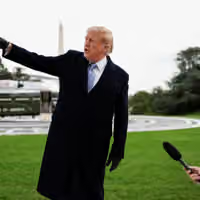
US President Donald Trump said he is open to meeting with Iran’s President or Supreme Leader, as Washington and Tehran continue indirect talks over Iran’s nuclear program.
“Sure,” Trump said in an interview with Time magazine when asked if he would be willing to meet Iran’s top leaders.
The comments come as the third round of indirect negotiations is scheduled to take place on Saturday in Oman. The talks, which began earlier this month, aim to revive diplomacy after years of tension following Trump’s 2018 decision to abandon the 2015 nuclear deal between Iran and world powers.
"I think we're going to make a deal with Iran. Nobody else could do that," he said during the interview.
Earlier this year, Trump reinstated his administration’s maximum pressure policy on Iran, while also expressing openness to dialogue.
In February he also said he was prepared to speak with his Iranian counterpart and voiced hope for a peaceful resolution. “I really want to see peace, and I hope that we're able to do that,” Trump said at the time. “They cannot have a nuclear weapon.”
Iran maintains that its nuclear program is peaceful, but Trump has warned of catastrophic consequences if a new deal is not reached swiftly. He has also said military action remains a possibility to prevent Iran from developing a nuclear weapon.
In the Time interview, Trump rejected reports that he had stopped Israel from launching strikes on Iranian nuclear sites, but said he preferred a diplomatic solution. “I didn’t stop them. But I didn’t make it comfortable for them, because I think we can make a deal without the attack,” he said. “It’s possible we’ll have to attack because Iran will not have a nuclear weapon.”
Asked if he was concerned that Israeli Prime Minister Netanyahu might draw the United States into a broader conflict, Trump replied, “No.”