"Threatening language from the Iranian regime or its mouthpiece against the President, or any American, is unwise," Fox News Digital reported citing a State Department spokesperson, referring to threats by the Khamenei-linked newspaper Kayhan to kill Trump.
On Sunday, Iran’s ultra-hardline Kayhan newspaper, managed by a representative of the Supreme Leader, repeated weekend calls to assassinate Trump to avenge the 2020 killing of IRGC commander Qassem Soleimani.
Later in the day, Iran's Press Supervisory Board officially warned Kayhan over the threatening language, calling it an act against national interests.
"The board has issued an official warning to the editor-in-chief of a newspaper for violating the Article 6 of the Press Law, which explicitly prohibits the publication of content against the security, dignity, and interests of the Islamic Republic of Iran, whether domestically or abroad," a statement by the Board said without naming Kayhan.
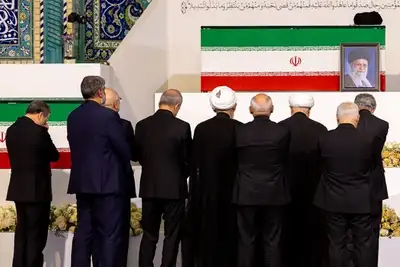

As nuclear talks resume and threats from the US and Israel continue, Iran’s atomic chief claims the country’s electricity shortages will be solved by building new nuclear power plants.
Nuclear power currently accounts for just one percent of Iran’s electricity generation. To make up for the country’s 25,000-megawatt shortfall, Iran would need to build 25 nuclear plants the size of Bushehr—which took 25 years to complete, even with Russian assistance.
Since its launch in 2011, the Bushehr nuclear plant has produced just 70 terawatt-hours (TWh) of electricity—worth less than $6 billion on regional markets. This modest output contrasts sharply with Iran’s extensive uranium enrichment program, which has been justified as necessary for nuclear power generation but has contributed to at least $2 trillion in direct economic losses from sanctions since 2012.
The Islamic Republic has repeatedly announced plans to develop 20,000 megawatts of nuclear power capacity, but progress has been minimal. Atomic Energy Organization chief Mohammad Eslami has reiterated the goal, describing it as a “long-term” objective.
It remains unclear why Iran, with over 300 sunny days a year and vast windy coastal and mountainous regions, has not prioritized solar and wind energy—especially given that the cost of electricity from renewables is now comparable to that of nuclear power. Despite this potential, renewables still account for just one percent of Iran’s electricity production.

By contrast, the International Energy Agency recently reported that 75% of new global power capacity in 2024 came from renewable sources, while nuclear contributed only 5% to the growth in global electricity production last year.
Iran’s electricity and gas shortages now span all seasons
For the first time, Iran is experiencing electricity and gas shortages year-round, with blackouts beginning as early as spring—where previously they were confined to the peak of summer and winter.
This year’s electricity deficit is so severe that all provinces, including Tehran, are facing scheduled 90-minute blackouts during the day. The situation in the industrial sector is even worse. A petrochemical industrialist in Tabriz told Iran International—on condition of anonymity—that his factory endures two full days of power cuts and one day of water outages each week. In addition, daily 90-minute blackouts continue to disrupt production.
These outages are happening despite spring electricity demand being 35% lower than in summer, averaging around 50,000 megawatts (MW). With peak summer demand looming, there are serious doubts about the country’s ability to cope.
While Iran’s installed power generation capacity is officially around 62,000 MW, its failure to meet even current demand suggests a deeper crisis—most likely a fuel shortage for thermal power plants, which supply over 90% of the country’s electricity.
Gas shortages have also become a year-round issue since last year, and now electricity has followed the same pattern.

According to the Ministry of Energy, around 800,000 new electricity consumers are added to the grid annually since 2010—70% of them residential. To keep pace, Iran needed to boost electricity production by about 7% per year. In practice, only half that target was achieved over the past decade, and in recent years, production growth has fallen to just 30% of planned levels.
As a result, Iran’s net annual electricity exports have fallen from 8 Twh in the mid-2010s to zero over the past two years — with domestic production no longer sufficient to meet internal consumption.
Hydropower generation
Iran’s nominal power generation capacity stands at around 94,000 megawatts (MW), but only 62,000 MW is actually operational. The gap is due to the decommissioning of aging thermal plants and reduced output from hydroelectric facilities amid ongoing drought conditions.
In an attempt to mitigate the electricity shortfall, the government increased hydropower production by 25% over the past two years. However, this came at a cost: water levels in key dams—some of which supply drinking water to major cities, including Tehran—have dropped to just 7–10% of capacity. As a result, the country’s ability to rely on hydropower has been nearly exhausted.
Thermal power plants
Over the past 15 years, nearly all growth in Iran’s electricity supply has come from thermal power plants running on natural gas, fuel oil (mazut), and diesel. These plants now generate over 90% of the country’s electricity.
However, Iran is facing critical fuel shortages year-round, making it increasingly difficult to supply these plants. Compounding the problem, many of the facilities are outdated and inefficient, operating well below global standards.

It’s not just the low efficiency of power plants that is driving the electricity crisis. According to an official report from the Ministry of Energy, 13% of the electricity produced is lost in the country’s old and deteriorating transmission and distribution network.
Iran's judiciary has filed criminal charges against a former senior advisor to President Hassan Rouhani apparently for his criticism of the leadership's approach to US talks and Iran's nuclear program on social media.
Mizan news website, affiliated with Iran’s judiciary, confirmed the charges on Thursday but did not name Hessamoddin Ashna or specify the exact charges against the former head of aa Iranian think tank.
"Tehran Prosecutor’s Office has filed charges against the former head of the Strategic Studies Center during the 12th government (Hassan Rouhani's administration) for posting content on social media," Mizan reported.

On Tuesday, Ashna made a now deleted post on X: "Do not be Libya! Do not harbor the illusion of leading the Arab world and Islam. Do not unite your neighbors against you. Do not exaggerate outdated, imported nuclear technology... Do not ruin your people for the survival of your family. Do not trust the East or the West."
Iran's judiciary chief on Thursday referred to President Donald Trump as a bully and expressed confidence the US president’s policy on Iran would fail.
The remarks follow Trump’s warning that military action was the alternative to a new nuclear deal.
"Currently, there is a bully in the United States who will not last, and God willing, the dreams he has for Iran will not come true," said Gholamhossein Ejei.
He added that Iran’s adversaries have been attempting to destabilize the country’s security but despite economic pressure wrought by US sanctions over the past year, the Islamic Republic has managed to persevere.
"The enemy has not been able to disrupt the livelihood and peace of the Iranian people," Ejei said.
Iranian Navy Commander Rear Admiral Shahram Irani said on Thursday that Iran’s naval and defense capabilities are at their strongest level to date, amid rising tensions over the possibility of a military attack against the country.
“Our maritime power and defensive capabilities are stronger than ever,” Irani said. “Today, our enemies see the Islamic Republic’s armed forces and strategic navy as a superpower.”
“The enemy seeks direct confrontation at sea, but with divine support, we will defeat and drown the devil, just as Pharaoh was drowned.”

Supreme Leader Ali Khamenei’s decision to drop his longstanding opposition to talks with the United States drew criticism from some Iranians that the veteran leader capitulated under pressure in order to retain power.
The reaction came after Iran International invited public responses to the reversal in Khamenei’s stance, asking why he would now consider negotiations he previously called “unwise, undignified, and dishonorable.”
One respondent, in a video message to Iran International, referenced the leader’s earlier rhetoric: “You said negotiating with America is dishonorable. Now do you realize you’re without honor?”
US President Donald Trump on Tuesday confirmed the start of high-level, direct talks with Iran, following his meeting with Israeli Prime Minister Benjamin Netanyahu.
“We’re dealing with them directly and maybe a deal is going to be made,” Trump said, warning that if not, “Iran is going to be in great danger”.
Tehran is set to hold negotiations with Washington in Oman on Saturday.
In the face of criticism from inside and outside government, Iranian officials continued to frame the diplomatic channel as indirect. Foreign Minister Abbas Araghchi told state TV, “What America is doing is dictating. We believe indirect talks are more effective”.
Fatemeh Mohajerani, the administration’s spokesperson, also said the negotiations, while advanced and significant, remain indirect for now. “We have to begin the process to see where it leads, but the format remains non-direct,” she added.
Still, the public remains unconvinced by the government’s attempts to save face. Several respondents accused Khamenei of misleading the population over years of opposition to the US, only to retreat under duress.
“They lied about indirect negotiations for so long,” one person said in a voice message. “Now they should admit they were wrong.”
Others tied the capitulation to a fear of system collapse in the wake of the Women, Life, Freedom movement which has seen a mass movement against the government since 2022.
“Khamenei agreed to talk because he fears ending up like Gaddafi or Saddam,” another one said.
One man argued the stakes had now grown too high, just last month, Trump threatening to bomb Iran if a new deal was not agreed upon within two months. “Khamenei has no choice but to sit at the table. He knows if war breaks out, the same youth he wants to send to fight won’t aim at America or Israel—they’ll aim at him," he said.
Criticism also targeted the perceived hypocrisy of the leadership. “You used to accuse protesters of collaborating with hostile governments,” said one voice message addressed to Khamenei. “Now you’re negotiating with the very government you called hostile.”
Another message addressed Khamenei directly: “You’re a coward ruining the lives of over 80 million people. Now that you've suffered a defeat and backed down, even your own followers can see how cowardly you are.”
A separate voice message even accused the leader of backpedaling so much that he risked a total turnaround of decades of anti-US and anti-Israel animosity.
“Khamenei redefines words. Even ‘honor’ means something different to him,” the speaker said, before adding, “Soon he’ll be on his way to kiss Netanyahu’s hands.”
An overwhelming sense of "humiliation" has dominated the messages received by Iran International.
“This is humiliation. Khamenei once vowed neither war nor negotiation. Now there’s negotiation, no deal, and he still has to go," another Iranian said.