Iran's judiciary has filed criminal charges against a former senior advisor to President Hassan Rouhani apparently for his criticism of the leadership's approach to US talks and Iran's nuclear program on social media.
Mizan news website, affiliated with Iran’s judiciary, confirmed the charges on Thursday but did not name Hessamoddin Ashna or specify the exact charges against the former head of aa Iranian think tank.
"Tehran Prosecutor’s Office has filed charges against the former head of the Strategic Studies Center during the 12th government (Hassan Rouhani's administration) for posting content on social media," Mizan reported.

On Tuesday, Ashna made a now deleted post on X: "Do not be Libya! Do not harbor the illusion of leading the Arab world and Islam. Do not unite your neighbors against you. Do not exaggerate outdated, imported nuclear technology... Do not ruin your people for the survival of your family. Do not trust the East or the West."
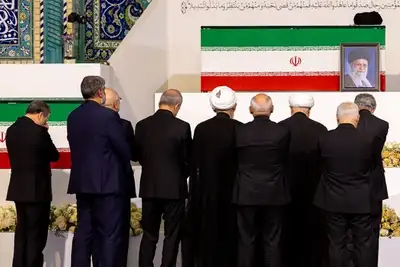
Iran's judiciary chief on Thursday referred to President Donald Trump as a bully and expressed confidence the US president’s policy on Iran would fail.
The remarks follow Trump’s warning that military action was the alternative to a new nuclear deal.
"Currently, there is a bully in the United States who will not last, and God willing, the dreams he has for Iran will not come true," said Gholamhossein Ejei.
He added that Iran’s adversaries have been attempting to destabilize the country’s security but despite economic pressure wrought by US sanctions over the past year, the Islamic Republic has managed to persevere.
"The enemy has not been able to disrupt the livelihood and peace of the Iranian people," Ejei said.
Iranian Navy Commander Rear Admiral Shahram Irani said on Thursday that Iran’s naval and defense capabilities are at their strongest level to date, amid rising tensions over the possibility of a military attack against the country.
“Our maritime power and defensive capabilities are stronger than ever,” Irani said. “Today, our enemies see the Islamic Republic’s armed forces and strategic navy as a superpower.”
“The enemy seeks direct confrontation at sea, but with divine support, we will defeat and drown the devil, just as Pharaoh was drowned.”

Supreme Leader Ali Khamenei’s decision to drop his longstanding opposition to talks with the United States drew criticism from some Iranians that the veteran leader capitulated under pressure in order to retain power.
The reaction came after Iran International invited public responses to the reversal in Khamenei’s stance, asking why he would now consider negotiations he previously called “unwise, undignified, and dishonorable.”
One respondent, in a video message to Iran International, referenced the leader’s earlier rhetoric: “You said negotiating with America is dishonorable. Now do you realize you’re without honor?”
US President Donald Trump on Tuesday confirmed the start of high-level, direct talks with Iran, following his meeting with Israeli Prime Minister Benjamin Netanyahu.
“We’re dealing with them directly and maybe a deal is going to be made,” Trump said, warning that if not, “Iran is going to be in great danger”.
Tehran is set to hold negotiations with Washington in Oman on Saturday.
In the face of criticism from inside and outside government, Iranian officials continued to frame the diplomatic channel as indirect. Foreign Minister Abbas Araghchi told state TV, “What America is doing is dictating. We believe indirect talks are more effective”.
Fatemeh Mohajerani, the administration’s spokesperson, also said the negotiations, while advanced and significant, remain indirect for now. “We have to begin the process to see where it leads, but the format remains non-direct,” she added.
Still, the public remains unconvinced by the government’s attempts to save face. Several respondents accused Khamenei of misleading the population over years of opposition to the US, only to retreat under duress.
“They lied about indirect negotiations for so long,” one person said in a voice message. “Now they should admit they were wrong.”
Others tied the capitulation to a fear of system collapse in the wake of the Women, Life, Freedom movement which has seen a mass movement against the government since 2022.
“Khamenei agreed to talk because he fears ending up like Gaddafi or Saddam,” another one said.
One man argued the stakes had now grown too high, just last month, Trump threatening to bomb Iran if a new deal was not agreed upon within two months. “Khamenei has no choice but to sit at the table. He knows if war breaks out, the same youth he wants to send to fight won’t aim at America or Israel—they’ll aim at him," he said.
Criticism also targeted the perceived hypocrisy of the leadership. “You used to accuse protesters of collaborating with hostile governments,” said one voice message addressed to Khamenei. “Now you’re negotiating with the very government you called hostile.”
Another message addressed Khamenei directly: “You’re a coward ruining the lives of over 80 million people. Now that you've suffered a defeat and backed down, even your own followers can see how cowardly you are.”
A separate voice message even accused the leader of backpedaling so much that he risked a total turnaround of decades of anti-US and anti-Israel animosity.
“Khamenei redefines words. Even ‘honor’ means something different to him,” the speaker said, before adding, “Soon he’ll be on his way to kiss Netanyahu’s hands.”
An overwhelming sense of "humiliation" has dominated the messages received by Iran International.
“This is humiliation. Khamenei once vowed neither war nor negotiation. Now there’s negotiation, no deal, and he still has to go," another Iranian said.
US lawmakers from both parties reacted to President Donald Trump’s approach to talks with Iran, with some expressing concern over the scope of his objectives and the role of allies in the process, The Hill reported Thursday.
Rep. August Pfluger (R-Texas), chair of the Republican Study Committee, said any agreement must include the complete dismantlement of Iran’s nuclear program. “A firm commitment, verifiable and permanent, is the only acceptable outcome,” he said.
Some lawmakers also questioned whether the White House is coordinating closely with Israel, which remains wary of any US engagement with Tehran.
Sen. Mark Warner (D-Va.), the top Democrat on the Senate Intelligence Committee, said the process appeared to bypass key allies. “I worry a little bit that this seems to be done, almost going around Israel,” he said.
Sen. Tommy Tuberville (R-Ala.) expressed doubt over the effectiveness of any verification mechanism. “It would be hard to do,” he said, though he added he could support an agreement if verification was possible.
A senior Iranian military adviser said on Thursday that Iran’s armed forces are prepared to respond forcefully to any potential military strike, amid renewed threats from the United States.
Amir Nasser Arasteh, deputy head of Supreme Leader Ayatollah Ali Khamenei’s military advisory group, dismissed the warnings from Washington as empty rhetoric.
“The threats from global arrogance and the US president will never be carried out, and we are ready to respond to them,” Arasteh said, according to state media. “As a veteran, I firmly say these threats will not materialize.”
He added that Iran’s armed forces are fully prepared to confront any military action. “Our readiness goes beyond these threats, and above all, it is the faith of our soldiers that will answer any aggression,” he said.
Arasteh said forces have been placed on alert to respond “with power and decisiveness.”