US slaps new sanctions on Iran days before nuclear talks
The United States on Wednesday imposed sanctions on five Iranian companies and one individual for their alleged support of Iran’s nuclear program, the Treasury Department said.
The action targets entities linked to the Atomic Energy Organization of Iran (AEOI) and its subsidiary, the Iran Centrifuge Technology Company (TESA), both of which play key roles in Iran’s uranium enrichment and nuclear development efforts.
The Treasury’s Office of Foreign Assets Control (OFAC) designated the firms under Executive Order 13382, which aims to curb the proliferation of weapons of mass destruction.
Jailed activist Mehdi Mahmoudian warned in a letter to Supreme Leader Ali Khamenei that public mistrust has left Iran too fractured to support any government stance in a possible future conflict or negotiations.
“If war breaks out, the enemy won’t need to attack from outside — you’ve sown hatred in hearts, and this land will collapse from within,” he wrote from Evin Prison.
Mahmoudian criticized Iran’s leadership for isolating the country and weakening national unity, saying: “From the families of those executed, to ethnic minorities whose languages are banned, to a youth fleeing the country — who do you expect to defend Iran?”
Mahmoudian dismissed both diplomacy and displays of strength as solutions: “Today, neither the JCPOA, nor negotiations, nor the illusion of power in your mind can save us. Only your unconditional retreat from power, handing it to the people, and accepting that no one lives forever, can save Iran.”
“Otherwise,” he warned, “what will remain is not your system, nor even our country — only a bitter ruin of a nation once called Iran.”
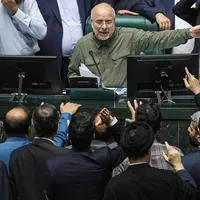
Iran's Supreme Leader Ali Khamenei (center) and senior officials during a meeting (March 2025)
The United States on Wednesday imposed sanctions on five Iranian companies and one individual for their alleged support of Iran’s nuclear program, the Treasury Department said.
The action targets entities linked to the Atomic Energy Organization of Iran (AEOI) and its subsidiary, the Iran Centrifuge Technology Company (TESA), both of which play key roles in Iran’s uranium enrichment and nuclear development efforts.
The Treasury’s Office of Foreign Assets Control (OFAC) designated the firms under Executive Order 13382, which aims to curb the proliferation of weapons of mass destruction.
"The Iranian regime’s reckless pursuit of nuclear weapons remains a grave threat to the United States and a menace to regional stability and global security," said Treasury Secretary Scott Bessent. “Treasury will continue to disrupt Iran’s nuclear advances and broader destabilizing agenda.”
Among those sanctioned is Atbin Ista Technical and Engineering Company (AIT), accused of aiding TESA’s acquisition of foreign components. AIT's managing director, Majid Mosallat, was also designated for acting on behalf of the company.
Also blacklisted are Pegah Aluminum Arak Company, which supplies aluminum products to TESA, and Thorium Power Company (TPC), established in 2023 to develop thorium-fueled reactor technologies under the guidance of AEOI.
The designations further include Pars Reactors Construction and Development Company (Satra Pars) and Azarab Industries Co., both of which are involved in AEOI-led nuclear projects, including reactor construction and equipment production.
As a result of the sanctions, all US-linked assets of the designated individuals and entities are frozen, and US persons are generally prohibited from conducting transactions with them. Secondary sanctions may apply to non-US persons engaging in certain activities with the listed entities.
The sanctions come amid heightened nuclear tensions and just days before talks between the United States and Iran are set to take place in Oman on Saturday.
The upcoming negotiations, to be led by Iranian Foreign Minister Abbas Araghchi and US envoy Steve Witkoff, were announced on Monday by President Donald Trump, who has repeatedly threatened Iran with military action if it does not agree to a deal since returning to the White House in January.
Former vice president Eshaq Jahangiri voiced support for ongoing talks between Iran and the United States, urging unity behind the country's negotiating strategy.
“At this stage, we must support these decisions, especially the policies the Supreme Leader has adopted,” he said on Wednesday.
Jahangiri also called for backing the negotiating team and warned against partisan moves that could weaken Iran’s broader diplomatic efforts.
Former deputy parliament speaker Ali Motahari called for the inclusion of senior current and former officials in Iran’s negotiating team with the United States, now led by Foreign Minister Abbas Araghchi.
“I suggest appointing Mr. Zarif, Salehi, Ali Larijani, and Takht-Ravanchi to the delegation to benefit from their experience and reach a fair agreement,” he wrote on X.
Javad Zarif is the architect of Iran’s 2015 nuclear deal and a former foreign minister; Ali-Akbar Salehi is a former head of the Atomic Energy Organization; Ali Larijani is a former parliament speaker; and Majid Takht-Ravanchi is currently deputy foreign minister for political affairs.
Frustrated ultra-hardliners are subtly warning Supreme Leader Ali Khamenei that making major concessions to Washington could risk a fate similar to Libya’s Muammar Gaddafi.
“Negotiation, whether direct or indirect, with [Qasem] Soleimani’s killers, those who murdered 50,000 people in Palestine, is not going to end well," warned Fatemeh Tashakori, an ultra-hardliner activist on X, referring to an Iranian commander assassinated in a US drone strike in President Donald Trump's first term.
"The reason: Gaddafi’s fate in Libya!” she added.
As US-Iran talks are set to begin on Saturday, Israeli Prime Minister Benjamin Netanyahu and influential US Senator Tom Cotton in recent days both said Tehran ought to follow the example of Libya and renounce weapons of mass destruction.
Tripoli under veteran strongman Muammar Gaddafi made the move in 2003, only to be toppled in a Western-backed uprising and murdered by armed rebels in 2011.
Another popular ultra-hardliner activist with 22,000 followers, @Ya_Fatemeh, echoed similar sentiments, arguing that Gaddafi complied with US demands—scrapped Libya’s nuclear program, limited missile ranges—and it only brought years of civil war. “Yes, that’s what the Libyan model negotiations are like.”
The Libyan civil war was primarily rooted in internal grievances against Gaddafi’s authoritarian rule, including political repression and corruption.
While the United States and NATO intervened militarily in 2011 to prevent a massacre in Benghazi, they did not start the uprising. The conflict began as part of the broader Arab Spring uprisings, with Libyans taking to the streets demanding change well before any foreign involvement.
Ultra-hardliners who claim to be Khamenei’s most loyal—and only—true followers are well aware that the upcoming talks in Oman would not be happening without his tacit approval.
Though they stop short of naming him directly, the implication is unmistakable—and widely noted on social media. “Shame on you for comparing the Leader of the Revolution with these three people,” hardliner figure Mohammad-Ali Ahangaran, who has nearly 28,000 followers on X, wrote in response to a post that invoked the fates of Egypt’s Hosni Mubarak and Iraq’s Saddam Hussein.
In their opposition to renewed nuclear talks between Tehran and Washington, ultra-hardliners frequently cite Israel’s influence over the Trump administration, particularly its push for the total dismantling of Iran’s uranium enrichment program.
“America and Israel’s Main Strategy Against Iran: Libyazation of Iran,” read the headline of a Raja News article—the outlet affiliated with supporters of former nuclear negotiator Saeed Jalili an ultra-hardliner ideologue.
The piece referenced statements by Israeli Prime Minister Benjamin Netanyahu and US Senators Tom Cotton and Lindsey Graham advocating the use of the "Libyan model" in dealing with Iran’s nuclear program.
While Israeli media reported that Netanyahu discussed the Libyan model during his recent visit to Washington, the US stance remains ambiguous, as Trump gave no firm indication on whether he would adopt the model.
Ultra-hardliners recently warned that the Islamic Republic was risking alienation of its staunchest supporters, who they said make up the “solid core of the system”, if authorities continued suspending strict hijab enforcement.
Often referred to as “super-revolutionaries” by rival conservatives, most ultra-hardliners have strong links to the Paydari (Steadfastness) Party and a group known as MASAF. The two parties form the majority in the Parliament.
Last week, Iran’s Press Supervisory Board issued a rare warning to Kayhan newspaper, a leading ultra-hardline publication, after it published an article interpreted as a threat to assassinate Trump over the 2020 killing of Soleimani. The paper later claimed the piece was satirical.
Officials have made clear that tolerance for dissent against the talks, even from the far right, will depend on the outcome of negotiations—and the Supreme Leader’s position.
Some hardline publications appear to be adjusting their tone. An editorial by Gholamreza Sadeghian, chief editor of the Revolutionary Guards (IRGC) linked Javan newspaper, for instance, said on Wednesday that Iran may agree to reduce its enrichment levels but warned that this should not be viewed as a concession.
In return for reduced enrichment and increased inspections by the UN nuclear watchdog, IAEA, Iran should demand full sanctions relief and an end to Western support for the Islamic Republic’s opposition, the editorial argued.