Book reveals new aspects of Iran’s plan to assassinate Trump - Axios

Iran's threat to assassinate US President Donald Trump during the 2024 election campaign was more severe than publicly known, according to a new book.

Iran's threat to assassinate US President Donald Trump during the 2024 election campaign was more severe than publicly known, according to a new book.
Extraordinary precautions, including the use of a decoy plane, were implemented by Trump’s team to counter the threat, according to a forthcoming book, Revenge: The Inside Story of Trump’s Return to Power written by Alex Isenstadt.
“Law enforcement officials warned Trump last year that Tehran had placed operatives in the US with access to surface-to-air missiles,” the author said in an interview with Axios.
“The concern intensified after a foiled assassination attempt of Trump at his golf course in West Palm Beach, Fla., on Sept. 15.”
Isenstadt said he was given extensive access to Trump's inner circle during his campaign.
Though Iran was not conclusively linked to the events, they heightened fears of an attack on Trump Force One, his personal jet, according to the book.
On one occasion, Trump traveled aboard a plane owned by real estate executive Steve Witkoff while his staff flew on Trump Force One. Many aides only learned of the switch just before takeoff, leading to what campaign insiders dubbed the Ghost Flight.
According to the book, set for release on March 18, the Secret Service also organized decoy motorcades and took steps like disabling a drone suspected of following Trump’s motorcade in Pennsylvania.
Campaign insiders noted that Trump grew more cautious about public events and spoke less frequently about ordering the 2020 airstrike that killed Iranian general Qassem Soleimani in Iraq.
Soleimani led the Islamic Revolutionary Guard Corps’ Quds Force and Iran's influence and military allies in the Middle East.
Since then, US authorities have tracked several threats against Trump and former officials linked to Soleimani's assassination.
"If they did that, they would be obliterated," Trump said recently. "That would be the end. I've left instructions - if they do it, they get obliterated. There won't be anything left."
Iranian foreign ministry spokesperson Esmail Baghaei reacted to Trump's remarks saying, “Tehran reserves its right to pursue a legal process for achieving justice regarding the killing of national champions and senior officials to achieve results in domestic and international courts.”

Iran’s Atomic Energy Organization announced plans to construct a yellowcake production facility capable of producing 20 tons annually.
The announcement follows the commencement of radioactive materials extraction at a complex in Yazd province.
“Today, the extraction and operation of radioactive materials and accompanying elements in the Anomaly 10 area began,” said Javad Ahmadi, the deputy head of the Atomic Energy Organization.
“Last September, we carried out the exploration of this area, and now we have reached the stage of extracting radioactive materials and accompanying elements from this mine.”
Yellowcake, a processed uranium ore, is a key material for nuclear power plants, which Iran claims is its focus, though concerns remain over its potential use in atomic weapons. The West has expressed fears that Iran’s ultimate aim may involve weapons-grade enrichment.
Ahmadi also mentioned the project’s scope, saying that it involves approximately 40 million tons of radioactive materials, iron ore, and other elements.
“We have also planned to establish a yellowcake production plant with an annual capacity of 20 tons.”
Last year, the head of the UN's nuclear watchdog said that Iran is "weeks not months" away from a nuclear weapon.
In spite of a November resolution by the International Atomic Energy Agency's Board of Governors censuring Iran for its lack of cooperation, Iran has continued to forge ahead with its enrichment towards weapons level uranium.
The deputy head of Iran’s Atomic Energy Organization, Behrouz Kamalvandi, said at the time: "We will significantly increase enrichment capacity ... The Westerners are trying to push our nuclear industry backward through pressure tactics."
The latest developments come as President Donald Trump looks to bring Iran back to the negotiating table. During his first term, the US withdrew from the 2015 nuclear accord, a deal that restricted Iran’s uranium enrichment to 3.67 percent—well below the 90 percent required for weapons—while capping its stockpile at 300 kilograms.
Further expanding its nuclear initiatives, Iran on Saturday launched production of Iridium Hexafluoride (IR46) at the Shahid Raeisi Nuclear Site in Isfahan. State media claims the material has medical and industrial uses and opens new export opportunities for Iran.
While President Donald Trump’s new administration has indicated openness to renegotiations, Supreme Leader Ayatollah Ali Khamenei has dismissed the prospect, calling dialogue with the US dishonorable.
Trump has clearly announced that the Islamic Republic must not have nuclear weapons while countries such as the United Kingdom, Germany and France (the E3) continue to push for measures to prevent Iran's nuclear progress.
Iran insists its nuclear program is strictly for peaceful purposes, though its growing capabilities are likely to draw increased international scrutiny.

Iran can close the Strait of Hormuz in the Persian Gulf if ordered by senior officials, the commander of the Revolutionary Guards (IRGC) navy warned after US President Donald Trump announced plans to cut Iran’s oil exports to zero.
"We have the capability to close the Strait of Hormuz," Alireza Tangsiri was quoted as saying by Iranian media on Sunday in defiance against Trump's threats.
Tangsiri added that the decision rests with "high-ranking officials, and the IRGC navy will act in accordance with orders."
On Tuesday, Trump signed a directive aiming to reduce Iran's oil exports to zero in a bid to pressure Tehran back to the nuclear negotiating table, and reimpose stringent economic sanctions.
He said that Iran would face "catastrophic" consequences if it does not negotiate a new nuclear agreement.
However, Tangsiri dismissed Trump's directive, saying the US is incapable of reducing Iran’s oil exports to zero.
"They cannot achieve their goals. We have stood against them for 46 years, and they cannot break the Muslims. Look at Gaza—Muslims, with empty hands, have resisted and defended themselves against the ruthless, child-killing, and bloodthirsty regime for over 15 months. So, they certainly cannot break a bigger country with sanctions. The more they have sanctioned us, the greater achievements we have made," he said.
The strait, a key route for global oil shipments, has been at the center of past tensions. Iran has repeatedly threatened to block it, including in 2018 after the US withdrew from the nuclear deal.
Tangsiri made a similar threat in April last year, saying Israel's presence in the United Arab Emirates was viewed as a threat by Tehran and that Iran could close the Strait of Hormuz if deemed necessary.
Western nations have stationed naval forces in the region to prevent any disruption to the vital waterway, which handles about 20% of global oil trade.
In 2023, the US imported approximately 0.5 million barrels per day of crude oil and condensate from Persian Gulf nations through the Strait of Hormuz, accounting for about 8% of its total crude and condensate imports and 2% of its overall petroleum liquids consumption, according to the US Energy Information Administration (EIA).
Trump withdrew from the 2015 JCPOA nuclear deal with Iran during his first term, imposing tough economic sanctions that have triggered a prolonged financial crisis in the country.
In spite of this, under the Biden administration, oil sales have continued to grow.

As food costs continue to climb in Iran, agricultural products like fruits and vegetables have seen sharp increases with exports driving up domestic prices.
Gholamreza Nouri Qeziljeh, Iran’s Minister of Agriculture, attributed some of the price increases to sanctions, which targeted the country's kiwi crop.
However, he acknowledged that the same kiwis are being exported this year, and this has further inflated their cost on the domestic market.
"We need to examine how to reform this process," he said, suggesting that the government may need to take action to prevent further price surges.
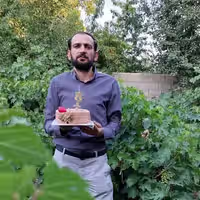
Kiwis are now being sold for up to 2,400,000 rials ($2.7) per kilogram, a price that eats up nearly two percent of the average monthly salary.
Tasnim News, a media outlet linked to Iran’s Revolutionary Guards, reported on Saturday that, based on field observations, kiwi prices in Tehran range from $1 to $2.7 per kilogram.
Prior to the increase, the ILNA news agency warned that the purchasing power of Iranian workers has plummeted by a quarter this year, compared to the last decade.

The kiwi price hikes come on the heels of similar price increases for potatoes. Reports indicate that potatoes in Iran have risen to 900,000 rials per kilogram (around $1), spurred in part by extensive exports.
Mehrdad Lahoti, a member of the Iranian parliament, said that while Iran once exported over one million tons of potatoes, poor management has now led to rotting stockpiles in warehouses. "Iran has become an importer of this product," Lahoti said.
To stabilize soaring potato prices, Iran is importing 50,000 tons of the staple vegetable, according to deputy agricultural minister Akbar Fat’hi.
Further complicating the issue, a review of customs data reveals that Iran exported 307,000 tons of potatoes in the first nine months of the year at a price of just 140,000 rials (15 cents) per kilogram, with much of it going to Iraq and Afghanistan.
In neighboring Iraq, Iranian agricultural exports are also causing economic strain. Iraqi tomato farmers in Basra have been dealing with price crashes due to the influx of cheaper Iranian tomatoes, which often flood the local markets.
According to Al Jazeera, farmers in Basra struggle to cover their production costs as tomatoes imported from Iran undercut local prices.
Back in Iran, political leaders are offering mixed explanations for the rising prices. President Masoud Pezeshkian argued that external sanctions are driving up costs.
"The enemies think that if they siege us, we will die from hunger," he said on Saturday.
Morteza Fazaeli, a member of Supreme Leader Ali Khamenei’s office, said on Saturday that domestic mismanagement is a key factor in the country’s economic woes.
With food prices continuing to rise and the purchasing power of citizens steadily declining, many Iranians are increasingly confronted with a difficult economic reality as the rial loses value by the hour, now being exchanged at 900,000 per dollar.

Israeli PM Benjamin Netanyahu told Fox News of plans with the US to create a new Middle East with a nuclear-free Iran, while Israeli military forces continued to pound suspected Iran-backed groups in the occupied West Bank on Sunday.
Speaking to the US news channel on Saturday night, Netanyahu spoke of a changing region under the new US President Donald Trump, including a peace deal with Saudi Arabia.
“When we complete the changeover of the Middle East, when we cut the Iranian access down to even further than we've already cut it when we make sure that Iran doesn't have nuclear weapons, when we destroy Hamas, that will set the stage for an additional agreement with the Saudis and with others,” he said.
Israel normalized relations with some Arab states such as the United Arab Emirates in the 2020 US-brokered Abraham Accords and the longest-serving Israeli premier hopes to do the same with Saudi Arabia.
As Trump reintroduced his maximum pressure policy on Iran on February 4, the issue of its nuclear program remains of grave concern to the Israeli PM who has long campaigned to have it crushed as Tehran continues uranium enrichment to weapons grade levels.
However, Trump has renewed his call for talks with Iran to reach a deal preventing Tehran from acquiring nuclear weapons, emphasizing that he prefers negotiations over bombing the country's nuclear facilities.
On Saturday, Trump told The New York Post: “I would like a deal done with Iran on non-nuclear. I would prefer that to bombing the hell out of it. . . . They don’t want to die. Nobody wants to die.”
Iran’s military allies in the region also remain a priority for not only Israel but the US, which has also suffered at the hands of groups such as the Houthi militia in Yemen.
Israel is still in the midst of a fragile ceasefire with Hezbollah in Lebanon and Hamas in Gaza. However, in the West Bank, Israel believes Iran’s influence only continues to strengthen as Tehran diverts its focus.
Israeli Defense Minister Israel Katz announced Sunday that the armed forces are expanding Operation Iron Wall to include the Nur a-Shams refugee camp.
"We are crushing the terrorist infrastructure in the refugee camps and preventing its return. We will not allow the Iranian axis of evil to establish an eastern terrorist front that would threaten the settlements of Samaria and the seam line and the large population centers in Israel,” he said.
Last month, Katz said the West Bank has become a new focus for Tehran after Israel’s crushing debilitation of Hezbollah and Hamas.
Iran is taking advantage of the ruling Palestinian Authority's lack of political legitimacy in the Israeli-occupied West Bank to arm militants, the director of a leading research center in Ramallah told Iran International last month.
"We are seeing increasing efforts to promote Palestinian terrorism in Israel through the smuggling of advanced weapons, funding and guidance both on the part of the Iranian axis and on the part of the radical Sunni Islamic axis that is strengthening its grip on the region after the events in Syria,” Khalil Shikaki, the director of the Palestinian Center for Policy and Survey Research in Ramallah said.
“Iran exploits this vacuum left by the lack of legitimacy of the Palestinian Authority (PA) and unpopularity of President Mahmoud Abbas to maintain and sustain this situation," he added.

A hacking group reportedly linked to Iran's intelligence ministry claims to have infiltrated Israel's police systems and obtained data including personnel files, weapons inventories, and medical and psychological profiles.
In a post on Telegram, Handala said the 2.1 terabytes of stolen information also includes legal cases, weapon permits, and identity documents. It also claims to have extracted 350,000 documents and made them publicly accessible.
Israeli police denied the attack, saying there was no evidence of a breach.
"Following inquiries regarding an alleged hack into police systems, we would like to clarify that after a thorough investigation, no external party had access to the police's information systems, and there is no indication that a hack occurred or that information was leaked," they said in a statement on X.
Last month, the same hacking group targeted kindergartens in Israel, disrupting public address (PA) systems and infiltrating emergency systems in at least 20 locations by exploiting vulnerabilities in a private company's infrastructure.
Additionally, the group used another system belonging to the same company to send tens of thousands of threatening text messages to Israeli citizens.
At the time, Israel's National Cyber Directorate confirmed the breach and said it is working with the affected company and the Ministry of Education to address the situation.
Last year in September, the group claimed it had successfully breached the Soreq Nuclear Research Center, alleging the theft of 197 gigabytes of data.
The hackers also published around 30 photos they claimed were taken inside the center, along with screenshots allegedly showing the names of nuclear scientists involved in the facility's particle accelerator project.
In response, the Israeli prime minister's office, speaking on behalf of the Israel Atomic Energy Commission, denied the authenticity of the images. "Following a thorough examination, the images and blueprint do not belong to any of its facilities," the statement said.
According to Microsoft, Israel has become the top target of Iranian cyberattacks since the start of the Gaza war, replacing the US as the number one target.
"Following the outbreak of the Israel-Hamas war, Iran surged its cyber, influence, and cyber-enabled influence operations against Israel," Microsoft said in its recent annual report.
"From October 7, 2023, to July 2024, nearly half of the Iranian operations Microsoft observed targeted Israeli companies," the Microsoft Digital Defense Report said.