G7 Warns Iran Against Giving Russia Ballistic Missiles
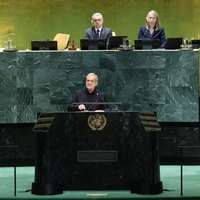
A view from the first day of the G7 summit, in Savelletri, Italy, June 13, 2024
The Group of Seven leaders warned Iran Friday not to give Russia ballistic missiles, only a day after the two countries’ much-publicized strategic agreement was confirmed to have been halted due to “issues” on the Iranian part.
Iran and Russia have grown closer due to the war in Ukraine, which has resulted in sweeping sanctions on Russia from the US and the EU. Iran has supplied Russia with hundreds of kamikaze drones, and unofficial reports suggest that Tehran may be considering enhancing its assistance with missiles.
"We call on Iran to stop assisting Russia’s war in Ukraine and not to transfer ballistic missiles and related technology, as this would represent a substantive material escalation and a direct threat to European security," the G7 stated.
In February, Reuters reported that Iran had provided Russia with “a large number of powerful surface-to-surface ballistic missiles”. The claim was later repeated by UK defense secretary Grant Shapps, who indicated that he had such information but refused to offer details..
Iran and Russia have been working on a long-term agreement for a few years now, hoping to set in stone a trend that has seen Tehran and Moscow expand and deepen ties.
The new comprehensive cooperation agreement was conceived under former President Hassan Rouhani and officially announced by his late successor, Ebrahim Raisi. “Documents of strategic cooperation can outline the horizons of the [two countries’] relations over 20 years,”Raisisaid after he met Putin and presented the draft in 2022.
The agreement was expected to be signed this year, but the Russian side announced Wednesday that the process was halted due to “issues faced by our Iranian partners.” Russia's TASS news agency then quoted foreign minister Sergei Lavrov as saying that several "procedural legislative actions" must be completed before the agreement can be signed.
It is unclear what the “actions” are and if it is related to the unexpected, upcoming presidential elections in Iran, which were announced after Raisi died in a helicopter crash last month.
Earlier on Friday, it was announced that Russian President Vladimir Putin and Iran’s acting president, Mohammad Mokhber, had talked on the phone Thursday evening, in what seems to be the latest attempt to counter rumors surrounding the ‘halt’ of the two countries’ comprehensive agreement.
“Both sides expressed their interest in further development of Russian-Iranian cooperation,” according to the Kremlin, “including in implementing promising joint projects in energy and transport.”
"It's a message from Vladimir Putin to Tehran, warning them not to alter their policies, particularly concerning Ukraine and the Gaza conflict. Additionally, it aims to pressure the incoming Iranian government into negotiations to secure more favorable terms," he stated.
Under severe international sanctions, Russia and Iran have expanded their economic ties, with mutual trade standing at $4 billion, which even Iranian officials admit is far below the target of $40 billion.
The two countries reached an agreement in December to eliminate the use of the US dollar in bilateral trade, a development heralded by Iran's central bank governor as a "new chapter." However, the move has more of a symbolic significance than a real economic act.