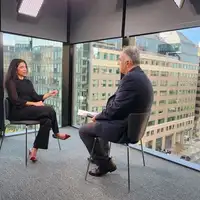
Pro-reform candidate Massoud Pezeshkian argued in his first economic discussion aired on state television that Iran's international isolation must end and that foreign investment is essential for economic improvement.
Pezeshkian was accompanied by two economic advisers and was questioned by three economic experts during the 45-minute program about his proposed plans. Throughout the program, however, he insisted that he was not an expert and would only follow the advice of economists.
“As a physician, I will ruin everything if I enter the economic arena [on my own],” he said. Some of his critics on social media charge that without economic knowledge he is more likely to ruin the economy anyway.
“Instead of establishing cooperation and attracting investment they do something else [that defeats the purpose]. We cause such catastrophes even when an investor comes to our country that they regret their decision to invest here,” Pezeshkian said.
“Bringing foreign investment can prevent the [continuation of] current pressures,” he said while also criticizing policies that have resulted in the country’s brain-drain problem.
Pezeshkian's remarks are typical of regime insiders, who when compelled to address the worsening economy, avoid mentioning the real reasons for Iran's isolation: its confrontational foreign policy and its controversial nuclear program. Their typical response is to blame inefficient officials, who do not fully follow policies and laws.
Iran's average annual economic growth rate for the past 12 years has been around zero, with international sanctions on oil exports and international banking devastating the economy and preventing investments. Tehran has also refused accession to global financial transparency conventions, which has further impeded foreign investments.
Ahmad Midari, one of the two advisers accompanying Pezeshkian, mentioned that tensions caused by political factionalism in the foreign policy apparatus and other government bodies was an impediment to the economy that Pezeshkian’s government would try to eliminate.
“The truth of the matter is that those who are unfairly called ‘pro-West’ are executives who were in a position of authority when the establishment decided to negotiate with the West or were employed at such times due to their expertise in negotiation,” he said.
In his introduction to the program, Pezeshkian pointed out that official figures indicate the inflation rate has been over 40 percent between March 2021 and March 2023 and that excluding oil the economic growth rate was negative.
All the presidential candidates have admitted that the economy is in trouble, but none have directly attributed it to Tehran's foreign policy, because that would be viewed as a criticism of Supreme Leader Ali Khamenei.
Pezeshkian, however, tried to highlight some negative economic indicators. The government’s debt to the Central Bank has more than doubled to $5.4 billion since March 2021 and its debt to other banks has doubled to $13.5 billion, he said, adding that during the same time the value of securities issued by the government has reached $12.4 billion from $5.5 billion.
Pezeshkian has been criticized for his choice of economic advisers due to their very different expert views. Hossein Abdo-Tabrizi, a former secretary general of the Tehran Stock Exchange (2003-2005), founder of a private bank (Eghtesad Novin), and owner of the banned Sarmayeh (Capital) newspaper is known for defending a free market economy while Midari, deputy minister of cooperatives, labor and social welfare under Hassan Rouhani, upholds left-leaning views and is a researcher in poverty.
Conservative politician Yahya Al-e Es'haq who was a former head of the Tehran Chamber of Commerce and served as minister of commerce under Akbar Hashemi-Rafsanjani sat on the three-member panel that questioned Pezeshkian and his advisers.
Al-e Es'haq was heard several times during the program saying “well said, well said” in response to Pezeshkian’s remarks including when he argued that there was no shortage of laws and problems stemmed from neglecting the existing ones.
Another member of the panel, Davoud Danesh-Jafari who currently sits on the Macro-Economy Committee of the Expediency Council and served as minister of economy under Mahmoud Ahmadinejad also occasionally showed his approval of Pezeshkian and his advisers by nodding his head.
The third 'expert' on the panel, Mohammad-Hossein Hosseinzadeh-Bahraini, a cleric and former lawmaker, tried to pressure Pezeshkian into admitting that he supported the elimination of fuel subsidies—an admission that could alienate the public. However, Pezeshkian responded by stating that he would rely solely on expert opinions if such a measure was necessary and would keep the public informed of the details.
Sudden announcement of an increase in fuel prices under Hassan Rouhani resulted in unrest across the country in 2019, during which security forces killed at least 1,500 protesters.