Iranian Director In Exile Rejects Government's Invitation

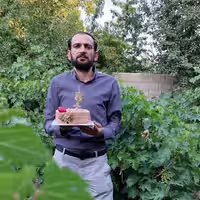
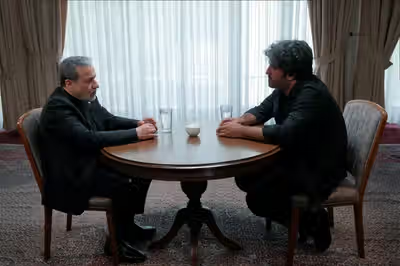
Acclaimed Iranian director Bahram Beyzai has rejected an invitation to return to Iran and create a film, citing opposition to government censorship.

Acclaimed Iranian director Bahram Beyzai has rejected an invitation to return to Iran and create a film, citing opposition to government censorship.
Beyzai's refusal came in response to a claim by Mohammad Khazaei, Director of the Cinema Organization of Iran who said this week that artists can return to the country "within the framework of the law." The organization is a government-controlled entity and its reference to framework of the law denotes the regime strict censorship practices.
Responding Khazaei's remarks, Beyzai took to Instagram, declaring, "It is due to my and other filmmakers’ existence that you are occupying that seat... You treat us like slaves and expect us to obey orders.”
He further noted that he will not allow Iranian officials to censor him, or force him to self-censor.
The invitation extended to Beyzai comes amidst ongoing cultural restrictions and a tightening of creative freedoms in Iran. Over the years, the Iranian government's censorship policies have led to the exodus of numerous talented people, including renowned artists and filmmakers, seeking greater creative liberty abroad.
Filmmakers, in particular, face challenges navigating the confines of government-approved content, often resorting to self-censorship to avoid repercussions.
The cultural crackdown extends beyond censorship to include harassment, intimidation, and imprisonment of dissenting voices. Notably, director Jafar Panahi's imprisonment in July 2022 following his inquiry about the whereabouts of other detained filmmakers illustrated the risks faced by those who challenge the status quo.
Panahi, a recipient of numerous international awards, including the Golden Bear at the 2015 Berlin Film Festival, was sentenced to a six-year prison term and a 20-year filmmaking and travel ban for his involvement in documenting the 2009 Green Movement protests.


Iranian Traffic Police announced Friday that 321 people have lost their lives in car accidents during the ongoing Norouz holidays so far.
Norouz, also known as the Persian New Year, is one of the most significant holidays in Iran. It marks the beginning of spring and is celebrated on the day of the vernal equinox, which typically falls on March 20th or 21.
Despite plans by the country's Traffic Police to reduce fatalities during the season, the death toll continues to rise, reaffirming Iran's status as one of the countries with the highest death tolls from road traffic accidents globally.
Every year, the Norouz holidays (Mid-March to early April) witness hundreds of deaths on Iran's roads as the country's population embarks on journeys for the festive season. A combination of factors, including poor road conditions, inadequate vehicle domestically made vehicle quality and maintenance, as well as dangerous driving practices, contribute to making the period the most fatal of the year for Iranian citizens.
According to ISNA website in Tehran, over the past decade, statistics reveal that 9,815 individuals have lost their lives in New Year accidents, highlighting the magnitude of the issue.
While poor road conditions and poor vehicle quality are significant factors contributing to road accidents, Iranian authorities often attribute the majority of incidents to "human factors," placing blame on drivers. However, concerns persist regarding the need for comprehensive measures to address the underlying causes of road accidents and enhance road safety across the country.

Iran's regime dubs its regional armed groups "resistance forces," while opponents label them mercenaries. Many ordinary Iranians view them as terrorists who exploit their country's resources.
However, the term "proxies" employed by Western media and think tanks fails to accurately depict the diverse relationships these forces maintain with the regime. No section of Iranian society refers to them as na’eb or niabati (proxies).
The exact relationship with the regime
What truly defines the relationship between the Iranian regime and these entities often termed "proxies"? Are they allies, foreign terrorists fully integrated into Iran's operations, collaborators, mercenaries, or something else?
Allies: These are partners with whom Iran cooperates based on specific objectives, aiming for mutual benefits. This alliance may be strategic or tactical, subject to change over time with the evolution of agreements.
Assimilated Forces: This designation refers to groups fully integrated into the Iranian regime, demonstrating organizational ties, funding sources, ideological alignment, and shared political goals within their operational territories.
Recruited forces: These individuals are recruited by the Iranian government for short-term projects, lacking the comprehensive affiliation of assimilated forces. Their nationality or origin holds minimal significance in this context.
The forces employed by the Islamic Republic extend beyond mere mercenaries driven solely by financial incentives. For instance, groups like the Fatemiyoun (Afghan Shias) and Zainabiyoun (Pakistani Shias) harbor their own political agendas and aspirations. Notably, the Quds Force doesn't recruit non-Muslim or Western groups, instead favoring Shia or Sunni Islamists motivated by goals beyond financial gain. Many Afghan fighters, for example, seek Iranian citizenship while serving in Syria.
Labeling these groups as "proxies" fails to capture the nuanced relationship between the regime and its affiliated entities, a crucial distinction for policy-making. Should an assimilated Islamist organization, for instance, attack US forces, Iran's regime may be held accountable for retaliatory actions, unlike in the case of an allied group. To sidestep potential repercussions, Western governments often opt to categorize these groups as proxies.

Allies: Hamas and the Houthis
According to the outlined criteria, Hamas and the Houthis align with the Islamist regime as allies, given they are not religiously affiliated nor directly founded by the regime. Additionally, the Islamic Republic does not fully finance Hamas and the Houthis, who can partially sustain themselves. However, organizations like Islamic Jihad differ in this aspect. Established by the regime, Islamic Jihad operates within a limited territory in Gaza.
Recruited Forces: Fatemiyoun and Zeinabiyoun
While established and fully funded by the Islamic Republic, these military brigades lack territorial dominance and are more dependent on Tehran than those categorized as allies. Despite sharing religious affinity, they primarily serve as collaborators with the regime for a defined period. The Zeinabiyoun predominantly operate in Pakistan, while a significant portion of the Fatemiyoun forces remains stationed in Syria. There is no indication that they will be fully assimilated into the regime's structure.
Assimilated: Hezbollah and Hashd al-Sha`bi
Hezbollah, established by the regime, shares religious and ideological alignment and receives full financial support; its military branch is practically a Quds Force’s brigade. Similarly, while Iraqi Hashd al-Sha`bi's expenses are partially covered by the Iraqi government, their ideological alignment and coordination with the IRGC indicate domestication by the regime.

The military branches of these groups operate under the complete command of the Islamic Republic, even in micro decision-makings. The regime's influence over them was evident when the US threatened direct attacks on regime’s facilities in response to attacks on American personnel; the attacks ceased upon the regime's signal. None of these groups’ brigades operate independently, consistently aligning with official regime policies.
Hashd al-Sha`bi, initially established by the Quds Force and Iraqi military groups, maintains loyalty to the Islamist regime despite receiving funding from the Iraqi government. Their close ties to Iran and loyalty to the Guardian Jurist and IRGC commanders are evidenced by familial connections and frequent travel between Iran and Iraq.
Lebanon's Hezbollah fighters, one of the largest divisions of the IRGC, receives comprehensive support from Iran, including financial, logistical, and welfare assistance. Even the cost of rebuilding their destroyed houses in Israeli attacks is compensated. The intermarriage between Hezbollah fighters and regime officials' families underscores their symbiotic relationship, blurring the lines between Iranian and Lebanese identities. Hezbollah leaders likely possess Iranian documents, and Hezbollah members have been employed to suppress Iranian protests.
The political branches of Hezbullah and Hashd al-Sha`bi have their own agenda in Lebanon and Iraq as IRGC sections in Khorasan and Fars provinces have theirs. Any unit that works for IRGC, domestic or foreign, has its political and economic agenda and specific mission. The whole system is structured like a fiefdom: units are vassals and the Guardian Jurist (vali-ye faqih) is the lord.

Mohammad Ali Abtahi, a prominent reformist politician and senior aide to former President Mohammad Khatami, published photos on social media showing that he was in hospital with injuries after unknown individual tried to snatch his mobile phone in the street.
Recounting the incident, Abtahi stated, "I was walking on the sidewalk holding my mobile phone. When I reached the intersection, two individuals on a motorcycle rushed to snatch my phone."
The altercation left Abtahi with injuries, including 10 stitches on his eyebrow and a wound on his chest. The incident sheds light on the escalating issue of cell phone robberies in Iran, a trend closely associated with rising inflation and poverty plaguing the nation.
In recent years, Iran has witnessed a surge in street crimes and robberies, a phenomenon linked to deep-rooted poverty exacerbated by economic sanctions, mismanagement, and political instability. The growing chasm between the affluent and the impoverished has pushed many into financial hardship, driving some towards criminal activities as a desperate means of survival.
Because of near 50-percent annual inflation, imported items such as mobile phones have become expensive and can fetch quick cash for robbers.
The allure of quick profits has also fueled the proliferation of cell phone theft. Criminals perceive stolen devices as valuable commodities that can be easily sold on the black market or through clandestine networks, fetching substantial sums of money.

Following a German court's ruling attributing Iran's regime to a foiled 2022 terrorist plot targeting a synagogue in Bochum, many have urged Berlin to close Tehran's embassy and designate the IRGC as a terrorist entity.
The Islamic Republic of Iran has launched numerous terrorist attacks since the 1979 Islamic revolution within the territory of Germany, including the infamous 1992 Mykonos attack.
There has been a spike of IRGC surveillance and terrorist operations over the last decade in Germany.
Germany’s dovish responses to Iran-backed terrorist and surveillance activities has been a great source of anger among German-Iranians and opponents of the clerical regime.
Dr. Kazem Mousavi, a human rights, environmental, and anti-nuclear activist in exile in Germany, emphasized to Iran International, "This terrorist attack was planned and executed from Tehran by the Revolutionary Guard. A robust response to the mullahs' antisemitic state terrorism would be to immediately classify the IRGC as a terrorist organization on both the German and EU terror lists. Additionally, the closure of the Mullah terrorist embassy in Berlin is imperative."

Regarding German Foreign Minister Annalena Baerbock's response, Mousavi, the spokesman for the Green Party of Iran in Germany (in exile), described it as "half-measures" for only summoning the Iranian ambassador. The German Foreign Ministry has announced intentions to take "additional steps."
German media and legal experts have noted that Baerbock has stymied a terror designation of the IRGC by invoking the bogus argument that there are no legal cases implicating the IRGC in terrorism. Baerbock is a Green party politician. The German Green party has favored dialogue with Iran’s regime, according to veteran observers of German-Iran relations.
The German Christian Democratic Union MP, Norbert Röttgen posted on X on Thursday that “The reasons for the judgment of the Düsseldorf Higher Regional Court are available. This clearly states that the planning of the Bochum attack goes back to ‘Iranian state authorities.’ The IRGC's terror listing must come now. There are enough starting points.”
In 2019, the United States classified the IRGC as a foreign terrorist organization. The IRGC controls more than 50% of Iran’s economy, according to some estimates, and Germany remains Iran’s largest European trading partner. Mid-size engineering companies conduct robust business deals with Iran’s regime.
Germany’s foreign policy has largely been viewed as hardcore appeasement of Khamenei’s regime. A telling example was after a German court convicted a Pakistani man in 2017, who was paid by the IRGC to engage in an assassination plot targeting pro-Israel advocates. The then-foreign minister, Sigmar Gabriel, secretly summoned Iran’s ambassador for a warning. The Quds Force—a part of the IRGC—paid Pakistani Syed Mustaf at least 2,052 euros from July 2015 to 2016 to spy on Jewish and Israel institutions and carry out the assassination plot.
Germany’s annual intelligence reports are routinely filled with passages about Iranian agents conducting spy operations against dissidents in the Federal Republic. The hubs of Iran’s espionage network are its embassy and the Khamenei-controlled Islamic Center of Hamburg.
The US-based Iran expert, Alireza Nader, told Iran International that “The German government must take the regime’s presence on German soil seriously by expelling all regime agents and closing down regime centers of influence. The Islamic Republic has been allowed to use Germany as its European center of influence and operations for too long.”
Jason Brodsky, the policy director for the US-based United Against Nuclear Iran, conveyed to Iran International that “Germany should be making a concerted push in the EU now to build consensus to sanction the IRGC as a terrorist organization. It should also be downgrading diplomatic ties with the Islamic Republic, namely withdrawing its ambassador and declaring a number of Iranian diplomats persona non-grata. It should also be banning Iranian banks from operating in Germany.”
According to a March 15 study by Gabriel Noronha , who served from 2019 to 2021 as a Special Advisor for the Iran Action Group at the US Department of State, Germany allows numerous “terror-tied banks” from Iran to operate.
The Tehran-born Ben Sabti, an expert on Iranian Jews from the Israeli National Security and Strategy Institute, does not believe Germany will do anything serious in response to the Iranian regime's planned terrorism attack on the Bochum synagogue. “They are afraid to do anything against Iran, Sabti told Iran International about the German government, adding that Germany “should define the IRGC as a terrorist group.”

Supreme Leader Ali Khamenei and President Ebrahim Raisi refrained from addressing economic challenges like poverty and soaring inflation in their Norouz Iranian New Year messages.
Khamenei's vague statement, "What has been done was good and should continue," brushed over the people's dissatisfaction, and despite Iranian media reports indicating that one in every three Iranians lives below the poverty line.
Relatively independent media outlets and pundits in Iran have warned that one-third of the population now lives below the poverty line, which is defined as roughly $400 of monthly income for a family of three. Many Iran International TV viewers have told he network that many families can no longer afford items such as meat and dairy products. The Central Bank of Iran has put the annual inflation rate at over 40 percent, but inflation for some food items is in triple digits.
The serious downturn began in 2018 when the United States withdrew from the JCPOA nuclear deal and imposed tough sanctions on Iran. However, Tehran has continued escalating its nuclear program and regional policies targeting US interests and Israel’s security.
As in previous years, Khamenei has bestowed a name upon the New Year: "The year of surge in production with people's participation." This "name of the year," as coined by Khamenei, is often seen by many Iranians as a play on words.

According to a Khabar Online report, for the eighth consecutive year, Khamenei has been emphasizing "production" and "surge in production" in his annual naming tradition and Norouz messages. Despite his repeated use of these terms, there has been no tangible improvement in production or other economic activities. Instead, financial corruption has continued to escalate. Two of the latest cases are a land grab by Tehran's Friday Prayers Imam Kazem Sedighi and the embezzlements in Iran's vehicle manufacturing industry.
Raisi's New Year message, like his previous speeches, focused on "achievements" that cannot be independently verified. Despite promising to construct four million houses, Raisi claimed in his message, without any evidence, that half of this target has already been achieved. However, Iran International's readers and viewers frequently express concerns about the increasing cost of housing in Iran.
Khabar Online reported that Khamenei began naming the years approximately three decades ago. Initially, "the name of the year" primarily reflected ideological and religious values, such as "the movement of serving the nation" in 2003. However, over the past 16 years, these names have predominantly focused on executive and economic issues. For instance, in 2001, it was "national authority and creating jobs," in 2018, "supporting domestically made goods," and in 2023, "curbing inflation, boosting production."
Over the past 8 years, Khamenei's focus has predominantly centered on domestic production. It began with "resistance economy, production, and employment," progressed to "knowledge-based production" in 2021 and culminated in "The year of surge in production with people's participation" for 2024. This progression suggests that Khamenei may have gradually lost confidence in the government's ability to improve the economy and is now turning to the people for participation.
Meanwhile, the middle class and private sector have been almost totally ruined by what even many regime insiders believe is government policies.
While Khamenei's annual theme may focus on economic growth and the country's development, observers in Iran, particularly since the 2022 nationwide protests, argue that the economic and foreign policies pursued by the Iranian government make development unattainable.
Year after year, many Iranians note that these themes neither provide guidance to the government and the people, nor do they reflect genuine intent. Instead, they seem to serve as fleeting slogans, repeated by officials to appease the originator of the themes, possibly as a means for him to express frustration about an economy that not only stagnates but often regresses.