Reformist Politician In Iran Injured During Phone Snatching
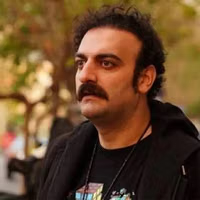
Politician Mohammad Ali Abtahi at the hospital after the phone snatching (March 2024)
Mohammad Ali Abtahi, a prominent reformist politician and senior aide to former President Mohammad Khatami, published photos on social media showing that he was in hospital with injuries after unknown individual tried to snatch his mobile phone in the street.
Recounting the incident, Abtahi stated, "I was walking on the sidewalk holding my mobile phone. When I reached the intersection, two individuals on a motorcycle rushed to snatch my phone."
The altercation left Abtahi with injuries, including 10 stitches on his eyebrow and a wound on his chest. The incident sheds light on the escalating issue of cell phone robberies in Iran, a trend closely associated with rising inflation and poverty plaguing the nation.
In recent years, Iran has witnessed a surge in street crimes and robberies, a phenomenon linked to deep-rooted poverty exacerbated by economic sanctions, mismanagement, and political instability. The growing chasm between the affluent and the impoverished has pushed many into financial hardship, driving some towards criminal activities as a desperate means of survival.
Because of near 50-percent annual inflation, imported items such as mobile phones have become expensive and can fetch quick cash for robbers.
The allure of quick profits has also fueled the proliferation of cell phone theft. Criminals perceive stolen devices as valuable commodities that can be easily sold on the black market or through clandestine networks, fetching substantial sums of money.
Following a German court's ruling attributing Iran's regime to a foiled 2022 terrorist plot targeting a synagogue in Bochum, many have urged Berlin to close Tehran's embassy and designate the IRGC as a terrorist entity.
The Islamic Republic of Iran has launched numerous terrorist attacks since the 1979 Islamic revolution within the territory of Germany, including the infamous 1992 Mykonos attack.
There has been a spike of IRGC surveillance and terrorist operations over the last decade in Germany.
Dr. Kazem Mousavi, a human rights, environmental, and anti-nuclear activist in exile in Germany, emphasized to Iran International, "This terrorist attack was planned and executed from Tehran by the Revolutionary Guard. A robust response to the mullahs' antisemitic state terrorism would be to immediately classify the IRGC as a terrorist organization on both the German and EU terror lists. Additionally, the closure of the Mullah terrorist embassy in Berlin is imperative."
A member of the Jewish community walks behind barrier tape following a police lockdown of the area after two Molotov cocktails were thrown at the Skoblo Synagogue and Education Center overnight in Berlin, Germany, October 18, 2023.
Regarding German Foreign Minister Annalena Baerbock's response, Mousavi, the spokesman for the Green Party of Iran in Germany (in exile), described it as "half-measures" for only summoning the Iranian ambassador. The German Foreign Ministry has announced intentions to take "additional steps."
German media and legal experts have noted that Baerbock has stymied a terror designation of the IRGC by invoking the bogus argument that there are no legal cases implicating the IRGC in terrorism. Baerbock is a Green party politician. The German Green party has favored dialogue with Iran’s regime, according to veteran observers of German-Iran relations.
The German Christian Democratic Union MP, Norbert Röttgen posted on X on Thursday that “The reasons for the judgment of the Düsseldorf Higher Regional Court are available. This clearly states that the planning of the Bochum attack goes back to ‘Iranian state authorities.’ The IRGC's terror listing must come now. There are enough starting points.”
In 2019, the United States classified the IRGC as a foreign terrorist organization. The IRGC controls more than 50% of Iran’s economy, according to some estimates, and Germany remains Iran’s largest European trading partner. Mid-size engineering companies conduct robust business deals with Iran’s regime.
Germany’s foreign policy has largely been viewed as hardcore appeasement of Khamenei’s regime. A telling example was after a German court convicted a Pakistani man in 2017, who was paid by the IRGC to engage in an assassination plot targeting pro-Israel advocates. The then-foreign minister, Sigmar Gabriel, secretly summoned Iran’s ambassador for a warning. The Quds Force—a part of the IRGC—paid Pakistani Syed Mustaf at least 2,052 euros from July 2015 to 2016 to spy on Jewish and Israel institutions and carry out the assassination plot.
Germany’s annual intelligence reports are routinely filled with passages about Iranian agents conducting spy operations against dissidents in the Federal Republic. The hubs of Iran’s espionage network are its embassy and the Khamenei-controlled Islamic Center of Hamburg.
The US-based Iran expert, Alireza Nader, told Iran International that “The German government must take the regime’s presence on German soil seriously by expelling all regime agents and closing down regime centers of influence. The Islamic Republic has been allowed to use Germany as its European center of influence and operations for too long.”
Jason Brodsky, the policy director for the US-based United Against Nuclear Iran, conveyed to Iran International that “Germany should be making a concerted push in the EU now to build consensus to sanction the IRGC as a terrorist organization. It should also be downgrading diplomatic ties with the Islamic Republic, namely withdrawing its ambassador and declaring a number of Iranian diplomats persona non-grata. It should also be banning Iranian banks from operating in Germany.”
According to a March 15 study by Gabriel Noronha , who served from 2019 to 2021 as a Special Advisor for the Iran Action Group at the US Department of State, Germany allows numerous “terror-tied banks” from Iran to operate.
The Tehran-born Ben Sabti, an expert on Iranian Jews from the Israeli National Security and Strategy Institute, does not believe Germany will do anything serious in response to the Iranian regime's planned terrorism attack on the Bochum synagogue. “They are afraid to do anything against Iran, Sabti told Iran International about the German government, adding that Germany “should define the IRGC as a terrorist group.”
Supreme Leader Ali Khamenei and President Ebrahim Raisi refrained from addressing economic challenges like poverty and soaring inflation in their Norouz Iranian New Year messages.
Khamenei's vague statement, "What has been done was good and should continue," brushed over the people's dissatisfaction, and despite Iranian media reports indicating that one in every three Iranians lives below the poverty line.
Relatively independent media outlets and pundits in Iran have warned that one-third of the population now lives below the poverty line, which is defined as roughly $400 of monthly income for a family of three. Many Iran International TV viewers have told he network that many families can no longer afford items such as meat and dairy products. The Central Bank of Iran has put the annual inflation rate at over 40 percent, but inflation for some food items is in triple digits.
The serious downturn began in 2018 when the United States withdrew from the JCPOA nuclear deal and imposed tough sanctions on Iran. However, Tehran has continued escalating its nuclear program and regional policies targeting US interests and Israel’s security.
As in previous years, Khamenei has bestowed a name upon the New Year: "The year of surge in production with people's participation." This "name of the year," as coined by Khamenei, is often seen by many Iranians as a play on words.
Iranian people shop at a flower market, ahead of Nowruz, the Iranian New Year, in Tehran, Iran March 17, 2024.
According to a Khabar Online report, for the eighth consecutive year, Khamenei has been emphasizing "production" and "surge in production" in his annual naming tradition and Norouz messages. Despite his repeated use of these terms, there has been no tangible improvement in production or other economic activities. Instead, financial corruption has continued to escalate. Two of the latest cases are a land grab by Tehran's Friday Prayers Imam Kazem Sedighi and the embezzlements in Iran's vehicle manufacturing industry.
Raisi's New Year message, like his previous speeches, focused on "achievements" that cannot be independently verified. Despite promising to construct four million houses, Raisi claimed in his message, without any evidence, that half of this target has already been achieved. However, Iran International's readers and viewers frequently express concerns about the increasing cost of housing in Iran.
Khabar Online reported that Khamenei began naming the years approximately three decades ago. Initially, "the name of the year" primarily reflected ideological and religious values, such as "the movement of serving the nation" in 2003. However, over the past 16 years, these names have predominantly focused on executive and economic issues. For instance, in 2001, it was "national authority and creating jobs," in 2018, "supporting domestically made goods," and in 2023, "curbing inflation, boosting production."
Over the past 8 years, Khamenei's focus has predominantly centered on domestic production. It began with "resistance economy, production, and employment," progressed to "knowledge-based production" in 2021 and culminated in "The year of surge in production with people's participation" for 2024. This progression suggests that Khamenei may have gradually lost confidence in the government's ability to improve the economy and is now turning to the people for participation.
Meanwhile, the middle class and private sector have been almost totally ruined by what even many regime insiders believe is government policies.
While Khamenei's annual theme may focus on economic growth and the country's development, observers in Iran, particularly since the 2022 nationwide protests, argue that the economic and foreign policies pursued by the Iranian government make development unattainable.
Year after year, many Iranians note that these themes neither provide guidance to the government and the people, nor do they reflect genuine intent. Instead, they seem to serve as fleeting slogans, repeated by officials to appease the originator of the themes, possibly as a means for him to express frustration about an economy that not only stagnates but often regresses.
A senior US official said Washington is against the construction of the planned Iran-Pakistan gas pipeline, warning it would result in US sanctions.
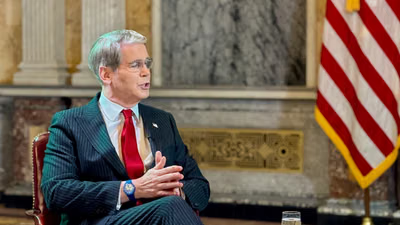
“I fully support the efforts by the US government to prevent this pipeline from happening … We are working toward that goal,” the Assistant Secretary of State for South and Central Asia Donald Lu told a meeting of the Foreign Affairs Subcommittee of the House of Representatives on Wednesday.
Stressing the need to implement Tehran sanctions, Lu confirmed that the US has been in consultation with Pakistan over the project. “Washington has not received any request from Islamabad regarding sanctions relief, so our efforts to stop Pakistan from Iran’s gas project will continue,” he added.
Iran and Pakistan have recently aimed to revive the gas pipeline project, commonly known as the Peace Pipeline or IP Gas, that has been languishing for more than a decade.
Pakistan’s Foreign Ministry Spokesperson Mumtaz Zahra Baloch told IRNA, Iranian state news agency, that Islamabad remains committed to the project.
Despite resistance from Western partners, Pakistan has made progress in advancing the project. The initial phase, covering 80 kilometers from Gwadar to the Iranian border, has received government approval and funding.
Last week, Mohsen Khojasteh-Mehr, the CEO of Iran’s National Iranian Oil Company, announced that the negotiations between Tehran and Islamabad are underway regarding the export of Iranian gas to its eastern neighbor. he said, “The will of the two countries is to implement this project,”.
The US Federal Bureau of Investigation (FBI) has informed a House panel that Iran is resolute in its intentions to carry out various attacks on US soil, including assassinations.
During a hearing at the US House of Representatives, the current status of Iran’s 'Axis of Resistance' and its implications for US homeland security and interests worldwide were examined, with a consensus that threats posed by Tehran and its proxies have escalated significantly.
Chairman of the Homeland Security Committee Mark Green (R-TN) commenced the hearing by outlining Iran’s threats, which encompassed "assassination plots on former Trump Administration officials, targeting and attacking US service members abroad, disrupting trade and commerce, and endangering Maritime Security in the Red Sea, along with attempting to coordinate external Terror operations in Europe and South America."
He elaborated that the hearing's focal point is on the threats posed by Iran's proxy networks, known as the ‘axis of resistance,' a collection of militia groups employed by Iran to bolster their power projection capabilities and provide plausible deniability for attacks conducted on behalf of the Iranian regime. Notably, these militias include Lebanon’s Hezbollah, Hamas, and Palestinian Islamic Jihad in Gaza, the Houthis of Yemen, and various Iraqi and Syrian militia groups.
Robert Wells, assistant director of the Counterterrorism Division at the Federal Bureau of Investigation (FBI), informed the committee that "The FBI believes Iran is capable of a variety of attack options against US targets, including cyber operations intended to sabotage public and private infrastructure, and targeted assassinations of individuals who are deemed to be a threat to the regime or its stability."
Several security officials provided testimonies during a hearing at the US House Committee on Homeland Security, March 20, 2024
According to Wells, the Tehran regime is resolute in executing attacks in the United States, whether to avenge the death of former IRGC-Quds commander Qasem Soleimani (such as the plan to murder former National Security Advisor John Bolton and Secretary of State Mike Pompeo in 2022), to silence dissidents (like the attempted murder of activist Masih Alinejad in 2023), or to eliminate the ambassador of an ally nation (as seen in the plot to murder the Saudi Ambassador to the US.
He also referred to Iran’s supplying weapons for the Houthis to disrupt global shipping, saying that in January 2024, US military intercepted Iranian-made weapon parts bound for Houthis, “who could have used the weapons to target US forces.”
James Dunlap, deputy undersecretary for analysis at the Department of Homeland Security’s Office of Intelligence and Analysis, highlighted the Iranian government’s cyber threats through a variety of tactics, techniques, and procedures -- “including social engineering, using easily accessible scanning and computer hacking tools, and exploiting publicly known software and hardware vulnerabilities” against the US government and the defense industry. “The Israel-Hamas conflict shows how Iran uses cyber operations to respond to geopolitical events while attempting to maintain plausible deniability.”
Elizabeth Richard, ambassador-at-large, and coordinator for counterterrorism at the US Department of State’s Bureau of Counterterrorism, pointed out, “Iran has been designated as a State Sponsor of Terrorism since 1984 and has long been directly involved in attack plotting against the US homeland and US personnel and activities, mainly but not exclusively via Iran’s Islamic Revolutionary Guard Corps’ (IRGC) Quds Force.”
“Hamas would not have been able to carry out its devastating October 7 terrorist attack without Iran’s long-time assistance, funding, and training,” she stated. “Our defense of the US homeland does not stop at our own physical border.”
Carrie Thompson, chief of intelligence at the Drug Enforcement Administration (DEA), addressed the threat from Iran and its proxies from an economic standpoint. She highlighted the “clear connection” between the drug trade and the financing of terrorist organizations and rogue state actors, including the Iranian regime. She said Hezbollah’s money laundering network collaborates with South American drug cartels to facilitate the smuggling of drugs into Europe and the Middle East. “The Assad regime in Syria has been associated with the production and trafficking of a synthetic drug called Captagon,” she added.
The hearing took place as Israel's war continues with Hamas, the epicenter of the current Middle East conflict ignited after the Islamist group invaded Israel and killed 1,200 mostly civilians and took 240 hostages. Iran’s ‘axis of resistance’ has increased attacks on US and Israeli targets to pressure Israel into a ceasefire.
Many American lawmakers have criticized the Biden administration for its Iran policy, which has not only failed to deter the attacks but also emboldened Tehran to boast about the victories of its ‘axis of resistance’ against the US.
According to David G. Perkins, a retired US Army general, deterrence means changing the minds and behaviors of Iran’s proxy forces, noting that the US should not try to deter the Houthis, but to deter Iran, which gives them “the head nod” for attacks.
The Iran-backed Houthis have allegedly vowed not to attack vessels belonging to Russia and China in the Red Sea and Gulf of Eden after crisis talks in Oman amid the maritime blockade.
Bloomberg reported that Russian and Chinese diplomats met with Mohammed Abdul-Salam, a senior Houthi official and the group’s spokesperson.
It is believed that a deal has been made whereby Moscow and Beijing may provide the group with political support, which according to Bloomberg can include “blocking more resolutions” against the Yemeni terror group in the UN Security Council.
Leeway would be given to China and Russia as key allies of Tehran amidst global sanctions.
The Red Sea blockade has massively impacted global trade and logistics and Tehran will be keen to keep its two major allies onside while the blockade, initiated in November on the orders of the Supreme Leader, continues.
The talks follow recent naval drills betweenIran, China and Russia as ties between the three pariah states deepen militarily and economically.
Yemen's Houthis launched their campaign to attack international vessels to initiate a blockade of Israelwhich has launched a relentless retaliatory attack on Gaza since Iran-backed Hamas militia invaded Israel on October 7, killing 1,200 mostly civilians and taking more than 250 more hostage.
However, not only Israeli vessels have come under fire, with international shipping falling victim to the attacks. In March, a Houthi missile attack killed three seafarers on a Greek-owned, Barbados-flagged ship in the Red Sea, the first fatalities since the start of the blockade.
On Thursday, a gun-fight broke outwhen gunmen attacked a merchant vessel in the Red Sea.