• العربية
  • فارسی
Brand
  • Iran Insight
  • Politics
  • Economy
  • Analysis
  • Special Report
  • Opinion
  • Podcast
  • Iran Insight
  • Politics
  • Economy
  • Analysis
  • Special Report
  • Opinion
  • Podcast
  • Theme
  • Language
    • العربية
    • فارسی
  • Iran Insight
  • Politics
  • Economy
  • Analysis
  • Special Report
  • Opinion
  • Podcast
All rights reserved for Volant Media UK Limited
volant media logo

Iran-Backed Houthis Escalate Attacks, Threatening US Warships
Iran International Newsroom
Mar 10, 2024, 07:46 GMT+0Updated: 10:57 GMT+0
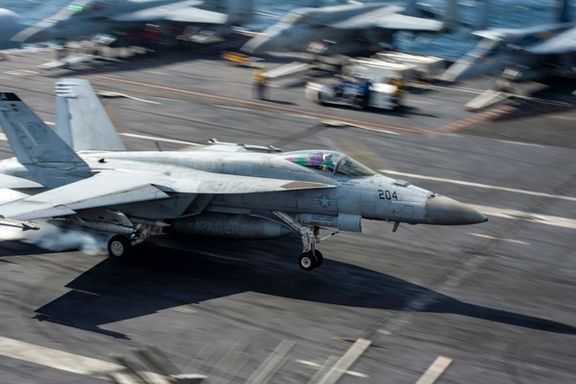
Navy plane on the deck of USS Eisenhower in December 2023

US, British and French forces on Saturday shot down dozens of kamikaze drones engaged in a "swarm" attack launched by Iran-backed Houthis in the Red Sea region.

The Houthi operation –largest reported to date– was against a Singapore-flagged cargo ship and several American warships. The Houthis’ military spokesman, Yahya Saree, confirmed the strike and said the attacks would continue “until the aggression stops and the siege on the Palestinian people in the Gaza Strip is lifted.”

The Houthis have been targeting commercial vessels (and often US warships) in the Red Sea and the Gulf of Aden since November, disrupting global maritime trade, forcing major shipping companies out of the region, sinking one ship and killing three civilian crew members. The attacks began after Iran's ruler Ali Khamenei called for Muslims to "blockade" Israel.

Their ‘swarm’ attack Saturday may be seen as a significant escalation, since it’s much more likely that one out of the many drones flying together evades the defense systems and hits a US warship – which would force the Biden administration to elevate the leval of its response, possibly even targeting Iranian assets.

This time, however, “no U.S. or Coalition Navy vessels were damaged in the attack and there were also no reports by commercial ships of damage”, according to US Central Command. The action was taken “to protect freedom of navigation and make international waters safer and more secure.”

Earlier this week, CENTCOM commander General Michael Kurilla warned about the threat of ‘swarm’ attacks in a US Senate Armed Service Committee hearing. He said such an attack was a “bigger concern” than single missile or drone strikes and needed “investment” in technologies to ensure it could be countered.

“Nothing is 100 percent,” Kurilla said. “At some point, the law of statistics will come up to you. You have to have a layered defense.”

Russia has used swarm attack tactics in Ukraine using Iranian kamikaze drones to overwhelm air defenses, with the aim of getting its ballistic missiles through the net.

The CENTCOM commander drew a worrying picture of Iran’s position as the key force behind many armed groups in the region, which act against US interests. He stopped short of criticizing the Biden administration, however, as it tries in vain to establish deterrence.

“Iran is undeterred in support to the Houthi,” Kurilla said, “they are undeterred in their support to Hezbollah, their support to Hamas, the support into the West Bank. They are deterred right now in Iraq and Syria and their support to the Iranian aligned militia groups, but not in terms of attacks, but not necessarily in terms of their funding and equipping.”

Ever since Hamas’ rampage of Israel on October 7 and the ensuing Israeli onslaught on Gaza, Iran has intensified its indirect campaign against American and Israeli interests, utilizing armed groups that it funds, equips, trains across the Middle East.

Critics of the Biden administration blame the US President and his team for having eroded deterrence and emboldened Iran and its proxies in the past few years. The only solution, they maintain, is to make the regime in Tehran ‘feel the heat’ and pay the ‘cost’ of their malign activities.

A case in point is the fate of the Iran spy ship Behshad, which has been the subject of intense scrutiny within maritime circles –many believing that it is helping Houthis with intelligence on commercial sea traffic, effectively enabling their attacks. And still no one, the US government in particular, is willing to take action against it.

The Biden administration and the coalition forces fear that sinking (or targeting) Behshad would put them at war with Iran and further complicate what seems to be an intractable crisis in the Middle East. Iran has threatened that attacking Behshad would jeopardize “international maritime routes” and would bring about “future international risks.”

Concerns about Behshad’s role have sharpened after the fatal attack on cargo ship True Confidence, which killed three of the vessel's crew. According to a report in the Financial Times Saturday, Behshad was 43 nautical miles away when the True Confidence was struck.

The report quotes experts who have studied Behshad’s recent behavior and have concluded that it’s “extremely unusual”. And still no one is willing to confront it.

“Whilst I’d like to see some kind of kinetic action against Behshad, I’m not sure we’ll see that in the near term,” the Financial Times quoted a maritime security expert in its report Saturday.


Most Viewed

Iran negotiators ordered to return after internal rift over Islamabad talks
1
EXCLUSIVE

Iran negotiators ordered to return after internal rift over Islamabad talks

2
ANALYSIS

US blockade enters murky phase as tankers spoof signals and buyers hesitate

3
ANALYSIS

Why the $100 billion Hormuz toll revenue is a myth

4

US tightens financial squeeze on Iran, warns banks over oil money flows

5
ANALYSIS

US blockade targets Iran oil boom amid regional disruption

Banner
Banner

Spotlight

  • Hardliners push Hormuz ‘red line’ as US blockade tests Iran’s leverage
    INSIGHT

    Hardliners push Hormuz ‘red line’ as US blockade tests Iran’s leverage

  • Ideology may be fading in Iran, but not in Kashmir's ‘Mini Iran'
    INSIGHT

    Ideology may be fading in Iran, but not in Kashmir's ‘Mini Iran'

  • War damage amounts to $3,000 per Iranian, with blockade set to add to losses
    INSIGHT

    War damage amounts to $3,000 per Iranian, with blockade set to add to losses

  • Why the $100 billion Hormuz toll revenue is a myth
    ANALYSIS

    Why the $100 billion Hormuz toll revenue is a myth

  • US blockade targets Iran oil boom amid regional disruption
    ANALYSIS

    US blockade targets Iran oil boom amid regional disruption

  • Iran's digital economy battered by prolonged blackout
    INSIGHT

    Iran's digital economy battered by prolonged blackout

•
•
•

More Stories

Iranian Cleric Filming Woman In Qom Sparks Controversy

Mar 9, 2024, 22:56 GMT+0

A video has gone viral in Iran depicting a tense encounter between a young woman and a cleric who is filming the woman holding her baby while her hijab is loose in a clinic in the religious city of Qom.

The incident escalated into a brawl as the protesting people asked the cleric to delete his video in fear that it would lead to further problems for the mother.

The footage captured the young mother in the clinic in Qom with her sick infant. Shortly after entering, her headscarf slips off.

Upon noticing the cleric filming her, the woman requests him to delete the footage, but the cleric refuses and demands her to cover her head.

Despite the intervention of bystanders and the woman's objections, the cleric persists in filming and engages in a physical altercation with another woman.

The distressed woman is then moved to another room by the clinic's staff.

The video has triggered widespread outrage on social media, with users condemning the cleric's harassment and interference.

The Islamic Republic, in its bid to pass the Hijab and Chastity bill to enforce mandatory hijab has failed to address incidents of harassment and violence against women in public spaces. The hijab enforcers appear to enjoy tacit government support.

In a similar incident in December 2021, another woman in Qom was arrested after confronting a cleric who reprimanded her for her hijab.

The protests gained momentum following the death of Mahsa Amini in police detention in 2022, leading to the formation of the Women, Life, Freedom movement. Since then, the regime has intensified its crackdown on women's rights activists.

Alarm Raised In Iran As Exports To Syria Shrink By 50%

Mar 9, 2024, 21:12 GMT+0
•
Iran International Newsroom

Despite tens of billions of dollars Iran spent in Syria to save Bashar al-Assad's regime from being overrun by rebels, its exports to the Arab country have dwindled to negligible levels.

Abdolamir Rabihavi, Director General of Iran’s Trade Promotion Organization for Western Asia, said Iran’s exports to Syria have plummeted by 50 percent to just $120 million annually.

Iran’s exports to Syria were $244 million in the previous Iranian calendar year (March 2022 to March 2023) but the figure has decreased to $120 million this year, reported Rabihavi in a video released by Navad-e Eqtesadi Telegram channel on Saturday.

This is far below the expected level of economic cooperation between the two allied countries, he stressed.

His remarks came a week after Hassan Shah Hosseini, head of the Syria Desk at Iran’s Ministry of Foreign Affairs, warned that Tehran’s 100-million-dollar exports to Damascus is “very insignificant.” He urged Iranian merchants “to find their own ways to trade with Syria.”

Referring to the shrinking trade volume, Hossein-Ali Haji-Deligani, a former high-ranking Revolutionary Guards (IRGC) officer and hardline lawmaker, said in a critical tone in September 2023: “Despite our support for the Syrian government, we have little to contribute to the reconstruction of Syria today.”

“The countries that were the main causes of the war in Syria are now leading its reconstruction,” he claimed, probably referring to Turkey.

This is while Iranian officials have repeatedly emphasized that Tehran’s expenditures in Syria since 2011 should be compensated via bilateral economic cooperation. Iran entered the Syrian civil war more than a decade ago dispatching thousands of fighters and even its own Revolutionary Guard forces to fight anti-Assad insurgents.

Trying to justify the high cost of involvement in the Syrian war, the IRGC, in particular, has been arguing over the past years that trade and investment in Syria will pay off and compensate for the billions of dollars Tehran has spent to support Bashar al-Assad.

Six years ago, Yahya Rahim Safavi, special military advisor to the Supreme Leader Ali Khamenei, remarked that Iran should “recoup” the expenses it has incurred in Syria through the latter’s “oil, gas and phosphate mines.”

However, reports indicate that a large part of Tehran-Damascus economic agreements have fallen short of realization.

In December 2022, Mehr news agency, close to Iran’s hardliners, confirmed that Iran has “lagged behind” in taking advantage of potential trade Syria could offer, particularly in terms of exporting goods and engineering services to the country.

“None of the clauses of the major agreements between the two countries’ political leaders have resulted in any economic benefit,” Mehr wrote at that time. It also noted that Iran was to build 200,000 housing units in Syria, but this project never came to fruition.

According to a leaked document revealed in May 2023 by the hacktivist group ‘Uprising till Overthrow', affiliated with the Albania-based opposition Mujahideen-e Khalq (MEK), Syria owes Iran $50 billion, a combination of aid in the form of military support and cash.

It is also estimated that Iran provided Assad’s regime with roughly $11 billion worth of oil from 2012 to 2021.

In May 2020 a member of the Iranian parliament's National Security and Foreign Policy Committee, Heshmatollah Falahatpisheh, made an unprecedented declaration that Iran has spent $30 billion in Syria and must recoup the loss.

Israel’s Alma, an institute focused on threats to northern Israel, revealed in 2023 that Iran’s investment into weapons plants in Syria continues, at the expense of the Iranian people suffering the worst economic crisis in decades.

Iranian Playwright, Director Transferred To Prison To Serve Sentence

Mar 9, 2024, 20:49 GMT+0

Renowned Iranian playwright and theater director, Ali Nourani, has been transferred to Evin Prison to begin serving a one-year sentence for supporting protests.

Nourani was detained on Wednesday and subsequently moved to Evin Prison.

The US-based Human Rights Activists News Agency (HRANA) revealed on Saturday that his detention is in connection with serving his sentence, and he now faces additional charges.

According to HRANA, he was summoned to Evin's courthouse last week. Following his court appearance, he was detained and transferred to Evin Prison to commence his sentence. It was disclosed during the court proceedings that a new case has been opened against him.

In December, Nourani was sentenced to six years in prison by Branch 26 of the Tehran Revolutionary Court, presided over by Judge Iman Afshari. The charges against him included “propaganda against the regime, conspiracy against the state, and acts against national security.” However, upon appeal, his sentence was reduced to one year in behind bars. These charges are typical to trumped-up accusations routinely made against dissidents and protesters.

Nourani’s arrest on September 16, coinciding with the anniversary of Mahsa Amini's government murder, occurred alongside several other artists, including Leila Naqdi Pari. Reports indicate that security forces raided Nourani’s home, confiscating personal belongings and mobile phones before violently arresting him.

After spending twenty-four days in custody, Nourani, the acclaimed playwright and theater director, was released from prison after posting bail of thirty billion rials, approximately $60,000, an astronomical sum for Iranians.

UK Spots New Iran-Made Drone At Russian Airbase In Crimea

Mar 9, 2024, 18:11 GMT+0

Britain's Ministry of Defense announced Friday that an Iranian Mohajer-6 surveillance and attack drone has been identified at Russia’s Saky Airfield in occupied Crimea.

“The continued presence of the system in western Crimea is likely evidence of Russia trying to identify threats to Russian ports and vessels following recent Ukrainian successes,” read the statement issued by the ministry on X.

The ministry also shared a satellite image which proved the presence of the Iran-made drone right beside a UAV ground control station in the airfield. The image was taken by an Airbus satellite on February 23.

Though the Mohajer-6 is mostly used in intelligence, surveillance and reconnaissance operations, it can also carry out air-to-surface missile attacks.

According to the UK’s Ministry of Defense, there is “a realistic possibility” that the drone is to be employed to back “Russian targeting processes for the south-west Ukrainian coastline.”

In September 2022, Ukraine’s army shot down at least one Mohajer-6 UAV over the Black Sea.

Russia annexed Crimea to its territory in 2014, a move that has not been recognized by the majority of the international community.

The Iranian regime has been one of the staunch allies of Russia in its war against Ukraine. Since mid-2022, Iran has reportedly supplied hundreds of kamikaze Shahed UAVs to Russia, which have been extensively deployed to target civilian infrastructure and cities in Ukraine.

Earlier in the month, British Defense Secretary Grant Shapps accused Iran of supplying Russia with ballistic missiles for use in Ukraine, claiming the regime is a "bad influence" not only on the Middle East but also in Europe.

Khatami's Election Abstention Sparks Debate In Iran

Mar 9, 2024, 16:44 GMT+0
•
Maryam Sinaiee

Former Reformist President Mohammad Khatami's remarks on his refusal to vote in Iran's recent elections have sparked significant controversy among political circles.

For the first time in his political career, Khatami not only refrained from voting in the parliament and Assembly of Experts elections, despite Supreme Leader Ali Khamenei's repeated declarations that voting is a religious duty, but also defended his decision as a stance in solidarity with the majority of Iranians discontent with the country's governance, in a speech to his advisors on Wednesday.

While many reformists praise him as "a winner" for boycotting Iran's "stage-managed" elections, he faces strong criticism from other political factions and social media users, both within the regime and among dissidents, who accuse him of hypocrisy and opportunism.

In a note on Wednesday, the ultra-hardline Kayhan newspaper, whose chief editor Hossein Shariatmadari is an appointee of Supreme Leader Ali Khamenei, accused him and other abstaining reformists, such as the Etehad-e Mellat (Nation’s Unity) party, of complicity with the “known enemies of the regime”.

“Refusing to participate in the elections is the officially announced instruction of America and Israel. Is it not? So why are you selling your open complicity and collaboration with America and Israel as moving together with the people?” Kayhan wrote.

Khatami's election abstention, however, appears to have reinvigorated reformists who view his action as a significant step forward with the potential to reconcile with Iranians who have been disillusioned with reformists over the past decade.

Mohammad Khatami shaking hands with Gholam-Ali Haddad Adel, an influential conservative politician and a relative of Supreme Leader Ali Khamenei. May 30, 2023
100%
Mohammad Khatami shaking hands with Gholam-Ali Haddad Adel, an influential conservative politician and a relative of Supreme Leader Ali Khamenei. May 30, 2023

Protesters in the past few years often chanted not only against hardliners but also against reformists who they saw as part of the system.

Khatami stated that he abstained from voting in solidarity with the many dissatisfied people who believe that "correcting/reforming" the current trajectory of affairs is the only way to salvage the country.

To him, not voting in the current adverse circumstances is another form of voting, and he hopes that his abstention can help restore people's "damaged trust" in the government and political currents, including reformists.

He argued that the country's urgent need is to restore social capital and "settle differences" between the government and people to "save the country from threats and crises," emphasizing that the ruling system has a greater responsibility in reforming its structure, approach, and behavior.

Khatami has faced criticism for his "historical delay" in refusing to participate in the elections managed by Khamenei and his appointees in the Guardian Council, as well as for not officially articulating his departure from "political Islam."

The political act of abstention by Khatami and his supporters can only be taken seriously when they officially denounce political Islam in every shape and form and admit that all people are equal irrespective of their backgrounds, thinking, and lifestyle, one of his critics argued in an article by Ehsan Rastgar published by Zeitoon news website Wednesday.

“As long as it is devoted to political Islam, this school of thought [to which Khatami and his supporters belong] is not different in essence and its overall approach from Shia fundamentalism and people like the leader of the Islamic Republic,” he wrote.

Once an advocate of “religious democracy,” Khatami referred to “developmental democracy” as the ideal form of governance in his speech and seemed to be endorsing secularism in governance.

The use of the term “developmental democracy” has baffled many who expected him to offer a more straightforward and clear definition of the form of governance he is proposing.

“Developmental democracy” is a notion proposed by Richard L. Sklar, a professor emeritus of political science at the University of California in a book of the same name in which he said developmental democracy is the best form of democracy for African countries.

According to his own website, Sklar’s developmental democracy posits a causal relationship between democratic practice and economic development.

This form of democracy has also been interpreted as one that gives priority to cultivating the development of individual abilities and holds that the estimation of democracy lies in its commitment to national and individual improvement.