Lawmaker Says Germany Will Take Part In EU Red Sea Naval Mission

Germany is expected to participate in a European Union naval mission to protect shipping in the Red Sea, the head of the German parliamentary defense committee said.

Germany is expected to participate in a European Union naval mission to protect shipping in the Red Sea, the head of the German parliamentary defense committee said.
EU foreign ministers are expected to approve a naval mission later this month to join efforts in protecting international shipping amid attacks by Iran-backed Houthis on commercial vessels.
Speaking at her party's reception for the new year on Sunday, Maria-Agnes Strack-Zimmermann said the aim of the mission would be for EU frigates to protect commercial vessels passing through the strait.
The approaches to the Suez Canal, one of the world's most important shipping lanes, have been all but paralyzed by attacks on passing vessels by Iran-backed Houthi forces on the Yemen coast.
"This is an attack on free trade and has to be countered," Strack-Zimmermann said. Newspaper Welt am Sonntag earlier reported that the German frigate Hessen would set sail for the Red Sea on Feb. 1.
Parliament must approve any foreign deployment of Germany's armed forces.
The United States has already formed a naval coalition to guard the Red Sea shipping lanes. American and British militaries recently launched air and missile attacks on Houthi bases in Yemen after repeated warnings to the militant group to stop its attacks remained ineffective.
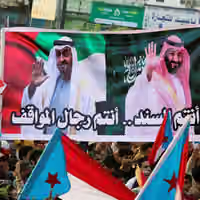

The representative of Houthi rebels in Iran has issued a warning, stating that the United States would bear responsibility for any incidents occurring in the Red Sea.
Ibrahim Al-Dailami emphasized that the Houthis were determined to respond to what they viewed as US aggressions.
In an interview with ISNA news website in Tehran on Saturday, when asked about allegations of the Houthi militants serving as proxies for Iran in the Red Sea, Al-Dailami rejected these claims as baseless. He emphasized that the primary concern was the US support for what he referred to as the "crimes of the Zionist regime" in Gaza.
The United States and Britain launched an extensive airstrike against Houthi targets this week, after they repeatedly warned the militant group to stop its attacks on commercial shipping.
Iran's support for the Houthi rebels, ongoing for a decade, involves the supply of weapons and military expertise to the Muslim sect in Yemen, closer religiously to the Shia sect. While Iran has avoided direct military involvement in the Israel-Hamas conflict, its proxy groups, including Houthi militants, have escalated attacks on commercial vessels in the Red Sea. This comes in response to Iran's Supreme Leader Ali Khamenei's call in early November for blockading Israel. In December, the US-led multinational naval coalition was launched in the Red Sea to protect commercial vessels, gaining support from various countries.
The UN Security Council recently passed a resolution urging the Houthis to cease Red Sea shipping attacks, with notable abstentions from Russia and China.

Iran will continue to support the Palestinians and “resistance groups”, President Ebrahim Raisi stated in Tehran on Sunday, emphasizing that compromise is not feasible.
“We have repeatedly stated without hesitation that supporting Palestine and resistance groups is on the agenda of the Islamic Republic's policies,” Raisi stated on Sunday.
Raisi’s speech in an Islamic gathering appeared to be the only response to President Joe Biden’s remarks on Saturday where he said Washington had delivered a private warning to Iran about its Houthi allies in Yemen responsible for attacking commercial shipping in the Red Sea.
"We delivered it privately and we're confident we're well-prepared," Biden told reporters at the White House before departing to the Camp David presidential retreat for the weekend.
On Friday, after American and British planes and ships attacked dozens of Houthi targets in Yemen, Biden told reporters that the US had delivered a message to Tehran.
Reactions from the Iranian government, the Revolutionary Guard and a web of hardliner media and politicians remained muted to Biden’s remarks. Overall, reactions even to the bombings in Yemen were low-key by officials and state media.
Biden, whose administration removed the Houthis from a State Department list of "foreign terrorist organizations" immediately after assuming office in 2021, was asked by reporters on Friday whether he felt the term "terrorist" described the movement now. "I think they are," Biden said.
Critics in Washington and elsewhere have expressed frustration that the Biden administration after pursuing a policy of accommodation with Iran and the Houthis for three years, still has not taken more decisive steps to establish deterrence against Tehran.
In 2023, Washington greenlit the release of up to $16 billion of frozen funds to Tehran, in an apparent de-escalation deal, while Hamas, another Iranian militant proxy, was preparing the October 7 attack on Israel. Even after the attack and the outbreak of the Gaza war the administration has not re-frozen the funds kept in Qatar and Oman.
Iran’s exiled Prince Reza Pahlavi issued a statement on Saturday harshly criticizing the Biden administration.
“While the Islamic Republic is financing and training its Houthi proxies, the American administration is facilitating this terror group’s continued access to capital,” he stated, in a reference to the released funds.
Critics also say that President Biden has allowed Iran to increase its oil exports to China, relaxing stringent sanctions imposed by his predecessor. Tehran’s oil revenues have increased from less than $10 billion in 2019 to nearly $30 billion in 2023.
“When he took office, President Biden made two critical mistakes: delisting the Houthis and refusing to implement oil sanctions on the dictatorship in Tehran.,” Pahlavi said in his statement. He went on to blame Biden’s policies for the current situation in the Middle East and urged the previous ‘maximum pressure policy to be restored. “This capitulation has brought about the latest regional conflagration by legitimizing this terror group and doubling the oil exports of their patron in Tehran— which has sold more than $100 billion worth since this administration took office.”

The limited responses from Iranian officials to the US and UK's attacks on Houthi targets in Yemen have largely consisted of typical rhetoric from the regime.
So far, Iran's Foreign Ministry Spokesman Nasser Kanaani has provided the most "critical" response to the Western air strikes. He strongly condemned the military action and claimed that they only divert attention from the "crimes" in Gaza and "have no result other than fueling insecurity and instability in the region."
In a reaction that can be evaluated as relatively mild, Iran’s Foreign Minister Hossein Amir-Abdollahian wrote on X that Houthis are committed to maritime and shipping security in the region.
Since mid-November Iran’s Yemeni proxies have launched dozens of missile and drone attacks against international commercial vessels in the Red Sea, after the Supreme Leader in Tehran called for a blockade of goods to Israel.
“Instead of a military strike on Yemen, the White House should immediately end all military and security cooperations with Tel Aviv against the people of Gaza and the West Bank,” stated Amir-Abdollahian, adding that only then, security will be restored across the region.
Iran’s Supreme Leader Ali Khamenei and top IRGC commanders have not yet made any comments on the strikes.

Likewise, state-sponsored media in Iran have also provided limited reporting on the events in Yemen, mostly repeating stereotypical statements made by the Islamic Republic, Houthi officials, and Tehran’s allies in the region.
IRNA, the Iranian state news agency, covered the condemnation of the attacks by Syria, Oman and Iraq’s Hezbollah, a Tehran-backed militant group.
In an article released on Friday, IRNA called the US and UK airstrikes against Houthi targets “the escalation of tensions by cowboys,” warning that the offensives “can further complicate the spiral of instability in the region and increase the risk of expanding the war.”
Other state-sponsored and military-affiliated news agencies in Iran such as Fars, Mehr, and Tasnim, have adopted a similar stance by reiterating the familiar “the enemy will be conquered” rhetoric while avoiding any straightforward pledge regarding the Islamic Republic’s direct interference in support of Houthis.
Tabnak news website, reportedly owned by Mohsen Rezaei, a former IRGC commander, conducted an interview with Heshmatollah Falahatpisheh, a former lawmaker. Falahatpisheh, who once served as the head of the National Security and Foreign Policy Committee of the Iranian parliament, claimed that Saudi Arabia greenlit the recent attacks on Yemeni Houthis.
Citing Saudi Crown Prince Mohammed Bin Salman, Falahatpisheh stressed that Riyadh is still willing to normalize relations with Israel despite the war in Gaza.
Relatively independent media in Iran, nonetheless, can be said to adopt a more analytical approach toward the escalation of the tensions in the region. KhabarOnline news website predicted on Saturday that the Islamic Republic will not enter the war as it is “mired in complex internal issues” that it has yet to resolve.
The tension and conflict in the Red Sea will continue “on a normal, and not very heavy, scale,” added the report by Khabaronline, further noting that the US, Britain, and NATO will avoid a full-scale, long-term, ground war against Houthis as they believe it will benefit Russia and China.
Meanwhile, Fereydoun Majlesi, a former Iranian diplomat, said that the recent strikes in Yemen were predictable because targeting commercial vessels in the Red Sea affected a large variety of players across the region and the whole world.
“The Red Sea is not just a cargo route for Israel’s port of Eilat, but a transit route for oil and other commodities to go through the Suez Canal,” Majlesi told Rouydad24 news website, adding that US President Joe Biden has been under the pressure of the Republicans to respond to the Houthis.
The most controversial stance among Iran’s relatively independent media belonged to Donya-e-Eqtesad daily which covered the attacks against the Houthis under the headline, “The US Sealed Yemen’s Fate.” Kayhan daily, the regime's most uncompromising media outlet, severely criticized Donya-e-Eqtesad's title, saying it shows that some newspapers that serve the US and NATO's interests are still active in Iran.
The US and UK strikes came two days after the UN Security Council passed a resolution, calling on Yemeni Houthis to stop attacks on shipping in the Red Sea immediately.
Biden issued a veiled threat to the Islamic Republic following the strikes. Asked by a reporter if he had a message for Tehran in the light of the attack, Biden said “I’ve already delivered the message to Iran. They know not to do anything.”
On Thursday, the leader of Iran-backed Houthis warned that the group is ready to respond to any “US aggression.”
We will continue “to fulfil our duties with regard to Palestine” despite the efforts by Washington and London to protect Israeli and Israel-related ships in the region, Abdul-Malik al-Houthi stressed, adding that Houthis will do “what is necessary” in the case of a “direct confrontation” with the US.

Iranian Foreign Minister Hossein Amir-Abdollahian has praised the actions of the Houthi rebels in Yemen, describing their attacks as "commendable."
In a statement on X, he asserted that the Houthi group is "fully committed to maritime security and shipping," despite their repeated attacks on commercial vessels.
Amir-Abdollahian went further to call on the White House to halt its "comprehensive military and security support" for Israel in its conflict with Hamas, suggesting that redirecting the support would contribute to "restoring security across the entire region."
Earlier, Naser Kanaani, spokesperson for the Ministry of Foreign Affairs of the Islamic Republic, condemned the US and British attacks on the Houthis, denouncing them as "a self-serving act, a clear violation of Yemen's sovereignty and territorial integrity, and a breach of international laws and rights."
On Friday evening, supporters of the Islamic Republic gathered outside the British Embassy in Tehran, vocalizing their discontent with the United States and Britain.
Citing financial and arms support from the Islamic Republic to the Houthi rebels, the United States and its allies hold Tehran responsible for the recent attacks on vessels in the Red Sea.
UK Defense Secretary Grant Shapps, in a message to Iran, demanded an immediate cessation of support for the Yemeni Houthi militants, amid the ongoing conflict involving Israel and Gaza. The call coincides with coordinated airstrikes targeting over 60 Houthi sites in Yemen, indicating an intensified international response to the escalating tensions in the region.
In a related context, Linda Thomas-Greenfield, the United States Ambassador to the United Nations, asserted on Friday that without Iran's support, the Houthi militants lack the capability to carry out attacks on commercial ships.

UK Defense Secretary Grant Shapps has urged Iran to immediately halt its support for Yemeni Houthi rebels as the ongoing Middle East conflict is spiraling out.
Shapps, in an exclusive interview with The Telegraph, emphasized that global patience is wearing thin and expressed deep concern over the continuous missile attacks on trade vessels in the Bab el-Mandab Strait and the Red Sea.
“You must get the Houthi rebels, others who are acting as proxies for you, Lebanese Hezbollah are obvious examples, [and] some in Iraq and Syria, you must get these different organizations to cease and desist,” he addressed Tehran.
Iran is the main supporter of Houthi rebels. Iran's involvement in the current conflict, which started after Hamas Islamist militia attacked Israel on October 7, extends to providing aid and training to Hamas as well as dozens of militia groups in Iraq and Syria along with substantial financial and logistic backing to Hezbollah in Lebanon.
The remarks by the British defense secretary came in the wake of coordinated US and UK airstrikes on Houthi targets in Yemen, signaling a heightened international response to the escalating tensions in the region.
The military strikes were a retaliatory measure in response to recent attacks on trade vessels, which have led several companies to suspend operations in the region.
Following the joint strikes on Friday, the Iranian Ministry of Foreign Affairs accused the US and UK of supporting "war crimes" committed by Israel against the Palestinian people and Gaza.