Houthi Envoy Warns Of US Responsibility In Any Red Sea Incident
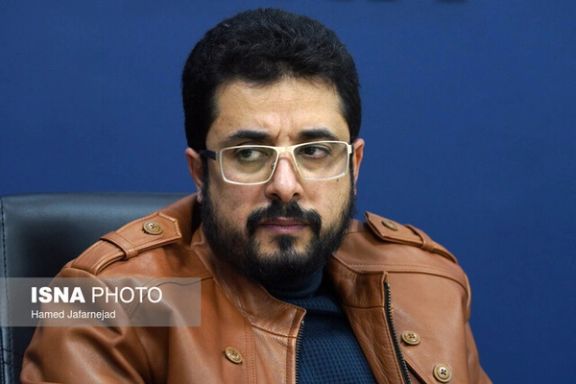
Houthi envoy in Tehran, Ibrahim Al-Dailami. January 13, 2024
The representative of Houthi rebels in Iran has issued a warning, stating that the United States would bear responsibility for any incidents occurring in the Red Sea.
Ibrahim Al-Dailami emphasized that the Houthis were determined to respond to what they viewed as US aggressions.
In an interview with ISNA news website in Tehran on Saturday, when asked about allegations of the Houthi militants serving as proxies for Iran in the Red Sea, Al-Dailami rejected these claims as baseless. He emphasized that the primary concern was the US support for what he referred to as the "crimes of the Zionist regime" in Gaza.
The United States and Britain launched an extensive airstrike against Houthi targets this week, after they repeatedly warned the militant group to stop its attacks on commercial shipping.
Iran's support for the Houthi rebels, ongoing for a decade, involves the supply of weapons and military expertise to the Muslim sect in Yemen, closer religiously to the Shia sect. While Iran has avoided direct military involvement in the Israel-Hamas conflict, its proxy groups, including Houthi militants, have escalated attacks on commercial vessels in the Red Sea. This comes in response to Iran's Supreme Leader Ali Khamenei's call in early November for blockading Israel. In December, the US-led multinational naval coalition was launched in the Red Sea to protect commercial vessels, gaining support from various countries.
The UN Security Council recently passed a resolution urging the Houthis to cease Red Sea shipping attacks, with notable abstentions from Russia and China.
Amid conflicts between Iran’s two main political camps and an election on the horizon, a prominent commentator says the hardliner president has no plan for the country.
In an interview published Saturday, influential reformist pundit Abbas Abdi criticized the government of President Ebrahim Raisi -- hailing from the ultraconservative or the so-called principlist camp -- claiming that it lacks any plan or vision for governing the country.
Abdi said Raisi had announced during the 2021 election campaign that he had a 7,000-page plan for solving Iran's pressing issues, but now after 30 months, his government says it has a limited plan for certain issues. "Seven lines would have been enough to understand what you intend to do," Abdi retorted and argued that the government is evaluated by its actions and results, pointing out that the economic situation proves they do not have any concrete plans that would yield tangible results.
Mocking the government’s strategies, he said if you compile remarks by the top economic decision-makers --including the president himself, his economy minister, the Central Bank Governor, and the head of the Planning and Budget Organization --, you can see there is not a single practical plan to address the country’s woes.
As an example, Abdi, who is allowed to comment on various issues in the government-controlled media, mentioned that when the inflation rate is over 40 percent, how the government can justify raising wages by less than 20 percent. He noted that the government claims economic growth, but the people are increasingly sinking into poverty. "Why doesn't this economic growth benefit the people? Where does the rest of the money go?" he asked. The root cause of such problems is the government’s inefficiency, he stated.
Commentator Abbas Abdi
Highlighting an expected low turnout in the upcoming parliamentary elections, he said people do not care about the election because they have seen that nothing can change the status quo. “Elections, in and of themselves, may not be significant; rather, their importance lies in the consequences and results. When people see that in the previous election, representatives who lacked competence were elected – even a lawmaker with two doctorates who struggles with basic legislative terms – questions arise about the quality of the parliament they have formed.”
Abdi also criticized the ruling hardliners for removing political rivals, claiming that such a lack of diversity will further damage the country’s political dynamism. Earlier this month, Iran’s clerical watchdog, the Guardian Council, rejected a large number of potential candidates,including many current lawmakers, who sought to run for a seat in the March 1 parliamentary elections.
The disqualifications are in line with a wider purge of critics of the ruling hardliners, known in Iran as “purification.” Various organizations and institutions have faced purges as hardline elements of the regime sideline their rivals. The notion of "purification" was initially coined by former Parliament Speaker Ali Larijani to describe the actions of ultraconservative allies of President Raisi, aiming to consolidate government power by marginalizing other politicians and officials, who are also regime insiders.
Abdi underlined the influence of a political faction in Iran's executive bodies and oversight committees that does not embrace the principle of republicanism. Implicitly addressing the reasons behind the ruling faction's rejection of the parliamentary candidates, he stated, "Ideologically, they may not align with republicanism, but in practice, they recognize that without a certain level of support from the ballot box, their survival is at risk.”
The Secretary General of harliner Paydari party, Sadegh Mahsouli
Meanwhile, the leader of ultra-hardliner Paydari Party, whose members occupy almost all key posts in state organizations and offices, defended the political trend, claiming that "purification" is just a code word coined by enemies to impose Western ideals of democracy on Iran. Mahsouli emphasized that the “righteous people” should take the helm of the country and defined ‘righteous’ as the most deserving.
"The opposing faction claims that by 'righteous’ we mean purification, but I argue that purification is a code name for the dominance of Western-leaning individuals... Even the moderates and reformists who criticize us are seeking the most deserving people, but their criteria are different and based more on a secular perspective,"Mahsouli said.
In a move met with widespread public opposition, the Iranian government has officially endorsed a bill to raise the retirement age.
Hadi Tahan Nazif, spokesperson for the Guardian Council, which gives final approval to all legislation, defended the decision on Sunday, asserting that the resolution aligns with both Sharia and the constitution.
The announcement follows admissions from some parliament members who claimed to have mistakenly voted in favor of the contentious bill. Lawmakers are possibly concerned about the bill's repercussions weeks before parliamentary election on March 1.
Islamic labor unions in Iran had earlier called for the repeal of the new law, which not only raises the retirement age but also extends the required years of service for a full pension. The legislation, passed by lawmakers in November, raises the retirement age for men by two years, reaching 62 after 42 years of work and social security tax contributions. However, the retirement age for women remains unchanged at 55.
The recent legal changes also include an extension of the employment duration required to qualify for a full pension. New entrants into the workforce are now obligated to work for over 42 years, while existing employees will face incremental increases in their mandatory work years. For instance, an individual entering the workforce at the age of 30 will now have to work until the age of 72 to enjoy a full pension.
Against a backdrop of economic hardship and a staggering 50-percent annual inflation rate, opposition to the law extends beyond labor unions. The general public perceives the government's decision as yet another tactic to burden ordinary Iranians, forcing them to bear the consequences of perceived inefficiency and corruption within the system.
Protestor in Tehran holding up a photo of Mahsa Amini, killed by hijab police in September 2022
An Iranian cleric has stirred controversy by asserting that "drinking alcohol, sexual misconduct, and illegitimate relationships are the fruits of democracy."
As advisor to the director of Iran's seminaries, Mohammad Hassan Zamani, went on to claim that "Western democracy has made humans worse than animals."
He expressed regret that today's Iranian youth are increasingly drawn towards a democracy lacking the influence of God and religion, characterized "by complete freedom."
Iran's clerical government imposes stringent religious code of social and private life, using courts and security forces to impose hijab and many other restrictions.
Zamani's comments come as since 2022, the global community has been captivated by powerful images of Iranian women rejecting the mandatory hijab following the birth of Women, Life Freedom movement. The women, along with their brothers, friends and activists, have taken to the streets to condemn Iran's authoritarian system that denies fundamental rights, including free elections and free speech, to all citizens. Despite a severe crackdown by the regime involving public beatings, rapes, and hangings, the protesters have remained steadfast.
The government's customary response to any form of protest or peaceful assembly has been to resort to shooting at the demonstrators and arresting thousands of people.
Additionally, in response to widespread defiance of the mandatory hijab, authorities have intensified efforts to enforce the dress code for women. This includes employing various strategies like legal summonses, introducing new legislative initiatives, and applying increased pressure on private businesses to enforce hijab rules.
Islamic Revolution anniversary rally in Tehran in February 2022
An Iranian official has announced that this year's revolution celebrations will extend to 140 international locations, with the focus on solidarity with Palestine.
Traditionally, February sees the Iranian regime compelling its supporters and civil servants to participate in the 1979 revolution anniversary parades. The ten-day period from February 1st marks the arrival of Ayatollah Ruhollah Khomeini, the revolution's leader, in Tehran from Paris in 1979, culminating in the victory of the revolution on February 11th.
Abdollah Sohrabi, the head of the International Committee of the Islamic Revolution's celebrations, underscored on Sunday the importance of involving Iranians residing abroad in observing the 45th anniversary of the Islamic revolution. He stated, "This committee has prepared various programs for Iranians living outside the country."
Notably, every year the Iranian regime organizes global rallies on the anniversary to demonstrate its influence and convey a sense of strength.
This year's plans gain prominence in light of reports from The Times, suggesting Iranian agents were involved in fueling unrest in the UK through Gaza protests in recent months.
Direct Iranian regime involvement has been observed through the physical presence of operatives at protests and online disinformation campaigns. At a pro-Palestinian rally in London, British-Iranian activist Vahid Beheshti, staging a sit-in protest outside Westminster and calling for the designation of the IRGC as a terrorist organization, was assaulted by pro-Palestinian demonstrators. Beheshti, 46, reported a threat to cut his throat from a Hamas supporter.
An investigation by The Times of London revealed over six UK-based groups with ties to the Iranian regime actively participating in pro-Hamas rallies.
Iran's President Ebrahim Raisi raising the picture of IRGC's Qasem Soleimani during his speech at the UN General Assembly.
Iran will continue to support the Palestinians and “resistance groups”, President Ebrahim Raisi stated in Tehran on Sunday, emphasizing that compromise is not feasible.
“We have repeatedly stated without hesitation that supporting Palestine and resistance groups is on the agenda of the Islamic Republic's policies,” Raisi stated on Sunday.
Raisi’s speech in an Islamic gathering appeared to be the only response to President Joe Biden’s remarks on Saturday where he said Washington had delivered a private warning to Iran about its Houthi allies in Yemen responsible for attacking commercial shipping in the Red Sea.
"We delivered it privately and we're confident we're well-prepared," Biden told reporters at the White House before departing to the Camp David presidential retreat for the weekend.
On Friday, after American and British planes and ships attacked dozens of Houthi targets in Yemen, Biden told reporters that the US had delivered a message to Tehran.
Reactions from the Iranian government, the Revolutionary Guard and a web of hardliner media and politicians remained muted to Biden’s remarks. Overall, reactions even to the bombings in Yemen were low-keyby officials and state media.
Biden, whose administration removed the Houthis from a State Department list of "foreign terrorist organizations" immediately after assuming office in 2021, was asked by reporters on Friday whether he felt the term "terrorist" described the movement now. "I think they are," Biden said.
Critics in Washington and elsewhere have expressed frustration that the Biden administration after pursuing a policy of accommodation with Iran and the Houthis for three years, still has not taken more decisive steps to establish deterrence against Tehran.
In 2023, Washington greenlit the release of up to $16 billion of frozen funds to Tehran, in an apparent de-escalation deal, while Hamas, another Iranian militant proxy, was preparing the October 7 attack on Israel. Even after the attack and the outbreak of the Gaza war the administration has not re-frozen the funds kept in Qatar and Oman.
Iran’s exiled Prince Reza Pahlavi issued a statementon Saturday harshly criticizing the Biden administration.
“While the Islamic Republic is financing and training its Houthi proxies, the American administration is facilitating this terror group’s continued access to capital,” he stated, in a reference to the released funds.
Critics also say that President Biden has allowed Iran to increase its oil exports to China, relaxing stringent sanctions imposed by his predecessor. Tehran’s oil revenues have increased from less than $10 billion in 2019 to nearly $30 billion in 2023.
“When he took office, President Biden made two critical mistakes: delisting the Houthis and refusing to implement oil sanctions on the dictatorship in Tehran.,” Pahlavi said in his statement. He went on to blame Biden’s policies for the current situation in the Middle East and urged the previous ‘maximum pressure policy to be restored. “This capitulation has brought about the latest regional conflagration by legitimizing this terror group and doubling the oil exports of their patron in Tehran— which has sold more than $100 billion worth since this administration took office.”