UK Warns Iran Against Backing Houthis Of Yemen

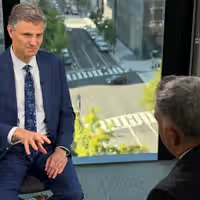
UK Defense Secretary Grant Shapps has urged Iran to immediately halt its support for Yemeni Houthi rebels as the ongoing Middle East conflict is spiraling out.

UK Defense Secretary Grant Shapps has urged Iran to immediately halt its support for Yemeni Houthi rebels as the ongoing Middle East conflict is spiraling out.
“You must get the Houthi rebels, others who are acting as proxies for you, Lebanese Hezbollah are obvious examples, [and] some in Iraq and Syria, you must get these different organizations to cease and desist,” he addressed Tehran.
Iran is the main supporter of Houthi rebels. Iran's involvement in the current conflict, which started after Hamas Islamist militia attacked Israel on October 7, extends to providing aid and training to Hamas as well as dozens of militia groups in Iraq and Syria along with substantial financial and logistic backing to Hezbollah in Lebanon.
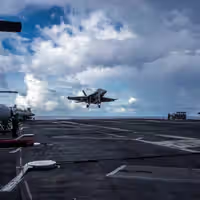
The remarks by the British defense secretary came in the wake of coordinated US and UK airstrikes on Houthi targets in Yemen, signaling a heightened international response to the escalating tensions in the region.
The military strikes were a retaliatory measure in response to recent attacks on trade vessels, which have led several companies to suspend operations in the region.
Following the joint strikes on Friday, the Iranian Ministry of Foreign Affairs accused the US and UK of supporting "war crimes" committed by Israel against the Palestinian people and Gaza.

The former head of Tehran University of Medical Sciences has sounded the alarm on the increasing inclination of medical students to seek opportunities abroad.
Ali Jafarian emphasized the shifting dynamics in the medical profession, revealing a decline in demand for residency positions within the country, leading to a growing dependence on foreign physicians.
Highlighting the stark contrast from five decades ago when doctors from India and Bangladesh sought employment in Iran, Jafarian noted that the current trend sees them heading to the UK. The change is reflective of the fact that physicians no longer find Iran as attractive as it once was.
Inflation has been hovering above 40 percent for more than three years and monthly minimum wages have declined to around $200.
“It means we are steering the country towards a future where even finding an anesthesiologist for an appendix operation in a rural area becomes challenging," he added.
The exodus extends beyond physicians to include a surge in healthcare professionals such as dentists, midwives, and nurses. Sharply declining incomes, professional limitations, and lack of social and political freedoms are identified as major catalysts for the trend. According to Iran's Nurses’ Organization there is an estimate of an annual emigration of 2,500 to 3,000 nurses.
In May 2023, MP Hossein Ali Shahriari disclosed that around 10,000 healthcare practitioners had departed Iran for opportunities in the Arab world over the previous two years.

Iran’s significant nuclear progress and a shift in global politics have eroded the foundations of the 2015 JCPOA accord, and made a new deal much less attainable.
This article consists of two parts: The first part deals with the political implications of the nuclear activities of the Islamic Republic of Iran, and the second part with the technical status of the nuclear program (NP) of the IRI and how they match or contradict the provisions of the nuclear accord JCPOA.
Part 1
Political implications
After the US withdrew from the nuclear agreement called Joint Comprehensive Plan of Action (JCPOA) in May 2018 by then-president Donald Trump, the Islamic government under former President Hassan Rouhani waited another year before taking countermeasures. It most likely hesitated because the conclusion of the JCPOA had been a key achievement for Hassan Rouhani's presidency; it did not want to give it up easily.
With the imminent change of administrations in the US, and Joe Biden’s announcement of his intention to return to the JCPOA, the hardliners in Tehran passed a parliamentary bill in December 2020 called "strategic measures to lift sanctions and protect the rights of the Iranian nation", which forced Rouhani’s government to take countermeasures. The December 2020 legislation ordered a gradual rollback of the IRI's JCPOA commitments. It required the government:
There are many signs indicating that the regime has seen Trump's withdrawal from the JCPOA as a favorable opportunity to accelerate the nuclear program (NP) (essentially Uranium enrichment) with an ambivalent intention: to move closer to the nuclear bomb in order to make it if feasible: either by a spontaneous decision or at a favorable opportunity; or merely to use it as a means of threatening or even blackmailing the West.
Tehran seemed determined to demonstrate that it could produce nuclear weapons it was undertaking measures to make it possible.
To emphasize this threatening gesture, high-ranking dignitaries of the regime, namely Kamal Kharrazi, the former foreign minister and current advisor to Supreme Leader Ali Khamenei, along with other high-ranking officials, have pointed out that the regime would be able to build a nuclear bomb if it only wanted to, only that that Islam prohibits weapons of mass destruction.
To implement parliamentary legislation, Tehran found itself in violation of the provisions of the JCPOA. The claimed legal basis for this action was clause 26 of the JCPOA, which allows parties to take countermeasures; however, this provision is restricted by clause 37 of the JCPOA. Clause 37 involves an arbitration mechanism that may eventually bring a dispute before the UN Security Council, potentially leading to the 'snap-back' scenario. This implies that all sanctions against the IRI imposed by the UN Security Council prior to the conclusion of the JCPOA, which were merely suspended (not lifted), could be reinstated.
Tehran believed that the West was neither willing nor able to initiate a military conflict in the Middle East. This encouraged the regime not only to disregard the provisions of the JCPOA but also to rapidly advance beyond it, aiming to become a so-called 'threshold' nuclear power.
Meanwhile, soon after Biden took office, multilateral negotiations began in Vienna in April 2021 to revive the JCPOA. The talks were said to have been moving in the right direction when presidential elections took place in Iran in June.

The newly elected administration of Ebrahim Raisi rejected the preliminary agreements reached by the Rouhani government with the 4+1 powers (China, Russia, France, UK, and Germany under the leadership of the EU) plus the US as an indirect negotiating party. The new administration only began negotiations after a pause of around 6 months.
Meanwhile, the regime initiated higher-level uranium enrichment pursuant to the parliamentary bill, enhancing its nuclear threat potential and boosting its self-confidence. However, given the dire economic conditions in Iran, exacerbated by US sanctions, Tehran likely found itself compelled to return to the negotiating table. Nevertheless, its envoys, some of whom had been staunch opponents of the JCPOA, arrived with high, at times unrealistic expectations. These expectations encompassed three primary aspects: the verifiable lifting of economic sanctions, the removal of sanctions related to individuals or institutions due to human rights violations or support for terrorism, and a long-term guarantee of future US presidents' commitment to the agreement.
From the outset, the Biden administration expressed its willingness to revitalize the JCPOA while also aiming to address Iran's regional policies and ballistic missile program in the negotiations. These later concerns were dropped and postponed.
Demands from the IRI, such as removing the Revolutionary Guard from the US terrorist list and ensuring overarching compliance with agreements by future administrations, could not be accepted by Washington.
Nevertheless, negotiations appeared to be progressing well, and an agreement seemed within reach when Russia initiated its military assault on Ukraine in February 2020. Russia's foreign minister, Sergei Lavrov, exploited Western sanctions against his country as a pretext to disrupt the conclusion of an agreement. The IRI might have ignored Russia's objections if it were not politically and militarily complicit with Russia in supporting the aggression against Ukraine.
Subsequently, a period of relative diplomatic inactivity ensued, lasting until August. Meanwhile, the IRI made determined efforts to accelerate the advancement of its enrichment program.
The nationwide Women-Life-Freedom uprising of Iranian citizens following the violent death of Mahsa Jina Amini shook the foundations of the Islamic regime, causing irreparable damage to its legitimacy among a vast majority of Iranian citizens. The government's violent and sometimes brutal response to the protests deeply angered Iranians. Furthermore, inefficiency, corruption, and mismanagement were eroding the regime's legitimacy.
Due to the global support for the Women-Life-Freedom movement, particularly in democratic Western countries, the Islamic regime's legitimacy suffered internationally as well. These pressures created cracks in the regime's power structures. To prevent these cracks from deepening, it became imperative to seek legitimacy abroad. The regime needed to demonstrate, especially to its own supporters, that it was still accepted as a partner in the West. The most effective way to achieve this goal was to enhance its nuclear threat potential to intimidate the West into entering negotiations.
From the IRI viewpoint negotiations with representatives of the major powers of the UN Security Council (UNSC) on a public stage would be an ideal vehicle for restoring its lost legitimacy abroad.
No surprise that the regime was suddenly prone to drop pretty much all the demands it had made before the negotiations were suspended. After some sporadic contacts with the EU foreign policy envoys, they finally succeeded in reaching their milestone goal -legitimacy and cash, first in secret talks and later in open indirect talks with the USA in Oman.
Meanwhile, the tremendous advancement of the Tehran’s nuclear program has almost eliminated the basis for a similar accord like JCPOA. Therefore, as a minimum consensus the parties reduced their expectations: For the West it was apparently sufficient to de-escalate if the IRI would freeze the stockpile of LEU and for Teheran to get access to world arena including the West and some urgently needed cash. Tacitly, both sides reached an agreement on release of Western citizens - mostly dual nationals who have in fact been taken as hostages -in exchange for granting legitimacy and money to the Islamic regime as well as freeing their own terrorists or sanction-breakers convicted by Western courts.
Among other things, the build-up of a nuclear threat on the part of the IRI has prompted Western governments to return to their notorious policy of appeasement towards the IRI. This behavior of the western countries legalizes de facto the hostage-taking policy of the IRI.

Part Two: The State of the IRI Nuclear Program
After the parliament's decision in 2020, taking the path of nuclear threats - the regime undertook the following measures:
The practical consequences of the IRI decisions and the resulting current situation of its nuclear program are explained below.
Commitments to the NPT and CSA vis-à-vis the IAEA
Undeclared nuclear facilities and activities:
Over the past 5 years, the IRI has not properly answered questions regarding four undeclared sites and suspected nuclear activities prior to 2003 where traces of anthropogenic uranium particles and other activities have been detected. The problem has been solved for two sites for the time being, but the sites Torqouzabad and Varamin have not yet been resolved.
Some of the questions are going back to the undeclared locations where nuclear activities had presumably taken place around 20 years ago. But in these sites the buildings and many other traces had since been removed. It is suspected that the IRI had conducted experiments to develop a nuclear weapon in these sites. In my view, the reason why these past issues have gained actuality is the conduct of the IRI. The unleashing of enrichment up to the threshold of weapons-grade Uranium gives rise to concerns among the involved institutions and countries. They would like to know how far the IRI nuclear program had previously progressed towards bomb-making beyond enrichment.
Reduction in transparency:
Following the official termination of the Additional Protocol to the NPT application in February 2021, IRI has gradually reduced its obligations under the NPT CSA: These are non-compliance with the requirements of modified Code C3.1 of the Supplementary Agreement to the CSA. The original text C3.1 stated that countries are obliged to notify the IAEA 180 days prior to the introduction of nuclear materials into their nuclear facilities. But the modified Code C3.1 states that countries must notify the IAEA immediately when they start planning a nuclear project. The IRI has nevertheless applied this code for some time. However, the IRI pairs it with the JCPOA and now that it no longer feels bound by the JCPOA, it does not want to observe the provisions of the Code C3.1 either - but it tacitly applies these provisions in practice. In short, there are divergent legal interpretations by the IAEA and the IRI in this case.
Another step the IRI has taken against transparency is the obstruction of inspectors. It recently culminated in the denial of visas to several particularly competent IAEA experts from Western countries. This was condemned in unusually harsh terms by IAEA director Rafael Grossi in his November 2023 report.

He is concerned that, under these circumstances, the transparency of the IRI's nuclear activities could be severely compromised. This may be the reason for his recent warning that the IRI could follow a similar path few years ago paved by North Korea. This language of the IAEA is completely new and reflects that concern.
Another point of contention between the IAEA and IRI is the discrepancy in the inventory of nuclear material at the UCF Isfahan plant.
In Connection with JCPOA
Shortly after the mentioned parliamentary legislation, the IRI in February 2021 terminated its observance of the following obligations:
Transparency measures in connection with enrichment
JCPOA requires that the Uranium235 enrichment level may not exceed 3.67 percent and that the maximum amount to be accumulated in Iran shall not exceed 300kg UF6.
The IRI has gradually increased this limit to 5, 20 and 60 percent. The total mass of enriched Uranium amounts to 4486.8 kg UF6, which is nominally 15 times the permitted amount (although the calculation is not that straightforward). Some experts wrongly report the factor 22, which is usually reflected uncritically by the media.
But what can be regarded as particularly menacing is the accumulated quantity of 60-percent enriched uranium (HEU Highly Enriched Uranium). It amounts to 128.3 kg UF6.
Further enrichment to 90 percent can take place within a few weeks, so that the regime could possess enough material for at least two nuclear bombs - at this point it is worth noting that the IRI still has a long way to go before getting a nuclear explosive device; enough HEU does not immediately make a bomb.
In the wake of a relative détente with the US and rapprochement with its Arab allies in the Persian Gulf, the IRI slowed down its production of HEU in 2023. The following diagram of the history of HEU production shows how de-escalation occurred in 2023, in line with the regime's intentions I mentioned above.

However, according to a December 2023 IAEA report, the IRI has reversed this de-escalation. Probably, due to the change of the political landscape in the Middle East following the outbreak of war between Israel and Hamas the IRI has triplet the production of LEU and reached 9 kg per month. It is difficult to determine whether this reversal is a reprisal for some additional sanctions recently imposed by the US, or the IRI will elevate its nuclear threat by accelerating the enrichment because it anticipates growing tensions between Israel and the Hezbollah.
Production of metallic Uranium:
The production of a nuclear warhead requires HEU % 90 in metallic form; Thus, the work in this field was prohibited under the JCPOA provisions. However, as described above, the regime has begun converting UF6 into metallic uranium at the Isfahan plant to reinforce its implicit threat.
Number and quality of centrifuges:
Centrifuges are machines that are used to produce higher concentration of Uranium235 out of natural uranium with a Uranium135 content of 0.7 percent. They work serially and are organized in groups called cascades. This requires uranium in gaseous form provided by Uranium hexafluoride (UF6).
In the framework of the JCPOA IRI committed to following provisions:
To entertain just over 5000 first generation (IR 1) centrifuges in operation (approx. 30 cascades). Research and development in the field of centrifuge technology was permitted but only in small numbers and not for production purposes.
Following the December 2020 legislation, Tehran began to produce, install and operate not only far more IR1, but also IR2, IR 2m, IR4, IR6 and beyond. The enrichment capability of the higher generations is 4 to 10 times higher than IR1, depending on the generation. The number of installed cascades amounts to 77 and those in operation to 62, which means that IRI currently has approx. 12,000 centrifuges, of which approx. 10,000 are in operation - and the trend is rising.
Uranium exploitation from Iranian mines
An important goal of the JCPOA was the complete transparency of the IRI nuclear program from uranium mining to disposal, so that the targeted breakout time of at least one year was guaranteed. The IAEA was therefore authorized to monitor uranium ore production activities for 25 years. During Tehran's countermeasures, this authorization was withdrawn from the IAEA. This means that the IAEA can no longer estimate how much uranium flows into the IRI's nuclear program.
Reduction of transparency during enrichment
The IRI refuses to provide the IAEA with online access to surveillance data in enrichment and other facilities. Instead, the IRI agreed to continue to store this data and to make it available to the IAEA only after a possible renewal of the JCPOA.
Later, maintenance of the monitoring equipment -- cameras, inline sensors, etc. -- was delayed, creating the risk of information gaps.
In June 2022, the 27 JCPOA-related cameras and inline sensors for recording the enrichment level were deactivated. However, the cameras that were installed in accordance with the CSA were retained. A similar procedure was followed regarding the cameras installed to monitor the production of centrifuge components. Here again, the IRI permitted the partial use of both cameras and inline sensors as part of its CSA obligations.
Inspection regulations
Under the Additional Protocol to the NPT, the IRI shall allow, beside the declared sites and facilities, inspection of undeclared sites as well as unannounced but managed inspections. By renouncing this commitment, Tehran has significantly reduced the transparency of its nuclear program.
Therefore, the IAEA complains that, firstly: seamless monitoring of the facilities is no longer possible and, secondly: if the amount of data generated becomes too large, it will be very difficult to reconstruct what has happened.
Furthermore, Rafael Grossi explicitly warns that the IAEA is no longer able to restore the continuity and integrity of knowledge in the following parts: The production and storage of centrifuges and their components, heavy water and uranium ore extraction.
These warnings have been accompanied, for the first time, by new language from the IAEA indicating concerns that the Islamic Republic of Iran (IRI) could follow a similar path to North Korea. This expression of uncertainty reflects the opaque behavior of the IRI in its interactions with the IAEA.
Conclusion: The prospect of revival of the JCPOA
A pre-requisite for JCPOA was to ensure a one-year break-out time for Iran. It is defined as the time required until a country succeeds to possess sufficient weapons-grade HEU for one nuclear weapon.
Many parameters that determine this breakout time have now been fundamentally changed: The IRI is only a few weeks away from it, the technology is well developed and a whole lot of know how has been acquired.
Even if IRI were prepared to eliminate all modern centrifuges and other hardware, the technological experience and know-how would remain. A return to the situation before the 2015 JCPOA is no longer feasible. In addition, the political constellation has changed dramatically. A decade ago, there was still some common ground between Russia and China on the one hand and the West on the other. Now, this common ground has vanished and is replaced by rivalries. Moreover, Tehran's support for Russian aggression against Ukraine as well as for Hamas against Israel make it more complicated for the West to reach an agreement with Tehran.
The Iranian regime is caught in a dilemma: delegitimized by the women-life-freedom uprising and under pressure due to the economic crisis it faces, it would perhaps prefer to seek a compromise with the West.
On the other hand, the regime is concerned about the softening of its long-held hostility towards the United States which has mutated into its raison d'être. Moreover, the IRI hardliners have experienced the benefits of practicing the nuclear threat. Are they willing to give up this perceived strength? As Raphael Grossi put it, an entirely new agreement is required.
Given the bloody carnage between Israel and Hamas, it is more likely that the Iranian regime would not give up this "weapon" so easily.
The prospects are not promising for an agreement in foreseeable future in the nuclear dispute between the West and the Islamic Republic of Iran.

Abram Paley, Deputy to the Iran Special Representative, has called for the immediate release of Nobel Peace Prize laureate Narges Mohammadi and all those “unjustly imprisoned in Iran.”
The statement, conveyed through an X message on Friday, emphasized the importance of upholding human rights and fundamental freedoms.
“We again call for the release of Nobel Peace Prize laureate Narges Mohammadi and all those unjustly imprisoned in Iran. No one should be held behind bars for exercising their human rights and fundamental freedoms,” Paley stated, highlighting the urgency of the matter.
The appeal coincides with the one-year anniversary of the Without Just Cause campaign launched by the US State Department. The campaign aims to draw global attention to the plight of political prisoners unlawfully detained worldwide, sharing their stories and increasing pressure for their release.
The campaign's statement revealed that approximately one million individuals are currently political prisoners. Among them are people detained for exercising human rights, fundamental freedoms, or due to factors such as race, religion, ethnicity, or sexual orientation.
The featured individuals in the Without Just Cause initiative represent a diverse group of victims, including faith leaders, civic activists, businesspeople, and former government officials. Among them Mohammadi, born in 1972, stands as a symbol of resilience and advocacy.
Mohammadi has received several international awards, including the Sakharov Prize from the American Physical Society in 2018, the International Press Freedom Award in 2016, and the Alexander Langer Award in 2009. Despite her accolades, she has faced multiple arrests, trials, and years of imprisonment due to her unwavering commitment to human rights. Her most recent arrest occurred in 2021, and she has since been held in Evin Prison.

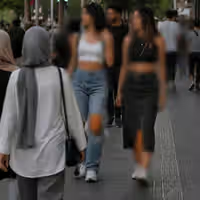
A key figure in drafting Iran's new hijab law has ignited controversy by suggesting that celebrities who resist compliance should contemplate leaving the country.
Abolfazl Eghbali emphasized the unique responsibilities of artists in adhering to the Islamic Republic's norms and laws, cautioning that they could face more severe penalties for violations.
"Their penalties in this bill are tougher and more severe because they are not ordinary citizens, and their behavior entails a series of social consequences," he told Dideban Iran news website on Saturday.
The bill, officially titled "Protection of Family Through Promotion of Hijab and Chastity Culture," secured parliamentary approval in September but encountered an unexpected setback. The Guardian Council, vested with ultimate legislative authority, rejected the bill, citing formal deficiencies and calling for revisions to clarify ambiguous terms.
Speculation is rife regarding the reasons for the rejection, with some attributing it to procedural issues and others suggesting the Council's cautious approach amid potential public discontent ahead of the upcoming March parliamentary elections.
The development unfolds against the backdrop of protests that followed the tragic death of Mahsa Amini in 2022. Actresses and female artists expressed solidarity by sharing images without hijab during the protests. The act of defiance led to tensions with the state broadcaster, resulting in the removal of the actresses from TV shows and movies or the discontinuation of the shows altogether.
Celebrities have been under increasing government pressure since the 2022-2023 anti-regime protests. Measures such as pay cuts, bank account freezes, and work bans have been imposed, with some personalities opting for exile after openly supporting the Women, Life, Freedom movement.

President Joe Biden issued a veiled threat to Iran on Friday, hours after the US and Britain struck at dozens of Iran-backed Houthi sites in Yemen.
The strike on Houthis Thursday night came after the group shrugged off all warnings and demands to stop attacking vessels in the Red Sea. There were more strikes Friday night, albeit on a much smaller scale, according to US officials.
Five people were killed and six injured in the earlier overnight operation that President Biden said aimed to degenerate the Houthis’ capability to launch more attacks in the Red Sea.
“I don’t think there’s any civilian casualties,” Biden said defending the Friday strikes conducted by warplanes, US Navy destroyers and even submarines, “that’s another reason why it’s a success.”
Asked by a reporter if he had a message for Iran in the light of the attack, Biden said “I've already delivered the message to Iran. They know not to do anything."
Iran and its regional militant proxy forces –from Iraq to Yemen and Lebanon– have been targeting American and Israeli forces or interests for two months, claiming obligation to support Palestinians in the face of Israel’s onslaught on Gaza.
Reacting to the US/UK attack, the spokesman for Iran’s foreign ministry, Nasser Kanaani, said such attacks only “divert” attention from the crimes in Gaza and “ have no result other than fueling insecurity and instability in the region”.
Some countries in the Middle East, including Saudi Arabia, are concerned that US strikes on Houthi capabilities would only aggravate, not deter, the group and lead to an all-out regional war or direct confrontation with Iran.
Asked about such a possibility Friday, President Biden only said “Iran doesn’t want a war with us.”
Biden’s chief spokesperson John Kirby reiterated his words.
“We’re not looking for conflict with Iran,” he said in an interview with MSNBC Friday. “We’re not looking to escalate and there’s no reason for it to escalate beyond what happened over the last few days.”
The second strike early on Saturday, which the US said targeted a radar site, was launched by the guided missile destroyer Carney, which used Tomahawk missiles "to degrade the Houthis' ability to attack maritime vessels, including commercial vessels," the US Central Command said in a statement on X, formerly Twitter.
Media outlets in Tehran affiliated with various regime entities were mostly silent on Saturday morning about the second strike on Houthis and Biden's remarks.
But the Houthis seem to have other ideas.
“All American-British interests have become legitimate targets,” the group’s Supreme Political Council said Friday, as ‘hundreds of thousands’ of Yemenis rallied in the capital Sanaa to show support for Palestinians and condemn the overnight attacks.
Turkish President Recep TayyipErdogan seconded the sentiment.
“It is as if they aspire to turn the Red Sea into a bloodbath,” he said, accusing the US and Britain of using excessive force. “Yemen, namely the Houthis, say they have given and will continue to give the necessary response to them.”
The attack on Houthis in Yemen is no doubt an escalation of the ongoing crisis in the Middle East. But the US and British governments have defended it as a “necessary and appropriate” response to the Houthi targeting of commercial vessels that has all but closed a major maritime route.
Many US lawmakers are not convinced though, especially since their word had not been sought on the matter as required (in their view) by the US constitution.
“The United States cannot risk getting entangled into another decades-long conflict without Congressional authorization,” wrote Rep. Mark Pocan on X. “The White House must work with Congress before continuing these airstrikes in Yemen.”