Iran shields its oil exports as Hormuz flows falter

While Iran has effectively choked off oil exports by its Arab neighbors through the Strait of Hormuz, it has continued shipping its own crude largely uninterrupted.
Oil, gas and Iran economic analyst

While Iran has effectively choked off oil exports by its Arab neighbors through the Strait of Hormuz, it has continued shipping its own crude largely uninterrupted.
Since the start of joint US–Israeli strikes on February 28, Iran has targeted at least 16 vessels and tankers, sharply curbing flows through one of the world’s most critical energy chokepoints.
Data from the commodity intelligence firm Kpler, seen by Iran International, shows Iranian crude exports averaging more than 1.5 million barrels a day (bpd) so far this month through the strait.
Discharges at Chinese ports have also risen, increasing from about 1.17 million bpd in February to more than 1.25 million so far in March. Figures from the International Energy Agency and maritime intelligence provider Lloyd’s List similarly point to a surge in Iran’s shipments.
Last week, Iran also loaded a two-million-barrel cargo from Jask — its only export terminal outside the Strait of Hormuz — marking the first such shipment since October 2024.
Before the escalation, roughly 14.7 million barrels of crude and 4.8 million barrels of refined products moved daily through the strait — about one-fifth of global oil consumption.
Among Persian Gulf producers, only Saudi Arabia and the United Arab Emirates have pipeline routes bypassing Hormuz. Even those alternatives were already partly utilized.
According to Lloyd’s List, combined exports from Saudi Arabia, the UAE and Oman via non-Persian Gulf ports averaged about 3.5 million barrels a day in recent months but have climbed to roughly 6 million — still far short of offsetting lost flows.
President Donald Trump said Friday the US Navy would “soon” begin escorting oil tankers through the waterway, though officials have not outlined a timeline or operational details.
Iran’s foreign minister, Abbas Araqchi, pushed back Sunday on suggestions Tehran was seeking talks, telling CBS’s Face the Nation: “We have never asked for a ceasefire … we are ready to defend ourselves for as long as it takes.”
Lloyd’s List estimates that even with naval escorts, no more than about 10 percent of lost volumes could realistically be restored — echoing the limited recovery seen after Houthi attacks in the Bab el-Mandeb.
The IEA said Thursday that disruptions have cut global supply by about 8 million barrels a day of crude and another 2 million barrels of condensates and natural gas liquids.
In response, its 32 member countries plan to release roughly 400 million barrels from strategic reserves over 120 days beginning next week, including about 172 million barrels from the United States and 80 million from Japan.
Even so, US Energy Secretary Chris Wright said Sunday there were “no guarantees” oil prices would fall in the coming weeks.






Iranian officials are urging citizens to fill the streets as Israeli strikes hit security sites, while opposition figures warn the calls aim to create civilian “human shields” around security forces under attack.
Critics argue that such calls expose civilians to danger. The diaspora-based Dadban volunteer lawyers group warned against encouraging civilians to gather near security installations.
“Encouraging civilians to gather near security centers or checkpoints that may become targets effectively turns them into human shields,” the group wrote in a statement. “Such actions knowingly expose civilians to danger and place direct responsibility on those issuing the calls.”

Iranian officials are urging citizens to fill the streets as Israeli strikes hit security sites, while opposition figures warn the calls aim to create civilian “human shields” around security forces under attack.
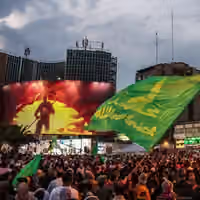
On Friday, several Iranian officials including the judiciary chief, the top security official, the foreign minister and many others demonstrated alongside Islamic Republic supporters in anti-Israel Quds Day rallies.
In one video from the rallies, Judiciary Chief Gholamhossein Mohseni Ejei was seen surrounded by a large number of bodyguards and participants forming what critics call a human shield as an airstrike hit an area nearby.
In an apparent move to avoid airstrikes, Ejei decided not to sit on the officials’ podium during Friday prayers, instead sitting among ordinary worshippers.
Before the Quds Day rallies, Iranian authorities had urged supporters of the Islamic Republic to pour into the streets despite the threat of airstrikes.
“This smallest soldier of yours has three requests from you: street, street, street,” parliament speaker Mohammad-Bagher Ghalibaf posted on X on Wednesday. “Your children in the armed forces have put their lives in their hands to defend Iran. Strengthen them by keeping the streets.”
A video circulating on social media also shows pro-government religious singer Meysam Motiee, speaking after several checkpoints were targeted in Tehran the same night, urging civilians to help protect security forces. “The US and Zionists have serious plans to take back the streets from the faithful forces.”
However, critics argue that such calls expose civilians to danger. The diaspora-based Dadban volunteer lawyers group warned against encouraging civilians to gather near security installations.
“Encouraging civilians to gather near security centers or checkpoints that may become targets effectively turns them into human shields,” the group wrote in a statement. “Such actions knowingly expose civilians to danger and place direct responsibility on those issuing the calls.”
Online users say that after some of these strikes, checkpoint personnel have moved their positions to busier streets. Some posts allege that instead of conducting vehicle searches as thoroughly as before, members of the Basij militia now stop cars primarily to create congestion around these checkpoints.
People urged to stay home
In contrast to these calls for street presence, opposition figures and foreign leaders have urged Iranians to stay indoors for the time being.
Iran's exiled prince Reza Pahlavi, who has said he is prepared to lead a transitional period after the Islamic Republic, warned that the coming days would be decisive and that people need to stay home.
In a video message on Thursday, he urged citizens not to approach “government, military and law-enforcement centers, or housing complexes affiliated with the repression apparatus.”
“The Islamic Republic is using schools, mosques, and other public locations to hide its forces and create human shields,” he said.
Addressing state employees directly, Pahlavi urged them not to risk their lives for the survival of the government. Instead, he called on them to “use your access and capabilities to disrupt repression and help the people.”
Similar appeals have come from abroad. Israeli Prime Minister Benjamin Netanyahu addressed Iranians in a Persian-language message published by an official Israeli account.
“We are delivering heavy blows to the Revolutionary Guards and Basij forces, both in the streets and at checkpoints,” he said, promising that the attacks would continue.
“I say to the people of Iran: the moment you can begin a new path of freedom is getting closer every day. We stand with you, we help you, but ultimately everything depends on you.”
Police commander Ahmad-Reza Radan had warned in a televised interview earlier this week that anyone taking to the streets would be treated as an “enemy” and said security forces had their “fingers on the trigger” and were ready to shoot.
In a mass text message reportedly sent to mobile phones across the country on Thursday, the intelligence arm of the Revolutionary Guards (IRGC) also threatened harsh consequences for street protests.
The message warned that if those it described as “domestic traitors” or “neo-ISIS elements” attempted demonstrations, they would face a response “stronger than January 7.”
The IRGC's statement effectively acknowledged the Islamic Republic's role in the massacre of at least 36,500 protesters during the brutal crackdown in January.
"The IRGC intelligence organization forgot that before the war, they used to deny the killing of people and say it was the work of terrorists. Today, they threatened people that if they come out to the streets, we'll give you a harsher response than on January 7," one user posted on X.
A statement attributed to the new supreme leader Mojtaba Khamenei on Thursday signaled no change in the government’s approach. Many Iranians on social media widely interpreted the message as confirmation that the policy of suppressing dissent would continue.
The confrontation has spilled onto social media as well, where supporters of the establishment and critics exchange threats and mockery.
One pro-establishment user wrote on X: “This time we are waiting even more than the Prince and Netanyahu for you to come to the streets… If you really want an uprising, don’t delay. Come to the streets.”
Some critics responded to the visible participation of pro-establishment citizens in rallies, including the annual Quds Day rally, with historical comparisons. “Hitler, Mussolini, Saddam, and Gaddafi could bring crowds many times larger than this to the streets,” one user wrote. “We all know how that ended.”
Others used sarcasm to encourage militia members to remain at checkpoints despite the risk of Israeli drone strikes.
“We wish you well,” one user wrote mockingly. “Please do not leave your posts under any circumstances. Your strong presence at checkpoints lets millions of Iranians smile with relief. They can watch and wave to you from afar.”
Moscow may be benefiting from the war between Iran and the United States and Israel, but the longer it continues, the less it serves Russia’s interests.
As has been widely reported, Russia has provided limited direct assistance to the Islamic Republic against its attackers, despite Tehran’s extensive military support to Moscow since 2021.
This contrasts with how Tehran supplied large quantities of armed drones and ballistic missiles to Russia in its war against Ukraine.
Some see the ongoing war as yet another example of Putin doing little to help longstanding allies, as occurred with the downfall of long-time Syrian ally Bashar al-Assad, the American abduction of Venezuelan President Nicolas Maduro, and Russia’s lack of help to Tehran last year during the 12-Day War.
Moscow, though, has provided some help to Iran in this war. Russia has long supplied Tehran with surveillance and repression technologies used to prevent domestic unrest. This support may have contributed to the Islamic Republic’s ability to survive the killing of Supreme Leader Ali Khamenei and many other top leaders—at least so far.
Moscow has also reportedly provided Tehran with intelligence support for Iranian drone attacks against targets including US troops in Iran’s Persian Gulf neighbours, Israel, Turkey, Azerbaijan and elsewhere. T
hese attacks may have been undertaken in hopes of giving some of America’s Middle East partners an incentive to press Washington and Israel to halt strikes on Iran so Tehran would stop targeting them.
Putin may also see enabling Iranian drone attacks against US military targets in the region as payback for earlier US support to Ukraine for its drone strikes against Russian military targets both in occupied Ukraine and Russia itself. Putin’s desire for retribution on this score should not be underestimated.
Yet as gratifying as this may be to Putin, it has also created a problem for Russia that he may not have anticipated. Ukraine has offered to share its considerable experience in defending against drone attacks with countries now receiving them from Iran—an offer many have welcomed.
Perhaps this helps explain why Moscow has denied sharing intelligence with Tehran. But regardless of Russia’s role, the attacks themselves have given targeted states reason to value Ukraine and its survival more highly than before—something that is not in Russia’s interests.
This points to a larger tension: while Moscow and Tehran are both strongly anti-American, their interests are not fully aligned. While Tehran may view all countries cooperating with the United States or Israel as adversaries, Moscow has long sought pragmatic relations with many of them and tried to split some from Washington on key issues.
This approach paid off in the willingness of Saudi Arabia, the United Arab Emirates, Turkey and even Israel not to enforce Western sanctions against Russia. The longer Iranian attacks continue, however, the less willing these states may be to cooperate with Moscow if they believe it is complicit or unwilling to restrain Tehran.
At the same time, Moscow may appear less useful to Iran’s post-Ali Khamenei leadership if Putin cannot pressure or persuade Donald Trump to end his war against Iran.
Putin also seeks to preserve as much of Trump’s sympathy as possible regarding Ukraine. He would not want to provoke renewed large-scale US military support for Kyiv by appearing to obstruct Washington’s campaign against Tehran.
To some extent, the US-Israeli war on Iran has benefited Putin by diverting Western attention from Ukraine. Hostile Iranian actions that reduce Persian Gulf energy flows and push global oil and gas prices higher also benefit petroleum-exporting Russia.
Moscow has also gained from Trump’s reduced pressure on India over purchases of Russian oil, helping stabilize global supply and prevent prices from rising even further.
The longer the war continues, however, the more it risks imposing greater costs than benefits for Moscow. Prolonged conflict could deepen Middle Eastern reliance on Ukraine against Iranian drone attacks, strain Russia’s relations with regional states wary of Tehran, and further weaken the Islamic Republic, making it less useful to Russia.
For Putin, the war’s advantages are real—but they are likely to diminish the longer it lasts.
Lebanon’s Parliament Speaker Nabih Berri receives more than $500,000 per month from the Islamic Republic in order to support Tehran's interests and those of its allied group Hezbollah in Lebanon, informed sources told Iran International.
Officials in Tehran say the sums are meant to “buy” unity among Lebanon’s Shiite leadership to ensure that they “act in accordance with Iran’s interests, not Lebanon’s interests.”
Nabih Berri did not respond to Iran International’s request for comment. One of his advisers said that Berri would not comment on the matter at this time.
Berri has not publicly opposed Hezbollah’s attacks on Israel in support of Iran, the sources said, because he does not want to risk losing his financial resources.
The 88-year-old politician heads Lebanon's Amal Movement and holds significant sway in Lebanon’s domestic and foreign policy.
The Shiite organization, formed in the 1970s, remains one of the country’s main political actors. It maintains close political ties with Hezbollah, and both belong to Lebanon’s Shiite political camp.
On March 1, Hezbollah targeted Israel in support of Tehran. Israel launched a new military operation in retaliation.
The sources said Berri has been unwilling to support efforts by the Lebanese government to disarm Hezbollah because, in exchange for receiving large sums from Tehran, he must “advance measures in the Lebanese parliament that align with Tehran’s interests.”
In recent months, Lebanon’s President Joseph Aoun and Prime Minister Nawaf Salam have tried to pressure Hezbollah to disarm in order to reduce tensions with Israel and the international community.
Army forces have confiscated Hezbollah weapons in parts of southern Lebanon, but senior Lebanese officials have said that fully implementing the plan could trigger internal tensions, as Hezbollah has refused to hand over its entire arsenal.
Hezbollah Secretary-General Naim Qassem and officials of the Islamic Republic have repeatedly opposed disarming the group.
Following Hezbollah’s attack on Israel, the Lebanese government announced that the group's military activities would be banned.
On March 6, Israeli Defense Minister Israel Katz warned the Lebanese government that if it remains unable to fulfill its commitments regarding Hezbollah’s disarmament, Lebanon will “pay a very heavy price.”
Tehran considers Hezbollah one of the main pillars of the so-called Axis of Resistance—a term used by Iranian officials to refer to allied armed groups such as Hamas, Islamic Jihad, Hezbollah, Iraq’s Popular Mobilization Forces, and the Houthis in Yemen.
The Wall Street Journal reported in November 2025 that Tehran transferred hundreds of millions of dollars in oil revenue to Hezbollah in the preceding year through exchange offices, private companies and a financing network in Dubai.
Israel’s Kan network reported in December 2025 that Tehran had agreed to pay $1 billion to Hezbollah.
Neither report can be independently verified by Iran International.
The office of the Speaker of Lebanon’s Parliament, in a statement issued after the article was published, called the claim "false and baseless."
Regional reactions to the appointment of Mojtaba Khamenei as Iran’s new Supreme Leader have revealed growing anxiety about stability, with Tehran’s allies condemning the killing of his father and adversaries hardening their military posture.
Khamenei Jr’s continued absence from public view has fueled speculation among analysts and diplomats about how power is being exercised during the transition.
The message read on his behalf on state television on Thursday was viewed by some observers as closely aligned with the Revolutionary Guards (IRGC) messaging, prompting questions about the balance between formal leadership and the IRGC.
As expected, Tehran’s regional non-state allies in Iraq, Yemen and Lebanon have rallied around the new leader, calling him the “Leader of the blessed Islamic Revolution.” His ascendence to power is perceived by these armed groups as continuity in funding and weapons transfers.
Not many share this view in the region and beyond.
Arab neighbors
Across the Persian Gulf, Mojtaba’s appointment has been met with a mix of defensive military posturing, criticism, and calls for closer security coordination.
Tensions with Saudi Arabia rose sharply after his appointment when an Iranian strike hit a Saudi residential area. Prior reporting in US media, including The Washington Post, indicated Riyadh had privately urged Washington to use significant military force to prevent Iran from emerging stronger after the transition.
Elsewhere in the region, Tehran and its proxies have been blamed for strikes on civilian infrastructure—including a desalination plant in Bahrain.
Arab League Secretary-General Ahmed Aboul Gheit denounced Iran’s “reckless policy,” reflecting broader anxieties among smaller Gulf states.
Reactions from Qatar, Kuwait and the United Arab Emirates have reflected concern about escalation, as the leadership transition coincided with direct attacks on regional infrastructure.
Turkey
In Turkey, President Recep Tayyip Erdogan struck a supportive tone, calling Iranian officials “brothers” and expressing hope they would “get through this trap-filled period.”
Ankara has also criticized US strikes and appears likely to maintain pragmatic engagement with Iran’s leadership to avoid instability along its borders.
Russia, China and the EU
Russia’s President Vladimir Putin was among the first to respond, calling Ali Khamenei’s death a “cynical murder” and describing him as an “outstanding statesman.” His message to President Massoud Pezeshkian emphasized solidarity with Iran during the transition.
China adopted a more cautious tone, stressing respect for Iran’s sovereignty and opposing regime change. Chinese officials framed the succession as a constitutional matter and an internal Iranian process.
The European Union’s reaction has been more fragmented. Diplomats say some member states quietly hope the transition could open space for political change, while others fear instability could widen the conflict. Publicly, EU officials have emphasized de-escalation regardless of who leads Iran.
None of the three powers aligned with Tehran as the United Nations condemned IRGC-linked attacks on regional targets this week.
Israel
Israel was the only country in the region to explicitly question the legitimacy of Mojtaba’s appointment, describing it as a continuation of what it called the IRGC’s “terror regime.”
Even before the appointment, Defense Minister Israel Katz wrote on X that “any leader appointed to continue the plan to destroy Israel will be an unequivocal target for elimination.”
Public reactions across Iran and parts of the Arab world have been mixed. Some early expressions of relief at Ali Khamenei’s death gave way to concern about escalation as Mojtaba’s ties to the IRGC came into focus.
Across the region, officials and analysts say the leadership transition has reinforced fears that an already volatile conflict could widen further in the weeks ahead.