Iranian-New Zealand MP Suspended Amid Shoplifting Allegations

Dual national Golriz Ghahraman, a Green Party MP in New Zealand and prominent human rights lawyer of Iranian origin, has been suspended amidst shoplifting allegations.

Dual national Golriz Ghahraman, a Green Party MP in New Zealand and prominent human rights lawyer of Iranian origin, has been suspended amidst shoplifting allegations.
In an official statement, a spokesperson for the Green Party said the party is "aware of allegations regarding MP Golriz Ghahraman" and was in contact with Scottie's Boutique to "better understand and address the situation".
"Green MPs are expected to maintain high standards of public behavior," the spokesperson said.
Ghahraman, who made history as the first refugee sworn in as an MP in New Zealand, arrived in Aotearoa as a child asylum seeker with her family from Iran. Initially serving as a Green Party list candidate in January 2017, she secured the seventh position on the Green Party's list in the 2023 election.
Ghahraman’s portfolios for the Greens included justice, foreign affairs, defence, ethnic communities, and trade.
Auckland police confirmed an investigation is ongoing.
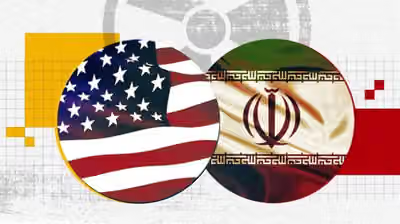

Amid continuing Iran-backed Houthi attacks in the Red Sea, calls are growing in Washington to zero in on Tehran, the main actor fomenting the Middle East crisis.
Senator Lindsey Graham (R-SC) stated in an interview with Iran International's Arash Alaei on Tuesday that the Biden administration should convey to Tehran that the US is willing to consider "targets in Iran" as an option if its proxies persist in attacking American troops and international shipping.
Iran's Yemeni proxy, the Houthis, along with other regional militias, have escalated attacks on American and Israeli targets since the October 7 invasion of Israel by Hamas, another Tehran-backed outfit. The attacks resulted in over 1,200 deaths in a single day, predominantly civilians, and the abduction of more than 240 men, women and children from communities on the Gaza border.
The Houthis' assaults on shipping in the Red Sea have disrupted the free flow of goods, leading the US and its allies to target Houthi boats and missiles aimed at either hijacking or striking commercial vessels. The attacks began after Iran’s Supreme Leader Ali Khamenei called for blockading Israel in response to its retaliatory offensive in Gaza to uproot Hamas. The Houthis have vowed to continue attacks until Israel halts its operations in Gaza and warned that it would attack US warships if the militia group itself was targeted.
According to the US military's Central Command, only on Tuesday, US and UK forces shot down 21 drones and missiles fired by Houthis at international shipping in the Red Sea.
Senator John Fetterman (D-PA) told Iran International that he hopes the situation would not escalate and the US would not go to a war with Iran, but the US supports Israel in its war against Hamas, making it a target for Iran's proxies. Answering a question about the European countries’ military support to maintain the maritime security, he said, “Unfortunately, often the United States has to go alone... And it’s the right and thing to do.”
He underlined that as long as Houthis’ threats prevail, “I hope they keep sinking more and more to the bottom of the sea.” Last month, US warships sank three Houthi small boats to protect a commercial vessel from being hijacked. All crew were killed.
Critics have urged the Biden administration to take a more assertive stance toward the Houthis and Iran to stop the attacks, instead of just defensive measures. The US has formed a more than 20-nation coalition to counter the threats, several countries members anonymously due to the sensitive regional tensions.
US Deputy Special Envoy to Iran, Abram Paley, told Iran International this week that when it comes to dealing with Iran, “words are not enough” and action has to be taken. However, so far, Washington has not targeted the source of the Houthi attacks in Yemen.
Richard Goldberg, a National Security Council official from the Trump era and a fellow at the Foundation for the Defense of Democracies, says the increase in Houthi attacks indicate that “Iran just called Biden’s bluff.”
In an article on New York Post, Goldberg argued that with Tehran closer to nukes, Congress must end Biden’s appeasement with Iran before it is too late. “President Biden’s three years of appeasing Iran has brought the world’s leading state sponsor of terrorism closer than ever to developing a nuclear weapon.”
He highlighted that “nothing has been able to disabuse Biden of his almost-religious commitment to appeasement as the only viable path to containing Iran’s myriad threats... Not even assassination plots targeting former US officials, attempts to kidnap Iranian Americans from US soil, Iran-directed attacks on US troops in Iraq and Syria, injuring dozens of servicemembers — one critically — or the suicide-drone attacks on US destroyers in the Red Sea.”

Iran’s chief justice says a significant number of Iranians living abroad express a desire to return but grapple with a lack of trust in the regime.
Gholamhossein Mohseni Ejei stated that mechanisms to foster trust between Iranians abroad and the government could help in this regard.
“We should treat the Iranians returning from abroad, including tourists, with utmost courtesy and dignity at key points such as airports, consulates, and embassies. In this way, the negative impact of foreign propaganda against our country can be neutralized,” he added.
Current estimates suggest that four to five million first-generation Iranians have settled in other countries, and the number may increase when considering their children born abroad, often acquiring Iranian citizenship. Some estimates propose that the total number of Iranians outside the country could be around eight million.
However, many Iranians living abroad, especially those with dual citizenship who could be accused of espionage for foreign governments, hesitate to return due to fears of being denied exit or facing imprisonment for their political activities or criticism of the regime while residing abroad.
In recent years, dozens of dual nationals, particularly citizens of Western countries such as the United States, Britain, and Germany, have been sentenced to prison on charges of espionage. The Islamic Republic often employs the individuals as bargaining chips in negotiations with foreign governments or exchanges them with Iranian prisoners in return for financial considerations.

When it comes to dealing with Iran, “words are not enough” and action has to be taken, the US Deputy Special Envoy to Iran, Abram Paley, told Iran International.
In an exclusive interview, with Samira Gharaei, Paley said the Biden administration has been “very clear” in both public and private messaging that “now is not the time for Iran or for the groups that it supports to take advantage of the situation [in the Middle East] and advance their own destabilizing interests.”
Iran and its regional allies have ramped up their operations against Israel and the US since last October, when Israel’s military began its onslaught on Gaza in response to the Hamas rampage of Israeli border areas.
For three months now, Iran-backed groups in Iraq and Syria have been targeting US bases, Hezbollah in Lebanon has been launching missiles towards northern Israel, and Yemen Houthis have been attacking commercial vessels in the Red Sea, all invoking Israeli war on Gaza as the reason for their actions, and calling for a ceasefire.
President Biden has refused to back the growing calls for a ceasefire in Gaza, though, and Paley reiterated in his interview that the administration’s support for Israel is unwavering.
Critics of the Biden administration on all sides –those who advocate more pressure on Netanyahu and those demanding a tougher stance on Iran– say lack of decisive action would not help calm, but aggravate, the situation and lead, eventually, to the kind of full-scale regional war that the administration is hoping to avert.
“I’m not going to preview US actions,” Abram Paley said when addressing the question of deterrence, and what the US government might do if the Iranian regime and its proxies continue their attacks on American interests in the region.
“We view Iran as an adversary and a state sponsor of terrorism… but we don’t focus on just one thing… we’re going to remain committed to focusing on a full range of Iran’s destabilizing behavior: from its nuclear program to its crackdown on human rights at home, to its provision of weapons to groups in the region.”
Many Iranian-American activists say the Biden administration is “soft” on Iran, demanding more pressure and less compromise, especially when it comes to human rights abuses and the US support dissidents and activists inside Iran.
“We’re going to stand with the Iranian people,” Paley responded. “We’re going to continue to make sure that their voices are heard… and that they stay connected to the outside world.”
Since coming to office, President Joe Biden seems to have framed his Iran policy around a wish to revive the abandoned 2015 nuclear deal or at least come to another (written or unwritten) agreement that would limit Iran’s nuclear program.
This doesn’t seem to have worked, however.
IAEA, the UN nuclear watchdog, confirmed in its last report of December 2023 that Iran has resumed enrichment to up to 60 percent, close to the roughly 90 percent that is required to make a nuclear weapon –after a temporary slowdown, brought about by release of some frozen Iranian funds and turning a blind eye on oil exports to China.
“We believe that diplomacy is the only way and the best way to arrive at a sustainable, effective resolution to [Iran’s nuclear] program over the long tem,” US deputy special envoy to Iran addressed the issue. “But at this point we’re very very far from that, given Iran’s continued escalation.”
Mr. Paley has been acting as special envoy after Biden's top choice Robert Malley was suspended after his security clearance was revoked due to an unspecified reason.
Asked about his former boss and what may happen to him next, Paley said, “I can’t comment… but despite that situation, the work at the State Department vis a vis Iran has continued.”

In an event to mark four years since Iran’s Revolutionary Guards downing of Flight PS752, Canada’s premier reiterated his resolve to label the IRGC a terrorist organization.
During the Monday ceremony, Prime Minister Justin Trudeau said his government is looking at ways to list the Guards, which shot down the Ukrainian airliner by two missiles shortly after taking off from Tehran on January 8, 2020, killing all 176 people onboard, including 55 Canadian citizens and 30 permanent residents.
He criticized the Iranian government's "disregard for the rule of law" and expressed Canada's ongoing efforts to responsibly designate the IRGC as a terrorist organization, citing sanctions against select IRGC officials.
"We know there is more to do to hold the regime to account and we will continue our work, including continuing to look for ways to responsibly list the IRGC as a terrorist organization," Trudeau said.
The Iranian government claimed in a 2021 report that the airliner was shot down accidentally after being "misidentified" by an air defense unit as a "hostile target" — a conclusion Canadian safety officials say Iran failed to support with evidence.
Canada has been wrestling with designation of the IRGC as a terrorist entity for years, but calls grew louder after the Flight PS752 incident. Canada’s federal government has referred to the IRGC as a terrorist organization, described its leadership as terrorists, announced measures to make its senior members inadmissible to Canada, and has listed the outfit’s extraterritorial expeditionary division Quds Force as a terrorist entity.
However, despite numerous calls from the federal Conservative party, activists and even US lawmakers as well as the families of victims of the Ukrainian flight, the government has refused to designate the whole entity as a terrorist entity under the country’s Criminal Code. In June, Canada's Senate passed a non-binding motion to designate the the Guards as a terror organization, echoing a similar motion in 2018. The country's Liberals supported the Tory motion in the House of Commons back in 2018, but have not done so since.
Trudeau’s government argues that such a listing would be a blunt-force approach that could affect low-level people who were forced to serve in the force as part of their mandatory military service. According to the CIA, conscripts make up more than 50 percent of the IRGC.
In addition to the prime minister, Canada’s Foreign Affairs Minister Melanie Joly, Finance Minister Chrystia Freeland, Transport Minister Pablo Rodriguez and Conservative deputy leader Melissa Lantsman attended Monday's ceremony in Richmond Hill.
Lantsman, who serves as Canada’s opposition deputy, criticized Trudeau's government for its handling of Iranian officials on Canadian soil, promising a definitive designation of the IRGC as a terrorist group. Canada’s Official Opposition emphasizes the need to end legal activities of IRGC members in Canada and their luxurious lifestyles funded by embezzled Iranian money.
Lantsman repeated her party's call to designate the IRGC a terrorist organization, saying "This evil act of murder ... underscored a truth that our country has known for a very long time — the IRGC is a terrorist group."
She highlighted that “the IRGC terrorists have given safe harbor in Canada by a Liberal government without the courage to ban them. To this day, over 700 IRGC terrorists have been able to legally operate on our soil and live in luxury with the money they stole from the Iranian people.”
Critics argue that existing measures, including expanded sanctions and amendments to the Magnitsky legislation, are insufficient to address the issue of regime-connected officials residing in Canada. The debate surrounding the designation of the IRGC continues, with members of the diaspora expressing concerns about accountability for crimes committed abroad by those holding Canadian citizenship.
In November, the Canadian opposition leader, running to be the next prime minister, said the IRGC poses the most significant security threat to his country. Describing the IRGC as the “most sophisticated, well-financed terror group on Planet Earth,” Pierre Poilievre, the leader of Canada's Conservative Party, said that the group was also behind the October 7 Hamas attack on Israel, and is an ally of Hezbollah, which has been designated in Canada as a terrorist group.
The ceremony for the fourth anniversary of the downing of Flight PS752 was held a few hours after Canada, Britain, Ukraine, and Sweden filed a complaint with the UN civil aviation agency against Iran. The four countries, announcing their complaint to the International Civil Aviation Organization (ICAO) in Montreal, said Tehran had used “weapons against a civil aircraft in flight in breach of its international legal obligations."

Iranian exiled prince Reza Pahlavi says the perpetrators behind the downing of the Ukrainian flight in 2020 killing 176 passengers, will not escape justice.
The Ukraine International Airlines Flight PS752 was downed by two air-defense missiles fired by the Islamic Revolutionary Guard Corps (IRGC) shortly after departing from Tehran's Imam Khomeini International Airport.
In a message released on various social media platforms on Monday, coinciding with the fourth anniversary of the downing of the Ukrainian passenger plane by Revolutionary Guard missiles over Tehran, Prince Reza Pahlavi underscored that the survivors of the victims continue to seek justice.
In the message, he stated: "Four years ago, the Revolutionary Guard committed a heinous act, killing 176 passengers of the Ukrainian plane. After four years, the families of the victims are still seeking justice."
Pahlavi said, "The perpetrators and planners of that terrorist act along with their leader, Ali Khamenei, should know that they cannot escape justice. One day, not long from now, the Iranian nation will try them and hold them to account in a free and fair trial."
Pahlavi's message was released simultaneously with the commemoration ceremony of the fourth anniversary of the incident held in Shahedshahr, Tehran, the site of the plane's downing. Government forces prevented citizens from attending and joining the families of the victims during the ceremony.