Political Prisoner's Father Sentenced to Five Years In Prison

Tehran's Revolutionary Court has handed down a five-year prison sentence to Mir-Yousef Younesi, the father of a political prisoner, after more than a year of temporary detention.

Tehran's Revolutionary Court has handed down a five-year prison sentence to Mir-Yousef Younesi, the father of a political prisoner, after more than a year of temporary detention.
The verdict has sparked outcry as it was delivered in his absence, with allegations of his refusal to wear prison uniform.
Reza, Younesi's son, took to Twitter on Tuesday to express his frustration, revealing that his father was denied the right to be present in court. The court session proceeded despite objections from his lawyers regarding the "lack of presentation of any evidence by the ministry of intelligence," which were reportedly disregarded.
Younesi was detained on December 28, 2022, in Shahroud, with the ministry of intelligence accusing him of "financial ties with the exiled opposition group Mojahedin-e-Khalq (MEK)."
His family has vehemently contested the charges, asserting that Younesi is an employee engaged in legitimate commercial transactions. The case is purportedly centered around a payment of 130 million rials.
Reza further alleged that the intelligence authorities were well aware of his father's lack of connection to the case's narrative but implicated him as an act of revenge.
Another son, Ali Younesi, a gold medalist from the International Astronomy Olympiad, was arrested in 2020 alongside Amir-Hossein Moradi. Both were subsequently sentenced to 16 years in prison on charges including "corruption on earth," "propaganda against the system," and "conspiracy and collusion with the aim of acting against national security."

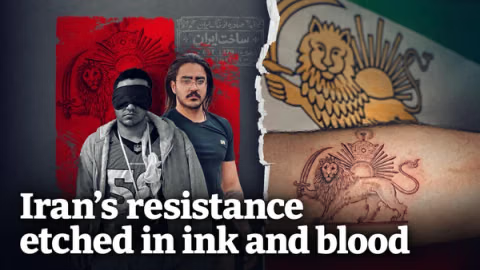
Exiled Queen Farah Pahlavi says that 88 years after Reza Shah abolished the hijab, Iran’s “backward regime” has not been able to reverse the progress of women.
Abolishing the hijab on January 17, 1936, was only one aspect of the modernization attempts by Reza Shah Pahlavi the founder of the Pahlavi dynasty. He not only freed Iranian women from hijab, but he also paved the way for them to be active members of society as teachers, government officials, nurses, and highly educated professionals.
Later in the dynasty's rule, Iranian women gained the right to vote and run for parliament, preceding many countries in granting women equal rights. However, the modernization of women and changes in their lifestyles were significantly reversed with the ascent of fundamentalist Shiite clerics to power in Iran in 1979.
In a statement released on the occasion, Farah Pahlavi praised Reza Shah for helping Iranian women to shine and “to free them from the dungeons of prejudice." She said the occasion is a landmark in the evolution of Iranian women's modern identity, adding that "many Iranian women today praise the two kings of the Pahlavi dynasty without even having lived in their period." The women, she said, demand Iran's return to the track of progress of that period.

Farah Pahlavi, characterized the current regime of Iran as "evil" and reiterated that "Finally, light will overcome darkness and Iran will be back on the track to freedom, welfare, and progress."
The modernization process initiated by Reza Shah in the 1920s propelled Iran from the depths of the Middle Ages into the modern world. Women became active and productive members of Iranian society in this evolving nation, as people transitioned from carts to trains and enrolled in newly established universities to acquire modern skills, bringing the country in line with the rapidly developing global landscape.
A modern justice system brought an end to clerical rule, limiting their involvement to solemnizing marriages and divorces, which still required registration at the Judiciary offices.
One of the initial actions taken by the Islamic regime after 1979 was the imposition of compulsory hijab on women. This was done to facilitate the suppression of women in society and symbolize the reversal of the modernization efforts initiated during the Pahlavi era.
Later, the clerics established their domination on the judicial system by replacing judges with clergymen who often were not trained to handle judicial cases. The law ceased to exist, and every decision was left to arbitrary ruling by clerics who often came from small villages.
Meanwhile, the destruction of the academic system persists as the regime dismisses university professors and replaces them with regime insiders loyal to Supreme Leader Ali Khamenei. Many officials bestow upon each other the title of "doctor," often without having completed high school. It was even exposed during televised presidential election debates in 2021 that Ebrahim Raisi, who later became president, had only received an elementary education, yet he holds the title of "Ayatollah, Doctor Raisi."
The suppression of women is one of the most elaborate examples of how the Iranian regime works. In early January, Roya Heshmati, an Iranian woman presented a dramatic account of how she was given 74 lashes for not wearing hijab. As her story went viral on social media, the regime tried to deny her account. Interestingly, tens of other women came out to tell their stories about being lashed in previous weeks and months.
Critics say that hijab is the Islamic regime's last trench to defend its existence and Islamic identity as it has lost its Islamic credential after major financial corruptions were disclosed. Nonetheless, the Islamic Republic ruthlessly cracks down on women who defy the compulsory hijab using the ‘morality police’ and the IRGC's Basij militia, while also passing laws to enforce hijab with the motto "Cover or suffer." Particularly, since the 2022 Women, Life, Freedom movement, many women have been suffering in jail and receiving lashes as religious punishment, although sharia scholars say there is very little if any about compulsory hijab and its punishment in the Quran.

A significant fire and explosion, suspected to be caused by a gas leak, occurred at a cosmetics factory near Tehran on Tuesday, injuring 53 individuals.
The incident occurred at a facility in Fardis, Alborz province, west of Tehran, where some of the victims are currently in critical condition, as stated by state media.
Preliminary investigations suggest that the blast was triggered within the production line of the factory, according to an official quoted by state TV. The injured individuals have been swiftly transferred to nearby hospitals for medical attention.
Ahmad Mahdavi, the head of the Emergency Medical Services Management Center of Alborz Province, provided an update, stating, "Overall, the general condition of most of the injured is good, and they are under medical care." He added that extensive damage occurred during the incident, and investigations into the precise cause are underway.
Hossein Ashouri, head of the Fire Department of Fardis Municipality, reported to the official Iranian news agency IRNA that "As a result of a widespread fire due to an explosion in a factory producing cosmetics and hygiene products in Simindasht of Fardis, some injuries and damages have occurred." Ashouri noted that the incident was reported to the Fardis Fire Department around 15:30, prompting immediate deployment of emergency response teams to the scene.
The previous week witnessed two bomb explosions in southeast Iran, resulting in the deaths of nearly 100 people and numerous injuries during a ceremony commemorating IRGC Commander Qasem Soleimani, who was killed by a US drone in 2020.

Iran’s chief justice says a significant number of Iranians living abroad express a desire to return but grapple with a lack of trust in the regime.
Gholamhossein Mohseni Ejei stated that mechanisms to foster trust between Iranians abroad and the government could help in this regard.
“We should treat the Iranians returning from abroad, including tourists, with utmost courtesy and dignity at key points such as airports, consulates, and embassies. In this way, the negative impact of foreign propaganda against our country can be neutralized,” he added.
Current estimates suggest that four to five million first-generation Iranians have settled in other countries, and the number may increase when considering their children born abroad, often acquiring Iranian citizenship. Some estimates propose that the total number of Iranians outside the country could be around eight million.
However, many Iranians living abroad, especially those with dual citizenship who could be accused of espionage for foreign governments, hesitate to return due to fears of being denied exit or facing imprisonment for their political activities or criticism of the regime while residing abroad.
In recent years, dozens of dual nationals, particularly citizens of Western countries such as the United States, Britain, and Germany, have been sentenced to prison on charges of espionage. The Islamic Republic often employs the individuals as bargaining chips in negotiations with foreign governments or exchanges them with Iranian prisoners in return for financial considerations.

When it comes to dealing with Iran, “words are not enough” and action has to be taken, the US Deputy Special Envoy to Iran, Abram Paley, told Iran International.
In an exclusive interview, with Samira Gharaei, Paley said the Biden administration has been “very clear” in both public and private messaging that “now is not the time for Iran or for the groups that it supports to take advantage of the situation [in the Middle East] and advance their own destabilizing interests.”
Iran and its regional allies have ramped up their operations against Israel and the US since last October, when Israel’s military began its onslaught on Gaza in response to the Hamas rampage of Israeli border areas.
For three months now, Iran-backed groups in Iraq and Syria have been targeting US bases, Hezbollah in Lebanon has been launching missiles towards northern Israel, and Yemen Houthis have been attacking commercial vessels in the Red Sea, all invoking Israeli war on Gaza as the reason for their actions, and calling for a ceasefire.
President Biden has refused to back the growing calls for a ceasefire in Gaza, though, and Paley reiterated in his interview that the administration’s support for Israel is unwavering.
Critics of the Biden administration on all sides –those who advocate more pressure on Netanyahu and those demanding a tougher stance on Iran– say lack of decisive action would not help calm, but aggravate, the situation and lead, eventually, to the kind of full-scale regional war that the administration is hoping to avert.
“I’m not going to preview US actions,” Abram Paley said when addressing the question of deterrence, and what the US government might do if the Iranian regime and its proxies continue their attacks on American interests in the region.
“We view Iran as an adversary and a state sponsor of terrorism… but we don’t focus on just one thing… we’re going to remain committed to focusing on a full range of Iran’s destabilizing behavior: from its nuclear program to its crackdown on human rights at home, to its provision of weapons to groups in the region.”
Many Iranian-American activists say the Biden administration is “soft” on Iran, demanding more pressure and less compromise, especially when it comes to human rights abuses and the US support dissidents and activists inside Iran.
“We’re going to stand with the Iranian people,” Paley responded. “We’re going to continue to make sure that their voices are heard… and that they stay connected to the outside world.”
Since coming to office, President Joe Biden seems to have framed his Iran policy around a wish to revive the abandoned 2015 nuclear deal or at least come to another (written or unwritten) agreement that would limit Iran’s nuclear program.
This doesn’t seem to have worked, however.
IAEA, the UN nuclear watchdog, confirmed in its last report of December 2023 that Iran has resumed enrichment to up to 60 percent, close to the roughly 90 percent that is required to make a nuclear weapon –after a temporary slowdown, brought about by release of some frozen Iranian funds and turning a blind eye on oil exports to China.
“We believe that diplomacy is the only way and the best way to arrive at a sustainable, effective resolution to [Iran’s nuclear] program over the long tem,” US deputy special envoy to Iran addressed the issue. “But at this point we’re very very far from that, given Iran’s continued escalation.”
Mr. Paley has been acting as special envoy after Biden's top choice Robert Malley was suspended after his security clearance was revoked due to an unspecified reason.
Asked about his former boss and what may happen to him next, Paley said, “I can’t comment… but despite that situation, the work at the State Department vis a vis Iran has continued.”

German-Iranian Nahid Taghavi, arrested in October 2020, has been temporarily released from Evin Prison under electronic surveillance.
Her daughter, Maryam Klaren, made the announcement on Tuesday, explaining that the 68-year-old’s movement is limited to within a one-kilometer radius of her apartment in Tehran.
Klaren expressed hope that her release marks the initial step towards securing the unconditional freedom of her mother.
Taghavi was arrested in Tehran and, as detailed by her daughter, endured psychological torture during her detention. Reports indicate that she was confined to solitary confinement in the notorious Ward 2-A of the Revolutionary Guards at Evin Prison for a staggering 220 days.
Narges Mohammadi, a civil rights activist and Nobel Peace Prize laureate, also in Evin, issued a warning about Taghavi's lack of access to medical care from prison in a letter in mid-June.
Mohammadi highlighted the denial of proper nutrition, quality air, and space for movement, coupled with the absence of medical and health care. Taghavi's history of a herniated disk, prolonged psychological and nervous pressure, and continuous interrogation in solitary confinement, exacerbated her condition.
Taghavi remained deprived of access to a specialist physician until February 2022. After months of delays, significant pain, and torture, she was finally transferred to a hospital in April 2023.
It is unknown how many dual-nationals are held prisoner in Iran as the Islamic Republic uses hostage diplomacy to exert pressure on Western countries to fulfill its own demands.