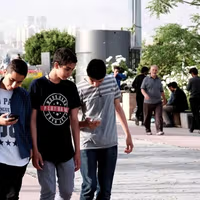
Iran’s Currency Rises After Accessing Unblocked Funds In Oman
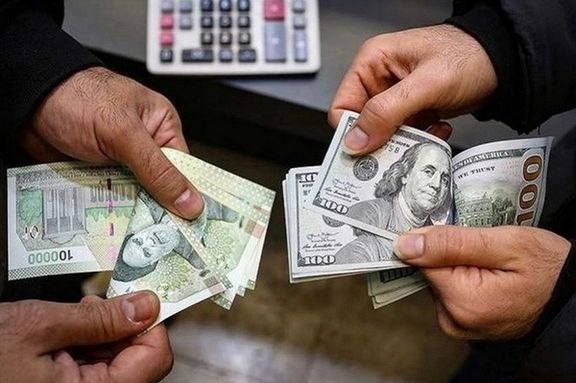
Iran’s currency, rial, rose against major currencies on Wednesday after reports last week said Tehran had used some of its unblocked funds kept in Oman.

Iran’s currency, rial, rose against major currencies on Wednesday after reports last week said Tehran had used some of its unblocked funds kept in Oman.
The rial broke through the psychological barrier of 500,000 per dollar, closing at 49,800 after a gradual rise this week. Although the change was around one percent, it was the first time since early October the rial broke through the 500,000 threshold.
The rial sharply strengthened in June when for the first time the United States offered Iraq a waiver for the release of $2.7 billion of Iranian funds frozen because of Washington’s sanctions. Later the waiver increased, allowing Iraq to send around $11 billion to Oman, where Iran can access the funds, presumably to import non-sanctionable goods.
Iraq imports gas and electricity from Iran but due to US banking sanctions imposed on Iran, could not pay its debt in hard currencies until this June.
The Biden administration released another $6 billion of Iran funds in September that was blocked in South Korea. Five American dual nationals were released from Iranian prisons in exchange for what some said was history’s largest ransom. It is not clear why the Biden administration released $11 billion from Iraq. A large part of the money was unblocked after the Hamas attack on Israel. Iran is the top financial and military backer of the Palestinian militant group.
The rial has fallen 12-fold since 2018, when the Trump administration withdrew from the 2015 nuclear deal with Iran and imposed ‘maximum pressure’ sanctions.

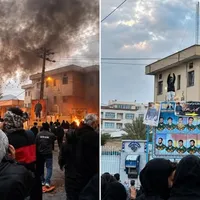
The jury of a UK court has returned a guilty verdict for a suspect gathering information on Iran International's London headquarters for a possible terror attack.
Originally from Chechnya but residing in Austria, Magomed-Husejn Dovtaev (Mohammad-Hussein Dovtaev) was detained at Chiswick Business Park by officers from London’s Metropolitan Police Counter-Terrorism Command in February. He was charged with a single count of attempting to collect information "likely to be useful to a person committing or preparing an act of terrorism." The final verdict will be issued by the court on Friday.
During the course of the trial, the police also released footage of Dovtaev gathering information about the security arrangements around the office building that housed Iran International and recording videos of the area. The police also released footage of the moment he was arrested.
Prosecutors said Dovtaev covertly filmed material on his phone in order to "identify vulnerabilities" in the media company's security which could be exploited by others.
“This trial was a reminder of the threats journalists and news organizations face. Journalism is under attack across the world from those who seek to suppress media freedom,” Iran International said in a statement after the verdict was announced.
“We will not be cowed by threats. Our journalists will continue to provide the independent, uncensored news the people of Iran deserve,” stated the news and television network, which is the the most viewed foreign-based channel in Iran in the absence of free media in the country.
Expressing gratefulness to the Metropolitan Police for all their efforts to ensure the safety of Iran International journalists, the channel said, “Today's verdict sends a clear message that the UK remains a bastion of free speech where threats against journalists will not be tolerated.”
Prosecutor Nicholas de la Poer told London's Old Bailey on Monday that Iran International became a target for reprisals following its reporting on the death in custody of Mahsa Amini in Iran last year and subsequent protests in the country. Iran's minister of intelligence later declared Iran International a terrorist organization, de la Poer said, which meant its employees "became targets for violent reprisals".
In November 2022, Volant Media, the parent company of Iran International, said that two of its journalists had been notified of direct threats. It said in a statement the Metropolitan Police had formally notified both journalists that these threats represented an imminent, credible and significant risk to their lives and those of their families. Following the significant escalation in Iranian state-backed threats and advice from the London Metropolitan Police, Iran International TV announced in February that it reluctantly and temporarily closed its London studios and moved broadcasting to Washington DC. After months of hiatus in broadcasting from the UK, the network relaunched operations from a new London building in September.
Faced with nationwide antigovernment protests since mid-September, the Islamic Republic has blamed foreign-based Persian broadcasters such as the BBC Persian and Iran International of “fomenting unrest”, while all media in the country are under tight government control and present protesters as “rioters” and “terrorists”. According to Iran’s Intelligence Minister Esmail Khatib, the Islamic Republic regards Iran International as “a terrorist organization.” He has stated that its staff and anyone affiliated with the channel will be pursued by the Ministry of Intelligence all over the globe, reiterating threats to “punish all those” who had a role in popular protests against the regime, wherever they might be.

An Iranian MP has criticized the government's proposal of a 20% salary increase for its employees and an 18% increase for retirees, while inflation in the country exceeds 40%.
"The government's disproportionate wage increase has set the people and retirees against the parliament," stated Alborz Hosseini on Wednesday.
It comes as the nation continues to grapple with persistent anti-regime protests and workers' strikes since 2017, driven by widespread discontent, particularly among the youth, amid an enduring economic crisis.
There has been a doubling of prices for specific food items in 2023 compared to the previous year and data from the Statistical Center of Iran has shown mutton and beef prices soaring by 151% and 132%, respectively.
The repercussions of high inflation are keenly felt by the poor and the middle class, intensifying their struggle to afford basic necessities, especially in terms of food and housing, as salary and wage increases fail to keep pace with inflation.
Despite hopes for a substantial pay hike, Davoud Manzour, the official in charge of economic planning, issued a warning stating that Iran cannot afford it due to a deepening cost-of-living crisis. He emphasized that such actions would result in a further imbalance in the government's budget, triggering withdrawals and expanding the monetary base, ultimately exacerbating inflation.

One day after a Swedish court upheld the conviction of a former Iranian jailer for killing prisoners, a Tehran court leveled serious accusations against a Swedish man.
Johan Floderus, detained in April 2022 during a vacation in Iran on charges of espionage, is now navigating a legal process marked by little transparency and what appears to be a hostage situation. He has been in detention for more than 600 days.
Iranian officials vehemently slammed a Swedish appeals court for upholding a life sentence for Hamid Nouri, a former prison official who was convicted earlier this year for his role in the massacre of up to 5,000 political prisoners in 1988. The Swedish verdict upholding the sentence was announced on Wednesday, as Tehran used pressures and threats to influence the appeal decision.
Now, Floderus is accused of “corruption on earth”, a serious Sharia charge that can lead even to a death sentence. This particular charge is often used by the Iranian regime against pollical opponents. He is accused of espionage, but the case, as many other similar detentions of foreigners in Iran, is wrapped in a lack of transparency.
He was told in the court on Wednesday that "These accusations are based on intelligence surveillance by Iranian security forces, scrutiny of messages, emails, monitoring of your mobile phone, your travels to various countries, your presence in Iran's border cities, your communications, trips to occupied territories [Israel], and other pieces of evidence."

According to Iranian media, Floderus did not accept the allegations attributed to himself and emphasized: “The issued warrant has a general and abstract nature and has no direct connection with me."
Judge Iman Afshari also accused Floderus of having connections with Swedish military institutions, but this EU diplomat emphasized that after completing his 13-month military service, he had no ties to Swedish military, intelligence, or security institutions."
Iran’s foreign ministry and Judicial authorities have categorically rejected the Swedish appeal court’s decision regarding Hamid Nouri. Naser Kanaani, the foreign ministry spokesperson responded to the confirmation of the life imprisonment sentence for Nouri, saying, "Iran fundamentally finds the verdicts of the lower and appellate courts regarding Hamid Nouri unacceptable and strongly condemns them."
Kazem Gharibabadi, the Secretary of the Human Rights Headquarters of Iran’s Judiciary, threatened that “Sweden's actions in this regard will not be without cost.” He made a bizarre statement that “In this case, the English were also involved, and it was not a case solely decided by Sweden."
The Floderus case is similar to the conviction of Assadollah Assadi, an Iranian diplomat convicted for terrorism in Belgium but released in May after Iran detained a Belgian traveller and accused him of espionage. Aid worker Olivier Vandecasteele spent 455 days in Iranian detention facing an uncertain future until Belgium gave in and released the convicted Iranian official.
At the time, many warned that such a prisoner exchange would set a dangerous precedent for other Westerners. The Islamic Republic of Iran has a history of detaining foreigners and dual national to use the as bargaining leverage against Western countries.

Amid criticism over the Iranian regime's environmental mismanagement, the head of the Department of Environment claims that Iran's drought might be the result of enemy actions.
Ali Salajegheh stated Wednesday "It is not unlikely that Iran's drought on a small scale is the result of hostile actions, but research in this area has not yet been conducted," a typical charge made by the government on matters for which it has no justifications.
Recent years have seen a number of Iranian environmentalists convicted of espionage for the US and UK governments and sentenced to prison.
The latest claim comes four months after Iranians protested in Tabriz against the mismanagement that led to the disappearance of Lake Urmia. The lake, once the largest in the Middle East, has significantly shrunk over the years due to water mismanagement and climate change.
Reports indicate that a quarter of Iran's farmers have lost their jobs in the past seven years, mainly due to water scarcity. Droughts and water shortages have also led to soil erosion, desertification, and hazardous dust storms affecting approximately half of Iran's population, according to the country's health ministry.
In recent years, scientists and activists have criticized the Iranian regime for its mismanagement of the country's environment, particularly concerning water resources.

Iranian authorities have executed Samira Sabzian-Fard, a victim of child marriage who was convicted of murdering her husband.
Sabzian-Fard, married at the age of 15, faced the implementation of her death sentence for killing her husband four years after their marriage in 2013, according to the Norway-based Iran Human Rights (IHR).
Mahmood Amiry-Moghaddam, the Director of IHR, branded her execution as a “stark reflection of an inefficient and corrupt government resorting to violence and intimidation to sustain itself.” The IHR has called on the international community to hold Supreme Leader Ali Khamenei and other officials of the Islamic Republic accountable for such actions.
Sabzian-Fard's story is emblematic of women in Iran who, at a young age, are forced into marriage and subsequently become victims of marital issues. The latest report from the Iranian Statistical Center reveals a distressing statistic: at least 27,448 girls under the age of 15 in Iran married in 2022 alone.
Simultaneously, there has been an intensification of policies encouraging marriage in the country, as emphasized by the Supreme Leader Ali Khamenei. In recent years, targeted efforts have been made to reduce the age of marriage for girls and encourage families to facilitate the marriage of their daughters. One in five marriages involves minors, girls allowed to marry as young as 13.
The regime's efforts have been championed by some members of the parliament, government officials, and various cultural and educational institutions.
Iran is the world's leading executor of women, with a minimum of 16 reported executions in 2022 and a total of at least 17 women executed in the country so far this year. This grim reality is exacerbated by Iranian laws that prevent women from seeking divorce, even in cases of domestic violence.