Iran called on the United States to clarify its association with Jamshid Sharmahd, an Iranian-German national sentenced to death in Iran after a State Department official met with his family.
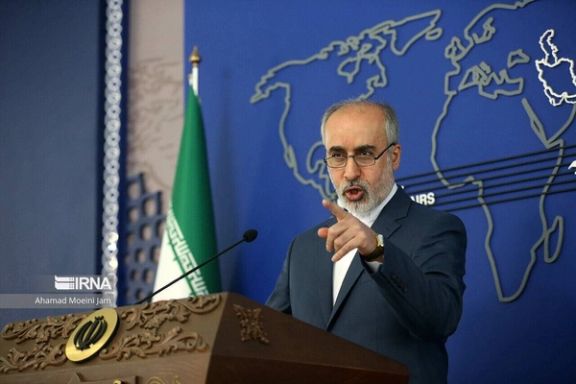
Foreign Ministry Spokesperson Nasser Kanaani stated, "The United States government must respond to the Iranian government and people regarding the individual who is recognized and condemned in court for terrorism."
He added that Sharmahd, “responsible for a recognized terrorist group, has committed numerous acts of terrorism against Iran." He specifically alleged that Sharmahd had a role in planning and executing bombings in Shiraz, resulting in deaths and injuries.
Kanaani's remarks followed a meeting between US envoy for Iran, Abram Paley, and the family of Jamshid Sharmahd. Sharmahd, a German Iranian citizen abducted by Iranian agents in Dubai, in 2020, was sentenced to death in Iran in February. He was convicted of leading a pro-monarchist group linked to a deadly 2008 bombing.
Paley succeeded Rob Malley as US envoy for Iran, with Malley placed on unpaid leave due to security protocol violations. Sharmahd's family, including his son and daughter, Gazelle and Shayan, have been actively seeking US officials' attention through sit-in protests outside the State Department to advocate for their father's case.
A controversial deal exchanging five US citizens held hostage by Iran for the release of $6 billion in Iranian funds frozen in South Korea has sparked criticism, especially due to the exclusion of Sharamhd, who hold US permanent residency and another prisoner. Former hostages and analysts argue that the deal could embolden future hostage-taking incidents.
Sharmahd's health has deteriorated during his imprisonment, with human rights organizations expressing concern. He has been held in solitary confinement and denied fair legal proceedings. In February, Iran's judiciary handed down a death sentence.
Regime affiliated Tehran Times has published a “sensitive but unclassified" US government memo allegedly showing three violations of US national security protocols by suspended Iran envoy, Rob Malley.
The document, purportedly from Erin Smart, Director of the State Department's Bureau of Diplomatic Security, Office of Personnel Security and Suitability, cites three reasons for Malley's suspension: “Personal Conduct,” “Handling of Protected Information,” and “Use of Information Technology.” The memorandum further underscores that Malley's “continued national security eligibility is not clearly consistent with the interests of national security."
While Iran International has yet to independently verify the document's authenticity, it has been informally corroborated by two congressional sources, who have described it as seemingly "authentic."
Iran International reached out to the State Department for confirmation on the authenticity of the leaked document; however, there was no immediate response.
Michael McCaul, chairman of the US House Foreign Affairs Committee, expressed concerns in July, hinting at a possible subpoenaif the Biden administration remains reticent on the specifics of Malley's situation.
McCaul, relying on publicly available information, voiced serious apprehensions: "If he (Malley) has leaked very sensitive or classified information to our foreign adversaries like Iran or Russia, that's a very serious act that would fall under treason."
The State Department, citing privacy, has remained largely silent on the matter. However, the memo published by Tehran Times suggests that Malley might have been privy to the reasons behind his suspension, contrary to his earlier statements to the media.
"I have been informed that my security clearance is under review. I have not been provided any further information, but I expect the investigation to be resolved favorably and soon," Malley said in response to press inquiries at the time.
In the wake of the leaked document, Gabriel Noronha, a former State Department advisor on Iran, took to Twitter, suggesting, "The letter indicates Malley lied about not knowing why his clearance was pulled."
Richard Goldberg, a National Security Council official from the Trump era, remarked, "The Tehran Times knows more about Rob Malley than the New York Times. This is insane."
The controversy has also stirred debates among Iran analysts. Princeton University's decision to employ Malley at its School of Public and International Affairs has drawn criticism. Alireza Nader, an Iran analyst and a former senior researcher at the RAND Corporation questioned the institution's judgment, asking, "What in the world are Princeton and its SPIA dean Amaney Jamal thinking in hiring Malley? Does anyone want someone like this teaching students?"
Jason Brodsky, a policy director at the United Against Nuclear Iran, weighed in on the situation, expressing deep concern over the leak to a state-run newspaper of a nation often at odds with the US. "Can you imagine if this situation happened during the Trump administration? Somehow, I think there would be more press and congressional scrutiny. Just extraordinary. This is a newspaper of a hostile foreign power in possession of a seemingly authentic sensitive document."
Earlier this year, Iran International revealed Malley's interactionswith Iran's UN ambassador, Amir Saeed Iravani, a former high-ranking member of Iran’s Supreme National Security Council. These interactions marked a pivotal diplomatic touchpoint, being the first direct US-Iranian official communication since the US's 2018 JCPOA withdrawal. The State Department, when questioned about these meetings, responded, "We have the means to deliver specific and firm messages to Iran when it is in America's interest to do so.”
Iran International first reported June 29 that Malley had been absent for a considerable time, his security clearance was suspended and he is under investigation related to his handling of classified documents. The Involvement of the Federal Bureau of Investigation was also reported, although until now no official details have been announced, except that Malley is on “unpaid leave.”
Iran’s media have reported that Ali Salehabadi, former governor of Iran's Central Bank, is set to assume the position of Iran's new ambassador to Qatar.
Salehabadi resigned as the governmental head of the Central Bank in December 2022 amid nationwide economic challenges. His new potential appointment appears timely as it coincides with the unfreezing of $6 billion of Iranian assets to Qatari banks and Iran’s hostage release of US citizens.
While no official confirmation has been released by either the Iranian government or Qatari authorities, this speculative appointment raises eyebrows due to Salehabadi's extensive financial background.
Salehabadi's tenure as the head of Iran's Central Bank was marked by a period of economic turbulence and uncertainty. Last year’s departure from the Central Bank was attributed to the complex economic problems that Iran faced during his term, including inflationary pressures and international sanctions.
The potential selection of Salehabadi as Iran's ambassador to Qatar, a role often filled by career diplomats, indicates a strategic shift in Iran's diplomatic approach. Experts speculate that this move might reflect Iran's intention to leverage Salehabadi's financial expertise to navigate the economic intricacies of the region, especially in light of the recent unfreezing of assets.
Iran’s deal with the US, which led to the release of the frozen funds, has been a point of contention within the international community. Critics argue that unfreezing these assets could inadvertently provide Iran with more resources to support its oppressive regime towards its citizens, while proponents suggest that it might pave the way for improved diplomatic relations.
An oil leak has hit a transmission pipeline linking Iran's Kharg island to the country's mainland port of Genaveh.
An oil leak has been detected in a crucial transmission pipeline connecting the strategic Kharg Island south of Iran to the mainland port of Genaveh.
According to a report from the semi-official Tasnim news agency on Sunday, two vessels have been dispatched to the coasts of Kharg and Genaveh to facilitate the clean-up operations and to mitigate potential environmental and economic repercussions.
"To prevent oil leakage on the seabed from the pipelines, diving teams have been dispatched," an official from Bushehr province said.v
While the exact extent of the spill remains undisclosed, authorities have revealed that officials from Bushehr province have mobilized diving teams to prevent further oil leakage on the seabed from the pipelines.
Kharg Island, located 25 kilometres off the Gulf coast of Iran, holds importance as a critical oil terminal responsible for a significant portion of the country's oil exports. Therefore, a prompt response to the leak will safeguard not only the environment but also Iran's crucial economic interests. Further updates will be provided as the situation develops.
Reza Amiri Moghadam, Iran's ambassador to Pakistan
Iran’s new ambassador to Pakistan has said Iran can help to solve Pakistan's energy crisis by supplying electricity, gas and oil at the "lowest price."
Speaking to local media in Islamabad on Saturday, Reza Amiri Moghadam, who was appointed as Iran's new ambassador in June, said that the Islamic Republic would be able to relieve Pakistan's electricity and gas shortages with cheap fuel.
His comments come three weeks after the Iranian Foreign Minister Hossein Amir-Abdollahian visited Pakistan and their Ministry of Energy announced that a new contract had been signed to increase electricity imports from Tehran.
During his unofficial discussions with the media, Moghadam also claimed that the gas pipeline project and Iran's gas purchase from Pakistan wouldn't be threatened by US sanctions.
Iran itself is facing severe energy shortages, but President Ebrahim Raisi’s administration has continued to increase electricity and gas exports mostly to Iraq, Pakistan, and Afghanistan.
In addition to increasing gas exports, various reports indicate that Iran has resorted to extensive mazut combustion in power plants and industries to compensate for domestic gas shortages. Mazut is the most polluting fossil fuel and leads to severe air pollution.
Earlier this year, Tehran warned Islamabad that if it fails to complete its share of the gas pipeline project by March 2024, it would have to pay around $18 billion in fines. Washington opposes the construction of this pipeline and considers it a violation of US and Western sanctions against Iran.
Iran's foreign minister has expressed his gratitude for the mediation efforts of Qatar and Oman in the ongoing process to release Tehran's frozen assets.
Hossein Amir-Abdollahian made separate telephone conversations to his Omani and Qatari counterparts during which he recognized and commended their mediation efforts to facilitate negotiations to unfreeze Iran's assets.
These discussions also underline the multifaceted nature of Iran's diplomatic engagement, encompassing broader bilateral economic, political, and regional matters.
Earlier this month, Iran and the United States announced that $6 billion frozen in South Korea due to US sanctions will be released through Qatari mediation, as Iran releases five US hostages from prison into home detention.
The Iranians insist that the release of the US citizens was part of a prisoner exchange agreement not related to the release of the funds. However, it is clear that the hostages are being kept in Tehran until the money reaches Iranian bank accounts in Qatar.
Currently, the funds are with the central bank of Switzerland, which is exchanging them into Euros gradually and will transfer to Qatar where Iran will be able to access them.