Virginia Man Sentenced To Prison For Violating Iran Sanctions

Behrouz Mokhtari, a 72-year-old US citizen, and a native of Iran received a 41-month federal prison sentence for conspiring to violate sanctions.

Behrouz Mokhtari, a 72-year-old US citizen, and a native of Iran received a 41-month federal prison sentence for conspiring to violate sanctions.
In January, Mokhtari pleaded guilty to two counts of conspiracy to violate the International Emergency Economic Powers Act ("IEEPA") – that restricts the exportation, re-exportation, sale, or supply, directly or indirectly, of any goods, technology, or services to Iran. He was sentenced this week to 41 months in federal prison, followed by three years of supervised release.
United States Attorney Erek L. Barron said, "This defendant knew that he was prohibited from engaging in business with Iran but did so anyway and attempted to conceal his actions through his control of businesses and financial entities in Iran and the United Arab Emirates. Now, he will not only serve time in federal prison, he will forfeit cash and property purchased with his ill-gotten proceeds."
The charges against Mokhtari involved two separate conspiracies. In one, he engaged in prohibited business activities on behalf of Iranian entities, evading sanctions from March 2018 to September 2020.
The second conspiracy spanned from February 2013 to at least June 2017. Mokhtari and Iranian nationals conducted illicit shipments of petrochemical products to and from Iran, using the US financial system to facilitate the shipments.
Mokhtari transferred ownership of the vessels to other entities to hide their financial interests. He used the United States financial system for related transactions, including the sale of one vessel for over $3.1 million, from which he received approximately $2.8 million. Mokhtari used these proceeds to purchase a residence in Campbell, California.


Reports about a serious human rights violator from Iran being treated in a private clinic in Germany have stirred sharp controversy among Iranians and German media.
Iranian opponents of the Islamic Republic on Monday accused the Hanover-based International Neuroscience Institute of expunging the patient record of the “hanging judge” Hossein-Ali Nayeri who was involved in the massacre of hundreds of political prisoners in 1988.
Germany’s largest paper, the mass circulation Bild, reported that INI deleted Nayeri’s medical record in apparent move to avoid a new pro-Iran regime scandal. The director of the INI, Dr.Madjid Samii, scrambled to deny the allegation that he was caught again treating a regime official responsible for severe human rights abuses.
“There are currently no patients from Iran at the INI. These allegations damage our reputation, and not for the first time,” said Samii, according to the regional paper HAZ.
Samii, who was born in Tehran in 1937, faced widespread outrage in 2018 for providing care to Ayatollah Mahmoud Hashemi Shahroudi at INI. Shahroudi headed the Islamic Republic’s opaque judiciary from 1999 to 2009 and imposed executions on 2,000 people, including adolescents. Germany’s government permitted Shahroudi to leave the country after his treatment.

Samii told the HAZ that “As a doctor, I have an obligation to treat every patient, even it is Putin.”
Jason Brodsky, policy director of the US-based United Against a Nuclear Iran (UANI), tweeted a report from the German paper Die Welt that said “According to eyewitnesses, two vehicles with license plates of the Embassy of the Islamic Republic of Iran were in the parking lot of the clinic [INI]last Friday.”
The Iranian-German dissident, Dr. Kazem Moussavi, told Iran International that Samii is a “well-known friend of the mullahs” and also treated former Iranian regime judge Gholamreza Mansouri in 2020. Mansouri incarcerated 20 journalists during his tenure. The regime-controlled Young Journalists Club reported at the time that Mansouri “is said to be hospitalized in Professor[Majid] Samii's hospital in Germany.”
Moussavi added, “As an Iranian member of the opposition and spokesman for the Green Party of Iran in Germany, I sharply criticize the Federal government and Green Foreign Minister Annalena Baerbock for regrettably turning Germany into a secret place of treatment for the mullahs' death judges. He [Nayeri] is being treated in a German city of all places, in Hanover, where the Germanpolitical hostage awaiting his execution in Tehran, Jamshid Sharmahd, lived with his family.”
Moussavi said the German “Federal government must end its appeasement policy” toward Iran’s regime and called for the immediate arrest of Nayeri.
The Bild paper also took the German government to task for its policies that reportedly placate Tehran’s rulers. “Sweden shows that there is another way: Hamid Nouri, a member of the Islamic Revolutionary Guards and Nayeri’s assistant, was arrested [in Sweden] in 2019. Despite protests from Tehran, Nouri was sentenced to life imprisonment in 2021 for torture and murder.”
Moussavi said that Nayeri ”has served as chief adviser to the Islamic Republic's death judge, Gholam-Hossein Mohseni-Ejei, since Ebrahim Raisi's presidency. Both are directly responsible for the political prisoners and those executed in the ‘Woman, Life, Freedom’ protests in Iran.”
The Bild reported that Iranians, who live in Germany and were victimized by Nayeri, filed criminal complaints against the cleric and judge. The human rights activist Mina Ahadi told the paper “Many of his traumatized victims are here in Germany, you meet them everywhere.”
Amnesty International classified the 1988 massacre as a “crimes against humanity” in which the regime slaughtered at least 5,000 political prisoners. Nayeri issued summary executions to hundreds of political prisoners at Evin and Gohardasht prisons.
The Iran People’s Tribunal on Monday wrote on its website that it filed a case against Nayeri at the Berlin Prosecutor’s Office. Four witnesses are part of the Tribunal’s case who were taken to Nayeri’s “Death Committee” in 1988. The Tribunal said the Berlin Prosecutor forwarded the case to the Hanover Prosecutor who assigned the police to investigate. The police said Nayeri had not been admitted to the INI.

Mizan, an Iranian regime-controlled news agency affiliated to the judiciary, denied that Nayeri visited Germany.
Sheina Vojoudi, an Iranian dissident in Germany, termed Germany’s conduct toward admitting Iranian regime officials accused of grave human rights violations a “double standard.”
She said, “How can Germany express its concern about human rights violations in Iran, yet let the human rights abusers who are responsible for thousands of innocent lives be hospitalized in Germany while there is no way for the persecuted Christians or political activists to apply for a German visa.”
She continued, “These ayatollahs who have been treated on German soil issued thousands of death sentences to innocent Iranians. Arresting these human rights abusers for their crimes against humanity is the least expected when they enter a democratic country.”
Vojoudi, an associate fellow for the Gold Institute for International Strategy, argued that “Iranian refugees in Germany fled to save their lives from the same Ayatollahs who always come to Germany for the best treatment.”
Iran International sent numerous press queries to the INI and the German Foreign Ministry.

Oman will be the third country that will hold part of the funds Iraq owes Iran, which should be used for non-sanctionable goods, the US State Department said Monday.
Last month, the United States issued a sanctions’ waiver allowing Baghdad to pay over $2.7 billion of the $11 billion it owes Tehran for importing electricity and natural gas. Last week, Washington announced a change in the method of disbursing the funds, by transferring the money to third-country banks and then allowing purchases of goods such as food and medicine.
State Department spokesperson Matt Miller in his Monday briefing announced that the third country selected for the new payment method is Oman. “As we’ve said for some time, we thought it was important to get this money out of Iraq, because it is a source of leverage that Iran uses against its neighbor,” he said, without elaborating.
Late last year, the Biden administration started to tighten controls over dollar transactions by Iraqi banks, seeing evidence that there were banking violations potentially enabling Iran to illegally acquire US dollars. In February this year news emerged that Washington further tightened regulations over dollar transfers to and from Iraqi banks.
The leverage the US has in this matter is that Iraqi oil export proceeds are cleared by its banking system. Iraqi requests for cash dollar shipments and banking transfers are scrutinized by US federal agencies to make sure that illicit activities are prevented.
Since the Trump administration exited the 2015 JCPOA nuclear deal and imposed banking sanctions on Iran, it has periodically issued waivers allowing Iraq to make funds available to Iran for purchase of non-sanctionable goods, but to control all the transactions and Iranian attempts to syphon money out of Iraq has been hard.
Whether shifting the funds to Oman will ensure a tighter control over the process is yet to be seen. Clearly, Iran’s attempts to pressure all parties involved in slackening controls will continue. It is not clear if the change is not the result of an Iranian plan to gradually weaken the impact of US banking sanctions on its dealings with Iraq. Iran’s next move could be to further pressure Iraq to ask the United States to lift restrictions on how the funds are disbursed, enabling Tehran to withdraw cash dollars. The current Iraqi government has closer ties with Tehran than its predecessor.
State Department’s Miller, however, insisted that all funds “will still be subject to the same restrictions as when the money was held in accounts in Iraq, meaning that the money can only be used for non-sanctionable activities such as humanitarian assistance, and that all the transactions need to be approved by the United States Treasury Department in advance.”
There have also been multiple media reports that Washington and Tehran have been negotiating over the release of four American held hostage in Iran in exchange for $7 billion frozen by South Korean banks due to US sanctions. The decision to shift Iraqi funds to Oman could also be related to these secret talks.
Miller was asked Monday about the prisoners, but he refused to provide details.
“It’s obviously a very sensitive matter with respect to these detainees,” he said.
But critics who are suspicious of the Biden administration’s secret dealings with Tehran are wary of attempts to give financial rewards to the Islamic Republic in return for the hostages or a limited nuclear understanding, that has been reported by the media.

Iran has accused the US of destabilizing cybersphere, claiming that lack of fair international laws has made it vulnerable to US influence.
Speaking at a meeting of national security advisors and secretaries of BRICS countries in South Africa, Iran’s Secretary of the Supreme National Security Council Ali Akbar Ahmadian warned of the impacts of Washington’s interference on the internet.
"The experience of Iran has shown how Americans have tried to make different types of interferences and create insecurity in other societies through cyberspace," Ahmadian said.
He claimed that the US’s control over online platforms like Google, Twitter, Instagram, etc. has made it possible for Washington to assert control over the global online media.
In a subtle attempt to justify the regime’s restrictions on the Internet and access to information, he said "The cyberspace of each country... must be managed exclusively by their respective governments."
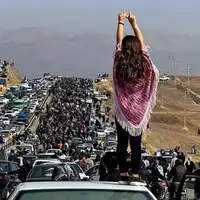
Among the challenges the regime faces to stifle voices of dissent and crack down on popular protests, authorities have blocked access to Instagram and WhatsApp in September, when the death of Mahsa Amini in police custody ignited the boldest uprising against the Islamic Republic since its establishment. Facebook, Twitter, and Telegram had previously been banned after the 2009 presidential election and the November 2019 protests.
His remarks came as concerns have been raised over cyber threats emanating from Iran. Hackers linked to the country have targeted critical US infrastructure, including transport, energy, and ports, prompting heightened vigilance in the United States.

Secretary of State Antony Blinken reiterated Sunday that the US is pursuing de-escalation with Iran, but it remains unclear if Washington has made any offers to Tehran.
Speaking on CNN’s Fareed Zakaria GPS program, Blinken announced that “We’re now in a place where we’re not talking about a nuclear agreement. We are very clearly making it known to them that they need to take actions to de-escalate, not escalate, the tensions that exist in our relationship across a whole variety of fronts.”
Iranian officials and government media have yet to react to Blinken’s statement. Official and semi-official government media were silent on Monday but a ‘reformist’ website in Tehran, not directly controlled by the government, published the news about his remarks with a clear distortion.
Speaking about long negotiations in 2021 and 2022 that came to a deadlock last September, Blinken told CNN that “An agreement was on the table. Iran either couldn’t or wouldn’t say yes.” However, Etemad Online translated the sentence to, “Iran has not made a decision yet.”
Blinken did not explain what de-escalation means from the Biden administration viewpoint. Clearly, high levels of uranium enrichment and stockpiling fissile material for nuclear bombs is the most provocative policy Tehran currently pursues. But is the administration also telling the Islamic Republic they have to also de-escalate in their provocations in the region, such as attacks on US forces and open incitement of terror attacks on Israel?

There is also the issue of Iran supplying kamikaze drones to Russia that the administration has said is one of its pre-conditions for resumption of full nuclear talks. So far, Iran has shown no inclination to de-escalate in any of these areas.
Blinken also did not say what the United States is promising Iran in return for de-escalatory steps. Certainly, Tehran would demand the lifting of at least some sanctions. Already, the Biden administration has not been rigorously enforcing existing oil export sanctions that has allowed Iran to increase its exports to as high as 1.5 million barrels a day. Before former President Donald Trump withdrew from the 2015 JCPOA nuclear agreement, Iran was shipping around two million barrels. One can argue that Iran has almost overcome the oil sanctions, although US banking sanctions are still deterring most banks in other countries from doing business with Iran.
But if we assume that de-escalation applies only to less enrichment or a cap of 60-percent uranium purity in exchange for lifting some critical sanctions, then that was Iran’s plan all along. In December 2020, the Iranian parliament passed legislation to enrich at higher levels to force the US to lift sanctions. In fact, the bill was called the ‘Strategic Action to Eliminate Sanctions and Defend Iranian Nation's Interests.’
That negotiating tactic was initiated a month earlier in November by parliament, when Joe Biden won the presidential election and Tehran was certain that his administration was determined to reverse Trump’s decision and revive the JCPOA.
Now, the administration just hopes for de-escalation while it knows that Iran will use every means of pressure to project power.
“We are continuing to work out, to develop, to flesh out every possible option for dealing with the problem if it asserts itself,” Blinken said.
Earlier this month Iran tried to seize to commercial vessels in the Persian Gulf and the US Navy intervened to prevent it. Immediately plans were put in motion to reinforce the US naval presence in the region, dispatching more warplanes and warships.
Iran will not confront the United States where a clear deterrent signal has been issued. It most probably will hit back elsewhere or use new tactics.

One of the judges involved in the summary trial and execution of thousands of Iranian prisoners in the 1980s has been under treatment in a hospital in German city of Hanover.
According to German media outlet Presseportal, Hossein-Ali Nayeri was admitted to a private neurosurgical clinic -- the International Neuroscience Institute (INI) -- headed by Madjid Samii, a prominent Iranian-born neurosurgeon.
Nayeri, a cleric, judge and chief adviser to Iran’s judiciary, was one of the main figures in the "death committee" responsible for the mass execution of political prisoners in Iran in 1988. President Ebrahim Raisi was also a key member of this committee.
On July 7, Volker Beck, the president of the German-Israeli Society, notified Germany’s Federal Public Prosecutor, the Foreign Office, and the Federal Interior Ministry about Nayeri’s stay, urging them to initiate criminal prosecution measures against him.
While people are murdered and tortured to death in Iranian prisons, those responsible for the human rights violations travel to Germany with impunity, he said, stating, “This must come to an end.” He also referred to another Iranian judge -- Mahmoud Hashemi Shahroudi – who was treated in the same clinic in Hanover in 2018.
In July 2022, Nayeri defended the massacre in an interview with the Islamic Republic Documents Center, a government entity that collects the history of the 1979 revolution and more than four decades of rule by the Islamic Republic in Iran.
He tried to justify and explain away the killing of thousands of political prisoners, saying, “The country was in a critical state. If Khomeini [the Islamic Republic's first leader] did not stand firm... perhaps the regime would have not been able to survive.”