Israel Accuses Iran Of Efforts to Disrupt Jerusalem Day Flag March

On the eve of Jerusalem Day Flag on Thursday and Friday, Israeli police accused Iran of trying to disrupt a traditional march by creating “wild” incitement.

On the eve of Jerusalem Day Flag on Thursday and Friday, Israeli police accused Iran of trying to disrupt a traditional march by creating “wild” incitement.
Police chief Kobi Shabtai warned against Iran-backed terror group incitement, saying “terrorist elements motivated by Iran — through Hezbollah, Hamas and Islamic Jihad — have been spreading false information on social media about the route of the flag parade…. in the capital of Israel, Jerusalem.”
“The goal of those terrorist elements is clear — it is to create wild incitement to terrorism against the thousands of Israelis who will come to celebrate Jerusalem Day at a number of events,” he said.
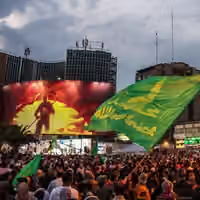
More than 3,000 police officers will be deployed across the city for the Jerusalem Day Flag March, which is anticipated to attract tens of thousands of mostly Orthodox Jewish nationalists.
The event marks Israel's unification of East and West Jerusalem during the 1967 Six Day War, but has gained notoriety over the years due to hate speech and violence by some Jewish participants.
On Wednesday, Hamas officials threatened an unspecified response if the march went ahead.
“The Zionist Flag March will not pass, and the response will inevitably come,” said senior Hamas official Salah al-Bardawil in a statement.
Israel has warned Hamas that if it fires rockets, it will respond.
Iranian proxies in Gaza, Lebanon and Syria have all recently attacked Israel with rockets as tensions simmered during the month of Ramadan.
A whistleblower active in the IT industry has leaked documents revealing hundreds of millions of dollars' worth of telecommunications contracts between Iran and China.
London-based Iranian-British internet security expert and cyber espionage investigator Nariman Gharib released a list of contracts signed between the Islamic Republic's Ministry of Information and Communications Technology and Chinese companies.
The secret document – which has no date and cannot be verified independently by Iran International -- contains a table of 10 contracts for various projects such as development of Iran’s landline network, infrastructure for fourth and fifth generation of broadband cellular networks and three satellite projects as well as production of smartphones and developing messenger services.
Feasibility studies for several of the projects have been carried out but some others are in the planning stages.
The project for the supply and operation of a geosynchronous telecommunication satellite is announced to be at $100 to $450 million for a 42-month project while another satellite project is valued at $300 million for a three-year project.

The project for landline development is worth $220 million while the project for the modernization of Telecommunication Company of Iran, or TCI -- the country’s main mobile service provider -- is $325 million followed by the modernization of MTN Irancell -- another telecommunications company -- at $250 million.
Each company will get 1,500 5G sites and 3,000 LTE networks, according to the contracts.
China’s large-scale effort to control and censor the Internet has become a viable conceptual and technical model for authoritarian regimes, like Iran's Islamic Republic. The Islamic Republic of Iran follows China’s lead in systematic oppression techniques.
China has combined legislative actions and technological enforcement to regulate the Internet domestically, calling it “The Great Firewall” of China.
Cybersecurity expert, Robert Potter, has said in a joint report, "China is known to be building a techno-surveillance authoritarian state domestically."
China’s second-largest telecom equipment maker, ZTE, sells to more than 500 carriers in more than 160 countries, 60 of which have questionable human rights records. In addition to selling services, China provides training programs that include subjects like ‘manipulating public opinion.’
According to a 2012 report by Reuters, China’s ZTE sold TCI a powerful surveillance system capable of monitoring landline, mobile and internet communications. The system was part of a 98.6-million-euro ($130.6 million) contract. Government-controlled TCI has a near monopoly on Iran’s landline telephone services and much of Iran’s internet traffic is required to flow through its network. The ZTE-TCI deal, signed in December 2010, illustrates how despite tightening global sanctions at the time, Iran still managed to obtain sophisticated technology, including systems that can be used to crack down on dissidents.
During a briefing at an annual security conference in Munich in 2020, United States’ officials warned that China will use Huawei’s presence in future communication networks to steal corporate secrets, censor content, and track dissidents. Critics of China say the rapid rise of these tech companies stems from the theft of intellectual property. Chinese tech giant Huawei has done business with North Korea, helped Iran spy on their citizens, and created ‘back doors’ for easier intellectual property theft.
As Washington stepped up pressure on the world's largest telecommunications equipment maker, the US Justice Department accused Huawei Technologies in February 2020 of helping the Islamic Republic track anti-government protesters. In September 2021, Huawei Technologies chief financial officer Meng Wanzhou admitted helping Huawei conceal dealings with the Iranian regime.

Iran's president has warned the Taliban to share water from the Hirmand River in the latest episode of a long-running dispute.
Flowing 700 miles, the river – also known as Helmand – enters Iran's Hamoun wetlands in the Sistan-Baluchestan province after originating in the Hindu Kush Mountains near Kabul. Lake Hamoun used to be one of the world's largest wetlands, straddling 4,000 square kilometres (1,600 square miles) between Iran and Afghanistan.
The river constitutes more than 40% of Afghanistan’s surface water, according to water experts, and runs about 1,125km (700 miles) southwest from the Hindu Kush mountains into Iran. The River, which both Afghanistan and Iran depend on for agriculture and drinking water, has been their biggest source of tension for years.
Over the years, Iran has accused Afghanistan of restricting the flow of water from the river by building dams over it, a charge that Afghan authorities deny.
Speaking on Thursday on a visit to the southeastern Sistan and Baluchestan province – a deprived region where the water is desperately needed – President Ebrahim Raisi warned the Taliban: "Take my words seriously so that you don't complain later."Sistan-Baluchestan is the most deprived region of Iran.
"Afghanistan's rulers should allow our experts to come and check the truth of the matter. If our experts confirm a lack of water, we have nothing to say, otherwise we will not allow the rights of our people to be violated in any way," he added.
During his visit, Raisi also inaugurated a project to supply water from the Gulf of Oman to eastern cities of the country, including to more than 150 villages across the Sistan-Baluchestan province.
The new water supply project would take water from the Persian Gulf and Gulf of Oman to the provinces of Sistan-Baluchistan, South Khorasan and Razavi Khorasan via a 1,700-kilometer pipeline.
It has been criticized by experts as another measure by the government that would aggravate the situation, with environmentalist Kaveh Madani describing it as detrimental to unique ecosystem of the Persian Gulf region.

Iran's Foreign Minister Hossein Amir-Abdollahian recently said that the Afghan side has claimed the dam built over Hirmand does not have enough water.
Calling on Afghan authorities to let the water flow, he said, "Our clear request from the Afghan side is to open the gates of the Kajaki Dam before the time is lost," he said.
An agreement between Tehran and Kabul in 1973 stipulated that Afghanistan had to allow Iran an average of 556,000 acre-feet or 820 million cubic meters of water per year.Afghanistan must deliver water from the Helmand River to Iran at a rate of 22 cubic meters per second per annum (normal water year) with an additional four cubic meters per second for “goodwill and brotherly relations.”
Earlier in the month, the Iranian president's special envoy for Afghan affairs, Hassan Kazemi Qomi, only 27 million cubic meters of water reached Iran last year that is a small fraction of how much Iran is entitled to under the water-sharing treaty.
“The issue of the (1973) treaty is a legal issue, to which the Afghan government is committed and has declared its adherence. It must also implement the treaty,” he said.
Iranian Energy Minister Ali Akbar Mehrabian has also recently said that the government is taking "serious steps" to ensure proper implementation of the treaty, adding that Taliban authorities in Kabul are committed to the water-sharing treaty.
The previous Afghan government stopped the flow of water to Iran after inaugurating the Kamal Khan Dam, in Nimroz province in 2021.

At the inauguration of the dam, ex-President Ashraf Ghani, pledged to stick by the 1973 agreement over Hirmand waters, saying that Kabul wanted to trade water for oil. “Afghanistan would no longer give free water to anyone, so Iran should provide fuel to Afghans in exchange for water,” he said.
In late July 2022, Amir-Abdollahian also warned his Taliban counterpart, Amir Khan Muttaqi, that prohibiting Tehran from its rightful access to the Helmand River will only cause further strain to already tattered ties.
Afghanistan argues that complaints about improper allocation of water were made when the Helmand River Basin was under drought which severely reduced the river’s water flow, with Afghani pundits claiming that Iran had been receiving more water during normal and above-normal water years.
One way to solve the issue, as foreseen in the Helmand River Treaty in 1973, is that the two neighboring countries jointly determine places of delivery and construct joint hydrometric stations, regulating their water share more strictly.
In August 2022, Afghanistan and Iran agreed on a timeline for the construction of joint hydrometric stations, but such projects will take years to complete.

The US, UK, Denmark and others have warned about the booming practice of unregulated ship-to-ship oil transfers at sea, which increase the risk of pollution.
"These transfers undermine the rules-based international order and increase the risk of pollution to nearby coastal States. This threatens global efforts to prevent pollution from ships," the paper submitted to the UN said.
The paper was submitted to United Nations International Maritime Organization (IMO), by the member states ahead of a major marine environment protection committee session in July. It was also backed by Australia, Canada, Spain and Ukraine.
Hundreds of "ghost" tankers, which are not fully regulated, have joined this opaque parallel trade over the past few years, carrying oil from countries hit by Western sanctions and restrictions, including Russia and Iran, whose oil exports have been sanctioned.
The number of incidents last year, including groundings, collisions and near misses involving these ships reached the highest in years, a Reuters investigation showed.
"These risky practices, although under the jurisdiction of a flag state, unjustly expose national and local governments and authorities to paying for response and clean-up costs and compensating victims," the paper said.
Tactics used by such ships include switching off tracking transponders, faking locations and also conducting ship-to-ship (STS) operations at locations outside of authorized transfer zones and sometimes in poor weather to conceal activities.
The paper, which will be discussed at the IMO session, said deceptive shipping practices were also "serious threats to the safety and security of international shipping", including crew members.
The countries recommended that when flag states became aware of such practices, they should step up inspections of those vessels and boost monitoring of activity including around territorial waters.
Reuters Report

Ten months before parliamentary elections in Iran, the ‘reformist’ and centrist factions of the regime are already concerned about an electoral candidate purge.
Hardliners, who packed the parliament in 2020 with help from the Guardian Council, which barred most other candidates, are seen as determined to hold on to power.
There is also near unanimous consensus among non-hardliners that voter turnout will be very low in the absence of competition, at least among regime factions.
Jahanbakhsh Mohebbinia, a former Iranian lawmaker close to ex-Speaker Ali Larijani has accused media outlets close to the Revolutionary Guard (IRGC) of spreading fake news to create an atmosphere of excitement ahead of the upcoming parliamentary election.
Recently IRGC-linked Tasnim news agency spread rumors about former President Hassan Rouhani and former Parliament Speaker Ali Larijani allegedly considering the idea of running for the parliament. However, Larijani issued a terse response, alluding to “purification” efforts by hardliners.
Referring to Iranian ultraconservatives in the parliament, Mohebbinia said, "They are individuals who had no part in the 1979 Islamic revolution but occupied the country's power centers."

Some Iranian media including Rouydad24 website say there is no election mood in the country, although in the previous rounds of elections unofficial campaigning started more than one year before the election.
Mohebbinia said that hardliners wish to make Larijani angry so that he would make a few controversial comments. He said such methods are "unethical."
"With these news fabrications, Tasnim wishes to ensure a high turnout in the election," said Mohebbinia, adding that "Certainly, the turnout in this round is likely to be as low as the previous election [barely above 20 percent in big cities and around 40 percent in small towns].
Mohebbinia added some moderate conservatives in Iran wish to see Larijani as Iran's next President and Expediency Council member Mohammad Javad Bahonar as the Speaker of the Parliament.
Meanwhile, the leader of the ultraconservative Paydari Party Sadeq Mahsouli told Tasnim news agency: "Our strategy in the upcoming elections is quite clear. We try to elect the best individuals. Currently we are scoring possible candidates and those who score higher will be included in our list of candidates."

Mahsouli added: "We have our own red lines, and we will not make any compromise. However, we are prepared for cooperation with other political groups who share our values." However, he did not elaborate on those values and red lines.
In the reform front, former Vice President Mohammad Reza Aref said: "We need to make big decisions for the country. There are big lessons for us in the Turkish elections."
Aref who is known for his "strategy of silence" and for speaking in vague terms to protect himself against reactions, possibly meant that Iran should introduce democratic processes in its election system and do away with the arbitrary vetting by the Guardian council, which disqualifies reform-minded candidates. He said, "the state [regime] should value the political elites' qualifications rather than making decisions based on a security approach."
In another development, Hossein Naqashi, a member of the Central Committee of the reformist Unity of Nation Party said that the Guardian Council's approach will do harm to the elections. He warned that Iranians still remember the scars of recent protests and voters may not go to the polls even if there are well-known candidates in the elections.
However, it looks highly unlikely that "well-known individuals" would ever be permitted to run for any election. According to Rouydad24, Iranian Interior Minister Ahmad Vahidi on Tuesday told Mehr news agency that he has ordered government offices to fire, as soon as possible, all the managers appointed by the former government under the relatively moderate President Hassan Rouhani. This looked like what Larijani characterized as purging or purification.

Iranian activist and former political prisoner Shima Babaei has been given the 2023 Geneva Summit's International Women's Rights Award.
This is the third time the award has been given to an Iranian woman, after activists Masih Alinejad and Shaparak Shajarizadeh in previous years.
Presenting the 2023 award, Mayor of Frankfurt, Narges Eskandari said: "It is an honor for me to present this award to Shima Babaei, our Iranian daughter."
Then architecture student Shima became synonymous with the “Girls of Revolution Street” demonstrations held across Iran in 2017.
The women's rights activist openly defied the law requiring women to wear headscarves and stood up for political prisoners. The Iranian police repeatedly summoned, arrested, and jailed Shima.
In late 2018, Shima and her husband, fellow activist Dariush Zand, fled Iran after being charged with "assembling and colluding against national security," "propaganda against the state," and "publishing falsehoods on social media" and facing six years of imminent imprisonment.
Currently residing in Belgium, Shima continues her fight against gender discrimination.
She is now fighting for the release of her father, human rights activist Ebrahim Babaei, whose fate and whereabouts have been unknown since he was forcibly taken into custody by the Iranian authorities in December 2021.
The Geneva Summit for Human Rights and Democracy is sponsored by a coalition of 20 non-governmental organizations. Each year, on the eve of the United Nations Human Rights Council's main annual session, activists from around the world meet to raise international awareness of human rights issues.