Iran, Russia Sign Rail Deal For Strategic New Rail Link
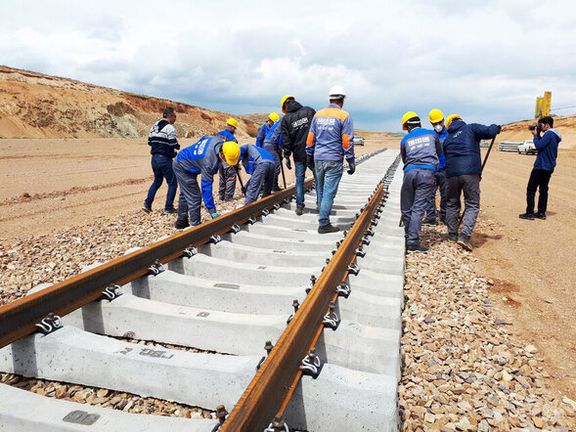
Russia and Iran have agreed a deal to finance and build a railway providing a strategically significant new link in the region.

Russia and Iran have agreed a deal to finance and build a railway providing a strategically significant new link in the region.
The Rasht-Astara link is seen as an important link in the corridor that will connect India, Iran, Russia, Azerbaijan, and other countries by rail and by sea.
The 162 km railway along the Caspian Sea coast will go from Russian ports on the Baltic Sea to Iranian ports on the Indian Ocean and Gulf of Aden.
Wednesday’s deal was signed by Russian President Vladimir Putin and his Iranian counterpart Ebrhaim Raisi in a meeting on video link.
Putin said: "The unique North-South transport artery, of which the Rasht-Astara railway will become a part, will help to significantly diversify global traffic flows."
He claimed the “successful cooperation within the framework of this ambitious project is evidence of the high standards and the fruitful and mutually beneficial nature of Russia-Iran relations.”
Both Russia and Iran are giving priority attention to the strengthening of trade, economic and other bilateral ties, which are based on the principles of neighborliness, mutual respect and consideration for each other’s interests, said Putin.
Raisi said: "Without a doubt, this agreement is an important and strategic step in the direction of cooperation between Tehran and Moscow."
It comes as Western sanctions bite hard against Russia following its invasion of Ukraine and against Iran over its nuclear programme. The two ostracised nations are increasingly cooperating, with Iran providing drones and other weapons for Russia as its fights in Ukraine.
The North-South route was originally signed by Russia, Iran, and India in the early 2000s, and since then other countries have ratified it, including Azerbaijan, Belarus, Bulgaria, India, Iran, Kazakhstan, Kyrgyzstan, Oman, Russia, Tajikistan, Turkey, and Ukraine.


United States senators expressed disappointment with an administration briefing on Iran on Tuesday in comments to reporters after the meeting.
“Based on what I heard during the last 40 minutes they really don't have much to say on the topic, and I didn't think it was particularly useful briefing. I don't know if they really have a coherent strategy if there is one I didn't I didn't hear,” Sen. Josh Hawley a staunch Republican critic of the Biden administration said in response to our correspondent Arash Alaei.
US senators on Tuesday heard a confidential briefing on Iran by Biden administration officials eight months after long nuclear talks with Tehran reached an impasse last September and Iran continued its uranium enrichment, building up its stockpile of fissile material.

Sen. Hawley added that in his view there was no need to classify the briefing as ‘confidential’ and the senators were not given any new information. “We didn't learn anything new or remotely classified.”
Senator Jim Risch (R-Idaho) released a brief statement saying that after six months since President Joe Biden declared the 2015 nuclear accord, the JCPOA “dead” the US “is no closer to a more comprehensive Iran policy. Strategic ambiguity on Iran policy only serves to embolden the regime and push our partners closer to China.”
President Biden was heard saying in November 2020 that the JCPOA is dead, but the administration has continued to emphasize its commitment to a diplomatic solution.
After nuclear talks with Iran hit a dead-end last year, senior US officials have repeatedly said that they are no longer focused on the JCPOA.
Sen. Risch went on to say that “As Iran continues to illegally seize vessels, target Americans in the region, and support its terror proxies and the Russian invasion of Ukraine, Americans deserve a policy that is more than a failed nuclear negotiation.”
Republican senator from Lousiana, John Kennedy, told reporters that he believes China, Russia and the Islamic Republic are coordinating efforts to dominate the Indo-Pacific, Central and Eastern Europe and the Middle East respectively.
“That is not a world that is safe for the US,” he said, and added, “We are in a bar fight with Putin, with Xi, with the Ayatollah,” and the Biden administration “believes in peace, but they believe in peace for weakness.”
Senator Kennedy also echoed Sen. Risch’s comment about the administration not having an effective policy. Sanctions have been imposed on Iran and Russia, but “when you ask the administration, what is your plan given that the sanctions have not stopped them, or what is your plan in addition to the sanctions, you are met with either silence or BS or both.”
The senator was also clear about what he expects from a possible nuclear deal with the Islamic Republic. “The deal I want is for Iran to give up all of its fissile materials, all of it, and give up its capability of making a nuclear bomb and to allow international inspectors to check them every other day. Otherwise, they probably won't have any deal.”
Senator Rick Scott (Rep-Fl) in response to questions expressed deep concern about Iran’s role in the region and in helping Russia’s invasion of Ukraine.
“I don't think you can say there's anything good happening out of Iran.”

Russia's second-largest bank VTB VTBR.MM has opened a representative office in Iran, an Iranian official said Wednesday, as Moscow and Tehran try to react to Western sanctions.
The money-losing Russian lender is one of many key Russian banks now blocked from the SWIFT international financial messaging service.
Ties with Iran, also disconnected from SWIFT since 2018, have become ever more crucial for Russia since Moscow invaded Ukraine in February 2022.
The two countries have already connected their interbank communication and transfer systems, and Tehran has for months been planning to accept Russia's Mir payment cards, Moscow's alternative to Visa and Mastercard.
"The number of foreign banks' representative offices in recent years dropped from around 45 to 15, and VTB is the only bank to open its office during this period," semi-official news agency ILNA quoted Alireza Peymanpak, the head of Iran's Trade Promotion Organization, as saying. "Due to its active presence in the banking networks of Iran's export destinations such as CIS countries, India, Vietnam and particularly China, VTB will help to attract export earnings and reduce foreign transfer costs for Iran."
A source familiar with the Iranian banking market said VTB had already opened correspondent accounts with Iranian banks.
Meanwhile, Bank of Russia Governor Elvira Nabiullina may visit Iran in the coming weeks to strengthen financial ties, a separate source told Reuters.
Dominant lender Sberbank's SBER.MM CEO, German Gref, has also discussed reinforcing ties with the Islamic Republic, but has not yet entered the market, another source said, while fellow state-owned lender Promsvyazbank, which focuses primarily on the defense sector, is already present in Iran.
Reporting by Reuters

An Oman airliner has been grounded after hitting debris on the runway in Shiraz – the latest evidence of the poor state of transport in Iran.
Oman Air said Tuesday that its flight WY2435 from Shiraz to Muscat was grounded on Monday after the aircraft was damaged.
The Muscat-based airline did not specify what debris struck the Boeing 737 during the landing at Shiraz International Airport.
“Our engineering team is undertaking the necessary measures to safely bring the aircraft back to Muscat,” the airline said in an online statement. Passengers on the flight were given accommodation in Shiraz, 680 kilometers southeast of Tehran.
Another plane was sent to take them back to Muscat.
There was no immediate acknowledgement of the incident by the Iranian officials.
There have been a number of similar incidents over the past few years, as Iran’s air sector struggles with the effects of US sanctions over the Islamic Republic’s nuclear program.
Norwegian Air Shuttle landed a brand-new Boeing 737 Max in Shiraz in December 2018 after one of its engines failed at altitude while flying from Dubai. The aircraft remained on the ground for several months before finally departing.
Shiraz airport serves both commercial and military flights, as do many other airports in the Middle East.
Oman has often served as a mediator for the West with Iran, against a backdrop of Tehran's tense relations with its Arab neighbors and the US.

A lawmaker who had recently revealed bribery involving a former minister and seventy lawmakers in Iran has been indicted for “making a claim without evidence”.
Mizan, the official news agency of the country’s judiciary said Tuesday that Ahmad Alirezabeigi, representing the northwestern city of Tabriz in the parliament, was indicted based on a report by the parliament’s board supervising lawmakers’ conduct.
The board ruled that the whistleblower had not offered any evidence for his claim of bribery, although after his revelation evidence emerged that more than 70 lawmakers had received SUVs from carmakers accountable to the minister of industry.
In an interview with Etemad newspaper on April 30, Alirezabeigi described his meeting with the board as “a political trial”.
He insisted that his claim was proven by the fact that an official of the parliament’s human resources department had signed the letter to the company that made the offer of cars below market value with installments and without any interest. The letter contained a list of lawmakers who signed up to receive the cars.

Alirezabeigi and another lawmaker, Hossein Jalali, also claim that Speaker Mohammad-Bagher Ghalibaf was aware of the offer of cheap cars for lawmakers.
According to Mizan, Alirezabeigi has made his final defense and a court order (writ of security) has been issued to ensure he would return to the court when summoned.
Alirezabeigi revealed in late April that over seventy SUVs were offered to the lawmakers at a lower price by the ministry of industry ahead of lawmakers’ discussion of a motion in December last year to impeach former minister of industry, Reza Fatemi-Amin. The minister was accused by at least 40 members of parliament of “inadequate performance” including failure to control rising prices for domestically produced vehicles, their low quality, preventing competitive imports, and corruption in the industry.
The first impeachment drive failed as many lawmakers stopped supporting the motion, allegedly after receiving the vehicles. Eventually, parliament sacked Fatemi-Amin on April 30th, two days after Alirezabeigi’s revelation, despite the government and Fatemi-Amin’s denials of any wrongdoing.

More than 200 members of parliament have sent text messages to the public or told the media that they were never involved in the scheme and had not benefited from it. The media have published a list of others who have not denied receiving the SUVs. These include both Ghalibaf supporters and hardliner Paydari Front lawmakers.
Importing cars has been mostly banned by the government in recent years and domestic production is limited, making personal vehicles a sought-after commodity. Obtaining domestically produced vehicles is hard and there are long waiting lists that boosts their price.
Alirezabeigi who has close ties to the former populist President Mahmoud Ahmadinejad claims he only meant to combat corruption and had no hidden agenda when he disclosed the bribery by automakers on behalf of the minister.
Khabar Online, a news website close to the former moderate-conservative speaker of parliament, Ali Larijani, wrote Saturday that the scandal has turned into an excuse for the two major groups of hardliners in the parliament -- supporters of Ghalibaf and Paydari Front lawmakers – to settle political accounts.
“I was not personally offered to receive a car, but I have seen the cars in the parliament. They were in the parliament’s parking lot and were given to lawmakers. The matter is quite clear,” Bigdeli told Asr-e Iran news website on April 27.
“Some people gain privileges on various excuses to compromise and undermine the supervisory duty of the parliament,” he said on April 30 while calling such bribery a “tradition in the parliament” to prevent impeachments.

Russian Deputy Prime Minister Alexander Novak, in charge of energy diplomacy, arrived in Iran Tuesday and stressed the benefits of more cooperation in the oil and gas sectors, Moscow said.
Russia and Iran, both under Western sanctions, are forging closer ties in order to support their economies and to undermine Western sanctions which they both cast as unjustified.
Novak met Iranian Oil Minister Javad Owji and also visited a number of oil and gas equipment manufacturers and discussed prospects for working together in the fuel, energy and transport sectors, the Russian government said in a statement.
"The oil and gas industry is a backbone for the economies of our countries. Strengthening bilateral cooperation in this area will undoubtedly increase the economic sustainability of Russia and Iran," it quoted Novak as saying.
The two sides also discussed cooperation in the field of electrical and nuclear energy as well as renewable energy sources, the statement added, but gave no details.
Iran claimed last year that Russia was ready to invest $40 billion in Iran’s energy sector, but despite similar reports in the past Moscow’s involvement in Iran’s economy remains negligible, except its technical support for the Busher nuclear reactor.
Iran has been supplying kamikaze drones and possibly other weapons to Russia since mid-2022 that have been used against Ukraine. Western countries have deplored the Iranian arms transfers and imposed sanctions on individuals and entities involved.
Russia started fuel exports to Iran by rail this year for the first time after traditional buyers shunned trade with Moscow, industry sources and exports data revealed in April.
With reporting by Reuters