EU To Sanction Iran Entities Helping Russian War In Ukraine

European Commission President Ursula von der Leyen says the EU will propose sanctions targeting for the first time Iranian economic operators involved in the Russian war in Ukraine.

European Commission President Ursula von der Leyen says the EU will propose sanctions targeting for the first time Iranian economic operators involved in the Russian war in Ukraine.
"For the first time we are also proposing to sanction Iranian entities including those linked to Iran's Revolutionary Guard," Von der Leyen told European lawmakers in Strasbourg on Wednesday.
Von der Leyen said the 10th package of sanctions, worth a total of 11 billion euros ($11.79 billion), would target new trade bans and technology export controls, including drones, helicopters and missiles.
Iran has been supplying Shahed kamikaze drones to Russia since mid-2022 that have been used in large numbers against Ukrainian infrastructure targets and also to swamp air defenses during massive Russian missile strikes.
At the same time, the brutal suppression of protesters in Iran has angered European politicians, who are contemplating to list the Revolutionary Guard as a terrorist organization.
There are also reports that the Islamic Republic might export ballistic missiles to Russia to make up for a shortfall Moscow faces as it has used hundreds in its stockpile against Ukraine.
Iran initially denied supplying drones to Russia, but as physical evidence of their use in Ukraine built up foreign minister Hossein Amir-Abdollahian admitted the transfer, claiming that drones were sent before the Ukraine war.
With reporting by Reuters


The US believes China has a role to play in telling Iran to end its “destabilizing activities,” the State Department said as Iran’s president visited Beijing.
The department spokesperson Ned Price was asked on Tuesday to comment on Chinese President XI Jinping’s remark earlier in the day that the Iranian nuclear issue should be resolved as soon as possible.
In response he said that the United States has engaged with China and other global stakeholders to encourage them to counter Iran’s policies “that destabilize the region and threaten our partners and our allies. Iran’s nuclear program, its ballistic missile program, its other malign activities and influence, are profoundly destabilizing in the region.”
Ned Price drew attention to Chinese cooperation in pressuring Iran in the early 2010s regarding its nuclear program. Presumably, he said, that’s why “the PRC came together with us the better part of a decade ago by now in the original configuration of the P5+1 to work with us to ultimately negotiate what became known as the Joint Comprehensive Plan of Action [JCPOA].”
However, China has been violating US oil export sanctions imposed on Iran on a large scale since the Biden administration came into office. Industry observers believe that Beijing is allowing at least 700,000 barrels of Iranian crude oil to be imported by its refineries, which provides a financial lifeline to the regime in Tehran.
But Price also reiterated the administration’s new policy of not pursuing the nuclear talks unless Tehran meets a number of demands. The spokesman said, “the JCPOA has not been on the agenda for some time. We continue to discount, if not dismiss repeated claims from Iranian officials that we are eager to go back to the JCPOA, we’re calling for a return to JCPOA negotiations. We’re not. We’re sending very clear messages to the Iranian regime. Those messages are: Stop killing your own people, stop sending UAV technology to Russia, and free those wrongfully detained American citizens.”
Critics have repeatedly accused the administration of not sufficiently enforcing sanctions the US imposed in 2018, when former President Donald Trump withdrew from the JCPOA. The main loophole is the oil exports to China that can generate more than $20 billion a year for the Islamic Republic.
Price continued the administration’s rhetoric demanding that Beijing should act responsibly. “My point is that the PRC has a role to play in very clearly signaling to Iran that its destabilizing activities, that its brinksmanship is not going to be rewarded. It’s not going to be countenanced. It is not something that the international community is prepared to sit idly by and watch.”
Not only China supports the Islamic Republic by buying its illicit oil shipments, but inviting Raisi at a time when the regime stands accused of gross human rights violations against protesters, is a clear attempt to support the rulers in Tehran.
The Islamic Republic is facing isolation also because of its drone deliveries to Russia and Beijing’s invitation to Raisi partially mollifies that isolation.
Judging from numerous social media posts by Iranian critics of the regime, it appears that their anti-China sentiment has increased because of this latest lifeline thrown to the Islamic Republic.

The US military is considering sending Ukraine thousands of seized rifles and ammunition once bound for Iran-backed Yemeni rebels, the Wall Street Journal reported Tuesday.
US officials said they are looking at sending Ukraine more than 5,000 assault rifles, 1.6 million rounds of small arms ammunition, a small number of antitank missiles, and more than 7,000 proximity fuses seized in recent months off the Yemen coast from smugglers suspected of working for Iran, according to the report.
“The unusual move would open up a new supply of firepower America and its allies could tap into as they struggle to meet Ukraine’s need for military support as its war with Russia enters its second year,” the WSJ wrote.
“The war in Ukraine is consuming an enormous amount of munitions and depleting allied stockpiles,” NATO Secretary-General Jens Stoltenberg said Monday, on the eve of an alliance meeting. “The current rate of Ukraine’s ammunition expenditure is many times higher than our current rate of production. This puts our defense industries under strain.”
The US had announced two arms seizures this year from vessels traveling in the Sea of Oman, on a route often used to carry arms from Iran to Yemen. There were also arms seizures last year. The two consignments captured this year yielded more than 5,000 AK-47 assault rifles.
Iran has been supplying kamikaze and possibly larger drones to Russia since mid- 2022 that have been used against infrastructure targets in Ukraine. The West has warned Iran to seize arms supplies to Russia, expressing serious concern.

The former secretary general of the Iran-Iraq chamber of commerce has confirmed that it is difficult to buy US dollars for travelers in Iraq due to US restrictions.
Mehdi Karami Pour told Shargh daily that he has been in Iraq last week and even had trouble getting a taxi.
A Shargh reporter also wrote on twitter that a number of Iranian travelers in Iraq said that due to the imposition of US restrictions on dollar transactions by Iraqi banks, exchange offices do not sell foreign currency to travelers.
Ali Shariati, a member of the Chamber of Commerce and a businessman, has also confirmed the news, saying that in Iraqi media Iran has been introduced as the main cause of inflation in the country and its dollar crisis.
According to reports many Iranian companies in Iraq do not have a clear identity and after Iraq joins the Financial Action Task Force (FATF) the activity of these firms would become even more difficult.
Washington has imposed new restrictions on dollar transfers to Iraq as the Arab country’s banking officials believe there is widespread money laundering for the purpose of sending funds to Iran and Syria, both under US banking sanctions.
Iraq is now feeling the result, with an unprecedented drop in the value of its currency.
Hundreds of people demonstrated near the central bank headquarters in Baghdad to protest the devaluation of the Iraqi dinar against the dollar, which has triggered a rise in prices of imported consumer goods.

The United Kingdom has submitted evidence to the UN showing that the Iran’s Revolutionary Guard (IRGC) is violating Security Council resolutions.
According to a statement by the UK Ministry of Defense on Monday, weapons seized by Royal Navy ship HMS Montrose, which have been presented to the UN as evidence, proved the IRGC is smuggling weapons in violation of a UN Security Council resolution, indicating that the UK is turning the screws on the Islamic Republic.
“On two occasions in early 2022, HMS Montrose seized Iranian weapons from speedboats operated by smugglers in international waters south of Iran,” the statement said, adding that “the items included surface-to-air-missiles and engines for land attack cruise missiles, in contravention of UN Security Council Resolutions 2231 and 2140,” approved in 2015.
The defense ministry also said that “The weapons were presented to representatives of the United Nations who provide an assessment of the conflict in Yemen and Iranian nuclear activity.” “The interdictions were referred to in the Secretary General’s UNSCR 2231 report published in December 2022 and are expected to feature in the UNSCR 2140 annual report that will shortly be released.”
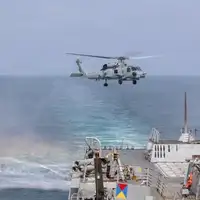
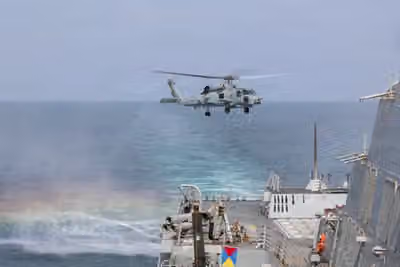
In reference to the evidence, Defense Secretary Ben Wallace said that London is committed to upholding international law and will continue to counter Iranian activity that contravenes UNSC resolutions and “threatens peace across the world.” That is why the UK has a permanent Royal Navy deployment in the Persian Gulf region, conducting vital maritime security operations and working in support of peace in Yemen, he added. The Royal Navy has a permanent deployment of a Type 23 Frigate, equipped with a Royal Marine boarding party and a Wildcat helicopter to support maritime security operations in the Gulf of Oman.

A key piece of evidence presented by the UK was a commercial quadcopter drone designed for reconnaissance activities. According to the statement, “By decrypting the internal memory of the uncrewed aerial vehicle (UAV) controllers, the UK Ministry of Defense discovered the records of 22 test flights conducted at the IRGC Aerospace Force Headquarters and test facility in western Tehran." The Islamic Republic failed to delete flight logs from a drone on its way to Yemen.
Minister of State for the Middle East, Lord (Tariq) Ahmad of Wimbledon said, “Once again, the Iranian regime has been exposed for its reckless proliferation of weapons and destabilizing activity in the region.”
Iran’s sustained military support to the Houthis and continued violation of the arms embargo has stoked further conflict and undermined UN-led peace efforts, the official added, noting that “The UK will continue to act to protect the security of our partners and hold Iran to account.”
“The UAV was in the same shipment as a number of Surface to Air Missiles and components for the Iranian Project 351 land attack cruise missile. This evidence indicated a direct link between the Iranian state and the smuggling of missile systems being used by the Houthis to attack the Kingdom of Saudi Arabia and the United Arab Emirates,” read the statement.

The Iranian regime has been arming, training and supporting Houthi forces since at least 2015. Previous weapons and missiles used by the Yemeni rebel force were examined by UN experts before and found to have Iranian origin.
The UK defense ministry added that “The threat posed by long range weapons made in Iran is not limited to the Middle East. Since the invasion of Ukraine, Iran has supplied hundreds of Shahed one way attack drones to Russia; these transfers violate UNSCR 2231. These attacks have killed civilians and damaged critical national infrastructure (such as power substations) far from the front lines of the conflict.
The British government also revealed that a typo in the word "Netherlands" helped expose illegal Iranian weapons shipments to Yemen. The word was spelt "Nether1ands" on part of a missile engine, in what defense officials believe was a clumsy attempt by Iran to pretend the component was Dutch. The word "version" was also misspelt as "verslon" in one of the missile parts seized by Britain's Royal Navy last year.
Such evidence can be used in case of snapback at the UN Security Council. In December, the United States, France, and the United Kingdom met to argue that Russia and Iran are violating UN Security Council Resolution 2231 by Tehran sending military drones to Moscow

The United States is doing everything possible to counter the “burgeoning” military ties between Iran and Russia, the State Department spokesperson said Monday.
In response to a question by Iran International’s correspondent Samira Gharaei about a report on Monday that Iran has supplied new drones to Russia, Ned Price said that the US has been warning about this expanding “two way” relationship since last year.
Price reiterated that “we are taking action to do everything we can to counter this relationship and to counter the transfer of technology…we have exposed this linkage and we are continuing to galvanize countries around the world to maintain focus on this.”
He went to characterize the alliance between Moscow and Tehran as a “profound threat to the people of Ukraine but also a security relationship that has the potential to be a threat way beyond.”
Asked about Iranian opposition leaders coming together and potentially forming a council to counter the Islamic Republic, Price said the United States cannot make decisions for Iranians but it is eager to listen to both those inside the country and activists in the diaspora, and will continue to hear a wide spectrum of voices.
Price also confirmed that US Special Envoy for Iran Robert Malley was heading a delegation that has arrived in Saudi Arabia to hold discussions with Gulf Cooperation Council countries on air and missile defense, challenges presented by Iran and issues of counter terrorism.
Elsewhere, Price warned about the dangers posed by Iran’s nuclear advances and its export of terrorism, in the context of US Chinese areas of cooperation.