Iran To Get $7 Billion Of Frozen Funds In Prisoner Swap Deal With US - IRNA

Iran’s official government news agency confirmed Sunday that Tehran will receive $7 billion of its frozen funds for a prisoner exchange deal with the United States.

Iran’s official government news agency confirmed Sunday that Tehran will receive $7 billion of its frozen funds for a prisoner exchange deal with the United States.
IRNA confirmed on Sunday that a prisoner swap deal has been finalized between Tehran and Washington, according to which Iran’s blocked money in South Korea well be released. The report, however, did not mention the name of the Iranian(s) who are supposed to be freed.
On Saturday, reports said that an Iranian-American hostage, Siamak Namazi was released from Tehran’s Evin prison in a one-week renewable furlough. Namazi has spent 7 years in jail on Trumped-up espionage charges. His father Baquer Namazi who went to Iran to free his son in 2016 was also arrested and accused of espionage, but later freed from prison on medical grounds and now has been allowed to leave Iran.
United Nations spokesperson Stephane Dujarric announced about Namazis in a statement on Saturday.
Iran's Nour news said Saturday that the deal is the result of intensive negotiations in recent weeks with the mediation of a regional country regarding the simultaneous release of Iranian and American prisoners. Iran had earlier claimed that the $7 billion would be freed in exchange for the release of three American dual citizens.
Nuclear negotiations since April 2021 between Tehran and Washington are stalled, and a prisoner deal could be a positive signal for a resolution, but Washington has not confirmed the Iranian claims.

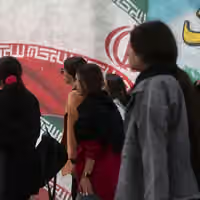
A hacking group has shared the alleged identities of the hijab police team that arrested Mahsa Amini, the woman whose death has sparked an uprising in Iran.
Hacker group Backdoor (3ackd0or) provided Iran International with documents about the four police officers who stopped Mahsa along with a few of his relatives in Tehran and took her to the Vozara police station in a police van. According to reports, she suffered at least one severe blow to her head that led to her death in the following hours.
Iran International has no knowledge of how they obtained this information, which cannot be independently verified.
The commander of the team was Captain Enayatollah Rafiei, 52 years old and from the town of Khodabandeh in northwestern Zanjan province.

The other male agent of the team was identified as Sergeant Ali Khoshnamvand, 27 years old and from the village of (Khoshnamvand) Khushnamvand in the Kouhdashtdistrictof Lorestan province in western Iran.

Parastou Safari is 36 years old and was born in the eastern city of Kermanshah. She is probably the female agent who deemed Mahsa’s clothing “inappropriate” and decided to take her to the station for “a short training on Islamic dress code.”

Fatemeh Ghorban-Hosseini is 27 years old, the youngest of the team that arrested Mahsa and was born and raised in the capital Tehran.

The authorities first tried to spread disinformation that Mahsa Amini had an illness which caused her death, but soon information emerged that severe blows had broken her skull and caused a coma after two hours of her arrest.
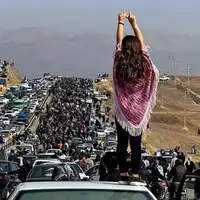
Her death almost immediately led to protests in her home province of Kordestan in Western Iran and then spread to the capital Tehran and other cities. The government resorted to brutal force against demonstrators and so far at least 150 people have died, with the largest single-day toll on September 30 in the city of Zahedan where 42 local protesters were shot.
On Thursday, September 29, Mohammad-Bagher Bakhtiar, a former commander of the Revolutionary Guard during Iran's 1980-88 war with Iraq, published an audio file quoting informed sources at the Forensic Medicine Organization as saying that Amini died because of a "blow to her skull".
Iran International had earlier published Mahsa's skull CT scan which showed bone fracture, hemorrhage and brain edema. The medical documents and dozens of exclusive images sent to Iran International by a hacktivist group vividly show a skull fracture on the right side of her head caused by a severe trauma to the skull, which corroborate earlier accounts by her family and doctors about her being hit several times on the head, proving that the Iranian police's claim that she suffered a heart attack was untrue.
An eyewitness told Iran International last week that Mahsa had told her in a detention room that an officer had hit her on the head.

Siamak Namazi, an Iranian-American hostage has been let out of prison in Tehran, as a semi-official Iranian source said there is a prisoner deal with the United States.
His lawyer Jared Genser told Reuters on Saturday that the furlough is renewable.
United Nations spokesperson Stephane Dujarric said in a statement that Siamak's father, Baquer Namazi, is being allowed to leave Iran for medical treatment.
However, Iran's Nour news said Saturday that intensive negotiations were held with the mediation of a regional country regarding the simultaneous release of Iranian and American prisoners in recent weeks. Billions of dollars from the blocked resources of Iran are also about to be released in this framework.
US officials have not commented yes about the Namazis, although Secretary of State Antony Blinken tweeted Saturday afternoon that several Americans jailed in Venezuela will be released.
Baquer Namazi was convicted in Iran of "collaboration with a hostile government" in 2016 and sentenced to 10 years in prison. Iranian authorities released him on medical grounds in 2018 and closed his case in 2020, commuting his sentence to time served but effectively barring him from leaving the country.
His son, Siamak, was convicted of the same charge and has been held in Evin prison since 2015. The US government has described the charges against both as baseless.
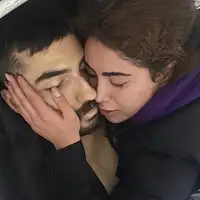
"I am thrilled for the Namazi family that for the first time in seven years Siamak Namazi is sleeping at home with his family," Genser, who represents the family, told Reuters.
"This is a critical first step but of course we will not rest until the entire family is able to return to the United States and their long nightmare is finally over," Genser added.

Amid protests in Iran and abroad against the Islamic Republic, Iraqis held a demonstration Saturday against Tehran’s interference in the country and recent attacks on Iraq.
The demonstrations led to clashes between protesters and security forces in the center of Baghdad as thousands of Iraqis had gathered around the city’s iconic Tahrir Square to mark three years since nationwide demonstrations erupted against endemic corruption that caused rampant unemployment and the country’s decaying infrastructure. Dozens of people were injured during the scuffles.
Protesters also chanted slogans against the Islamic Republic and demanded an end to its influence and interventions in Iraq.
The latest protests in Baghdad come as Iraq has been mired in political paralysis since elections one year ago that have failed to bring in a new president, prime minister or government.
According to Iraqi media reports, Iran-backed militia groups in Basra fired several Iranian-made rockets at people's houses on Friday night. This is the latest attack in a wave of missile and drone strikes by Iran’s Revolutionary Guards targeted at Kurdish groups in the Iraqi Kurdistan region.
Amid nationwide protests in Iran sparked by the death in custody of a 22-year-old Kurdish woman, Iran’s Revolutionary Guard has stepped up its attacks on the region, apparently aimed at intimidating the Kurds.
In solidarity with residents of Iraqi Kurdistan, many business owners have launched strikes in Iran’s Kordestan province and other western provinces with Kurdish population.

Iranian dissident figure Mir-Hossein Mousavi has expressed support for the current protests across Iran, calling on the military to stand behind the nation.
Mousavi, who has been under house arrest since February 2011 as one of the leaders of the protests in 2009-2011 known as the Green Movement, issued a statement Saturday addressing the military forces, "I hope you will be able to stand on the side of the truth, on the side of the nation."
"No one has the right to stand in front of the nation as a blind agent," he said.
Mousavi (Musavi), 81, was Iran’s Prime Minister from 1981 to 1989. He was a candidate in the disputed presidential election in 2009 and challenged the results leading large protests for months before he was arrested and put under house arrest without a trial. His wife Zahra Rahnavard and another candidate Mehdi Karroubi suffered a similar fate as all three were accused of “sedition” against the regime. He was put under house arrest after he and his wife urged their supporters to organize demonstrations in support of uprisings in the Arab world in February 2011.
His statement has been met with conflicting responses from Iranians -- who have been holding daily demonstrations across the country since mid-September, when 22-year-old Mahsa Amini was killed in custody of hijab police – as the new wave of protests is essentially different from earlier ones.
The current protests are against the entire Islamic regime, which was not the case for Mousavi’s Green Movement in which people were seeking reforms.

Business owners and merchants have announced strikes in Kordestan province and other western provinces with Kurdish population, such as East and West Azarbaijan and Ilam.
Unions and guilds in 15 cities, including Orumiyeh (Urmia), Oshnavieh, Mahabad, Piranshahr, Sardasht, Saqqez, Marivan, Sanandaj, and Ilam are on a massive strike, Hengaw Organization for Human Rights reported on Saturday.
Last week, businesses in Kordestan held another round of strike in protest to Iran’s Revolutionary Guard’s attacks on Kurdish groups in Iraqi Kurdistan, which have killed dozens of people so far. Amid nationwide protests in Iran sparked by the death in custody of a 22-year-old Kurdish woman, Iran’s Revolutionary Guard has stepped up its attacks on the region, apparently aimed at intimidating the Kurds.

The cooperation center of Kurdish parties of Iran called for the strikes in protest against the IRGC's missile and drone attacks on the civilian headquarters of these parties in the region.
NetBlocks, a watchdog organization that monitors cybersecurity and the governance of the Internet, also confirmed on Saturday that the Internet access has been shut down in most of the areas that are on strikes as well as the southeastern province of Sistan-Baluchestan.