A quick look at the main headlines on the IRGC-linked Tasnim News Agency on Monday captured the mood in Tehran: “Possibility of Iran–US Negotiations Confirmed,” “Implications for America if War Spreads Across the Region,” and “With Trump’s Conditions, There Will Be No Negotiations.”
Together, they betray a system simultaneously preparing for talks, threatening escalation, and insisting negotiations are impossible.
Despite the government’s efforts to project calm beneath Tehran’s smog-covered skyline, a speech on Sunday by Supreme Leader Ali Khamenei only deepened the sense of foreboding.
Khamenei recounted a joke from his native province of Khorasan about a man boasting of how close he was to marrying the woman he loved. “Only two steps remain,” the man says. “I ask her father for her hand, and he replies: ‘How dare you!’”
Those seated around Khamenei, including his financial confidant Mohammad Mokhber, smiled uncertainly—perhaps only gradually realizing that, in Khamenei’s telling, the hopeful suitor was US President Donald Trump, and the disapproving father was Khamenei himself.
‘American graveyard’
For opportunistic politicians and commentators in Tehran, the message was unmistakable: recent claims by Foreign Minister Abbas Araghchi and security chief Ali Larijani about ongoing negotiations with Washington mattered far less than the Supreme Leader’s evident reluctance to engage.
On the central question—whether Iran is prepared to make concessions—Khamenei remains firmly unwilling to yield.
Hardliners, who had briefly lowered their volume in anticipation of a possible diplomatic opening, appeared to have received the memo and quickly returned to form.
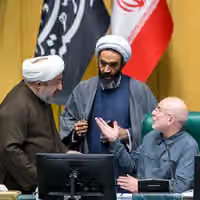
In parliament, the cleric Mohammad Taghi Naghdali declared that Iran should not only close the Strait of Hormuz but also disrupt Europe’s shipping routes and gas export networks, while calling for reduced cooperation with the International Atomic Energy Agency.
The rhetoric soon veered into the absurd. The managing director of Tehran’s main cemetery, Behesht-e Zahra, claimed he had prepared 5,000 graves for US soldiers he believed would be killed on the first day of a war with Iran.
The statement was swiftly refuted by Tehran city councillor Jafar Tashakori, who warned that reckless remarks could trigger crises “far beyond domestic politics.”
Vested interests
Even seasoned analysts struggled to impose coherence on the moment. Political commentator Ali Bigdeli said no one could say with certainty whether war was coming, arguing that Iran’s only viable path forward lay in direct talks with the United States.
While Iran’s official position, articulated by Araghchi, is that any talks must be confined to the nuclear file, Bigdeli cautioned that Washington’s ambitions extend to Tehran’s missile program and its regional allies.
“Trump is not interested in a direct war with Iran,” Bigdeli told the moderate outlet Khabar Online. “But he is unlikely to leave the region with his armada without achieving something.”
Ebrahim Rezai, spokesperson for parliament’s National Security Committee, cited a briefing by IRGC Aerospace Force commanders to assert that any US attack would trap American forces in a regional war.
Yet another conservative figure, Hossein Naghavi Hosseini, cautioned that those beating the drums of war in Tehran were playing into Israel’s hands.
Taken together, the cacophony points less to confidence than to paralysis: a system torn between waiting for a signal from the top and being pulled in opposing directions by vested interests, each pressing for the outcome it prefers.