France Tells Iran It's Disappointed To See No Progress In Nuclear Talks

In a two-hour telephone conversation Saturday, French President Emmanuel Macron told Iran's Ebrahim Raisi that he is disappointed with results of nuclear talks.

In a two-hour telephone conversation Saturday, French President Emmanuel Macron told Iran's Ebrahim Raisi that he is disappointed with results of nuclear talks.
Macron expressed his disappointment to his Iranian counterpart Raisi at the lack of progress over talks on the 2015 nuclear agreement, the Elysee Palace said in a statement.
In June, Iran began removing essentially all the monitoring equipment of the International Atomic Energy Agency (IAEA), installed under its 2015 nuclear deal with world powers.
Iran has been enriching uranium at 20 and 60 percent since early 2021, raising alarm in Western capitals and among regional countries of getting closer to a nuclear breakout point.
The French leader urged Raisi to make a "clear choice" to reach a deal and go back to the implementation of Iran's commitments under the 2015 nuclear agreement, the Elysee Palace said.
Macron said he was convinced that such an outcome was still possible but that it should take place "as soon as possible," the French presidency said.
According to the official Iranian news agency IRNA, Raisi reiterated Iran's demands of receiving guarantees of full economic benefits to make a nuclear deal possible.
Macron also urged the liberation of four French citizens that he said were "held arbitrarily" in Iran.
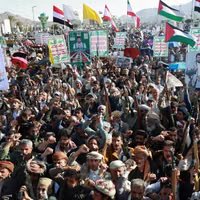
Repeatedly setting deadlines by Western powers for Iran to reach a nuclear agreement has become “an empty threat”, IRGC-linked Tasnim news agency said Saturday.
Tasnim ridiculed Western diplomats and governments for repeatedly threatening that “just a few weeks” remain for concluding a deal to revive the 2015 nuclear agreement, the JCPOA, or they will walk away from negotiations.
“Setting deadlines has been one of the main tactics used by Westerners” in nuclear talks, Tasnim said, “but they used it so often that today it has turned into an empty threat.”
Tasnim went on to cite the first time the United States mentioned a deadline in December 2021, when National Security Adviser Jake Sullivan said that Washington and others have not publicly put a date on the calendar “but behind closed doors, there is a deadline, and it is not far away.” He added that in the coming weeks, participants in the Vienna talks will find out "whether Iran is ready for the diplomatic solution."
After six weeks, State Department spokesperson Ned Price said on February 2 that time “is very, very short” to restore the JCPOA, arguing that once Iran reaches “the point where its nuclear advances have obviated the non-proliferation benefits” of the JCPOA, “that’s a point at which it will no longer make sense, from our national security interests.”
Then on February 9, CNN quoted US officials as saying that there were three weeks left to reaching an agreement.
“The Biden administration believes it has until the end of February to salvage the Iran nuclear agreement, otherwise the US will have to change tack and launch aggressive efforts to prevent Tehran from obtaining a nuclear weapon, according to three administration officials,” the network reported.
As February ended with no results, and after 11 months of talks in Vienna, negotiations came to a halt in early March, Western governments continued to say that a “few weeks” remain for a deal to be concluded, as Iran carried on with its uranium enrichment at 60 percent.
In July, the US has been refusing to mention a deadline anymore, saying that the time to conclude that negotiations have failed is when it is technically determined Iran’s nuclear program has passed the point when a restoration of JCPOA would make sense.
US Under Secretary of State for Political Affairs Victoria Nuland told the Aspen Security Forum on July 22 that "The deal is sitting there on the table for the taking if the Iranians want it," but she admitted that Iranian officials "haven’t chosen to go that route."
Highlighting the benefits of an agreement for Iran, Nuland said,"It would get their oil back on the market, it would get them some relief from some of the sanctions that have come on. But, so far, they haven't chosen to go in that route.”
"The Iranian people pay the price as their prices go up and inflation goes up," Nuland added. "If (the Supreme Leader Ali Khamenei) doesn’t take the deal, we’re going to have to increase pressure, of course."
The Tasnim article questioned the logic of setting deadlines when Western powers still say they want to pursue diplomacy to restore the JCPOA. It highlighted that “even a Jewish thin-tank recently said, ‘the nuclear talks apparently will never end’,” without naming the group.

With more voices calling for a US ‘plan B’ if the Iran nuclear talks fail, the Washington-based Middle East Institute hosted Friday a Zoom discussion.
Norman Roule, advisor at the advocacy group United Against Nuclear Iran and a former officer in the Central Intelligence Agency, and Mohammad Al Sulami, President of the Riyadh-based International Institute for Iranian Studies, both argued that the US should tighten implementation of existing sanctions.
Both asserted that Iran is now selling 1.3 million barrels of oil daily, despite US ‘maximum pressure’ sanctions that threaten punitive action against any third party buying Iranian crude or dealing with its central bank.
With the 2015 nuclear deal, the JCPOA (Joint Comprehensive Plan of Action) dead, Roule argued, Beijing was benefiting unduly from its political and military neutrality.
“China, is part of the problem…Iran sells about 1.3 million barrels of oil a day and much of this goes to China,” Roule said. “The money that does make it back from those sales…is funding the missile industry [in Iran] and is funding the militia industry – not in its entirety, but it’s part of the general budget that funds those two organizations. If a missile lands in Saudi Arabia, it’s not unreasonable to think that some Chinese money has enabled that missile to be given to the Houthis [Ansar Allah, Yemenis].”
Integrated approach
Sulami claimed there was no support in the region for “returning to the JCPOA as it is,” and pointed to recent public disagreement between visiting US President Joe Biden, who says he is committed to talks aimed at reviving the JCPOA, and Israel prime minister Yair Lapid.
While Sulami wanted existing sanctions enforced – presumably by US action against Chinese buyers – he ruled out more sanctions.
A different, integrated approach was needed, he argued. “For the United States, the nuclear issue is the priority. For Europe, the missile program [of Iran] is important… these countries are within reach of Iranian missiles. For regional counties these two files…have to be dealt with, but the threat we are experiencing …is the Iranian behavior in the region, the proxies, the militias, the Houthis, Iraq, Syria and other places. That is the main, immediate threat.”

Sulami conceded that comprehensive talks with Iran over all such matters could take two to three years. “Of course, we support reaching an agreement…we want a very good relationship with Iran. The [Saudi] Crown Prince [Mohammad bin Salman] has said this more than once … Plan B should be to bring Iran back to the table of negotiation with hope …this will be a win-win situation for everybody.”
‘Enough is enough’
Sulami cautioned against military confrontation. “Nobody is supportive of that, specifically regional countries – nobody wants more wars in the region – enough is enough.” He added that “tit-for-tat” conflict – presumably meaning low-key engagement – had “benefit for Iran and gets more support for the political system inside the country.”
It was also important, Sulami noted, for Arab leaders to continue to “normalize” with the “Syrian regime,” bringing it back after “reforms” into the Arab League and so prevent Iran “spreading the ideology, spreading Shi’ism, spreading drugs through the IRGC [Revolutionary Guards].”
Among other recent advocates of a ‘plan B,’ historian John Ghazvinian argued in the Los Angeles Times that the JCPOA was a “roadblock” that should be replaced by “broader, deeper and more comprehensive negotiations with Iran.”
The British ambassador to Iran Simon Shercliff in a tweet Friday, after visiting companies in Shiraz, called on British firms to boost trade “JCPOA or not.” While the United Kingdom alongside France and Germany has moved closer to the US under the Biden administration, it does not accept US third-party sanctions as legitimate.

Iran's nuclear chief says construction projects for phase two and three of the Bushehr Nuclear Power Plant have accelerated since a few months ago.
Mohammad Eslami, vice president and the head of the Atomic Energy Organization of Iran (AEOI), said on Friday that since President Ebrahim Raisi made a visit to the site in January, the pace of the projects have changed thanks to the president’s emphasis.
Eslami did not elaborate on the details nor did he mention that Russia is responsible for the projects.
Vienna negotiations hit a bump in the road on March 5 when Russia asked that sanctions for its invasion of Ukraine should not impact implementation of a revived 2015 nuclear deal , the JCPOA. Moscow later said it received the needed assurances from the US.
The Bushehr reactor is not part of the current nuclear dispute between the West and Iran, as Russia handles the nuclear fuel cycle. Iran has been enriching uranium and stockpiling more purified fissile material at other facilities.
The United States had expressed reservations about Russia building the Bushehr nuclear power plant but finally relented in late 2000s, saying that as long as Russia controls the fuel, it did not see the project as a proliferation risk.
Russia commissioned Iran's first nuclear power plant, Bushehr, in 2011. It has one operational unit that generates 1,000 megawatts, providing less than two percent of the country’s electricity.
Iran is expanding the Bushehr reactor to generate more electricity as the country suffers from a chronic shortage of electrical power, with daily outages that cripple industry and anger home consumers.

United Nations nuclear chief Rafael Mariano Grossi reiterated in an interview published Friday that he had “very limited visibility” of Iran’s atomic program.
Around six weeks after Grossi, director-general of the International Atomic Energy Agency (IAEA), said June 9 that four weeks remained during which he could certify the peaceful nature of Iran’s nuclear work, he told the Spanish newspaper El Pais that Iran’s nuclear work was “galloping ahead.”
Iran began restricting IAEA access to that required under the Nuclear Non-Proliferation Treaty at the end of 2020 after its nuclear scientist Mohsen Fakhrizadeh was killed. Iran announced its latest steps downscaling agency monitoring equipment June 8 after the IAEA board passed a critical motion moved by the United States and some European countries.
Grossi told El Pais that even if stalled negotiations succeeded in reviving the 2015 nuclear deal, under which the agency had extensive inspection powers, there would remain a period for which he lacked knowledge. He did, however, moderate his June 9 comments.
“If there is an agreement [to restore the 2015 deal, the JCPOA, Joint Comprehensive Plan of Action], it is going to be very difficult for me to reconstruct the puzzle of this whole period of forced blindness,” Grossi said. “It is not impossible, but it is going to require a very complex task and perhaps some specific agreements.”
Iran has breached several JCPOA restrictions on its nuclear program, which it began doing in 2019, the year after the United States, under President Donald Trump, withdrew from the agreement and imposed draconian sanctions on Iran.
Grossi expressed to El Pais concern over the number of centrifuges, used to enrich uranium, Iran is either constructing or has in operation. Both numbers and type were limited by the JCPOA.
Fragile database
“The agency needed to reconstruct a database, without which any agreement will rest on a very fragile basis, because if we don't know what's there, how can we determine how much material to export, how many centrifuges to leave unused?” Grossi asked.
The number and kind of centrifuges Iran operates, or has ready, determines how quickly it could enrich sufficient ‘weapons grade’ uranium, generally taken to be 90 percent purity, for a bomb. Iran currently enriches to 60 percent, way above the JCPOA limit of 3.65 percent.
The US Special Envoy for Iran Rob Malley said Tuesday Iran was “a few weeks” from having enough sufficiently enriched uranium for a bomb “it if chooses to enrich at that level,” although weaponization would take longer.
US-Iran Talks over JCPOA restoration seem stuck, despite diplomatic efforts by the European Union, with some analysts arguing both sides await the outcome of November’s US mid-term Congressional elections. For now, both Tehran and Washington are dealing with domestic critics and arguing the onus lies with the other.
Iranian foreign minister Hossein Amir-Abdollahian repeated Friday that Iran wanted US assurances it would get the “full economic benefits of the agreement.” He said Iran would not be “bitten twice,” referring to Tehran’s argument that when the US was ‘in’ the JCPOA, it used other means than direct sanctions to restrict Iran’s access to world trade.
One economic imperative for Iran is foreign investments, which might prove hard to secure given the closed nature of its government-controlled economy and its image as an un-hospitable country for foreign businesses.

US State Department Thursday said remarks by Britain’s spy chief that Iran is not interested in a nuclear deal, did not need any special intelligence insight.
Richard Moore, chief of the Secret Intelligence Service (SIS) known as MI6, speaking at the Aspen Security Forum in Colorado, he was skeptical that Iran’s Supreme Leader Ali Khamenei wants to revive the 2015 nuclear agreement known as the JCPOA.
"I'm not convinced we're going to get there. ... I don't think the Supreme Leader of Iran wants to cut a deal," Moore said and added, "The Iranians won't want to end the talks either, so they could run on for a bit."
Asked about these remarks during the State Department briefing on Thursday, spokesperson Ned Price said, “I…don’t think you need a security clearance to discern the fact that Iran at this point doesn’t seem to have made the political decision – or decisions, I should say – necessary to achieve a mutual return to compliance with the JCPOA.”
After almost 16 months of negotiations with Iran and seven months after Washington says a final draft was offered to Tehran, negotiations remain stalled, as Iran seems to demand more concessions. More pundits and critics of the Biden strategy have begun to say that Iran simply wants to drag out the talks to prevent any decisive decision in Washington, while expanding its nuclear program to the point of a nuclear threshold state.
Price in his comments Thursday agreed with Moore’s assessment. The fact is that a deal has been on the table for months now. We have continued to engage in indirect diplomacy with Iran, courtesy of the efforts of the European Union and other partners, but Iran, to this point at least, has not displayed an inclination to seek that deal. So certainly, those comments ring true,” he said.
Iran’s former president Hassan Rouhani told his former aides in Tehran earlier this week that he could have made a deal with the new Biden Administration as early as March 2021 but the hardliners in parliament blocked any progress in the talks by passing legislation to intensify uranium enrichment and reducing UN inspections.
But the Biden Administration still argues that diplomacy remains the best option to restrain Iran’s nuclear program.
The British spy chief who said he agrees with the diplomatic option said, "I think the deal is absolutely on the table. And the European powers and the (US) administration here are very clear on that. And I don't think that the Chinese and Russians, on this issue, would block it. But I don't think the Iranians want it.”
Speaking later in the day at the Aspen forum, Israel's defense minister Benny Gantz said Israel had the military capability to prevent Iran from obtaining a nuclear weapon, if it came to that as a last resort.
"Should we be able to conduct military operation to prevent it, if needed? The answer is yes. Are we building the ability? Yes. Should we use it as a last (resort)? Yes. And I hope that we will get United States' support," Gantz said.
Bahrain's Undersecretary of Political Affairs Sheikh Abdulla bin Ahmed bin Abdulla Al Khalifa declined to directly answer a question about whether his country might participate in pre-emptive military action against Iran's nuclear program.
But when asked whether it would be fair to interpret his answer as "an ambiguous maybe," he quipped: "Fair enough."