EU Firms Can Scrap Iran Deals Hit By US Sanctions, EU Top Court Says

European companies can end contracts with Iranian firms pressured by US sanctions if deals would lead to "disproportionate economic loss," the EU's top court said on Tuesday.

European companies can end contracts with Iranian firms pressured by US sanctions if deals would lead to "disproportionate economic loss," the EU's top court said on Tuesday.
The judgment from the European Court of Justice (ECJ) in Luxembourg was prompted by a lawsuit from the German branch of Iran's state-owned Bank Melli against Deutsche Telekom after it terminated a contract with the bank in 2018 prior to its expiry.
The Higher Regional Court in Hamburg will have to decide whether upholding the contract with Bank Melli would expose Deutsche Telekom, which makes about half of its turnover with its US business, to such a disproportionate economic loss.
It is not clear when the Hamburg court will make its decision.
In 2018, then US president Donald Trump decided to withdraw unilaterally from the Iran nuclear deal and to reimpose sanctions on Iran.
To try to rescue the nuclear deal and its economic benefits for Iran, the European Union as a signatory issued a "blocking statute" that prohibited individuals and companies in the bloc from complying with the renewed U.S. sanctions.
The court on Tuesday backed the EU blocking statute in its ruling, saying "the prohibition imposed by EU law on complying with US secondary sanctions against Iran may be relied on in civil proceedings".
But the judges also said the rules of the blocking statute "cannot infringe the freedom to conduct a business...by leading to disproportionate economic loss".
Report by Reuters

In an interview with an Iranian website published Monday, South Korean ambassador Yun Kang-hyeo said US sanctions on Iran have harmed his country’s economy.
Yun told the Iranian Labour News Agency (ILNA) his country had suffered more than any − other than Iran itself − from ‘maximum pressure,’ under which the US threatens punitive action against anyone buying Iran’s oil or dealing with its financial sector.
ILNA said the interview took place a month ago but gave no reason for the delay in publishing the story.
Yun criticized the US 2018 withdrawal from the 2015 Iran nuclear deal and its imposition of unilateral sanctions, but argued Seoul had no choice but to comply. South Korean banks hold around $7 billion owed to Iran that they are not transferring for fear of US punishment.Most is for oil imports, as South Korea was among the main buyers of Iran's crude oil before 2018.
South Korea was among the top buyers of Iran's crude oil before President Donald Trump unilaterally withdrew the US from the 2015 nuclear agreement between Iran and world powers, Joint Comprehensive Plan of Action (JCPOA).
South Korea's petrochemical industries and refineries have faced difficulties due to the break in oil imports, Yun told ILNA, as they had been geared to process the type of crude bought from Iran and had struggled to find alternatives. Yun said Korea was importing oil from Qatar, ironically from a field jointly owned by Qatar and Iran, at a higher price.
Freezing the assets has soured Tehran's relations with Seoul. Iran detained a South Korean tanker and its crew in the Persian Gulf in January 2020, on grounds of environmental violations as the cause. The vessel was freed in April without the release of Iran’s assets.
After a letter from Iran's Supreme Leader Ali Khamenei September 6, President Ebrahim Raisi (Raeesi) barred imports from South Korea’s LG and Samsung, referred to by Khamenei as "two South Korean companies." While the leader referred to boosting local manufacturers, state media also saw the move as a diplomatic message.
LG and Samsung had reportedly stopped trade with Iran in 2018 despite Iran’s warning that it would be difficult for them to return once US sanctions ended. The Korean firms had previously strong sales in Iran, including partnerships with Iranian companies that assembled goods like air conditioners and televisions.
Yun told ILNA that an Iranian home-appliances manufacturer, Snowa, wanted a ban on South Korean imports but that he had urged company officials to extend cooperation with companies such as LG and Samsung. "The director of Snowa welcomed my suggestion and we proposed to find a good way to cooperate," Yun noted.
In early November some Iranian media, including Javan newspaper, which is affiliated to the Revolutionary Guards, criticized the Korean ambassador overhis visit to a private hospital to donate 2,000 Covid masks. The newspaper wrote that Seoul should instead free Iran’s billions and called Yun’s action “cheap and shameless.”

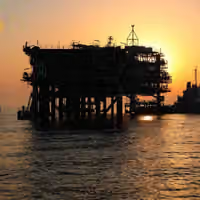
Iran’s oil minister said Monday that output at many oil wells has fallen from 50,000 barrels p/d to 1,000 and local expertise should help restore production.
Speaking at an event dedicated to research at the oil ministry, Owji urged Iranian young scientists to help the oil industry and raise production to much higher capacity, which he insisted is possible for the country. He said only 30 percent of oil reserves are currently accessible and 700 oil wells can benefit from infusion of technology to revive production.
Throughout years of American and international sanctions on finance and technology transfers, Iran’s oil and gas industry is in a bad need for infusion of investments and assistance of large oil companies with the necessary knowhow to maintain production.
In early November Owji said that Iran needs $160 billion of investments to avoid becoming a net importer of oil and gas in the future.
Sanctions and Iran’s inefficient economic system have used up most of Iran’s oil income throughout the 43-year existence of the clerical government in Tehran, leaving its most vital source of wealth in need of serious rejuvenation.
Owji also said natural gas consumption is rising 10-12 percent annually in Iran while production cannot keep. Natural pressure is falling at many extraction sites and Iran needs superior technology to prevent fall in gas production.

Iran’s government is again planning to take money from the National Development Fund (NDF) to finance its budget next year, as sanctions have cut its revenues.
The government’s plan is to slash in half the amount of money from oil sales which is supposed to be saved in the NDF and spend it on its operations.
According to the charter of the National Development Fund, 40 percent of oil revenues next year should be saved by the government in the fund for investment on productive economic activities that would guarantee the welfare of future generations. NFD is a sovereign wealth fund.
Now, the budget bill presented to parliament on December 12, proposes to save only 20 percent of oil revenues and transfer the other 20 percent to the government.
At the time of its establishment, the fund's share from oil revenues was 20 percent to be increased by 3 percent annually until the end of the Fifth [five-year] Socio-Economic Plan in 2016. The fund's share from oil revenues increased to 30 percent with a 2 percent annual increase during of the Sixth [Five-year] Socio-Economic Plan.
"What has happened in reality, however, is [various] administrations' request to pay less into the fund and to take hold of the rest [of the money destined for the fund] as [US] sanctions grew stronger and oil revenues fell," the Iranian Students News Agency (ISNA) wrote Sunday.
Another problem with this scheme is that Iran might not be able to repatriate all the oil revenues because of US banking sanctions, which means the NDF money the government wants to spend will not enter the country as hard currency. Economists say that in such a case, borrowing from the fund would mean printing Iranian rials and spending it in the country, further fuelling inflation, which now stands at the annual rate of 45 percent.
Since its establishment in 2000 as a currency reserve fund, all administrations have borrowed from the fund for various purposes, including 2 billion euros in 2019 to increase the military's budget. The administration of President Mahmoud Ahmadinejad borrowed heavily from the fundwhich had been handed over to him with over $24b, including $2.7b to pay New Year cash handouts to all Iranians in 2013.
In 2008 the government of President Ahmadinejad classified information about the fund. In 2013, the newly elected President Hassan Rouhani said the fund had completely been drained by his predecessor's government. There is currently no concrete information on the fund's assets, but it is clear billion were withdrawn since 2018 when the United States abandoned the 2015 nuclear agreement and imposed sanctions.
The amount that the Raisi administration intends to borrow, half of the fund's share, will be the largest percentage ever drawn from the fund.
Withdrawing, or borrowing, from the fund requires the approval of Supreme Leader Ali Khamenei.
In 2020, Khamenei did not approve the Rouhani administration's request to slash NDF’s share from oil revenues and add it to its budget revenues.

Iran is negotiating with Chinese and Turkish companies for building affordable government housing in a possible oil barter deal oil, an official said on Saturday.
Iran’s President Ebrahim Raisi (Raeesi) has promised to build one million apartment every year, during his four-year term to solve rising housing costs for ordinary Iranians squeezed by high inflation and a worsening economic crisis.
Ahmad Donyamali, a member of the state housing council told the Iranian Labour News Agency (ILNA) that the government is in talks with Chinese, Turkish and even a European company for contracting out part of the construction job and pay for it in oil.
News about Chinese companies participating in the construction project emerged in October but it was swiftly denied at the time.
Tehran faces two impediments in contracting with foreign firms. The first hurdle is to pay for goods and services amid a US banking sanction that threatens foreign banks with third-party sanctions if they deal with Iran. The second problem is lack of foreign currency.
US oil sanctions have substantially reduced Iran’s dollar earnings since 2018, forcing the country to dip into its foreign currency reserves, which observers say declines substantially in three years, although they might have marginally recovered this year.
An oil barter deal might specially work for Chinese companies that already import Iranian oil under the radar of US sanctions.
However, the promise to build 4 million apartments in 4 years amid an economic crisis might be more of a wish than a reasonable project for Iran.
Nuclear talks with the United States that could help lift sanctions are stalled at the moment and the outlook for Iran’s economy is bleak. The national currency that has declined tenfold in four years might dip to unprecedented lows if sanctions continue for another year.
The US has threatened to tighten the application of sanctions. Diplomats visited the United Arab Emirates this week to pursue the issue of actors in the region abiding by the US sanctions.
Donyamali, without naming any companies, said that negotiations have proven foreign firms are offering much better prices than their Iranian counterparts. A price of $100 per square meter ($9 per sqf) has been offered for building cheap, prefab apartment buildings. This means more than a $24 billion investment for 4 million apartments, money that Iran does not have now. He emphasized that Iran’s position is not pay any cash to foreign companies and is basing the talks on the principle of oil barter.
Iranian companies are asking almost double of what foreign firms are ready to accept, Donyamali said. Most Iranian companies in such a large project would be state or quasi-sate entities, some possibly linked with the Islamic Revolutionary Guard Corps, IRGC.

The US Department of Commerce Thursday designated several Chinese and other companies that have aided Iran’s conventional weapons’ development to Entity List for acting against US interests.
A statement issued by the Department said the End-User Review Committee (ERC), composed of representatives of the Departments of Commerce (Chair), State, Defense, Energy and, the Treasury makes determination if a company has inappropriately diverted US technology for purposes that are harmful to US interests.
A senior administration official had said earlier in the day the Commerce Department and Treasury Departments would announce a series of actions on Thursday targeting Chinese companies that Washington says use biotechnology and surveillance to abuse human rights.
Aside from China, the Commerce Department also took action against entities from Georgia, Malaysia, and Turkey for allegedly "diverting or attempting to divert U.S. items to Iran’s military programs."
A document released said several companies are being designated “for actions contrary to the national security or foreign policy interests of the United States. Specifically, these companies have supplied or attempted to supply U.S.-origin items that could provide material support to Iran’s advanced conventional weapons and missile programs...”