His account, given in an extended interview, offers a detailed insider description of how forces were assembled, armed and deployed – and how protesters were shot and bodies removed. Certain personal and operational details are not being published for security reasons.
Kazem, a 40-year-old Tehran resident, says he was present as part of the state’s repression apparatus during two nights of mass violence, January 8 and 9.
He says he had previously spent a relatively long time in detention by the IRGC Intelligence Organization and was released after promising cooperation. He maintains that he did not kill anyone and that he fired only into the air.
The call-up
Kazem says that on the afternoon of January 7, while returning home from work, he received a call from a security contact instructing him to report to the IRGC’s Vali-e Asr garrison at 10 a.m. the next morning.
The compound houses intelligence operations for Tehran province and coordinates deployments of security and plainclothes forces across the capital.
“I assumed it was related to Pahlavi’s call for January 8 and 9,” he said.
He says dozens of men were present when he arrived, some of whom he had seen during previous security mobilizations.
“There were two types of people,” he said. “Some looked like office employees or shopkeepers – probably like me, under their knife – and others looked like thugs and hooligans. Those were especially violent.”
Roughly 50 to 60 men were taken into a hall, he says, where an intelligence official outlined the “possibility of unrest” and said they would assist in “controlling riots.”
Those without firearms experience received brief weapons instruction. Pre-prepared authorizations were distributed for Kalashnikov rifles, handguns and ammunition.
“The document I received was a temporary mission order,” he said, “on the letterhead of the Mohammad Rasoulallah Corps” – the IRGC’s main Tehran command, responsible for coordinating IRGC Ground Forces and Basij operations in the capital – signed by a senior operations official at the Imam Ali headquarters, a Basij-affiliated security structure created to respond to street protests and internal unrest.
“I received a weapon from the armory and was told to report at 5 p.m. to the Qods Basij Resistance Base in Jannat Abad, northwestern Tehran”
From there, he says, groups were assigned geographic zones. Some moved two by two on motorcycles; others in Toyota Hilux or Peugeot vehicles. He says he was deployed to western Tehran before 8 p.m.
Hunting leaders and death ambushes
Kazem describes Sadeghieh, a bustling northwestern neighborhood of the capital, as one of the primary confrontation zones.
He says he observed what he calls two distinct operational patterns.
The first he describes as “hunting leaders.”
According to Kazem, experienced intelligence operatives infiltrated protest crowds while appearing to join demonstrators. Their task, he says, was to identify individuals perceived as organizers or focal points – often those who appeared physically fit or athletic.
“After identifying targets, at an opportune moment – such as in dark streets where lights had been cut – they would shoot them from behind at close range with handguns,” he said. “Or they would communicate with snipers stationed on nearby rooftops, giving descriptions of clothing so the target could be shot.”
He says rooftop snipers were positioned on multiple buildings in the area.
The second pattern, he says, involved steering crowds into enclosed spaces.
“They would drive and direct frightened people into dead-end alleys or places already under control,” he said. “This pattern was repeated many times Friday night in the part of Tehran where I was. The goal was to kill as many as possible. No one was meant to be arrested there. Many fell into ambushes and were killed.”
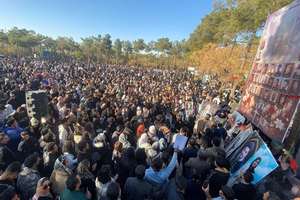
Multiple videos sent to Iran International, along with documented reports published by outlets including Reuters and verified by Amnesty International, indicate that snipers were positioned on rooftops – including on top of a police station – and fired at protesters’ heads and upper bodies.
One eyewitness told Iran International that on Sunday morning, January 11, even after municipal water trucks had washed the streets, blood traces were still visible along Ashrafi Esfahani Street in Sadeghieh.
According to information shared with Iran International, during an emergency meeting with Tehran medical officials on the morning of January 9, a senior health official said that aggregated figures from the city’s treatment centers up to that point showed at least 1,800 people had been killed in the crackdown on the evening of January 8.
Finishing shots
Kazem describes encountering injured protesters in southern Tehran in the early hours.
In one instance, he says, he approached a man who had lost a significant amount of blood.
“He pleaded, ‘I have a small child, don’t shoot,’” Kazem recalled.
“I told him to pretend to be dead so they wouldn’t give him a coup de grâce,” he said.
Minutes later, he says, a motorcycle stopped beside the wounded man.
“The officer kicked him to confirm he was alive, then shot him in the head at close range.”
Killing children and refrigerated trucks
Kazem says children were among those killed. Based on what he says he personally observed in Sadeghieh and in one southern Tehran district, he estimates that at least 200 children died over the two nights.
He says bodies were collected using refrigerated trucks belonging to the Mihan ice cream company, similar to methods he says were used during earlier protests.
“Like in the 2022 protests, refrigerated Mihan ice cream trucks were used,” he said. “I personally helped load corpses.”
According to Kazem, the trucks were used to remove bodies from streets and transport them to undisclosed locations.
He describes a scene that remains vivid to him.
“We were loading bodies into a Mihan truck when I saw the man next to me tear the necklace and earrings off a 9- or 10-year-old dead girl before throwing her into the truck. I looked at him in fear. He looked back in a way that frightened me. I said, ‘It’s your right, take it, what’s it to me?’”
Kazem says he did not intervene and continued loading bodies.
Reports suggest the removal operation was systematic.
Iran Human Rights said in a report published on February 3 that, citing an eyewitness in Lorestan province, security forces transported the bodies of those killed in refrigerated Mihan ice cream trucks to the courtyard of a hospital in the province.
Iran International contacted Mihan to ask whether the company’s trucks were used to move bodies during the January 8-9 protests and whether the company confirmed the account. No response had been received by the time of publication.
France 24 and Amnesty International’s Switzerland office have also reported the use of food transport vehicles and containers to move the bodies of those killed.
Burning property and foreign forces
Kazem says he personally witnessed security personnel setting fire to banks and mosques after first clearing valuables.
“They would first evacuate valuables before burning the site,” he said. “I personally witnessed instructions to remove valuable items from a mosque before it was set on fire.”
He also says he saw a small number of fighters affiliated with Iraq’s Popular Mobilization Forces in Sadeghieh on the first night.
“The absolute majority were IRGC, plainclothes, Basij and security forces,” he said. “But I did see a small number of Hashd al-Shaabi.”
In the areas where he was present, he says regular police and special units appeared less directly engaged in lethal force.
“I think they weren’t prepared for killing on that scale,” he said.
Media reports have confirmed a limited presence of Hashd al-Shaabi forces in some areas during the crackdown. Videos from inside Iran also suggest that damage to public property was carried out by security forces footage – that several outlets, including Le Monde, have verified.
Payment for the dead
Kazem says he returned his weapon to the Vali-e Asr garrison on Saturday morning and was no longer required.
He says that afterward he heard from contacts that families seeking the bodies of loved ones were sometimes required to pay money, calculated according to neighborhood and reported property damage.
“They couldn’t charge everyone for bullets,” he said. “But when they did, it was based on how much damage the neighborhood had suffered.”
Iran International has documented in multiple reports that authorities extorted money from bereaved families in exchange for returning the bodies of their loved ones.
Kazem’s narrative adds another piece to the picture: January 8 and 9 were not reactive policing, but a coordinated, military-style campaign designed to crush protests with deadly force.