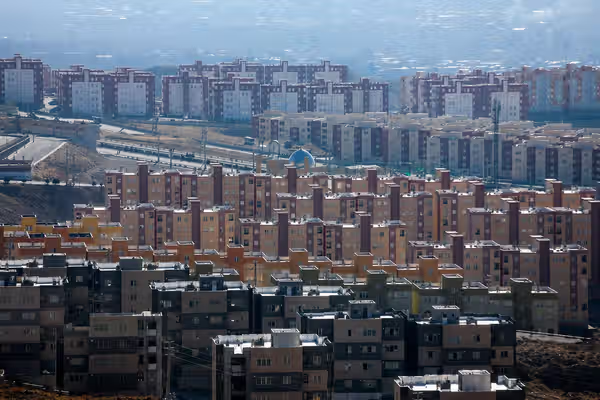
Reports of Ghalibaf-Trump channel sparks political storm in Tehran
Remarks by Donald Trump suggesting backchannel contacts with a figure inside Iran’s government have stirred intense political debate in Tehran.

Remarks by Donald Trump suggesting backchannel contacts with a figure inside Iran’s government have stirred intense political debate in Tehran.

A missile fired from Iran struck Lebanon’s coast hours after Beirut expelled Tehran’s ambassador, sources told Iran International, contradicting earlier reports that it had been intercepted.

Mohammad Bagher Ghalibaf may soon be called a pragmatist. That would be a mistake.

President Donald Trump said Tuesday that Tehran had offered Washington a “very significant prize” related to oil and gas, expressing optimism that a deal to end the conflict could be possible.

Iranian officials and commentators are increasingly portraying control of the Strait of Hormuz not just as a strategic advantage but as a financial asset that could help offset the costs of war.

Pakistan has offered to host talks between the United States and Iran aimed at ending a war that has rattled global energy markets. Here’s why Islamabad is involved—and whether it could work.

In history, authoritarian systems usually fall twice: first psychologically, when fear breaks; then politically, when the men with guns hesitate. Iran’s recent shocks look less like a single crisis than a classic collapse sequence unfolding at speed.

A young Baha’i detainee in Iran has been subjected to torture and mock executions and is at serious risk, a rights group said on Tuesday.

The United States has paid $129 million to victims of Iran-linked terrorism as part of a broader $318 million settlement tied to a long-running case over a Manhattan office tower, prosecutors in New York said on Monday.

Iranian state media continued issuing warnings against the United States even after President Donald Trump said Monday that the two countries had held “constructive” talks—and that he was therefore postponing planned strikes on Iran’s power grid.

Ambiguous reports of contacts between US and Iranian officials may reflect a tactical effort to calm markets, shape global opinion and deepen uncertainty inside a state already gripped by paranoia, analysts and former US officials told Iran International.
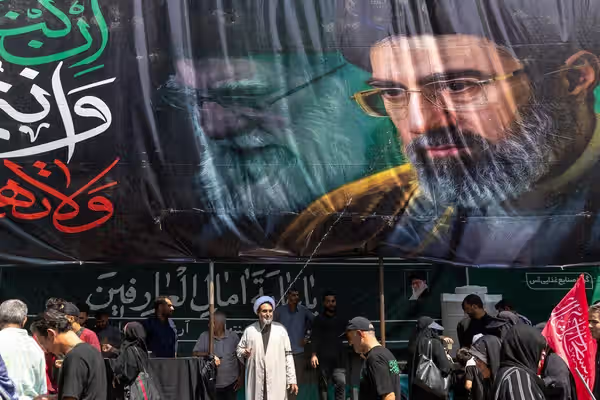
Whether real or not, President Donald Trump’s statement that Iran has reached out for talks is already having an impact: fueling mistrust within Tehran leadership while easing tensions in global oil markets, even as Iranian officials deny any such contact.

Since Donald Trump threatened to target Iran’s power plants, anxiety has surged among Iranians at home and abroad, many warning that this directly targets people’s lives, not the government.

Russia and China expressed concern on Monday over restrictions in the Strait of Hormuz and warned that further escalation could widen the conflict and disrupt global energy supplies.

Several safe houses in Tehran were targeted in attacks early on Monday, according to reports received by Iran International, as security deployments intensified across the country.

An Iran-aligned militant network has claimed responsibility for the arson attack on Jewish ambulances in north London early Monday, a monitoring organisation said, linking the incident to a string of similar fires across Europe.

Cases tied to the January protests have been reviewed, with some reaching final verdicts and now being carried out, Iran’s judiciary said on Monday, warning that those convicted would face no leniency.

A British man jailed on espionage charges in Iran called on Prime Minister Keir Starmer to step out of the shadows and publicly declare that he and his wife are innocent.

More than 1,400 civilians have been killed in Iran during the first three weeks of the war with the United States and Israel, according to figures compiled by the rights group HRANA.

An Israeli security insider says Iran could be weeks away from reaching conditions for an uprising, as the US and Israel may soon judge the Islamic Republic weak enough to call on Iranians to take to the streets.

The commander of US Central Command said Iran has increasingly targeted civilian sites across the Middle East out of "desperation" as its military capabilities deteriorate in the third week of the war.