• العربية
  • فارسی
BrandBrand
  • Iran Insight
  • Politics
  • Economy
  • Analysis
  • Special Report
  • Opinion
  • Podcast
  • Live TV
  • Iran Insight
  • Politics
  • Economy
  • Analysis
  • Special Report
  • Opinion
  • Podcast
  • Live TV
  • Theme
  • Language
    • العربية
    • فارسی
  • Iran Insight
  • Politics
  • Economy
  • Analysis
  • Special Report
  • Opinion
  • Podcast
  • Live TV
All rights reserved for Volant Media UK Limited
volant media logo

Seven in 10 Americans want new Congress to end Iran war - Reuters/Ipsos poll

Nov 10, 2026, 13:26 GMT+0Updated: 14:55 GMT+0
The US Capitol dome seen at sunset through a window on Capitol Hill in Washington, DC, US, November 9, 2026.

Seventy-one percent of Americans want the new Democratic-led Congress to pass a law ending the war with Iran, including half of Republicans, a Reuters/Ipsos poll found, a week after midterm elections that handed Democrats their largest majorities since at least 2008.

The four-day poll, completed on Monday, found 93 percent of Democrats and 51 percent of Republicans in favor of legislation to end the war the United States launched with Israel on February 28. The new Congress is sworn in on January 3.

The war has pushed fuel prices sharply higher, adding to inflation already driven up by Trump’s tariffs, and 62 percent of respondents said they would support repealing the tariffs.

Nine in 10 said the cost of living should be the new Congress’s focus in its first 100 days.

Trump has defended the war as necessary to stop Iran from acquiring a nuclear weapon.

The poll surveyed 1,705 adults online nationwide and has a margin of error of about two percentage points.

Most Viewed

Iran acquires oil facilities in China to bypass US sanctions, leaked document shows
1
EXCLUSIVE

Iran acquires oil facilities in China to bypass US sanctions, leaked document shows

2

Qatar takes Iran mediation to Trump as regional peace efforts gather pace

3

Trump signals openness to Iran deal amid renewed Hormuz tensions

4

Iran signals readiness for talks but demands US lift restrictions

5

Trump says Iran war ‘effectively over’ militarily, but US ready to strike again

Banner
Banner
Banner
Banner
Banner
Banner
Banner

Spotlight

  • Oil prices or US prestige? Tehran analysts weigh Trump's next move
    INSIGHT

    Oil prices or US prestige? Tehran analysts weigh Trump's next move

  • Trump lost the midterms. Did Iran win?
    PODCAST

    Trump lost the midterms. Did Iran win?

  • Iran tortured boy at 13 before killing him at protest, source says

    Iran tortured boy at 13 before killing him at protest, source says

  • Iran acquires oil facilities in China to bypass US sanctions, leaked document shows
    EXCLUSIVE

    Iran acquires oil facilities in China to bypass US sanctions, leaked document shows

  • Iran's solar ambitions falter as Chinese panel imports collapse

    Iran's solar ambitions falter as Chinese panel imports collapse

  • Tehran hails economic pain in US as Iranians struggle to make ends meet
    INSIGHT

    Tehran hails economic pain in US as Iranians struggle to make ends meet

  • Opportunity or trap? Vance's Iran war remarks divide Tehran
    INSIGHT

    Opportunity or trap? Vance's Iran war remarks divide Tehran

•
•
•

More Stories

Hegseth says he 'would do it again' as US remains 'locked and loaded' against Iran

Nov 10, 2026, 13:12 GMT+0
100%
US Defence Secretary Pete Hegseth participates in a panel on Project Agincourt, an initiative about autonomous warfare, during the 2026 Association of the United States Army (AUSA) Annual Meeting and Exposition at the Walter E. Washington Convention Center in Washington, DC, US, October 14, 2026.

US War Secretary Pete Hegseth said on Tuesday that he would carry out the military operations against Iran again, warning that American forces remained ready to respond to any further action by Tehran.

"I stand behind every one of these operations. I was proud to execute them, and I would do it again tomorrow," Hegseth said at a Pentagon briefing, referring to US military operations involving Iran, Yemen and Venezuela.

"And if that regime makes one wrong move, as the president said, we remain locked and loaded with the full weight and lethality of Central Command," he said, referring to Iran.

Hegseth also said American forces had destroyed more than 80% of Iran's nuclear industrial base during the war.

Hegseth says more than 80% of Iran's nuclear industrial base destroyed

Hegseth said American forces had struck more than 13,000 targets during Operation Epic Fury, the US military campaign against Iran, and caused extensive damage to the country's military and nuclear infrastructure.

"In under 40 days of sustained combat, more than 13,000 targets struck. Their navy sunk. Their air force grounded. Their defense industrial base gone. More than 80% of their nuclear industrial base gone," he said.

Hegseth also said the US naval blockade of Iranian ports remained in place and asserted that Washington controlled the Strait of Hormuz.

"The ironclad blockade unbroken. We control the Strait of Hormuz," he said.

"By every measure, we achieved a historic military victory," Hegseth added.

Trump also says he would launch Iran war again

Hegseth's remarks echoed Trump's defense of the decision to attack Iran, despite the president acknowledging that the conflict had contributed to Republican losses in the November 3 midterm elections.

"I did the right thing. I would have done it again," Trump told The Wall Street Journal.

Trump also said the military campaign was necessary to prevent Iran from acquiring nuclear weapons.

"We had no choice. You can't let Iran have a nuclear weapon," he told reporters last Wednesday.

Hegseth discusses strikes on Iranian nuclear facilities

Hegseth also referred to Operation Midnight Hammer, the earlier US strikes involving B-2 bombers against Iran's nuclear facilities at Fordow, Natanz and Isfahan.

"The largest and most successful B-2 strike in American history. Nuclear sites obliterated," he said.

Hegseth reiterated Washington's position that Iran must not acquire nuclear weapons.

"The crazy Islamists in Tehran will never, ever have a nuclear weapon," he said.

He credited Trump with ordering military action that previous administrations had avoided.

"History will judge the Iran war quite differently than conventional wisdom right now," Hegseth said.

"We didn't start this war. Iran did 47 years ago," he added, referring to the 1979 Islamic Revolution.

Hegseth says operations were lawful

The Secretary of War also addressed the legality of the military operations conducted under Trump's administration, including the campaign against Iran.

"Iran, the cartels, Maduro, Yemen, every one was a lawful operation ordered by the commander in chief, then ordered by myself, notified to Congress, and executed by American warriors who did their jobs," he said.

His remarks followed an impeachment effort by Republican Representative Thomas Massie, who accused him of launching military operations without congressional authorization.

Hegseth rejected suggestions that the operations had been unlawful.

"Their service was not a crime. These are heroes, and no politician in Washington will tell them otherwise while I hold this office," he said.

He added that the operations had targeted military capabilities and criminal activities.

"We destroyed terror regimes' capabilities. We sank the boats carrying poison into our communities," Hegseth said.

Hegseth acknowledges 18 US military deaths

Hegseth said 18 American service members had died during Operation Epic Fury.

"Nobody was lost in the mission in Venezuela, but 18 Americans have given their lives in Operation Epic Fury," he said.

"We know their names. I've been to Dover. We honor them every day, but their sacrifice only stiffens our resolve."

He compared the Iran campaign with previous US military conflicts that lasted for years and resulted in thousands of American deaths.

"For generations, my generation fought other Middle Eastern wars that dragged on for years, for decades. We lost thousands, thousands of Americans," he said.

Hegseth said the Iran campaign would not follow the same course.

"This Epic Fury has never been that, and it never will be," he said.

The United States continues to enforce its naval blockade of Iranian ports while diplomatic efforts involving Washington and Tehran remain underway.

US moves aircraft out of second British base over Iran threat - WSJ

Nov 10, 2026, 10:08 GMT+0
100%
A USAF KC-135 tanker of the 100th Air Refuelling Wing (100 ARW) at RAF Mildenhall airbase, amid reports that US military aircraft are being moved from bases in Britain following a reported threat from Iran, near Mildenhall, Britain, November 10, 2026.

The US military moved tankers and tiltrotor aircraft out of RAF Mildenhall in eastern England on Monday over a threat from Iran, the Wall Street Journal reported, the second British base it has thinned out since a suspected Iran-linked plot at RAF Fairford in September.

Flight-tracking data showed nine KC-135 refueling tankers and three V-22 Ospreys leaving Mildenhall in Suffolk on Monday afternoon and evening, Sky News reported. Most of the tankers went to bases in Germany and Spain and one to Prestwick in Scotland. The Ospreys moved to nearby RAF Lakenheath.

The exact nature of the threat was still under discussion among US officials, the Journal said. Washington raised the security level at Mildenhall and Lakenheath to FPCON Charlie, the second-highest on the Pentagon’s scale, which applies when intelligence indicates that some form of terrorist action is likely.

100%
A military vehicle stationed at RAF Lakenheath, which hosts US Air Force personnel and units, amid reports that US military aircraft are being moved from bases in Britain following a reported threat from Iran, in Lakenheath, Britain, November 10, 2026.

US European Command said aircraft move between locations “for a variety of reasons” and that it could not discuss force protection measures.

Britain’s Ministry of Defense said it did not comment on other nations’ activity. “We’re constantly keeping the security of our bases under review,” cabinet minister Lucy Powell told Sky News, “and as we’ve seen with other cases recently, we take firm and quick action where we need to.”

  • Iran threatens to reconsider UK ties over RAF Fairford allegations

    Iran threatens to reconsider UK ties over RAF Fairford allegations

  • Two charged over alleged Iran intelligence operation at RAF Fairford

    Two charged over alleged Iran intelligence operation at RAF Fairford

  • UK blames IRGC for RAF plot, vows crackdown on Iranian networks

    UK blames IRGC for RAF plot, vows crackdown on Iranian networks

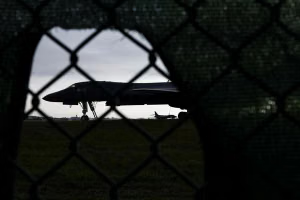
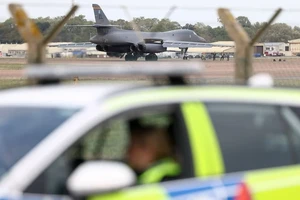
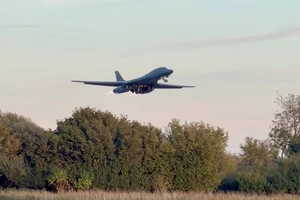
The move comes six weeks after police arrested five men in the early hours of September 27 near RAF Fairford in Gloucestershire, which US bombers used to strike Iran during the war, after a local farmer reported three white vans and a group of men, some with their faces covered. The United States pulled all 12 of its B-1B bombers from Fairford on October 4.

Two men were charged last month under the National Security Act. Prosecutors said one, a British-Iranian dual national, had arranged for the men to drive to the base on the instructions of a man known only as “Ali,” and accused him of assisting a foreign intelligence service; police said they believed that country to be Iran. Six others remain on bail. Prime Minister Andy Burnham said the plot was “almost certainly” directed by the Revolutionary Guards.

Iran’s ambassador in London has denied any involvement. The Revolutionary Guards warned Britain in July that Fairford and any other base used to attack Iran would be a legitimate target.

Trump’s Iran diplomacy faces a test: Can both sides claim victory?

Nov 10, 2026, 09:17 GMT+0
•
Negar Mojtahedi
100%
US President Donald Trump speaks to the media before boarding Air Force One en route to Joint Base Andrews, Maryland, at President Donald J. Trump International Airport in West Palm Beach, Florida, US, November 8, 2026. REUTERS/Eric Lee Purchase Licensing Rights

President Donald Trump’s talks with Qatar’s prime minister come amid a renewed diplomatic push to end the Iran war, but securing terms both Washington and Tehran can present as a victory remains a central obstacle, analysts told Iran International.

Trump and Sheikh Mohammed bin Abdulrahman Al Thani met behind closed doors in the Oval Office on Monday, and Axios reported that their discussions focused on Iran. The Qatari prime minister also met Vice President JD Vance earlier in the day.

An Iranian official told Al-Monitor on Friday that the country’s nuclear program was “under discussion” with mediators. Tehran has said negotiations depend on Washington meeting its demands, including sanctions relief and the release of billions of dollars in frozen assets.

Trump needs a nuclear achievement to justify the war, not just the reopening of the Strait of Hormuz, said Aaron David Miller, a former US Middle East negotiator now at the Carnegie Endowment for International Peace.

“It’s the nuclear issue. He needs a win to justify this war,” Miller told Iran International.

“And I don’t know whether the Iranians are prepared to make that concession or what Trump would consider to be a win that they could accept. So I think that’s a huge problem.”

Who moves first?

The new round of diplomacy has not settled the basic dispute: whether economic and military concessions should come before progress on Iran’s nuclear program, or after.

Danny Citrinowicz, a former head of the Iran branch of Israeli military intelligence and now a senior researcher at the Institute for National Security Studies in Tel Aviv, said an interest in ending the war should not be mistaken for an agreement in sight.

“I believe both sides genuinely want to find a way to end this war, but that does not mean they are close to an agreement,” he told Iran International.

Iran wants Washington to meet its conditions on Hormuz, the naval blockade, oil exports and other economic restrictions before nuclear talks begin. Washington wants movement on the nuclear issue much earlier, he said. “The problem is not simply what each side wants, but who moves first.”

A breakthrough was possible, Citrinowicz said, if Washington accepted a different sequence of reciprocal steps. “Without meaningful American flexibility, however, I see little reason to expect Iran to abandon its red lines.”

Miller criticized the interim memorandum of understanding reached in June, which was meant to open the way to nuclear talks but collapsed soon afterward. It committed Washington to a sequence that favored Iran, he said, calling it “one of the worst negotiated documents in the history of US diplomacy.”

Two definitions of victory

Even if negotiators settle the order of steps, both governments would have to defend the concessions at home as achievements.

Trump could claim victory by reopening Hormuz, lowering energy prices, ending the fighting and securing an Iranian commitment not to build nuclear weapons, Citrinowicz said. Tehran would need an outcome it could present as a success too.

“After surviving months of attacks, the Iranian leadership is not going to accept an agreement that looks like surrender,” he said.

Iran could reopen Hormuz, stop attacks on shipping and regional infrastructure, return to nuclear talks and possibly accept tighter international monitoring, he said. In return it would expect real steps on sanctions, oil exports, frozen assets and guarantees against further attacks.

Miller doubted Trump’s wish to end the war would outweigh his fear of looking beaten. “I think he’d want to be done with this, but I don’t know if he’s prepared to spend the next three years being called a loser,” he said.

Eric Mandel, founder of the Middle East Political Information Network, said a deal could let Trump declare victory while leaving the nuclear dispute open.

“The president would like to have a diplomatic solution. The president is looking for victories. He may claim victories where there aren’t,” Mandel told Iran International.

Tehran was drawing out the talks to wait Trump out, Mandel said, and economic relief in exchange for promises of future nuclear concessions could throw the Islamic Republic a lifeline without securing lasting limits.

A meeting is not a breakthrough

Conflicting reports over a possible meeting between Vance and Iran’s security chief show how uncertain direct contact remains.

Turkey’s intelligence chief, Ibrahim Kalin, said Qatar would host Vance and Mohsen Rezaei, secretary of Iran’s Supreme National Security Council, next week, the Turkish newspaper Türkiye reported. The Tasnim news agency, which is affiliated with the Revolutionary Guards, then quoted a senior Iranian security official as denying any meeting was planned and saying Washington must first act on Iran’s seven conditions.

Foreign Minister Abbas Araghchi said on Tuesday there were no plans for Rezaei to meet Vance. The war, he said, would end neither through military action nor through more sanctions. “The only way to end it is diplomacy and acceptance of the Islamic Republic’s conditions.”

Citrinowicz said Rezaei should not be expected to break with the Islamic Republic’s established positions. “He is deeply rooted in the Iranian political and security establishment,” he said. “He is not someone who can simply be persuaded to abandon the regime’s fundamental positions in exchange for an American offer.”

Rezaei is the subject of an Interpol Red Notice over his alleged role in the 1994 bombing of the AMIA Jewish community center in Buenos Aires, which killed 85 people. He and Tehran deny involvement. As commander of the Revolutionary Guards during the Iran-Iraq war, he led the failed Karbala-4 offensive of December 1986, in which Iran suffered heavy losses.

The decisive question, Citrinowicz said, is whether Vance has Trump’s authority to offer something substantially different.

“A failed meeting could be more dangerous than no meeting at all,” he said. Trump might conclude that diplomacy had run its course and order more strikes to force concessions.

Continued economic pressure, indirect talks and a limited interim deal would remain options, he said, but failure to close the gaps could raise the risk of a return to war.

Trump says Iran war ‘effectively over’ militarily, but US ready to strike again

Nov 10, 2026, 00:56 GMT+0
100%
US President Donald Trump gestures while delivering remarks at NASA’s Kennedy Space Center in Cape Canaveral, Florida, November 6, 2026. (White House)

US President Donald Trump said Monday the war with Iran was effectively over militarily but warned US forces remained “locked and loaded,” while Iran's security chief denied reports of talks with Washington and demanded acceptance of Tehran's conditions to end the conflict.

Qatar's prime minister, Sheikh Mohammed bin Abdulrahman Al Thani, met Trump at the White House in an effort to secure more time for diplomacy and advance negotiations between Washington and Tehran.

“Iran, militarily, is effectively over. We're just keeping it the status quo,” Trump told reporters at the White House after meeting with the Qatari prime minister.

While Trump described the war as militarily “effectively over,” he emphasized the continuation of the US naval blockade and Operation Iron Gate in a Truth Social post, saying Iran's neighbors, including Qatar, Saudi Arabia, the United Arab Emirates, Bahrain and Kuwait, favored maintaining the “status quo.”

He warned that American forces remained “locked and loaded” if developments in the Middle East changed, but said further military action appeared unlikely.

Trump also said Iran had accepted that it could never acquire a nuclear weapon, despite publicly denying such a commitment.

“They understand that. They accept that. They don't admit that they accept it,” he told reporters, describing the prohibition on Iranian nuclear weapons as non-negotiable.

Trump told Al Thani during their meeting that he wanted an agreement with Iran and was willing to give negotiations a chance, but could reverse course if Tehran failed to engage seriously, Axios reported Monday, citing a diplomat briefed on the discussions.

Despite reports of Washington's willingness to pursue diplomacy, Iran's Supreme National Security Council secretary Mohsen Rezaei accused the United States of fabricating reports of negotiations and demanded that it accept Tehran's seven conditions.

“STOP manufacturing FAKE NEWS about imaginary talks,” Rezaei wrote on X.

“The war on Iran has already wrecked the US government. But Washington flails like a desperate gambler,” he added, urging Washington to recognize what he described as a new regional order in West Asia.

The Washington Post reported in October that US officials viewed Rezaei as a key contact in Tehran who could help build support for a nuclear agreement.

Vice President JD Vance sent Rezaei a letter in late October expressing his willingness to meet personally to discuss a negotiated settlement, The Washington Post reported, citing a US official familiar with the initiative.

Axios reported that Vance was also closely involved in the indirect talks through frequent contact with Qatar's prime minister.

Following the White House meetings, Al Thani said he had discussed ways to advance US-Iran negotiations with Trump and Vance.

“Grateful for the positive discussions on reaching a deal and bringing peace to the region,” he wrote on X.

The mediation efforts have focused on a proposal setting out reciprocal steps to reduce tensions and restart negotiations over Iran's nuclear program.

Under the proposed two-day plan, Washington would first lift its naval blockade and release some frozen Iranian funds, while Tehran would invite UN nuclear inspectors to damaged sites, Axios reported. The Strait of Hormuz would reopen on the second day, followed by renewed talks over Iran's highly enriched uranium stockpile.

Iranian Foreign Minister Abbas Araghchi said Sunday that Tehran was awaiting Washington's response to the proposal, which also calls for an end to hostilities on all fronts.

US Secretary of State Marco Rubio, however, said Sunday that indirect negotiations had produced little progress and described some Iranian demands as unrealistic.

“I wouldn't say we're on the verge of a breakthrough,” Rubio said, adding that Trump preferred a diplomatic solution but that one was not always possible.

Meanwhile, Turkish intelligence chief Ibrahim Kalin said Monday that Vance and Rezaei were scheduled to meet in Qatar next week, according to Türkiye newspaper.

Speaking at a conference in Ankara, Kalin said the planned meeting in Doha could provide an opportunity to advance negotiations, warning that failure to reach an agreement could lead to another US attack on Iran.

Kalin said regional mediators were working on a seven-point proposal covering sanctions relief, frozen Iranian assets, nuclear commitments and the reopening of the Strait of Hormuz.

The main disagreement, Kalin said, was over which side would take the first step.

Oil prices or US prestige? Tehran analysts weigh Trump's next move

Nov 9, 2026, 23:20 GMT+0
•
Maryam Sinaiee
100%
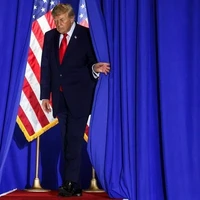
FILE PHOTO: US President Donald Trump speaks during a rally at Guardian Centers in Perry, Georgia, US, October 24, 2026.

Two Iranian analysts have offered contrasting assessments of what could prompt Donald Trump to launch another attack on Iran before the new US Congress convenes in January.

Speaking on the popular Tehran-based online talk show Azad, conservative commentator Mehdi Kharratiyan argued that the prospect of surging oil prices and damage to US financial markets could restrain Trump, despite his continued authority to order military action following the Republican defeat in the midterm elections.

International relations analyst Rahman Ghahremanpour disagreed, saying Trump might be willing to accept substantial economic costs if he believed America's international standing or his presidential legacy was at stake.

Kharratiyan warned that another major conflict could further disrupt energy supplies and push Brent crude prices as high as $130 a barrel, exposing the US and global economies to the risk of recession.

He argued that Iran would retaliate against regional infrastructure in the event of a major US attack, potentially worsening the economic consequences for Washington. Following the Republicans' heavy midterm losses, he said, Trump would struggle to justify another war that could further damage his party's prospects in the 2028 elections.

Ghahremanpour, however, argued that preserving American credibility could take precedence over financial considerations.

He drew a comparison with Britain's experience during the 1956 Suez Crisis, when London was forced to abandon its military intervention under international pressure, suggesting Trump would be determined to avoid a similar humiliation for the United States.

The discussion aired on Azad, known for hosting debates among commentators with opposing views. Its YouTube channel has more than 160,000 subscribers, and the episode had attracted nearly 190,000 views.

The platform was shut down by Tehran prosecutors in August over allegations of spreading false information and operating without a licence, but was allowed to resume broadcasting in late October.

Despite their disagreement over Trump's calculations, both analysts warned that the period before the new Congress convenes could be particularly dangerous for Iran.

“As long as Mr. Trump is in the White House and Netanyahu is in the prime minister's office in Israel, even if they are in a weakened position, the possibility of unpredictable actions, even foolish ones, or actions driven by desperation, remains,” Kharratiyan said.

“If we are not alert, we could suddenly be caught off guard, as we have been in the past.”

Kharratiyan said Iranian officials appeared determined not to allow another surprise attack. If Tehran concluded that Washington had decided to strike, he argued, Iranian forces could launch a pre-emptive attack.

He said a major US-Israeli operation would depend on Washington and Israel identifying an intelligence opportunity, finding potential assistance within Iran and believing they could disable Iran's ability to retaliate in the opening minutes.

Ghahremanpour also warned that Trump's midterm defeat could push him in opposite directions, making him either more cautious or more willing to take risks.

“The election results could make Trump more cautious in his foreign policy, but they could also make him act more boldly and recklessly,” he said in recent remarks to the Iranian Students' News Agency (ISNA).

“Which of these happens will naturally depend on Trump's own assessment and that of his team.”

Ghahremanpour, who favours a negotiated settlement, said the absence of substantial concessions from either Tehran or Washington suggested that any agreement reached in the coming days would likely be fragile, temporary and limited.

He argued that an understanding between Trump and congressional Democrats could reduce the risk of renewed war. But if the president anticipated aggressive moves against him once the new Congress convened, he might instead seek a military confrontation to reinforce America's standing and secure his political legacy.