• العربية
  • فارسی
BrandBrand
  • Iran Insight
  • Politics
  • Economy
  • Analysis
  • Special Report
  • Opinion
  • Podcast
  • Live TV
  • Iran Insight
  • Politics
  • Economy
  • Analysis
  • Special Report
  • Opinion
  • Podcast
  • Live TV
  • Theme
  • Language
    • العربية
    • فارسی
  • Iran Insight
  • Politics
  • Economy
  • Analysis
  • Special Report
  • Opinion
  • Podcast
  • Live TV
All rights reserved for Volant Media UK Limited
volant media logo

UAE, Oman continue search for Jordanian sailor missing after Hormuz tanker attack

Nov 22, 2026, 21:33 GMT+0

Jordan's Foreign Ministry said in a post on X Sunday that Jordan, the United Arab Emirates and Oman were continuing to coordinate search operations for a Jordanian sailor missing after an oil tanker was attacked in the Strait of Hormuz last week.

The missing sailor, Mohammad Hossam al-Din al-Otaibi, was aboard a tanker operated by UAE-based ADNOC Logistics & Services.

Most Viewed

Iran hardliners push tanker convoy to defy US blockade
1

Iran hardliners push tanker convoy to defy US blockade

2

Truck drivers strike across Iran over economic hardship

3

Iran signals readiness for Hormuz showdown despite US buildup

4

My mom knows, my dad doesn’t: The secret lives of young Iranian women

5
PODCAST

Iran-linked hackers posed as US expert to target Australian broadcaster

Banner

Spotlight

  • ‘The city smelled of blood’: Witness recalls Iran protest crackdown

    ‘The city smelled of blood’: Witness recalls Iran protest crackdown

  • Iran-linked hackers posed as US expert to target Australian broadcaster
    PODCAST

    Iran-linked hackers posed as US expert to target Australian broadcaster

  • Who gets to be a journalist? Iran seeks greater control over press
    INSIGHT

    Who gets to be a journalist? Iran seeks greater control over press

  • Iran hardliners push tanker convoy to defy US blockade

    Iran hardliners push tanker convoy to defy US blockade

  • War damage leaves Iran with few options to avert winter gas crunch
    ANALYSIS

    War damage leaves Iran with few options to avert winter gas crunch

Banner
Banner
Banner
Banner
Banner
Banner
•
•
•

More Stories

Trump threatens Iran strikes in new year, says blockade runners will be sunk

Nov 22, 2026, 20:58 GMT+0
100%

President Donald Trump said he was inclined to resume strikes on Iran after the new year if no deal was reached, and warned that Iranian ships trying to run the US naval blockade would be sunk, as Iran's attacks on Bahrain drew condemnation across the region.

In an interview with Fox News on Sunday, Trump accused Iranian officials of stalling in talks and said they had become more aggressive than before the US midterm elections. He called Iran's negotiators "professional tap dancers" who talked constantly but said nothing of substance.

Indirect talks with Tehran were continuing, he said, but he expected the exchanges of fire between US and Iranian forces to go on.

Asked about Iranian state media reports that Iran might test the blockade, Trump said: "I hope they do, they'll all be at the bottom of the sea like the rest of the navy."

He also urged Iranians protesting in recent days to keep going, after seeing videos of the protests, Fox News correspondent Trey Yingst reported.

Attacks on Bahrain

The Revolutionary Guards said on Saturday night that they had struck two radars for US Patriot air defense systems at bases in Riffa and Awali in Bahrain with missiles and drones. They called Iran's airspace a "red line" and warned of a response to any violation.

Bahrain's Interior Ministry said a civilian industrial facility had been hit and set on fire. Its Foreign Ministry rejected the Guards' account, saying the target was entirely civilian. Two people were injured, it said on Sunday: a Bahraini citizen with disabilities, whose condition was stable, and a Pakistani resident, who was in critical condition.

A US official told CBS News that the latest Iranian attacks had caused no damage to US forces or equipment in the region. It was the fourth attempted attack in Bahrain in about a week, the official said, after a pause of nearly two months.

Saudi Arabia, the UAE, Qatar, Jordan and the Arab League condemned the attacks, and the Gulf Cooperation Council said it stood with Bahrain. Saudi Arabia warned that Iran would bear the consequences if they continued.

Conflicting reports on tankers

Iran's navy said on Sunday that two tankers had caught fire after hitting mines east of the Strait of Hormuz, after entering the area with their identification and navigation systems switched off. The Guards' navy separately reported explosions that had disabled two supertankers north of Ghanam Island, east of the strait, and warned shipping companies to follow its instructions.

The UK Maritime Trade Operations agency said it had received a report of an incident between a tanker and military forces in the Gulf of Oman and was investigating. It did not confirm the mine accounts, and it is unclear whether the reports describe one incident or several. Seven tankers have been hit in the strait since November 16, the Joint Maritime Information Centre said.

Talks, and fears of a wider war

Deputy Foreign Minister Kazem Gharibabadi said on Sunday that talks with the United States were continuing and "the window of diplomacy is still open," but that Iran was ready for any scenario. Parliament Speaker Mohammad Bagher Ghalibaf said the state of "neither war nor peace" could not go on, and that removing the threat to Iran required "lasting deterrence."

Britain and several Arab states in the Persian Gulf have privately urged Washington not to launch new strikes, fearing Iranian retaliation and a long disruption to energy supplies, Bloomberg reported, citing people familiar with British government assessments.

Iran's housing crisis keeps divorced couples under one roof

Nov 22, 2026, 19:06 GMT+0
•
Sharareh Azizi
100%
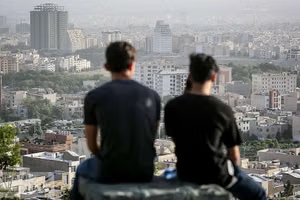
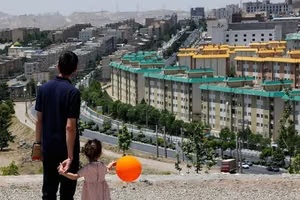
File photo of a sunset in Tehran

After 12 years of marriage and one child, they agree to divorce, and on a summer afternoon it is registered. Then they leave the registry office and go back to the same home, where they had split the rooms between them long before the divorce.

The father has moved into their 10-year-old son's room. The mother stays in the room she once shared with her husband.

For some couples in Iran, the marriage is over, but the housing crisis will not let them leave it behind.

The divorce has been granted, and neither sees the other as a spouse anymore. Yet every night they come home to the same apartment: not to reconcile, not to rebuild, but because neither can afford a place of their own.

In Tehran, the cost of housing can turn even a divorce into a half-finished decision.

A home out of reach

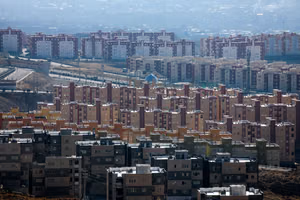
The latest data from Tehran's housing market show asking prices still rising. An analysis of 43,307 apartment listings in the city between November 13 and 20 put the average asking price at about 3 billion rials (about $1,100) per square meter, up 12.5 percent from a month earlier. At that price, a single square meter costs about 18 months of the minimum wage.

  • Tehran rents hit three times many workers’ monthly pay

    Tehran rents hit three times many workers’ monthly pay

  • Shared housing spreads in Iran’s deepening rent crisis

    Shared housing spreads in Iran’s deepening rent crisis

  • Skyrocketing rents push Iranians back to parents’ homes, shared housing

    Skyrocketing rents push Iranians back to parents’ homes, shared housing

Prices are rising even though households have little purchasing power left and sales have stalled.

Renters are under pressure too. Rents in the month to October 22 were 33.4 percent higher than a year earlier, the Statistical Center of Iran said, rising 3.5 percent in that month alone. That is slower than overall inflation, but it does not make renting cheaper. Tenants still pay more each time they renew a lease or look for a new home, which puts independent living further out of reach for low-income families.

For some divorced couples, paying for two homes is simply impossible, so they stay under one roof after their marriage has ended.

'Like two housemates'

Soudabeh, a bank employee who asked that her real name not be used, told Iran International that rising rents and living costs were the main reason she and her former husband still live together.

She had thought about divorce for years, she said, but hesitated because she worried about how she would cover her living costs, especially rent for a home of her own. Renting two separate places was practically impossible, she said. Now that the divorce is official, they live in the same home like two housemates.

  • ‘Living in despair’: uncertainty, economic turmoil erode hope in Iran

    ‘Living in despair’: uncertainty, economic turmoil erode hope in Iran

  • Food, medicine, hope: what Iran's economic crisis is costing its people

    Food, medicine, hope: what Iran's economic crisis is costing its people

The arrangement has cut their costs, she said, and spared them the difficulty of finding a place to rent as single people. But it comes with problems of its own. Privacy and the psychological effect on her children are the hardest parts, she said.

Soudabeh grew up in a traditional family. "Apart from close relatives, no one knows we are separated, and they find it hard to accept, even unacceptable," she said.

She hopes the arrangement is temporary, and that they will soon be able to rent two smaller homes of their own.

Living together after a divorce can take a psychological and social toll on both partners. The loss of privacy and independence, the difficulty of starting new relationships and unresolved tensions can all add to the strain.

For children, it is even more confusing. Children who still see their parents living together after a formal divorce may struggle to understand what has changed, caught between hoping their parents will reconcile and accepting that they have split. Without clear boundaries, and with conflicts still unresolved, their sense of security can suffer.

Families behind a curtain

Living together after divorce is only one of the new ways of living that the housing crisis has forced on Iranians.

In recent years, more and more families have moved in together to share the cost of a single apartment. Some are not even related. They share a home to pay the rent, cover mortgage installments or cope with rising living costs.

In one account on social media, a woman described two families sharing a home in south Tehran. They had divided it with a curtain, she said, but still shared the kitchen, bathroom and toilet.

It is a picture of families forced to adapt to the cost of housing, in a country where privacy has become a luxury.

In August 2023, as parliament debated the government's seventh development plan, its own research center published a report on housing that identified eight forms of homelessness produced by the crisis and the failure of the state's housing policies.

Alongside people sleeping on rooftops, in boiler rooms, in cars, on buses and even in graves, the report listed people who keep moving from place to place, people who take jobs mainly to get a place to sleep, and "two or more families sharing a single housing unit."

The research center said these were the result of low-income families and tenants being priced out of decent housing, and of housing policies that had failed the most vulnerable.

Poverty reshapes the family

Iran's housing crisis is no longer just about being unable to buy a home or pay the rent. It is changing the shape of family life, people's relationships, and even whether they can end one.

For some, separation no longer means leaving home and starting a life of their own. It means dividing the rooms, keeping their distance behind closed doors and going on living in a shared space.

Beyond the financial strain, that carries a psychological and social cost: it makes adjusting to divorce harder for both partners, and leaves children exposed to uncertainty, tension and their parents' unresolved conflicts.

The divorce is registered, but the home is still shared. Sometimes what keeps a marriage going is neither love nor a wish to return, but the inability to pay for a separation.

'Happy Ending' pushes the limits of Iran's underground cinema

Nov 22, 2026, 16:37 GMT+0
•
Mo Abdi
100%
A scene from Atena Mahmoudi's Happy Ending, an underground Iranian film that premiered at the Tallinn Black Nights Film Festival in Estonia without its makers, who are banned from leaving Iran.

Happy Ending, Atena Mahmoudi's underground first feature about a young Tehran masseuse trying to leave Iran, premiered at Estonia's Tallinn Black Nights Film Festival without its makers, who are banned from leaving the country.

The film, shown in the first feature competition of the festival's 30th edition, was made without a state permit. Security agents raided the production and seized footage, but the filmmakers managed to save a copy and finish it. It reached Tallinn as one of a growing number of Iranian films made outside the state system, which tries to push past the limits that system imposes.

Underground filmmaking has become one of the few ways Iranian directors can show life as it is. Films made with a permit must follow the state's rules: women cannot appear without a headscarf, and men and women cannot touch on screen. Directors who break them risk prison and travel bans.

A woman under pressure

The film is a portrait of today's Tehran. Elaheh wants to leave Iran with her boyfriend, Soheil. She works in a secret massage parlor but refuses to offer sexual services, the "happy ending" of the title.

Mahmoudi sets out to show Elaheh's world through her relationships with her mother, her boyfriend and a society that expects different things of her. But the film's most important element is its portrait of a woman in a society on the brink of war, under pressure from every side.

  • Made without permission: how Iran’s underground cinema owned 2025

    Made without permission: how Iran’s underground cinema owned 2025

  • An Iranian film broke every taboo. Viewers say society broke them first

    An Iranian film broke every taboo. Viewers say society broke them first

  • Film shot inside Iran breaks censorship ground with intimate scenes

    Film shot inside Iran breaks censorship ground with intimate scenes

  • Iran filmmakers defy state censorship despite repression

    Iran filmmakers defy state censorship despite repression

On one side is a tempting offer from a "Haji," a man close to the state who invites her to his home. Elaheh badly needs the money, both to help her mother, who lives alone, pay her rent and to raise what she still needs to emigrate.

On the other side are her own instincts, her commitment to the social struggle around her and Soheil, all pointing her the other way.

The film is the story of that temptation, set in a tense society worn down by poverty.

Iran's present, and the political and social upheavals of the past year, run through it. Its ending ties the story unexpectedly to the war. There, the film steps back from its heroine and gives her a strange fate: a victim in a closed society with no way out.

Breaking the rules, and some clichés

Happy Ending wants to be frank and to drop every restriction of official cinema. Its characters reject compulsory hijab and have no qualms about physical contact with the opposite sex.

In that sense, it is a step forward both in getting around the censorship that governs Iranian cinema and in telling a freer story, even by the standards of underground film.

But at times it falls back on the clichés of underground cinema: drinking, drunkenness and forbidden late-night parties.

These scenes have become a staple of recent underground films that try to record the uncensored lives of Tehran's middle class. Here, though, the way they are shown and told feels repetitive, as if all these films were copying one another, and the director cannot find a different way to tell them. As a first feature, the film also has weaknesses in execution that hurt parts of it.

A killing in the opening scene

The film opens with a death. During protests three years earlier, Elaheh takes shelter in her father's car, and he is shot dead by security agents in front of her.

The shadow of that killing by the state hangs over the whole film. It drives Elaheh's hatred of everything to do with "them" and shapes her rebellious character.

The film struggles, however, to reach the more complex layers of its heroine and settles for watching her from a distance. That may explain the coldness of some scenes, and why the unexpected ending arrives without the audience fully feeling for her.

Power cuts return across Iran, threatening over one million jobs

Nov 22, 2026, 13:17 GMT+0
•
Baharan Azadi
100%
A shopkeeper works by lamplight inside a clothing store during a power outage in Iran.

Scheduled power cuts have resumed across Iran, disrupting homes, businesses and schools, with a lawmaker saying electricity shortages could cost more than one million jobs.

People in Tehran, Isfahan, Shiraz, Mashhad, Yazd, Kermanshah and Ardebil reported hours-long outages, often without notice, in messages sent to Iran International on Sunday.

“Today, November 22, we are at school and the power has gone out. It is cloudy, and we are sitting in class in the dark,” a student in Mashhad wrote.

The disruptions have also affected water supplies and internet access.

Fuel shortages force renewed power cuts

Mohammad Allahdad, chief executive of state electricity company Tavanir, announced Saturday that residential and commercial power restrictions would begin November 22 because of fuel shortages at power plants.

  • Power, water outages disrupt daily life across Iran

    Power, water outages disrupt daily life across Iran

Outages could last two hours every other day, increasing to two hours daily if temperatures fall further, Allahdad said.

The cuts have returned just two months after summer. During winter, increased household demand for natural gas used in heating reduces supplies available to thermal power plants, which generate most of Iran's electricity.

Economic journalist Mahtab Gholizadeh told Iran International that worsening gas shortages had disrupted electricity supplies even before severe winter weather arrived.

“Reforming energy consumption is the country's most urgent and important issue, and these reforms must begin with natural gas, not gasoline,” Parliament Speaker Mohammad Bagher Ghalibaf said Sunday.

Natural gas accounts for 73% of Iran's energy mix, compared with 9% for gasoline, Ghalibaf added.

Electricity shortages threaten jobs

Electricity shortages have contributed to 600,000 job losses over the past six months by reducing industrial production, lawmaker Nasrollah Pejmanfar told parliamentary news agency Khaneh Mellat on Sunday.

More than one million workers could lose their jobs if the shortages continue, Pejmanfar added.

100%
Residential buildings stand largely dark at dusk, illustrating the impact of recurring power cuts across Iran.

Around 16% of electricity demand at industrial estates went unmet during the Iranian year ending March 2026, with conditions worsening since then.

Industrial operators also face charges 4.5 times official electricity tariffs, squeezing profit margins and discouraging investment, Pejmanfar said.

Schools left in the dark

The outages have reached schools already struggling with inadequate heating.

Parents previously told Iran International that children attended lessons wrapped in blankets because heating systems were switched off.

“How are teachers supposed to teach and students supposed to learn with the lights off?” a Tehran resident asked, referring to President Masoud Pezeshkian's advice to conserve electricity.

Others described disruptions to water supplies and internet connections, alongside rising electricity bills.

In Arak, one person questioned why a 70-square-meter apartment had received a thirty-million-rial electricity bill despite continuing restrictions.

President's energy-saving advice draws criticism

President Masoud Pezeshkian said November 19 that he slept wearing a jacket and extra clothing and kept his household lights switched off to save energy.

“We sold our jackets so we could put bread on the table for our wives and children for one night,” a person in Mashhad wrote to Iran International.

Others questioned whether officials' families faced similar heating shortages.

  • Unprecedented energy shortage rattles Iranian industries

    Unprecedented energy shortage rattles Iranian industries

Government spokesperson Fatemeh Mohajerani raised the possibility of natural gas cuts earlier in November, while Pezeshkian said November 21 that winter shortages could create further problems.

Some Iranians attributed the recurring outages to mismanagement of the country's energy resources.

The renewed cuts have intensified pressure on households and businesses already struggling with rising costs and reduced industrial production.

Truck drivers strike across Iran over economic hardship

Nov 22, 2026, 12:47 GMT+0
100%
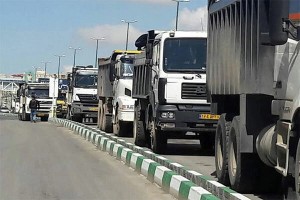
A line of trucks on a road in Iran at night, as truck drivers stage strikes over rising operating costs and worsening economic conditions.

Truck drivers in several Iranian cities have gone on strike over rising operating costs, stagnant freight rates and worsening economic conditions, with reports of work stoppages emerging on Sunday.

A video sent to Iran International showed a group of truck drivers stopping work in Shiraz, southern Iran, on Sunday.

The Telegram channel of the Union of Truck Drivers and Trucking Associations Across Iran also reported strikes in several cities, including Chabahar in southeastern Iran’s Sistan and Baluchestan Province and Dezful in southwestern Khuzestan Province, citing messages from its members.

“We went on strike because of these incompetent officials who do not care about the country or its people. We cannot go on like this anymore,” one driver wrote in a message to the union.

  • Explained: why Iran’s truckers are on strike and what it means

    Explained: why Iran’s truckers are on strike and what it means

Another driver pointed to soaring truck maintenance costs, saying 40 liters of engine oil and five filters now cost 620 million rials (approximately $230 at the free-market exchange rate).

For comparison, Iran’s minimum monthly wage in 2026 is about 166 million rials ($62), meaning the maintenance bill is equivalent to nearly four months of base pay for a minimum-wage worker.

A third driver urged colleagues to remain patient, arguing that the effects of a transport strike would take more than 24 or 48 hours to become visible.

“Be patient. Produce markets will empty, ports will empty, and factories will come to a halt,” the driver said.

Union backs nationwide strike

The Union of Truck Drivers and Trucking Associations Across Iran announced its full support for a nationwide strike on Saturday, November 21, calling on drivers across the country to stop work from November 22.

The union said freight rates had remained unchanged despite sharp increases in the prices of engine oil, tires and spare parts.

It also cited rising fuel, insurance, toll and repair costs, along with job insecurity and insufficient support for drivers, as reasons for the strike.

“This strike is a cry of protest from drivers who have spent years struggling under the weight of rising prices, injustice and neglect and can no longer endure these unbearable conditions,” the union said in its statement.

Economic pressures deepen

The strikes come as Iran faces renewed electricity outages and reports of long queues at petrol stations in several cities.

The continuation of the protests could encourage other professional groups to join, political analyst Iman Aghayari said in an interview with Iran International.

  • Truck driver strike tests Islamic Republic’s grip on road freight

    Truck driver strike tests Islamic Republic’s grip on road freight

The authorities are concerned about the potential spread of protests and are seeking to prevent other sections of society from joining through threats, inducements and repression, Aghayari added.

Iran's worsening economic conditions have placed growing pressure on households, particularly workers and pensioners struggling to meet everyday expenses.