Iran International spy verdicts don’t end threat to exiled Iranian journalists - CPJ
Exiled Iranian journalists remain at risk despite the conviction of two men in London for targeting Iran International staff on behalf of Iranian intelligence, the New York-based Committee to Protect Journalists warned on Friday.
Mostafa Sepahvand, 41, and Farhad Javadi Manesh, 46, were found guilty on Thursday at London’s Woolwich Crown Court of assisting a foreign intelligence service.
Sepahvand was also convicted of conducting surveillance and reconnaissance with intent to commit serious violence against a person in Britain. Javadi Manesh was acquitted of a separate charge of surveillance intended to help others commit serious violence, and a third defendant, Shapoor Qalehali Khani Noori, 57, was acquitted of all charges. The two men will be sentenced on December 17.
“The Woolwich trial has ended, but today’s verdicts don’t make the lives of our journalists any safer so long as the Islamic Republic of Iran continues its campaign of death threats and violence against them,” Iran International spokesman Adam Baillie said.
“Kambiz Hosseini and Mojtaba Pourmohsen and others remain under threat. We are thankful for the continued vigilance of the British police in protecting not only us but the many other Iranians targeted by Iran,” he said.
“Iran will no doubt continue its use of agents and proxies abroad in its campaign to terrorize its critics.”
CPJ calls for those behind operation to face justice
The six-week trial showed that Iran’s Revolutionary Guards had tasked the defendants with monitoring targets including the Iran International journalists Hosseini and Pourmohsen, a lawyer and a media production professional, CPJ said.
“The shocking evidence presented in this trial once again shows the lengths Iran is prepared to go to in order to silence journalists, wherever they are in the world,” said Fiona O’Brien, CPJ’s regional director for Europe and Central Asia.
“While it’s encouraging to see the perpetrators of crimes against them being held accountable, those who paid and instructed them must also be brought to justice,” she said.
Videos, photographs and messages showed Sepahvand watching his targets’ homes and workplaces while coordinating with contacts in Iran, according to Britain’s Crown Prosecution Service.
The men had been promised large payments for information, prosecutors said. In one message, Sepahvand asked for £150,000, about $200,000, to “finish [the target] off” once he had found them.
“This was a calculated operation to spy on those critical of the Iranian regime,” said Frank Ferguson, head of the CPS Special Crime and Counter Terrorism Division.
Sepahvand had shown he was willing to go beyond surveillance to serious violence, Ferguson said, but the men were stopped before any attack.
Convictions follow series of attacks on Iranian journalists
CPJ said the convictions followed several other cases of threats and attacks against Iran International journalists in Britain.
Earlier this year, two Romanian men were sentenced to 12 and eight years in prison for their part in the 2024 stabbing of Iran International presenter Pouria Zeraati outside his London home.
A Greek national has been charged with surveilling an Iran International journalist, and court proceedings over an arson attack on the broadcaster’s premises are under way.
Exiled Iranian journalists continue to face physical threats, online harassment and intimidation of their families in Iran, CPJ said.
Tehran has denied targeting journalists working for Iran International and BBC Persian.
The US-based Committee to Protect Journalists warned on Friday that exiled Iranian journalists remain at risk after two men were convicted in London of spying for Tehran on staff of Iran International, which said the verdicts had not made its journalists safer.
The service, the Établissement français du sang (EFS), said in a written reply that a judicial investigation was under way and that it could not comment on it or give details.
The attack took place on the night of November 1 to 2. Hackers took over the control systems of cold rooms at three regional centers and changed their temperature and defrost settings, the EFS said earlier.
Some units were reset from about minus 30 degrees Celsius to 110 degrees, the French weekly Le Canard enchaîné reported. That was the setting, not the temperature the blood products reached.
Alarms and an on-call technician caught the problem, and the products were moved to other sites or otherwise secured, the EFS said. No samples or blood products were lost. The service has not said when the attack was detected, how long the transfer took, or how the stocks were moved.
The attack came the same night that supermarkets in at least nine European countries, including Belgium and Luxembourg, reported suspected cyberattacks that sent fridge and freezer temperatures soaring.
The Paris prosecutor’s office has not yet linked the attack on the blood service to the supermarket cases and said its investigation is continuing, Agence France-Presse reported.
The supermarket attacks
On October 11 and 12, hackers took control of refrigeration systems at about 700 supermarkets and other businesses across France, letting fridges and freezers warm up. Some stores had to throw out their entire stock of fresh and frozen food, and officials said the attacks caused heavy losses and, at some sites, fires.
A joint report by French intelligence and cybersecurity agencies named Shahid Kaveh, an offensive cyber unit of the Revolutionary Guards, as responsible, and said it worked behind front groups posing as independent hacker collectives. Paris prosecutors have requested international arrest warrants for suspects.
Foreign Minister Jean-Noël Barrot summoned Iran’s ambassador and said France would seek European Union sanctions against those responsible. France was weighing further measures, he said, including some it might never make public.
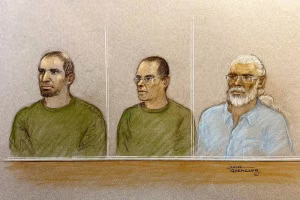
Mostafa Sepahvand, 41, (left) and Farhad Javadi Manesh, 46, were unanimously convicted on Nov. 12, 2026 of engaging in conduct likely to assist a foreign intelligence service under Britain’s National Security Act.
Two Iranian men were found guilty on Thursday of assisting Iranian intelligence operations targeting Iran International journalists in Britain, following a six-week trial at London’s Woolwich Crown Court.
Mostafa Sepahvand, 41, and Farhad Javadi Manesh, 46, were unanimously convicted of engaging in conduct likely to assist a foreign intelligence service under Britain’s National Security Act.
A third defendant, Shapoor Qalehali Khani Noori, 57, was acquitted of all charges and discharged by the court.
Sepahvand was also unanimously convicted of conducting surveillance and reconnaissance with the intention of committing serious violence against a person in Britain.
Javadi Manesh was acquitted of a separate charge alleging that he conducted surveillance intending to facilitate serious violence by others. Noori was also acquitted of that charge.
The judge had told jurors that the court would accept majority verdicts of 10 or 11 out of 12, although they should continue striving for unanimity. The guilty verdicts were unanimous.
Sepahvand and Javadi Manesh are scheduled to be sentenced at London’s Old Bailey on December 17.
Iran International journalists among targets
Prosecutors said the men conducted surveillance on behalf of Iranian intelligence between August 2024 and early 2025, gathering information about individuals in Britain whom Tehran regarded as opponents.
The targets included Iran International journalists Kambiz Hosseini and Mojtaba Pourmohsen, as well as British barrister Jonathan Turner.
During the trial, prosecutor Bill Emlyn Jones told jurors that the defendants visited addresses, photographed buildings and vehicles, and recorded videos to help Iran’s Revolutionary Guards identify potential targets.
The prosecution said Sepahvand was expected to carry out an attack and recruited the other two men to assist in locating and monitoring the individuals.
The court heard evidence of communications with contacts in Iran, including discussions about surveillance, payments and Sepahvand’s efforts to resolve a criminal case against him in Iran.
Defendants disputed knowledge and intent
Sepahvand acknowledged conducting surveillance but said he acted under threats against himself and his family and deliberately tried to frustrate the operation.
Prosecutors challenged that account, arguing that his repeated demands for more accurate information about the targets showed he was actively trying to help locate them.
Javadi Manesh denied knowing that his activities were assisting Iranian intelligence. He did not give evidence during the trial.
Noori also denied knowing that his actions were connected to Iranian intelligence operations.
The convictions come as concern grows in Britain over suspected Iranian intelligence activity targeting dissidents and journalists.
British authorities have repeatedly warned of threats against Iran International staff, while Tehran has previously denied involvement in plots targeting critics overseas.
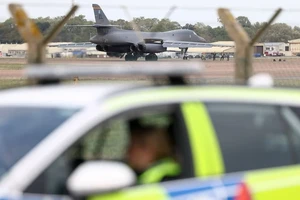
A police officer blocks a road near the RAF Fairford airbase, which hosts United States Air Force (USAF) personnel, in Fairford, Gloucestershire, Britain, September 27, 2026.
A network of seven men allegedly working on behalf of Iranian intelligence services helped coordinate a wave of attacks across Europe, using local criminals and AI-generated propaganda to target Jewish communities and spread fear, ITV News reported on Wednesday.
The British broadcaster identified two previously unnamed brothers with suspected ties to organized crime in the Netherlands as alleged members of the network, which Western security officials believe was involved in attacks across several European countries and a suspected plot against a British military base used by US forces.
ITV named Mustafa Mter Rassoul Alkyaui, who was arrested in Turkey and remains in detention, and his brother, Rassoul Mter Rassoul Alkyaui Mohsen, who remains at large.
The broadcaster said the brothers' contacts in Europe's criminal underworld were believed to have helped the network recruit local operatives to carry out attacks for money, sometimes without knowing whose instructions they were following.
The findings build on a November 10 US Justice Department indictment charging three other alleged members of the network: Mohammad Baqer Saad Dawood al-Saadi, a dual Iranian-Iraqi national; Mohsen Mohajeri, an Iranian national; and Mohammad Ali al-Hassani, an Iraqi national.
Credit: ITV News
US prosecutors linked the three men to nearly 20 attacks and attempted attacks across Europe and the United States, including a September plot targeting RAF Fairford, a British air base housing American forces.
According to ITV, Western security officials believe the network operated from a control room in Baghdad, selecting targets and recruiting criminals to carry out attacks as Iran sought ways to retaliate following the outbreak of war with the United States and Israel in February.
Investigators suspect the network received funding from both the Islamic Revolutionary Guard Corps (IRGC) Quds Force and Iran's Ministry of Intelligence, with neither agency apparently aware of the other's involvement.
An image released by the US Justice Department shows al-Hassani (left) and Mohajeri (right) allegedly meeting in April to plan terrorist attacks.
ITV reported that the group operated as a loose circle of associates rather than a conventional militant organization, using artificial intelligence to produce propaganda videos that made the network appear larger and more sophisticated.
The broadcaster publicly identified five alleged members, including the three men charged in the United States and the two brothers. The other two were not named.
Attacks targeted Jewish communities across Europe
The suspected campaign began in March with an explosion outside a synagogue in Liège, Belgium, followed by an arson attack on four ambulances belonging to the Jewish emergency medical service Hatzola in north London.
A previously obscure organization calling itself the Islamic Movement of Companions of the Right, also known by its Arabic initials HAYI, said it was responsible for the attacks.
ITV reported that al-Saadi was suspected of personally producing and distributing some of the group's AI-generated propaganda, including material relating to the March 23 ambulance attack.
A drone view of four ambulances belonging to Hatzola, a Jewish community organisation, that were set on fire in an incident that the police say is being treated as an antisemitic hate crime, in northwest London, Britain, March 23, 2026.
US prosecutors said the network was involved in approximately 18 attacks in Europe during the spring, seven of them in Britain. The incidents included arson, explosions and a near-fatal stabbing of two Jewish men in London.
The Justice Department alleged that HAYI served as a front for Iran-backed Kataib Hezbollah and other US-designated terrorist organizations, helping conceal those directing the attacks.
US prosecutors detail RAF Fairford plot
The alleged network subsequently turned its attention to RAF Fairford, an air base in Gloucestershire that housed US military aircraft and personnel.
According to the Justice Department, al-Hassani directed preparations from Iran, paying contacts in Britain to conduct surveillance and obtain vehicles and materials for the September operation.
British police recovered three vans linked to the alleged plot on September 27 and arrested their occupants, according to US prosecutors.
Prosecutors also alleged that al-Saadi, who had been in US custody since May, continued coordinating with other members of the network through coded messages passed during calls with relatives in Iraq.
Police officers guard an area as roadblocks remain in place near RAF Fairford airbase, after police declared a major incident at the base and arrested several men on suspicion of offences under the Explosives Act, who have since been released on bail, in Fairford, Gloucestershire, Britain, September 29, 2026.
ITV reported that Western officials believe the decision to target RAF Fairford probably received approval from senior figures within the Revolutionary Guards, unlike other attacks that the network was thought to have selected independently.
"This eight-count indictment shows the determination of Iran to commit terrorist attacks in Europe and the US," FBI Director Kash Patel said, citing the suspected plot against RAF Fairford.
The ITV investigation suggested the network's operations were designed not only to cause physical damage but also to generate widespread fear, particularly within Jewish communities.
Western security officials told the broadcaster that networks operating under the HAYI name could carry out further attacks.
The report came as Iran's security chief Mohsen Rezaei renewed warnings Wednesday about military bases stretching "from West Asia to Europe," according to ITV.
The allegations concerning the network, including the suspected involvement of Iranian intelligence agencies and the newly identified brothers, have not been established in court. The three men indicted in the United States are presumed innocent unless proven guilty.
Shahram Poursafi in the FBI's Most Wanted Terrorist list
The FBI on Tuesday added an Iranian Revolutionary Guard member accused of plotting to assassinate former US national security adviser John Bolton to its Most Wanted Terrorists list and released appeals for information on three alleged associates.
Shahram Poursafi, also known as Mehdi Rezayi, allegedly sought to arrange the killing on behalf of the Islamic Revolutionary Guard Corps’ Quds Force. The FBI said he solicited the murder of two former US government officials between October 2021 and April 2022.
The bureau also issued seeking information posters for Mohammad Reza Ansari, Abolfazl Alizadeh and Mohammad Hossein Shamoradizadeh, whom it linked to Iranian assassination planning.
“The FBI will not stand for the IRGC’s brazen attempts to silence, harm, or murder activists, dissidents, journalists, public officials, or anyone else it deems a threat,” said Gregory Heeb, special agent in charge of the Washington Field Office’s Counterterrorism Division.
The alleged Bolton plot
The Justice Department announced charges against Poursafi in August 2022, accusing him of offering $300,000 to have Bolton killed in Washington or Maryland, likely in retaliation for the January 2020 killing of Quds Force commander Qasem Soleimani.
Prosecutors said Poursafi initially asked a US resident he had met online to photograph Bolton, claiming the pictures were for a book. He subsequently negotiated the assassination with a confidential source working with US authorities. The charges include murder-for-hire and providing or attempting to provide material support to a transnational murder plot.
The State Department’s Rewards for Justice program is offering up to $20 million for information leading to Poursafi’s arrest or conviction. Its account says he used encrypted messaging applications to arrange the killing from Iran.
Quds Force network
The FBI described Ansari as a deputy in Unit 840, a Quds Force unit responsible for developing lethal operations, and said he had supported Iranian operations in Syria. With Poursafi’s assistance, Ansari allegedly planned and attempted to assassinate two former US officials.
Alizadeh and Shamoradizadeh are commanders in the Basij Imam Ali Battalion who have allegedly participated in lethal plotting, the bureau said. It identified Asghar Bagheri, who died in April 2026, as Unit 840’s former commander.
Iran International reported in December 2022, citing leaked documents, that Ansari led a failed operation targeting Bolton and former secretary of state Mike Pompeo. That report also identified Poursafi, Alizadeh and a commander named Mohammad Hossein Shahmoradi as members of Ansari’s team.
The US Treasury sanctioned Ansari and Poursafi in June 2023, accusing them of planning assassination attempts against two former US officials. Treasury said Ansari belonged to a Quds Force external operations unit targeting Iranian dissidents and other nationals in the United States, the Middle East, Europe and Africa.
View of the closed frozen food aisle at a supermarket near Nantes after a cyberattack targeted refrigeration systems at French supermarket chains, causing food losses and fires at several stores, France, October 12, 2026.
France is weighing measures against Iran, some of which it may never make public, over cyberattacks it blames on the Revolutionary Guards that made refrigerators and freezers overheat in about 700 supermarkets, Foreign Minister Jean-Noël Barrot said on Tuesday.
“We rule nothing out and will take all measures, including those we may not disclose publicly, that we deem proportionate and necessary to deter any further attacks,” Barrot told Franceinfo television. The aim, he said, was to deter anyone “in Iran or elsewhere” from trying the same.
France summoned Iran’s ambassador on Tuesday morning, a day after announcing that it had identified the Revolutionary Guards as responsible, and said it would seek European Union sanctions against those behind the attacks.
Barrot called the hacking “unprecedented in both its scale and its level of aggression” and the first large-scale cyberattack aimed at sabotaging infrastructure on French soil.
700 stores, one weekend
The attacks on October 11 and 12 hit refrigeration systems at about 700 supermarkets and other businesses across France, according to French authorities.
The hackers took remote control of temperature settings and let fridges and freezers warm up. Some stores had to throw out their entire stock of fresh and frozen food. French officials said the attacks caused heavy financial losses and, at some sites, fires.
Reuters has reported that some of the systems were obsolete or ran outdated software, which may have left them open to intrusion.
Paris prosecutors have opened an investigation into Shahid Kaveh, an offensive cyber unit of the Revolutionary Guards, on suspicion of sabotage in the interests of a foreign power.
A joint report by French intelligence and cybersecurity agencies named the unit as responsible and identified three alleged members: Hamid Reza Lashgarian, Mahdi Lashgarian and Reza Salarvand.
It said they worked behind front groups posing as independent hacker collectives, among them “CyberAveng3rs” and “Cyber Isnaad Front.”
Paris prosecutor Laure Beccuau said France had requested international arrest warrants for suspects.
Iran routinely denies carrying out cyberattacks.
Freezers across Europe
On November 2, supermarkets in at least nine European countries, including Belgium and Luxembourg, reported suspected cyberattacks that sent fridge and freezer temperatures soaring and forced units to shut down.
French authorities have not said whether the same group was behind those incidents.
The attacks are among several on civilian infrastructure since the war began on February 28. There other suspected cyber operations against US transit systems, water treatment plants and shipping.