Two Tehran bookstores reportedly sealed after Halloween crackdown
People wearing Halloween masks gather on a street in Tehran during celebrations on October 30, 2026.
Two bookstores on Tehran's Iranshahr Street were reportedly sealed Saturday, days after security forces cracked down on Halloween gatherings in the popular cultural hub, drawing criticism on Iranian social media.
Dey Bookstore and Arsa Book House, located opposite each other, were shut down, journalist Yaghma Fashkhami wrote on X. Dey also announced that it would remain closed until further notice and could not deliver or dispatch books this week.
Dey was previously sealed in October 2023 during a crackdown on businesses accused of violating mandatory hijab regulations.
Book-focused YouTuber Melika Ghanami linked the closures to recent pro-government gatherings on Iranshahr Street.
"Just yesterday or the day before, they flooded Iranshahr Street carrying flags. Now we're hearing that Dey Bookstore and Arsa Book House have been sealed too. It seems every corner of Tehran where there's even a little life is going to be taken away from us somehow," she wrote on X.
Since the outbreak of war in February, supporters of the Islamic Republic have held nighttime rallies in Tehran and other cities. More recently, Iranshahr Street itself has hosted pro-government gatherings, with images circulating of participants waving Islamic Republic flags.
Halloween crackdown
The closures come after security forces dispersed Halloween gatherings on Iranshahr Street on October 30. Police blocked the street near Artists Park before Basij members and plainclothes security personnel moved in to disperse the crowd. Witnesses told Iran International that people were beaten and detained and nearby cafes were forced to close.
The operation also affected families visiting Artists Park, who were ordered to leave. "It was like the protests. They were running after people and shouting, 'Disperse!'" one eyewitness told Iran International.
The witness also reported seeing people carrying Islamic Republic flags in another part of the street.
The operation followed a directive by Iran's Chamber of Guilds banning Halloween celebrations in public venues and businesses and warning cafes, restaurants and other establishments of closure and legal action for hosting or advertising such events.
Journalist and translator Emily Amraee criticized the bookstore closures in a post on X, linking them to the authorities' response to Halloween celebrations.
"Halloween has really gotten under their skin. They've gone crazy and started shutting down bookstores and cafes and sealing them off. The cultural renaissance is in full swing, dear Mohsen!" she wrote.
Amraee's reference was directed at musician Mohsen Namjoo, who returned to Iran in August after nearly two decades abroad and has since made public remarks defending the Islamic Republic's handling of cultural and social life, describing the changes he sees in Iran as a "cultural renaissance."
Concerns over public spaces
Hardline supporters of the Islamic Republic who advocate mandatory hijab had previously criticized women for appearing without hijab on Iranshahr Street and called on authorities to take action in social media posts.
Sociologist, translator and urban studies researcher Iman Vaghefi criticized what he described as a broader campaign against public spaces.
"The destruction of street furniture on Sanai Street, the attack on Iranshahr Street, the closure of bookstores and cafes, the prosecution of sports clubs, the deployment of morality patrols in smaller cities — these are different but interconnected parts of a planned assault on the foundations of collective urban life," he wrote on X.
"Under the pretext of war, they are targeting the destruction of shared public spaces."
Journalist Saeed Barabadi, organizer of the independent visual arts project Chizha (Things), also questioned the timing of a municipal initiative called Iranshahr Markets.
"At the same time, and quite coincidentally, the municipality has launched a project called 'Iranshahr Markets,'" he wrote on X.
"So it's not just about dispersing people from a street that, rightly or wrongly, has become a gathering place. The point is that the same name, Iranshahr, must be attached to the project so everyone knows who builds and who profits."
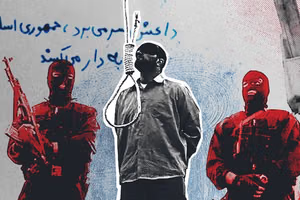
Iranians expressed anger and grief over the execution of three protesters and new death sentences against others, criticizing the United States and the international community for their response in messages sent to Iran International.
Iran's judiciary announced on November 8 that Hassan Divband, Hamid Kazemi and Reza Zanganeh, three people arrested during the January protests in Karaj, had been executed.
The executions came alongside reports of additional death sentences against protesters in the northeastern city of Mashhad.
Abolfazl Sedaghat, 20, Matin Farnian and Vahid Khedrikhah were sentenced to death on charges of moharebeh, or "waging war against God," in a joint case, according to the human rights organization HRANA.
Death sentences were also issued against Ali Zaghi and Ilya Akbari, bringing the number of protesters sentenced to death in the so-called Shandiz case to six, according to earlier reporting.
'We can no longer bear the news of executions'
"We woke up this morning to the news that three more innocent young men had been executed. I can no longer bear hearing about executions," a resident of Isfahan wrote to Iran International.
The executions prompted messages of grief and anger from people across Iran, many expressing concern about the future of younger generations.
"Every morning when we wake up, we are confronted with news of our beloved children being killed. You have taken life away from us," a Tehran resident wrote, addressing Iranian authorities.
Another from Dezful urged fellow Iranians to consider the future facing their children.
"Look at your beloved child. How can you bring yourself to leave the Islamic Republic as their inheritance? How can you bear to leave your child in line for execution and torture?" the citizen wrote.
Another, referring to discussion of possible US strikes on Iran's energy infrastructure, said the country's infrastructure was not their primary concern.
This citizen argued that the Islamic Republic's continued rule was destroying the country's infrastructure every day, from electricity and water supplies to the lives of its young people.
Questioning US response and call for continued solidarity
Several messages sent to Iran International criticized Washington's response to the executions, with some directly addressing US President Donald Trump.
"Do the human rights-defending Democrats in America not see all these crimes in Iran?" one asked, referring to the executions in Karaj.
Another described the executions as retaliation by the Islamic Republic against the Iranian people and questioned Trump's response.
"The oppressive system of the Islamic Republic cannot reach your soldiers, so it takes revenge on the Iranian people through executions. Isn't it time to fulfill your promise?" reads a message.
Other messages emphasized solidarity among Iranians and the importance of continuing efforts to seek justice for those executed.
A resident of Bandar Abbas expressed grief over the executions while thanking Iranians abroad for organizing demonstrations.
"One eye mourns the brave compatriots who lose their lives at the gallows every day, while the other sheds tears for the remarkable gatherings of compassionate Iranians who, despite all their difficulties, put their homeland first," the resident wrote.
A Tehran resident described the three executed protesters as "three stars whose names will live forever" and expressed determination to continue their cause.
"Victory is certain," the audience wrote.
Amnesty International warns over use of death penalty
Iranian authorities have intensified their crackdown in recent months through widespread summonses and arrests, lengthy prison sentences and a sharp increase in executions.
The growing use of capital punishment has also drawn criticism from international human rights organizations.
Iranian authorities are using the death penalty as a tool to suppress dissent, Diana Eltahawy, Amnesty International's deputy regional director, warned on October 13.
“The arbitrary executions of these five young men serves as another chilling reminder of how the Iranian authorities weaponize the death penalty to render the cost of dissent so high that it terrorizes the population into silence and deters further mass uprisings challenging their repressive decades-long rule,” she said.
The latest executions and death sentences have renewed expressions of grief and anger among Iranians, with messages to Iran International reflecting both frustration over the international response and determination to continue seeking justice for those killed.
A severely damaged car following a collision with a truck on a road in Iran, with an ambulance at the scene.
More than 78,500 people have died in road accidents in Iran over four years, yet the government is seeking to delay new vehicle safety standards despite repeated warnings about the quality of domestically manufactured cars.
Road accidents killed 10,357 people in the first six months of the current Iranian calendar year, ILNA news agency reported on Sunday, November 8, citing figures released a day earlier by Iran's Forensic Medicine Organization.
The figure was down just 0.4 percent from 10,401 deaths during the same period last year.
Another 224,220 people injured in road accidents were referred to forensic medical centers during the six-month period, an increase of 10.8 percent from a year earlier.
Industry minister seeks delay in safety standards
Poor-quality vehicles, unsafe roads and ineffective public education are among the main causes of Iran's road safety crisis, according to critics who say authorities have failed to address the underlying problems.
Traffic police chief Teymour Hosseini has previously urged the Ministry of Industry and the National Standards Organization to improve vehicle safety, arguing that higher traffic fines alone cannot reduce fatalities without safer roads, better-equipped cars and stronger enforcement.
However, Industry Minister Mohammad Atabak asked First Vice President Mohammad Reza Aref in a letter dated November 6 to postpone the implementation of new vehicle safety standards by at least one year.
Atabak cited foreign currency shortages, the country's emergency conditions and automakers' inability to invest in developing and redesigning vehicle platforms as reasons for the request.
If approved, the postponement would allow manufacturers to continue production under existing regulations, delaying an increase in mandatory vehicle standards from 85 to 122 requirements, along with new fuel consumption rules.
The proposed delay comes despite repeated warnings about vehicle safety and the country's persistently high road death toll.
"People die in road accidents because of their poor driving, and it has nothing to do with the quality of domestically manufactured cars," Mostafa Mirsalim, a member of Iran's Expediency Council, said on November 8.
Emergency responders attend the scene of a road accident involving a damaged car on a highway in Iran at night.
Mirsalim also described criticism linking domestic vehicle quality to road fatalities as unfair accusations against automakers.
Road accidents kill 78,510 in four years
Annual figures from Iran's Forensic Medicine Organization show that road deaths rose from 16,778 in the year ending March 2022 to 19,490 in the year ending March 2023.
Fatalities reached 20,045 in the year ending March 2024, the highest figure in the five-year period, before falling to 19,435 in the year ending March 2025 and rising again to 19,540 in the year ending March 2026.
Together, road accidents killed 78,510 people between March 2022 and March 2026, with annual deaths exceeding 19,000 throughout the four-year period.
Iran launched a national "No to Accidents" campaign in 2025 to reduce traffic fatalities, but ILNA questioned whether short-term initiatives could address the scale of the problem.
"It is unrealistic to expect that short-term campaigns and general recommendations can contain a crisis rooted in a combination of human, technical, infrastructural and managerial factors," ILNA wrote.
The news agency called for measurable targets and deadlines for the institutions responsible for road safety, including the Ministry of Roads, the Road Maintenance and Transportation Organization, municipalities and emergency medical services.
Young adults account for largest share of deaths
People aged 18 to 24 accounted for the largest share of road fatalities during the first six months of the current Iranian year, with 1,868 deaths, representing 18 percent of the total.
Another 1,555 victims were aged 30 to 39, while 1,514 were between 40 and 49 years old.
The fatalities also included 455 children aged 10 or younger.
Health Minister Mohammad Reza Zafarghandi described the roughly 20,000 annual road deaths as one of Iran's demographic challenges on June 16. Zafarghandi had previously said that 26 percent of road accident deaths were preventable.
The high number of young victims also raises questions about the government's population policies, which emphasize increasing birth rates and supporting infertility treatment.
"Population growth policies cannot be limited to encouraging childbirth and supporting infertility treatment. Preserving the lives of people already living in the country is equally important," ILNA wrote.
A worker packs dates in Ghasr-e Shirin, western Iran, November 5, 2026
While Tehran celebrates Donald Trump's midterm defeat and the economic pain the Iran war has inflicted on Americans, soaring prices and stagnant wages are pushing ordinary Iranians deeper into a cost-of-living crisis at home.
Senior Iranian officials have come close to claiming credit for the Democrats' sweeping election victory, frequently pointing to US officials' acknowledgment that the war contributed to Republican losses.
Many Iranian newspapers have followed suit, dwelling on America's economic and political troubles while portraying Iran as a country growing stronger despite the war.
"Ever-Stronger Iran on the Road to Progress," one economic daily declared on its front page on Thursday. Another proclaimed "American Humiliation Continues," alongside a photograph of a seemingly dejected Trump.
The hardline daily Kayhan highlighted what it described as €127 billion in European losses resulting from the closure of the Strait of Hormuz, presenting the economic damage as a measure of Tehran's success.
Largely absent from those triumphant headlines was the economic crisis that matters most to ordinary Iranians: the soaring cost of living.
The labour-focused news agency ILNA offered a starkly different picture, reporting that the estimated cost of basic household necessities had nearly doubled in seven months to 85 million tomans a month, almost six times the monthly earnings of an ordinary worker.
Labour expert Hamid Haji-Esmaeili told ILNA that inflation had become "normalised" in the thinking of Iranian officials, criticising the government's inadequate response and calling for wages to be revised midway through the year.
Pay levels set at the beginning of the Iranian calendar year no longer reflected economic realities, he argued, warning that the crisis was no longer confined to low-income workers but also affected civil servants and large sections of the middle class.
Economist Ali Ghanbari, also quoted by ILNA, described Iran as facing a "livelihood crisis", warning of a severe decline in the purchasing power of lower-income households.
Another ILNA report highlighted delayed wage payments for contract workers in Iran's southern oil-producing regions, adding to the uncertainty facing employees already struggling with inflation.
Growing calls to expand food-support programmes suggest that wages alone are no longer sufficient to protect many households from the rising cost of essential goods.
Years of inflation, currency depreciation, sanctions and inadequate investment had already eroded living standards. Two rounds of war in 2025 and 2026, and the subsequent US blockade of Iran's maritime trade, have compounded those pressures.
The government's response has come under increasing criticism, particularly over its failure to adjust wages and pensions to reflect the rapidly rising cost of living.
Pensioners have been among the most vocal groups demanding action. ILNA reported calls for authorities to restore their purchasing power immediately, as housing, healthcare and other essential expenses consumed an increasing share of their incomes.
In another report, a representative of military pensioners' organisations criticised repeated discussions about wage increases that had produced no concrete results.
He warned against creating "false hope" among pensioners frustrated by promises of financial relief that have yet to translate into higher payments.
Pensioners are among Iran's more organised social groups and have staged repeated demonstrations in recent years over inadequate incomes and rising prices.
Yet the emphasis in hardline political rhetoric remains on the costs Iran has imposed on its adversaries.
The closure of the Strait of Hormuz and its impact on international energy markets have been presented as evidence of Tehran's leverage over Western economies.
Such claims of success sit uneasily alongside accounts of hardship emerging from Iran's own media, where journalists operate under restrictions on reporting deemed damaging to the Islamic Republic's image.
For workers awaiting overdue wages and pensioners demanding relief, the economic pain inflicted on Iran's adversaries offers little consolation. Their immediate concern is whether they can pay next month's rent and put food on the table.
A healthcare worker speaks with a patient at a hospital in Iran.
Unpaid insurance reimbursements and rising medicine and equipment prices are draining private hospitals' finances, threatening their ability to maintain services and increasing costs for patients, hospital executives said in accounts published on Thursday.
A journalist in Iran described the financial pressures facing non-government hospitals following a meeting of hospital directors, with some executives saying insurers had failed to settle bills dating back to the Iranian calendar year that ended in March 2025.
One director of a major hospital in a provincial capital said the facility had contracts with about 35 basic and supplementary insurers, welfare departments, banks and other institutions, none of which had settled their outstanding bills for that year.
The largest unpaid balances belonged to Dey and Dana Insurance, the director said.
The financial shortfalls come as hospitals face rapidly increasing costs for medicines and medical supplies, with treatment tariffs adjusted annually even as procurement prices change daily.
A director overseeing another hospital with more than 1,200 medical and administrative employees said inflation had made it increasingly difficult to replace medicines and supplies after use.
The price of Ringer's solution, a commonly used intravenous fluid, had increased by 600 percent over three years, the director said.
Insulin and widely used blood pressure medications have also risen in price by as much as 50 percent over the past month.
Some retirees said these medicines were unavailable at Social Security medical facilities, forcing them to seek supplies from other pharmacies.
Hospital costs rise faster than treatment tariffs
One private hospital with more than 300 beds and nearly 20 operating rooms has established a separate department to update medicine prices because they change daily, its director said.
The hospital is not profitable, with revenue covering only operating expenses and staff salaries, according to the director.
The mismatch between changing procurement costs and annually fixed treatment tariffs has added to the financial pressures on hospitals already waiting for overdue insurance payments.
The difficulties extend to Iran's public health insurance system.
Inflation and rising expenditure have created an imbalance between resources and spending at the Iran Health Insurance Organization since the second half of the Iranian calendar year beginning in March 2024, its chief executive Mohammad Mehdi Nasehi said on October 24.
The Health Ministry owed the organization 420 trillion rials (about $157 million), while shares worth 850 trillion rials (about $318 million) transferred to settle outstanding receivables had not been converted into cash, Nasehi said.
Those figures cover the organization's wider network of contracted providers rather than the outstanding debts owed to individual hospitals.
Iran's Social Security Organization announced on November 3 that it had paid 50 trillion rials (about $19 million) to private pharmacies, family physicians and university-affiliated and private medical facilities.
The announcement did not specify how much of the outstanding debt to hospitals remained unpaid.
Patients face higher costs and reduced coverage
Private hospital executives said rising foreign exchange rates and tighter sanctions could make obtaining medicines and medical equipment more difficult.
Patients are also facing higher treatment costs and restrictions on insurance coverage, adding to the financial pressures across Iran's healthcare system.
The removal of some injectable medicines from outpatient insurance coverage is among the changes that could increase patients' out-of-pocket expenses.
Some retirees have stopped visiting doctors or purchasing medicines because of treatment costs, retirement rights advocate Ali Akbar Eyvazi told the ILNA news agency on Thursday, November 5.
The removal of medicines from insurance coverage had extended to commonly used diabetes and blood pressure treatments, Eyvazi said.
Prices for some pharmaceutical products have increased by as much as 380 percent in recent months, while patients have described shortages and rising insulin prices.
A plastic skeleton appears from the sunroof of a vehicle parked in front of the Capitol Hill in Washington, DC, US, October 31, 2026.
The Democrats' victory in the US midterm elections has drawn mixed reactions from Iran International's audience, with some criticizing Donald Trump's prolonged indecision over Iran and others maintaining that Democratic control of Congress will not prevent military action.
Democrats regained control of both the House of Representatives and the Senate from Republicans in the November 3 elections, ending two years of Republican control.
The outcome does not change Trump's presidential powers during his remaining two years in the White House, but could influence his administration's decisions, including its approach toward the Islamic Republic.
"Don't celebrate too soon. An angry Trump is far more lethal to you than a happy Trump," one wrote, addressing Islamic Republic officials.
Islamic Republic warned against early celebrations
Officials and supporters of the Islamic Republic have sought to portray the election results as a victory for themselves and a defeat for Trump's policies.
However, comments shared with Iran International reflected different perspectives, including concerns about the consequences of the vote and warnings against premature celebrations by Iranian authorities.
Several people suggested that such celebrations reflected a misunderstanding of the US political system and the powers Trump retains as president.
"Islamic Republic officials are talking as if they don't realize Trump still has two years in office. Even that amount of time is enough to finish the job," one user wrote.
Another commenter pointed out that congressional elections would not necessarily prevent military action against the Islamic Republic, suggesting Trump could use his veto powers to counter congressional opposition.
The new Congress will take office on January 3, 2027.
Trump previously said that a Democratic victory could force him to use his presidential veto so frequently that he might become known as "Mr. Veto."
Democratic majorities could increase congressional oversight of the administration and impose budgetary restrictions on military operations. However, overriding a presidential veto requires a two-thirds majority of members present and voting in both chambers.
Trump's delays over Iran draw criticism
A substantial portion of the comments criticized Trump's handling of the confrontation with the Islamic Republic, particularly his shifting positions on negotiations, economic pressure and military action.
Some expressed frustration over the prolonged uncertainty, saying Trump's approach had prevented him from fulfilling his promises and cost him an opportunity to end the war and bring about political change in Iran.
"Trump prolonged this uncertainty for so long, talking about war one day and negotiations the next, that he missed the opportunity to overthrow the Islamic Republic and turned what could have been a victory into a defeat," one commenter wrote.
Another accused Trump of excessive accommodation, saying his approach had given the Islamic Republic time to delay negotiations, use diplomacy to avoid further confrontation and escape additional Israeli strikes.
Others described the administration's approach as a "cat-and-mouse game" or a strategy of pursuing contradictory policies.
Trump said on November 2, a day before the elections, that he was in no hurry to resume the war and preferred to continue economic pressure to persuade Iran to accept an agreement.
The US president also said military action would remain an option if negotiations failed.
S House Minority Leader Hakeem Jeffries (D-NY) walks down the House steps on Capitol Hill in Washington, DC, US, September 30, 2026.
One citizen questioned Trump's apparent expectation that economic hardship would drive Iranians into the streets, pointing to the armed repression protesters face alongside their worsening living conditions.
Another blamed Trump for missing an opportunity to continue military strikes following the killing of Ali Khamenei. A separate commenter accused the US president of halting the momentum toward overthrowing the Islamic Republic by preventing further Israeli operations.
Other comments cited continued executions, economic hardship and threats to Iran's critical infrastructure as evidence that Trump's approach had failed to produce meaningful results.
Can a Democratic Congress constrain Trump?
Other Iran International audience questioned whether Democratic control of Congress would significantly restrict Trump's ability to pursue military operations or increase pressure on the Islamic Republic.
Some cited historical examples of US military campaigns that continued or expanded despite opposition-party control of Congress.
One pointed to the continuation of the Vietnam War and its expansion into Cambodia under President Richard Nixon, the 1991 war under President George H.W. Bush, and military operations against ISIS and in Libya under President Barack Obama.
The wars in Afghanistan and Iraq under President George W. Bush were also cited.
Democrats controlled both chambers of Congress from 2007 until Bush left office in January 2009, but the two wars continued.
These examples were raised to challenge the assumption that a Democratic majority would automatically prevent Trump from pursuing military action against the Islamic Republic.
The reactions highlighted two competing concerns among Iran International's audience: frustration over Trump's reluctance to pursue further military action against the Islamic Republic and uncertainty over how far the Democratic victory could restrict his options during his remaining two years in office.