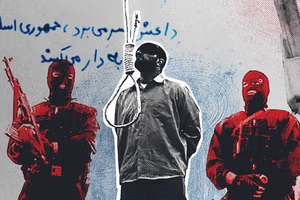
Iranians expressed anger and grief over the execution of three protesters and new death sentences against others, criticizing the United States and the international community for their response in messages sent to Iran International.
Iran's judiciary announced on November 8 that Hassan Divband, Hamid Kazemi and Reza Zanganeh, three people arrested during the January protests in Karaj, had been executed.
The executions came alongside reports of additional death sentences against protesters in the northeastern city of Mashhad.
Abolfazl Sedaghat, 20, Matin Farnian and Vahid Khedrikhah were sentenced to death on charges of moharebeh, or "waging war against God," in a joint case, according to the human rights organization HRANA.
Death sentences were also issued against Ali Zaghi and Ilya Akbari, bringing the number of protesters sentenced to death in the so-called Shandiz case to six, according to earlier reporting.
'We can no longer bear the news of executions'
"We woke up this morning to the news that three more innocent young men had been executed. I can no longer bear hearing about executions," a resident of Isfahan wrote to Iran International.
The executions prompted messages of grief and anger from people across Iran, many expressing concern about the future of younger generations.
"Every morning when we wake up, we are confronted with news of our beloved children being killed. You have taken life away from us," a Tehran resident wrote, addressing Iranian authorities.
Another from Dezful urged fellow Iranians to consider the future facing their children.
"Look at your beloved child. How can you bring yourself to leave the Islamic Republic as their inheritance? How can you bear to leave your child in line for execution and torture?" the citizen wrote.
Another, referring to discussion of possible US strikes on Iran's energy infrastructure, said the country's infrastructure was not their primary concern.
This citizen argued that the Islamic Republic's continued rule was destroying the country's infrastructure every day, from electricity and water supplies to the lives of its young people.
Questioning US response and call for continued solidarity
Several messages sent to Iran International criticized Washington's response to the executions, with some directly addressing US President Donald Trump.
"Do the human rights-defending Democrats in America not see all these crimes in Iran?" one asked, referring to the executions in Karaj.
Another described the executions as retaliation by the Islamic Republic against the Iranian people and questioned Trump's response.
"The oppressive system of the Islamic Republic cannot reach your soldiers, so it takes revenge on the Iranian people through executions. Isn't it time to fulfill your promise?" reads a message.
Other messages emphasized solidarity among Iranians and the importance of continuing efforts to seek justice for those executed.
A resident of Bandar Abbas expressed grief over the executions while thanking Iranians abroad for organizing demonstrations.
"One eye mourns the brave compatriots who lose their lives at the gallows every day, while the other sheds tears for the remarkable gatherings of compassionate Iranians who, despite all their difficulties, put their homeland first," the resident wrote.
A Tehran resident described the three executed protesters as "three stars whose names will live forever" and expressed determination to continue their cause.
"Victory is certain," the audience wrote.
Amnesty International warns over use of death penalty
Iranian authorities have intensified their crackdown in recent months through widespread summonses and arrests, lengthy prison sentences and a sharp increase in executions.
The growing use of capital punishment has also drawn criticism from international human rights organizations.
Iranian authorities are using the death penalty as a tool to suppress dissent, Diana Eltahawy, Amnesty International's deputy regional director, warned on October 13.
“The arbitrary executions of these five young men serves as another chilling reminder of how the Iranian authorities weaponize the death penalty to render the cost of dissent so high that it terrorizes the population into silence and deters further mass uprisings challenging their repressive decades-long rule,” she said.
The latest executions and death sentences have renewed expressions of grief and anger among Iranians, with messages to Iran International reflecting both frustration over the international response and determination to continue seeking justice for those killed.
A severely damaged car following a collision with a truck on a road in Iran, with an ambulance at the scene.
More than 78,500 people have died in road accidents in Iran over four years, yet the government is seeking to delay new vehicle safety standards despite repeated warnings about the quality of domestically manufactured cars.
Road accidents killed 10,357 people in the first six months of the current Iranian calendar year, ILNA news agency reported on Sunday, November 8, citing figures released a day earlier by Iran's Forensic Medicine Organization.
The figure was down just 0.4 percent from 10,401 deaths during the same period last year.
Another 224,220 people injured in road accidents were referred to forensic medical centers during the six-month period, an increase of 10.8 percent from a year earlier.
Industry minister seeks delay in safety standards
Poor-quality vehicles, unsafe roads and ineffective public education are among the main causes of Iran's road safety crisis, according to critics who say authorities have failed to address the underlying problems.
Traffic police chief Teymour Hosseini has previously urged the Ministry of Industry and the National Standards Organization to improve vehicle safety, arguing that higher traffic fines alone cannot reduce fatalities without safer roads, better-equipped cars and stronger enforcement.
However, Industry Minister Mohammad Atabak asked First Vice President Mohammad Reza Aref in a letter dated November 6 to postpone the implementation of new vehicle safety standards by at least one year.
Atabak cited foreign currency shortages, the country's emergency conditions and automakers' inability to invest in developing and redesigning vehicle platforms as reasons for the request.
If approved, the postponement would allow manufacturers to continue production under existing regulations, delaying an increase in mandatory vehicle standards from 85 to 122 requirements, along with new fuel consumption rules.
The proposed delay comes despite repeated warnings about vehicle safety and the country's persistently high road death toll.
"People die in road accidents because of their poor driving, and it has nothing to do with the quality of domestically manufactured cars," Mostafa Mirsalim, a member of Iran's Expediency Council, said on November 8.
Emergency responders attend the scene of a road accident involving a damaged car on a highway in Iran at night.
Mirsalim also described criticism linking domestic vehicle quality to road fatalities as unfair accusations against automakers.
Road accidents kill 78,510 in four years
Annual figures from Iran's Forensic Medicine Organization show that road deaths rose from 16,778 in the year ending March 2022 to 19,490 in the year ending March 2023.
Fatalities reached 20,045 in the year ending March 2024, the highest figure in the five-year period, before falling to 19,435 in the year ending March 2025 and rising again to 19,540 in the year ending March 2026.
Together, road accidents killed 78,510 people between March 2022 and March 2026, with annual deaths exceeding 19,000 throughout the four-year period.
Iran launched a national "No to Accidents" campaign in 2025 to reduce traffic fatalities, but ILNA questioned whether short-term initiatives could address the scale of the problem.
"It is unrealistic to expect that short-term campaigns and general recommendations can contain a crisis rooted in a combination of human, technical, infrastructural and managerial factors," ILNA wrote.
The news agency called for measurable targets and deadlines for the institutions responsible for road safety, including the Ministry of Roads, the Road Maintenance and Transportation Organization, municipalities and emergency medical services.
Young adults account for largest share of deaths
People aged 18 to 24 accounted for the largest share of road fatalities during the first six months of the current Iranian year, with 1,868 deaths, representing 18 percent of the total.
Another 1,555 victims were aged 30 to 39, while 1,514 were between 40 and 49 years old.
The fatalities also included 455 children aged 10 or younger.
Health Minister Mohammad Reza Zafarghandi described the roughly 20,000 annual road deaths as one of Iran's demographic challenges on June 16. Zafarghandi had previously said that 26 percent of road accident deaths were preventable.
The high number of young victims also raises questions about the government's population policies, which emphasize increasing birth rates and supporting infertility treatment.
"Population growth policies cannot be limited to encouraging childbirth and supporting infertility treatment. Preserving the lives of people already living in the country is equally important," ILNA wrote.
Iran has executed three men arrested during January protests in Karaj, west of Tehran, after the Supreme Court upheld their death sentences, the judiciary said early Sunday.
Hassan Divband, Hamid Kazemi and Reza Zanganeh had been sentenced to death and confiscation of their assets on charges of participating in operations for Israel, the United States and “hostile groups” against Iran’s national security and interests.
Judicial authorities alleged the men took part in attacks on public and government buildings, damaged public property and electricity infrastructure, and disrupted services during protests on January 8 and 9.
According to the judiciary, Divband was arrested on January 11 following a report by the Intelligence Ministry’s Alborz provincial office. Authorities accused him of setting fire to public property and encouraging others to carry out acts of destruction.
Ten other people were subsequently arrested on accusations of participating in the protests and collaborating with Divband.
The Karaj Revolutionary Court sentenced the three men to death and eight other defendants to prison terms ranging from five to 10 years.
The judiciary said proceedings to confiscate the executed men’s assets were continuing.
Human Rights Watch and the Abdorrahman Boroumand Center said in September that authorities were using rushed proceedings, torture-tainted confessions and public executions to instill fear and deter dissent. Their review found that 16 of 29 protest-related execution cases involved no allegation of killing.
An Iran International investigation in October showed Iran had executed nearly two people a week in political and security cases since the January protests, including over protest- and war-related accusations, while another 190 people faced death sentences.
At least 70 people were executed from January 7 to October 5. Human rights organizations and activists say the figures are minimum totals, covering only cases that have been reported and verified.
Of the 70 people executed, 35 were put to death in cases connected to the January protests, nine in cases linked to the 12-day and 40-day wars, and 26 in other political and security cases.
Iranians demonstrate in Frankfurt, Germany, on November 7, 2026.
Iranian exiled Prince Reza Pahlavi accepted Germany’s Freedom Prize for the Iranian people in Frankfurt on Saturday, its first award to a nation rather than a person, and said he would hold it until he could hand it to them in Tehran, as tens of thousands rallied in the city.
Iran’s exiled prince Reza Pahlavi accepted Germany’s Freedom Prize on behalf of the Iranian people in Frankfurt on Saturday, the first time the award has gone to a nation rather than a person, as tens of thousands of Iranians rallied in the city for the uprising at home.
The Friedrich Naumann Foundation for Freedom presented the 2026 prize at St. Paul’s Church, the seat of Germany’s first elected national assembly in 1848. The foundation, which is affiliated with the liberal Free Democratic Party, has awarded the prize every two years since 2006 to individuals who advance civil society and liberal values. This year it chose a nation.
“Not to any group, any party or any person,” said the foundation’s chairman, Steffen Saebisch, “but to a people: the Iranian nation.”
Pahlavi, the son of Iran’s last shah and the best-known figure in the opposition, holds the prize in trust until, in the foundation’s words, representatives freely elected by Iranians can receive it.
Iran’s exiled prince Reza Pahlavi receives the Friedrich Naumann Foundation’s 2026 Freedom Prize, awarded to the Iranian people, at St. Paul’s Church in Frankfurt on November 7, 2026.
Pahlavi said he had agreed to take the prize only on condition that he hold it as a custodian, not an owner.
“A custodian safeguards something of great value that belongs to someone else,” he said. “When the time comes, he returns it intact and in its entirety.”
That time, he said, was nearer than Tehran would admit. “One day, and I believe that day is closer than the dying clerical regime would like to admit, I will place it in the hands of its rightful owners, the Iranian people. Not on foreign soil, but in our capital, Tehran.”
He described the country as a house whose owners had been shut out. “For 47 years, Iran has been like a house whose residents, its rightful owners, have been locked out of their own home or held captive inside it,” he said. “The keys were taken from the people in 1979. I see it as my duty to help reclaim those keys and return them to their only rightful owners, the Iranian people.”
He paid tribute to the families of those killed in the struggle for freedom.
‘A nation willing to die for the right to vote’
Pahlavi built his speech on the building. In 1848 Germany’s first elected parliament sat in St. Paul’s Church and wrote a catalogue of rights that never took effect. In 1906, he said, merchants and intellectuals in Tehran forced the creation of Iran’s first parliament and “believed exactly what the men in this church in 1848 believed: that the nation is not the property of potentates, but of the people.”
Germany’s road ran through Weimar into Nazism, he said; Iran’s constitution was buried under a theocracy. “But this building teaches a lesson that tyrants never learn. The ideas of 1848 were not defeated.”
The church was bombed to ruins in 1944 and rebuilt by 1948, among the first buildings in the city to rise again. “A people standing in ruins chose to rebuild their house of freedom first. You did not forget liberty,” he said. “Well, neither have we.”
He described himself as a bridge. “A bridge carries people from one shore to another. One does not build a home on a bridge. You cross it, and then it has done its most important job.”
Iranians demonstrate in Frankfurt, Germany, November 7, 2026.
A German lawmaker, he said, had asked him this year whether Iranians were really ready for democracy. “I will admit the question stung.” His answer: “They prove it every time they march unarmed toward men with machine guns. They prove it when they organize strikes in a country with no free unions, and spread the truth in a country with no free press. A people willing to die for the right to vote is ready to exercise the right to vote.”
He asked the families of those killed in January, who were in the hall, to stand, and the audience to rise for them. “Daughters shielded by their dying fathers. Sons killed holding their mothers’ hands. That is the Islamic Republic.”
Pahlavi defended his support for military pressure on Iran’s rulers, a position that has divided the opposition. For years, he said, he had argued against both appeasement and war, for “maximum pressure on the regime, and maximum support for the Iranian people.”
January changed that. “An unarmed people cannot be asked to defeat, with bare hands, a state prepared to kill without limit,” he said. “We needed this humanitarian intervention and we do not apologize for it.” He said the targets should be the Revolutionary Guards and “the apparatus that turns its guns on our people,” and civilians and civilian infrastructure spared. “Every innocent Iranian lost in this war is a grief I carry.”
Pressure from outside could weaken the Islamic Republic, he said, “but it cannot replace it, and it must not try to choose what comes next. That belongs to the Iranian people alone.”
He set out four principles he called four freedoms: Iran’s territorial integrity; equal rights for every citizen “whatever their language, their origin or their beliefs”; a secular state that belongs to Shia and Sunni, Baha’i, Christian, Jewish, Zoroastrian and the non-religious “because it belongs to none of them, exclusively”; and the right of Iranians to choose their form of government at the ballot box.
“Please notice what is not on this list,” he said. “No name, no party, no system of government is on it, because all of those choices belong to the people. I will not take it from them. Nor will I allow others to.”
To Iranians who had written that he should not be the one to hold the prize, he said: “Thank you. You were able to make your objections freely, in German newspapers and on German streets, without fear of arrest or a bullet. That is exactly the freedom I am fighting for in Tehran.” And: “My hand is open. To monarchists and republicans. To the left and the right. We do not have to agree about the past to agree about the future.”
Iranians demonstrate in Frankfurt, Germany, November 7, 2026.
He asked Germany for three things. Justice: to prosecute the crimes of January as German courts in Koblenz had tried Syrian torturers, so that “every commander still deciding whether to fire on his own people” knows “the world is keeping a record.” Connection: help Iranians stay online, because “the regime’s most important weapon on January 8 was not a rifle. It was the off switch.” And no deal over Iranians’ heads: “Any arrangement that keeps this regime in power buys a short calm and pays for it with Iranian lives.”
He cited Tehran’s support for Russia in Ukraine, the foiled plot against RAF Fairford, the 1992 Mykonos restaurant killings in Berlin and the execution of the German citizen Jamshid Sharmahd, and asked Germany to protect Iranians living under its watch from the state’s agents.
He ended with the Berlin Wall, which fell 37 years ago this week. “No one in this hall in 1988 would have dared to predict it,” he said. “That is how dictatorships end: slowly, and then all at once. That day is coming to Iran.”
‘No people paid a higher price’
Saebisch paid tribute to Iranians killed, jailed or exiled for opposing the Islamic Republic, and to “the hundreds of thousands who, despite mortal danger, take to the streets,” the women defying the morality police, and those who risk their lives to send videos out of the country. “Freedom often comes late,” he said, “but it comes.”
The foundation’s decision was driven by the January massacre, when security forces killed thousands of protesters and shut down the internet.
“I think no people in the world paid a higher price for freedom in this year,” Ludwig Theodor Heuss, a member of the foundation’s board of trustees, told the Jerusalem Post before the ceremony. “The terrible thing is that these things go on. The killing goes on.”
Frankfurt’s mayor, Nils Kößler, said the prize was “dedicated to the people who protested and were killed in the most brutal manner,” and to “those who are in the regime’s prisons, enduring torture and facing execution at this very moment.” He ended his speech in Persian: “Be omid-e azadi,” in hope of freedom.
Marie-Agnes Strack-Zimmermann, who chairs the European Parliament’s security and defense committee, said the world had stopped talking about Iranians.
“The world is negotiating over the nuclear issue and now also over the closure of the Strait of Hormuz,” she said. “But hardly anyone is talking about the people in Iran anymore.”
She called for freezing the assets of the Revolutionary Guards and their officials and for sanctions on security personnel, judges and prison authorities.
“Anyone negotiating with Tehran must never, under any circumstances, leave human rights off the table.”
“The future of Iran will not be decided by us in this church, nor by Washington, Berlin or Brussels,” she said. “Only the Iranian people will decide, freely and democratically.”
The rally
The ceremony opened a day of demonstrations around the world that organizers said were in support of the national uprising in Iran.
The gatherings began in Australia and Japan, before dawn in Europe, and are expected to continue through the day in cities across Europe, the United States and Canada. The largest is in Frankfurt, where the city moved the main rally from the riverside to Ostpark because the original site was too small for the crowd expected.
Police planned for 24,000 marchers from the Römerberg square and 30,000 at the park, where a stage and loudspeaker towers had been built overnight.
Iranian pro-monarchy supporters of Reza Pahlavi, the exiled son of Iran's last shah and an Iranian opposition figure, demonstrate in Frankfurt, Germany, November 7, 2026.
Yasmine Pahlavi said Frankfurt police had told the couple that threats from the Islamic Republic meant her husband could not appear or speak at the rally. His office said later that he still intended to join the gathering after the ceremony.
The prize came in a week when the Islamic Republic hanged two protesters, Amirhossein Maleki, 20, and Amirhossein Ebrahimi, 19, over the Isfahan protests, and days after it executed a third man in Sistan and Baluchestan. The foundation’s Heuss said more than 70 people were executed in October alone.
A worker packs dates in Ghasr-e Shirin, western Iran, November 5, 2026
While Tehran celebrates Donald Trump's midterm defeat and the economic pain the Iran war has inflicted on Americans, soaring prices and stagnant wages are pushing ordinary Iranians deeper into a cost-of-living crisis at home.
Senior Iranian officials have come close to claiming credit for the Democrats' sweeping election victory, frequently pointing to US officials' acknowledgment that the war contributed to Republican losses.
Many Iranian newspapers have followed suit, dwelling on America's economic and political troubles while portraying Iran as a country growing stronger despite the war.
"Ever-Stronger Iran on the Road to Progress," one economic daily declared on its front page on Thursday. Another proclaimed "American Humiliation Continues," alongside a photograph of a seemingly dejected Trump.
The hardline daily Kayhan highlighted what it described as €127 billion in European losses resulting from the closure of the Strait of Hormuz, presenting the economic damage as a measure of Tehran's success.
Largely absent from those triumphant headlines was the economic crisis that matters most to ordinary Iranians: the soaring cost of living.
The labour-focused news agency ILNA offered a starkly different picture, reporting that the estimated cost of basic household necessities had nearly doubled in seven months to 85 million tomans a month, almost six times the monthly earnings of an ordinary worker.
Labour expert Hamid Haji-Esmaeili told ILNA that inflation had become "normalised" in the thinking of Iranian officials, criticising the government's inadequate response and calling for wages to be revised midway through the year.
Pay levels set at the beginning of the Iranian calendar year no longer reflected economic realities, he argued, warning that the crisis was no longer confined to low-income workers but also affected civil servants and large sections of the middle class.
Economist Ali Ghanbari, also quoted by ILNA, described Iran as facing a "livelihood crisis", warning of a severe decline in the purchasing power of lower-income households.
Another ILNA report highlighted delayed wage payments for contract workers in Iran's southern oil-producing regions, adding to the uncertainty facing employees already struggling with inflation.
Growing calls to expand food-support programmes suggest that wages alone are no longer sufficient to protect many households from the rising cost of essential goods.
Years of inflation, currency depreciation, sanctions and inadequate investment had already eroded living standards. Two rounds of war in 2025 and 2026, and the subsequent US blockade of Iran's maritime trade, have compounded those pressures.
The government's response has come under increasing criticism, particularly over its failure to adjust wages and pensions to reflect the rapidly rising cost of living.
Pensioners have been among the most vocal groups demanding action. ILNA reported calls for authorities to restore their purchasing power immediately, as housing, healthcare and other essential expenses consumed an increasing share of their incomes.
In another report, a representative of military pensioners' organisations criticised repeated discussions about wage increases that had produced no concrete results.
He warned against creating "false hope" among pensioners frustrated by promises of financial relief that have yet to translate into higher payments.
Pensioners are among Iran's more organised social groups and have staged repeated demonstrations in recent years over inadequate incomes and rising prices.
Yet the emphasis in hardline political rhetoric remains on the costs Iran has imposed on its adversaries.
The closure of the Strait of Hormuz and its impact on international energy markets have been presented as evidence of Tehran's leverage over Western economies.
Such claims of success sit uneasily alongside accounts of hardship emerging from Iran's own media, where journalists operate under restrictions on reporting deemed damaging to the Islamic Republic's image.
For workers awaiting overdue wages and pensioners demanding relief, the economic pain inflicted on Iran's adversaries offers little consolation. Their immediate concern is whether they can pay next month's rent and put food on the table.
Vida Mehrannia and her husband Ahmadreza Jalali, who's been imprisoned in Iran since 2016
The wife of imprisoned Swedish-Iranian researcher Ahmadreza Jalali has challenged Tehran's calls for expatriates to return home, urging authorities to first release those jailed after visiting Iran.
"If you're going to invite people, the door must first be open," Vida Mehrannia told Iran International on Tuesday. "Open that door first. Release those who are inside."
Her husband, a specialist in disaster medicine who worked at universities in Sweden, Belgium and Italy, was arrested during a visit to Iran for an academic workshop in April 2016.
He was sentenced to death on espionage charges in October 2017. Jalali denied spying for Israel and said his confession had been obtained under torture.
Mehrannia said her husband had repeatedly faced the threat of imminent execution and endured solitary confinement and prolonged hunger strikes, leaving his physical and psychological health severely damaged.
The imprisonment has also devastated their family. Their 14-year-old son barely remembers living with his father, while their daughter has completed her education during his detention, Mehrannia said.
She said Jalali had been excluded from two prisoner exchanges, including the 2024 agreement that secured the release of two Swedish citizens in exchange for former Iranian prison official Hamid Nouri.
Jalali's case is among several involving academics, dual nationals and foreign residents arrested during visits to Iran, often on espionage or national security charges.
Princeton University doctoral researcher Xiyue Wang was arrested in 2016 while examining historical archives for his dissertation. Sentenced to 10 years for espionage, the American researcher was released in a prisoner exchange in December 2019.
British-Australian academic Kylie Moore-Gilbert was arrested after attending a conference in Iran in 2018. She spent more than two years in prison on espionage charges before being exchanged for three Iranians detained abroad in November 2020.
British-Iranian charity worker Nazanin Zaghari-Ratcliffe was detained in 2016 after visiting family with her young daughter. She was released in March 2022 after nearly six years.
Mehrannia also questioned why Iranian authorities had failed to respond to repeated requests for judicial review, saying her husband had been told his case was an international matter.
She said the authorities had the power to release Jalali, whose health has deteriorated after years of imprisonment, but had repeatedly failed to act.