• العربية
  • فارسی
BrandBrand
  • Iran Insight
  • Politics
  • Economy
  • Analysis
  • Special Report
  • Opinion
  • Podcast
  • Live TV
  • Iran Insight
  • Politics
  • Economy
  • Analysis
  • Special Report
  • Opinion
  • Podcast
  • Live TV
  • Theme
  • Language
    • العربية
    • فارسی
  • Iran Insight
  • Politics
  • Economy
  • Analysis
  • Special Report
  • Opinion
  • Podcast
  • Live TV
All rights reserved for Volant Media UK Limited
volant media logo
ANALYSIS

Mohsen Rezaei’s negotiating calculus: someone else always pays the price

Mahdi Amiri
Mahdi Amiri

Iran International

Nov 2, 2026, 03:15 GMT+0
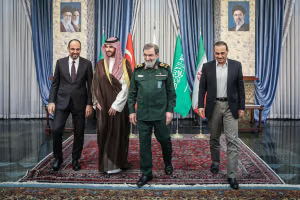
Iran's top security official Mohsen Rezaei (second from right), Pakistan’s Chief of Defence Forces Asim Munir (right), Turkish intelligence chief Ibrahim Kalin (left) and Saudi Arabia’s Defence Minister Prince Khalid bin Salman in Tehran, Iran, October 26, 2026. / Photo by ISNA

US Vice President JD Vance’s reported bid to meet Iran’s security chief Mohsen Rezaei for peace talks with Tehran raises a troubling question for Washington: Does it understand the man it would face across the table?

For more than four decades, Rezaei has occupied positions of power from which he could make decisions that imposed extraordinary human and economic losses on Iranians, while he and his factional allies in the Islamic Republic remained largely insulated from their consequences.

Understanding this track record and how he calculates the costs of diplomacy is essential to understanding how he might negotiate with Washington, how much he is prepared to tolerate, and what could finally persuade him to compromise.

The wartime calculus

The origins of Rezaei’s cost-benefit calculus go back to 1981, when the founder of the Islamic Republic, Ruhollah Khomeini, appointed the 27-year-old Rezaei as commander of the Islamic Revolutionary Guard Corps (IRGC). The IRGC was at the time a newly established institution in which revolutionary commitment and willingness to sacrifice often carried greater weight than professional military judgment.

Rezaei flourished in that environment and, in turn, helped consolidate a command culture that treated heavy casualties as an acceptable cost of pursuing ideological or factional objectives. The relationship was mutually reinforcing, as the institution rewarded commanders willing to endure enormous losses, while those commanders perpetuated a system in which the political consequences of those losses rarely affected the people responsible for them.

That high threshold for enduring costs paid by others became particularly consequential in 1982, after Iranian forces recaptured the city of Khorramshahr and Iraq subsequently offered negotiations. As IRGC commander, Rezaei was among those who argued for entering Iraqi territory rather than halting at the border. A war begun by Saddam Hussein's invasion now became another six years of bloody battles for goals extending beyond Iran's capacity.

During the catastrophic Operation Ramadan near the port city of Basra in July 1982, Iranian troops, including forces under Rezaei's IRGC command, repeatedly attacked entrenched Iraqi positions. Historians Anthony H. Cordesman and Abraham R. Wagner estimate between 20,000 and 30,000 Iranian troops were killed or critically wounded. Some Iranian leaders nevertheless saw progress in exhausting Iraq.

100%
Mohsen Rezaei (second from left) alongside Ali Khamenei (center) during the Iran-Iraq War.

One of my uncles was killed in Operation Ramadan, and another in the offensive campaigns Rezaei had advocated after Khorramshahr. In this calculation, a battlefield disaster became an investment in a hypothetical victory in the long run. That victory never came.

Iranian forces did improve tactically, as a US National Defense University study demonstrates in its account of the successful 1986 assault on Iraq’s Faw Peninsula. Yet those improvements rarely prompted Iranian commanders to reconsider whether their objectives justified the mounting human suffering and material losses, allowing the same strategic mistakes to persist even as battlefield methods evolved.

Later that year, Operation Karbala-4 proceeded despite warnings that Iraqi forces anticipated the assault and that the operation had been exposed. Thousands of mostly Iranian youths were killed, wounded or went missing. Decades afterward, Rezaei called the operation a “diversion” preceding Operation Karbala-5, before acknowledging that it began as a principal attack.

100%
File photo of Iranian forces preparing for Operation Karbala-4 during the Iran-Iraq War.

Here was another early expression of a dangerous institutional habit among Iranian decision-makers: a battlefield defeat could be treated as an investment in eventual victory, regardless of whether that victory was becoming more attainable or not.

The following year, Iranian forces continued operations toward Iraq’s Basra. A 2009 US National Defense University study, based on extensive interviews with former Iraqi Republican Guard commander Ra'ad Hamdani, described the fighting as the "Somme of the Iran-Iraq War," recalling frontal assaults with high casualties, enormous artillery concentrations and extraordinary destruction.

The National Defense University researchers concluded that repeated attacks reflected Iran’s persistent unwillingness to learn from previous failures. By 1987, they observed, Iranian political and military leaders were struggling to motivate soldiers who had suffered heavy losses without any meaningful gains.

Rezaei’s demands in the final year of the Iraq war exposed the deeper problem with his leadership style. In 1988, Rezaei set out requirements for rebuilding Iran’s offensive capacity over the following five years, including 350 infantry brigades, 2,500 tanks and 300 combat aircraft, while Prime Minister Mir-Hossein Mousavi’s government warned it could no longer finance the war.

Rezaei merely counted the weapons necessary for victory without offering a comparable accounting of the human cost of continuing the war. Ruhollah Khomeini accepted a ceasefire, and Rezaei remained commander until 1997.

Power and privilege

Peace brought Rezaei new positions and privileges, but the wartime mentality that allowed him to accept enormous costs borne by others followed him into politics. He served as secretary of Iran's Expediency Council from 1997 to 2021 and expanded his influence beyond the military.

He ran unsuccessfully for president in 2009, 2013 and 2021, but those electoral defeats did little to diminish his access to senior positions within the Islamic Republic.

100%
Mohsen Rezaei displays his identification document and inked finger as he registers to run in Iran’s presidential election.

A Tehran Bureau investigation identified him as the owner of Tabnak, a major news website whose corporate structure included relatives and associates. He now had assets and networks worth protecting, even as he continued to regard sacrifice by others as an acceptable price for pursuing political objectives.

Rezaei’s response to his son’s dissent also illustrated the tension between family ties and political loyalty. Ahmad Rezaei had publicly criticized the Islamic Republic and fled the country. Mohsen Rezaei denounced him and declared that he would be treated like any dissident if he returned. Ahmad subsequently returned to Iran in 2005 and was not prosecuted, before leaving the country again.

Ahmad was found dead in Dubai in 2011. Police reported an apparent suicide, although questions persisted. Nevertheless, Rezaei's public response to his son's dissent suggested that even family ties could be subordinated to his position in a political order he had devoted his career to building.

In peacetime economic policy, the same institutional tolerance for high costs borne by Iranian citizens found another arena. Rezaei carried his understanding of costs into economics. Former associates of his presidential campaigns told me he conceived what became slain Supreme Leader Ali Khamenei's "resistance economy" and brought the idea to him.

As vice president for economic affairs under President Ebrahim Raisi from August 2021 to June 2023, he helped direct economic policy amid inflation and declining purchasing power. Once again, ordinary people financed the "resistance," while Rezaei retained his position and influence.

In an interview for this article, former Kayhan editor-in-chief and representative of Ali Khamenei Mehdi Nasiri alleged that Rezaei sought a share of Tehran’s roughly €2 billion electric-vehicle procurement deal with China under hardline Mayor Alireza Zakani in 2024, but declined to elaborate on the basis for his allegation. Separately, investigative journalist Yashar Soltani reported that the deal bypassed standard procurement procedures and involved intermediaries whose selection and financial qualifications were unclear. His report did not name Rezaei.

In August 2026, Rezaei became secretary of Iran's Supreme National Security Council, returning to decisions over war and diplomacy. The body, chaired by President Masoud Pezeshkian, coordinates Iran's security and foreign policy. Rezaei brings decades of relationships within the IRGC into its deliberations, along with the same institutional mentality that shaped his earlier career.

His recent words reveal how much of his wartime calculation survives. In an October 2026 interview, Rezaei acknowledged that a prolonged blockade would hurt Iranian families and investment, then insisted that "economic pain and strategic collapse are not the same thing". Four decades after the Iran-Iraq war, he continues to distinguish between the suffering of ordinary Iranians and the ability of their rulers to continue costly confrontations.

Yet Rezaei also has reasons to protect what he himself has acquired. Political scientist Robert A. Pape's influential research showed that even suicide terrorism can follow strategic calculations. The broader point is that ideological commitment need not exclude strategic calculation. Rezaei’s record suggests a high tolerance for losses borne by Iranians and a potentially much lower threshold when his survival, wealth and the political institutions he serves face danger.

Implications for Washington

Pressure directed mainly at Iranian households may therefore leave his incentives intact, since the leadership has long learned to transfer the consequences of its decisions to the population. His estrangement from his son Ahmad Rezaei also makes family ties an uncertain source of restraint.

The calculation changes when leaders themselves face costs they can no longer transfer, particularly when the institutions and networks sustaining their power are directly threatened. This may help explain why Parliament Speaker Mohammad Bagher Ghalibaf, also a former IRGC commander, met JD Vance in Switzerland in June 2026, a few months after US-Israeli strikes killed Supreme Leader Ali Khamenei and other IRGC commanders.

A “credible threat” can bring Tehran to the negotiating table, although the problem of durability remains. Once the threat recedes, the incentives that sustained decades of confrontation may return, leaving agreements vulnerable to reversal. Any lasting settlement therefore needs verification and enforceable consequences for reneging, even after the immediate threat has passed.

For Washington, the implication is that a credible threat must alter the calculations of those making decisions in Tehran. Pressure that the leadership can transfer to civilians has repeatedly proved insufficient. A lasting agreement requires the regime's decision-makers to understand that renewed confrontation would carry sustained consequences for themselves. Those consequences must remain credible even after the immediate danger has receded.

Iranian state media eagerly repeat the claim that Iranian politicians are exceptionally tough negotiators. Much of that toughness comes from their ability to draw on other people’s wealth and lives, which allows them to prolong confrontation without personally bearing its consequences.

Mohsen Rezaei's career illustrates the extraordinary bargaining advantage of making decisions while others pay the price. Anyone who negotiates with other people’s lives and resources can afford to be a tough negotiator.

  • From Karbala-4 to AMIA: Mohsen Rezaei returns to Iran’s security helm

    From Karbala-4 to AMIA: Mohsen Rezaei returns to Iran’s security helm

Most Viewed

Iran court sentences 21-year-old protester to death
1

Iran court sentences 21-year-old protester to death

2

Iran says US tone shifts but demands still block talks

3

'No geographic limits': Tehran projects readiness for all-out war

4

Arab states demand response from Iran as fears of wider war dominate Bahrain summit

5

Iran rejects nuclear talks despite ongoing mediation with US

Banner
Banner

Editors' Pick

  • Iran says US tone shifts but demands still block talks

    Iran says US tone shifts but demands still block talks

  • Halloween gathering in Tehran ends in arrests and police crackdown

    Halloween gathering in Tehran ends in arrests and police crackdown

  • Netanyahu or Eisenkot? Tehran sees little difference on war
    INSIGHT

    Netanyahu or Eisenkot? Tehran sees little difference on war

Banner
Banner
Banner
Banner

Spotlight

  • Qatar turns to US LNG to cushion Iran war losses

    Qatar turns to US LNG to cushion Iran war losses

  • Mohsen Rezaei’s negotiating calculus: someone else always pays the price
    ANALYSIS

    Mohsen Rezaei’s negotiating calculus: someone else always pays the price

  • Iran’s nuclear bomb debate gains ground on official platforms

    Iran’s nuclear bomb debate gains ground on official platforms

  • Residents describe struggle to afford basic needs as Iran inflation hits 88.7%
    VOICES FROM IRAN

    Residents describe struggle to afford basic needs as Iran inflation hits 88.7%

  • Netanyahu or not, the next move on Iran may be Trump's
    PODCAST

    Netanyahu or not, the next move on Iran may be Trump's

  • New Baha'i memoir recounts life inside Iran's prisons

    New Baha'i memoir recounts life inside Iran's prisons

•
•
•

More Stories

Netanyahu pressing Trump to strike Iran immediately after midterms - Axios

Nov 1, 2026, 18:25 GMT+0
100%
FILE PHOTO: U.S. President Donald Trump and Israeli Prime Minister Benjamin Netanyahu at the Knesset on the day of Trump's address, amid a U.S.-brokered prisoner-hostage swap and ceasefire deal between Israel and Hamas, in Jerusalem, October 13, 2025.

Israeli Prime Minister Benjamin Netanyahu is pressing US President Donald Trump to strike Iran immediately after Tuesday's midterm elections, but Trump wants to let negotiations play out for now, Axios reported Sunday, citing an Israeli and a US source.

The two leaders had a candid phone call Saturday about the state of US negotiations with Iran and how quickly to return to combat, according to the report.

The Israeli source described the call as "tough," while the US source called it "direct."

Trump is pursuing diplomatic efforts to restart negotiations with Tehran while preparing for a possible resumption of major military operations after the November 3 elections, according to the report.

US Secretary of State Marco Rubio said Saturday that Trump had not decided whether to launch further strikes against Iran and preferred a diplomatic solution.

"He hasn't made a decision. I have no announcement in that regard with you today, and nor do we take any of it lightly," Rubio told reporters in Atlanta.

Trump told reporters Saturday that negotiations with Iran were "going fine" and that he was not "in much of a hurry," but said the United States still needed to "take care" of one or two Iranian nuclear sites.

"We can do that in 10 minutes. We have that planned. You can look at Pickaxe Mountain. We need to take care of that. We can do that very quickly," Trump said, referring to a suspected nuclear facility built into a mountain.

Iran considers US outreach

US Vice President JD Vance sent a letter last week to Mohsen Rezaei, secretary of Iran's Supreme National Security Council, about the possibility of restarting negotiations.

Rezaei said Saturday that he had received and read the letter but had not responded, according to Iranian state media.

"I read the letter. I haven't yet responded. Their tone has completely changed," Rezaei said in remarks broadcast on Iranian television.

IRGC-affiliated Tasnim news agency also reported that Tehran continued to insist on its seven conditions being met by Washington, saying any position contradicting that framework was unacceptable.

Qatar-mediated talks continue

Qatari mediators met with Iranian officials Sunday for a third consecutive day in an effort to reach a deal to restart direct negotiations between Washington and Tehran.

Iranian Foreign Minister Abbas Araghchi said Tehran was discussing a proposal that could allow the Strait of Hormuz to reopen within two days if Washington met Iranian conditions.

Araghchi said Sunday that consultations were continuing but had not produced a final agreement, stressing that progress depended on the United States responding to Iran's questions.

"We are making every effort in this regard and hope that the other side will demonstrate enough rationality to choose diplomacy over other paths," he said.

Iran rejects nuclear talks despite ongoing mediation with US

Nov 1, 2026, 14:15 GMT+0
100%

Iranian officials rejected nuclear negotiations, demanded acceptance of their conditions for ending the war and threatened military retaliation, despite continuing diplomatic contacts with Qatari mediators on Sunday.

Iranian officials rejected nuclear negotiations, demanded acceptance of their conditions for ending the war and threatened military retaliation, despite continuing diplomatic contacts with Qatari mediators on Sunday.

“The window for negotiations with our adversaries is now closed because they have nothing new to offer,” Ali Nikzad, deputy speaker of Iran's parliament, said on Sunday.

Nikzad accused what he called adversaries of repeatedly breaking commitments and attacking Iran's nuclear facilities. He said that renewed military action would trigger an “immediate, effective response without geographical limits.”

Foreign Minister Abbas Araghchi, however, said consultations with Qatari mediators were progressing without a final agreement.

  • Iran says US tone shifts but demands still block talks

    Iran says US tone shifts but demands still block talks

“Consultations with the mediators regarding the two-day plan are continuing and moving toward implementation, but we have not yet reached a definitive conclusion,” Araghchi said.

Washington keeps negotiations open

The United States remains open to negotiations but is prepared to pursue other options, Donald Blome, US assistant secretary of state for Near Eastern affairs, said at the Manama Dialogue security forum in Bahrain, according to the Associated Press.

“The hand of negotiation has been extended, and those channels have continued to be open and active,” Blome said.

Blome warned that Washington could take a different course and would not allow Iran to threaten the region and global economy.

Iranian negotiators were in Doha for a third consecutive day of indirect talks aimed at ending the war with the United States and Israel, Reuters reported, citing an official briefed on the discussions.

Araghchi said the delegation had no plans to meet US officials directly.

Iran sets conditions and threatens retaliation

Iran will not negotiate with Washington until seven conditions announced by the secretary of its Supreme National Security Council are implemented, lawmaker Esmail Kowsari said Sunday.

Nikzad also demanded unconditional acceptance of those conditions, including Iran's proposed arrangements for the Strait of Hormuz.

Ebrahim Azizi, chairman of parliament's National Security Committee, threatened a punitive response to hostile actions in the waterway.

  • Vance offers to meet Iran's Rezaei for peace talks as Qatar renews mediation efforts

    Vance offers to meet Iran's Rezaei for peace talks as Qatar renews mediation efforts

Iranian army spokesman Mohammad Akraminia said that another war could spread beyond the Middle East and said the military was shifting toward an offensive doctrine.

Defense Minister Mehrdad Akhlaghi said Iran was strengthening its military readiness and weapons production to respond to threats without geographical restrictions.

Calls grow to leave nuclear treaty

Lawmaker Nasser Pejmanfar urged Iran to withdraw from the Nuclear Non-Proliferation Treaty, arguing that membership had brought no benefits.

  • NPT withdrawal returns to Iran debate as diplomacy gains pace

    NPT withdrawal returns to Iran debate as diplomacy gains pace

Mohsen Araki, a member of the Assembly of Experts and Expediency Discernment Council, separately called for reviewing Iran's membership, according to the Revolutionary Guards-affiliated Tasnim news agency.

The calls to reconsider Iran's nuclear treaty commitments add another obstacle to efforts to resolve the dispute through diplomacy.

Negotiations through Qatari mediators continue in Doha without a final agreement. Washington has kept the door open to talks, but Iranian officials insist that their seven conditions must be accepted before the war can end.

'No geographic limits': Tehran projects readiness for all-out war

Oct 31, 2026, 16:33 GMT+0
100%
A graphic released by Supreme Leader Mojtaba Khamenei's official outlet depicts a missile with the phrase 'no geographic limits' written on it

As US-Iran diplomacy gains momentum through Qatari mediation, Tehran is seeking to project a willingness to wage a wider war with the United States and Israel, floating the prospect of retaliation without geographic limits.

Supreme Leader Mojtaba Khamenei and the country's top military commander issued warnings on Saturday of a wider response to any renewed attack, ordering an expansion of the list of potential American and Israeli targets.

The warnings came as Qatari and Pakistani mediators intensified efforts to broker an agreement between Tehran and Washington, while reports suggested President Donald Trump was considering renewed military action after Tuesday's US midterm elections.

In remarks published by Iranian state media following a meeting with senior military commanders, Khamenei called for "maximum deterrence," saying threats of any type or scale must be met with an "immediate and effective response without geographic limitations."

He also instructed commanders to update their list of potential targets to bring a wider range of American and Israeli assets, both physical and nonphysical, within reach of Iran's armed forces.

General Abdolrahim Abdollahi, chief of staff of Iran's armed forces, echoed the warning shortly afterward, saying the military was preparing a new list of targets across a broader geographic area and warning that Tehran's response to any attack would be "unimaginable" to its adversaries.

100%
File photo: People walk by a large banner depicting Iran's Supreme Leader Mojtaba Khamenei and his slain father, Ali Khamenei

The Wall Street Journal reported this week that Admiral Brad Cooper, the head of US Central Command, had briefed Trump on military options involving Iran.

The newspaper also reported that Washington had warned regional allies to prepare for the possibility of a short but intense resumption of fighting after the November 3 midterm elections.

Axios previously reported that the Pentagon had instructed Central Command to complete preparations for possible renewed combat operations.

The prospect of another round of war has alarmed regional powers.

Speaking at a security forum in Bahrain on Saturday, Saudi Vice Foreign Minister Waleed ElKhereiji said countries across the region wanted peace restored, although the outcome of mediation efforts remained uncertain.

Egyptian Foreign Minister Badr Abdelatty warned at the same event that another round of fighting would be "more dangerous, more destructive" and lead nowhere.

Iranian Foreign Minister Abbas Araghchi said Saturday that Tehran was reviewing proposals concerning its nuclear program and that an Iranian delegation had travelled to Qatar for further consultations.

He described an American effort to open dialogue as a "positive step," but said Iran had no immediate plans to meet US officials and that any resumption of negotiations would depend on Tehran's conditions being met.

Arab states demand response from Iran as fears of wider war dominate Bahrain summit

Oct 31, 2026, 09:45 GMT+0
100%
Jasem Mohamed Al Budaiwi, Secretary General, Gulf Cooperation Council.

Arab states remain open to negotiations with Iran but need a reciprocal response from Tehran, the head of the Gulf Cooperation Council (GCC) said on Saturday, as senior regional officials warned of a more destructive phase of the US-Iran war.

The warnings came at the 22nd IISS Manama Dialogue in Bahrain, where ministers from Egypt, Saudi Arabia, Britain, Syria and Yemen addressed Iranian attacks, Houthi operations and the growing risks to regional security.

"The GCC states have always called for dialogue and negotiation to resolve any issue in the region, and they still do," GCC Secretary General Jasem Mohamed Al Budaiwi said.

He said the six-member bloc maintained open channels with Iran alongside its partnerships with Western powers, China, Russia and other countries.

"In a region of widening divides, this ability to talk to all sides is one of the few assets left," he said.

"But diplomacy needs partners, partners who respond in kind."

Egypt warns next round of war could be more destructive

Egyptian Foreign Minister Badr Abdelatty expressed concern about renewed fighting between Washington and Tehran, warning that another escalation could have wider consequences.

"The second round will be more dangerous, more destructive, and it will lead to nowhere. We have to draw lessons from the past," Abdelatty said, according to Reuters.

He also warned that military action could unleash consequences beyond the control of those who initiated it.

"A war can begin with a unilateral decision, but no one can unilaterally control its consequences or stop it," he told the conference.

Abdelatty called for diplomatic channels, confidence-building measures and regional participation in security arrangements, warning against repeating what he described as mistakes during negotiations over the 2015 Iran nuclear agreement.

"Deterrence without diplomacy may postpone war, but cannot prevent it," he said.

Strait of Hormuz and Bab el-Mandeb emerge as major concerns

Al Budaiwi called for navigation through the Strait of Hormuz to return to conditions before February 28, when the US-Iran war began.

He said Iranian attacks on GCC member states had caused casualties and damaged civilian and critical infrastructure, while disruptions to the strait had affected energy prices, shipping, insurance and global supply chains.

"The GCC states were not a party to the war and did not seek it," he said.

  • Tehran summit divides Iranian hardliners over Yemen and US talks

    Tehran summit divides Iranian hardliners over Yemen and US talks

  • Iran hardliners split over role of mediators in US tensions

    Iran hardliners split over role of mediators in US tensions

Saudi Vice Foreign Minister Waleed Elkhereiji also warned about threats to international trade through the Strait of Hormuz, the Red Sea and Bab el-Mandeb.

"Securing navigation in the Red Sea and the Straits of Bab el Mandeb and Hormuz is a shared responsibility that requires regional and international cooperation based on the respect of international law," he said.

He condemned renewed Houthi attacks on Saudi Arabia and threats to commercial shipping, accusing the group of undermining diplomatic efforts to end the Yemen conflict.

Yemen points to Iranian support for Houthis

Yemeni Foreign Minister Afrah al-Zouba directly linked regional maritime threats to outside support for the Houthis.

"The UN panel of experts on Yemen has shown that all the support being given to the Houthis from Iran, from Iraqi armed groups and Hezbollah has been proven," she said, citing findings she attributed to UN experts.

Al-Zouba called for efforts to stop weapons and financing reaching the group, warning of its connections with other armed organizations.

She also cited information received in 2025 about cooperation between the Houthis and Somalia's al-Shabab militant group involving weapons and training.

"Coastal security starts with security on land and the protection of civilians," she said, arguing that restoring Yemeni state authority was essential to protecting maritime routes.

  • Iran turns on Pakistan as Saudi defense pact takes effect

    Iran turns on Pakistan as Saudi defense pact takes effect

  • Iran's rhetoric against UAE hardens after Netanyahu visit

    Iran's rhetoric against UAE hardens after Netanyahu visit

Britain pledges military support alongside diplomacy

British Middle East Minister Stephen Doughty said the UK had deployed air defense equipment and personnel to Saudi Arabia to help protect against missiles and drones following renewed Houthi attacks.

He said British forces had also flown defensive missions over Qatar, Bahrain, Jordan and the UAE during Iranian attacks and provided air defense support to Bahrain and Kuwait.

"We are clear and united in understanding the threat that is posed by Iran and the very serious threats from Iran and its proxies," Doughty said.

He reiterated Britain's opposition to Iran acquiring nuclear weapons while promising continued diplomatic engagement.

"We must strain every sinew for peace," he said, adding that Britain would support threatened partners "with actions and not just words."

Syria condemns attacks on Arab countries

Syrian Foreign Minister Asaad al-Shaibani also condemned missile and drone attacks on regional states, pledging support for Bahrain, Saudi Arabia, Qatar, Oman and Jordan.

"We are against using Syria to threaten the neighboring countries," he said.

Al-Shaibani said Damascus was working to consolidate state control over weapons and strengthen cooperation with neighboring countries.

The remarks reflected a common theme at the conference: calls for diplomacy with Iran alongside demands for stronger defenses, an end to attacks on Arab countries and restored freedom of navigation.

Al Budaiwi said the GCC's offer of regional cooperation remained open.

"This invitation still stands for those who answer it with action," he said.

Tehran refuses to budge as diplomacy races against war

Oct 30, 2026, 16:52 GMT+0
•
Behrouz Turani
100%
A participant holds a placard reading “We’ll stand for Iran” at a state-organized rally in Arak, central Iran, October 21, 2026

Qatari mediators returned to Tehran on Friday, barely a day after leaving the Iranian capital following the reported rejection of their latest peace proposal, as Washington and Tehran remained divided over which side should make the first concessions.

The delegation's swift return suggested that diplomatic efforts were continuing despite reports by Iranian news agencies that senior officials had rejected key provisions of the Qatari-mediated proposal.

On Friday, as the Qatari delegation, led by a senior adviser to Qatar's prime minister, held talks with Iranian diplomats headed by Foreign Minister Abbas Araghchi, Tehran's Friday prayer leader, Mohsen Haj Ali Akbari, poured cold water on the prospect of a breakthrough with Washington.

He said past experience showed Washington's offers of talks could coincide with more serious threats than its public military warnings suggested.

More notably, he lent weight to calls for a revision of Iran's nuclear doctrine, arguing that they were neither a fringe position nor merely an emotional reaction.

On Thursday, Araghchi said Tehran remained committed to the Islamabad Memorandum of Understanding (MoU) as the basis for further negotiations.

He rejected proposals requiring Iran to reopen the Strait of Hormuz as a unilateral confidence-building measure before the verified lifting of naval restrictions and the release of $24 billion in frozen Iranian assets.

‘War is certain’

The disagreement over which side should act first remains a central obstacle to negotiations, even as regional mediators continue efforts to prevent another round of fighting.

A separate diplomatic initiative by US Vice President JD Vance has also yet to produce a formal Iranian response.

Iranian media have confirmed receipt of a letter from Vance to security chief Mohsen Rezaei, but officials have not commented on its contents, insisting instead that Tehran's conditions for an agreement remain unchanged.

Former parliamentary national security committee chairman Heshmatollah Falahatpisheh offered a far more pessimistic assessment of the renewed mediation efforts.

"The mediators' visits to Tehran are a sign that war is certain, not that diplomacy is being revived," he wrote on X on Friday, arguing that only a regional agreement involving the United States and China could now prevent a fourth war.

Economic costs

In an article published Thursday, the reformist newspaper Shargh also expressed grave concern about the diplomatic deadlock..

It warned that celebrating mine attacks and escalating regional tensions while Iran's economy faced severe shortages of essential inputs could prove a potentially fatal mistake.

The conservative newspaper Khorasan offered a more measured assessment of the diplomatic difficulties, while supporting Araghchi's rejection of proposals requiring Iran to de-escalate before Washington lifted restrictions on shipping.

While some commentators warn that prolonged confrontation is deepening Iran's economic problems and increasing the danger of war, others argue that making concessions under military and economic pressure would weaken Tehran's position in any eventual agreement.

Who moves first?

The discussions appear to be focused on establishing a framework for renewed negotiations rather than resolving every outstanding issue in a comprehensive peace agreement.

Vance's letter, according to US media reports, sought to restart talks with Iran's nuclear program included from the outset. Tehran, meanwhile, insists that steps to ease the naval blockade and release frozen assets must precede substantive nuclear negotiations.

The disagreement is reflected in a proposed seven-day framework. Washington wants nuclear discussions to begin on the first day, while Tehran insists they should begin on the seventh, after other measures have been implemented.

Although the proposed timetable separates the two positions by six days, the dispute is about more than timing. Each side wants the other to demonstrate its commitment before taking what it considers a significant political risk.

The stakes remain high. US officials have warned of possible renewed military operations after the November 3 midterm elections, while Tehran continues to reject proposals it regards as requiring unilateral concessions.

For now, the return of the Qatari mediators shows that diplomatic contacts remain active. Whether those contacts can prevent another round of fighting depends on finding a sequence of steps that both Washington and Tehran are prepared to accept.