Senator Murphy calls US plans for Iran strikes 'insane'
Democratic Senator Chris Murphy warned that US military plans for renewed strikes on Iran would fail to achieve their objectives and instead trigger a prolonged conflict and devastating escalation.
Speaking at the Middle East Institute in a clip he shared on X, Murphy said lawmakers had received a detailed briefing on a possible new military campaign, which had been presented as a short-duration operation.
“Their plan is insane,” he said, warning that it would lead to “devastating escalation and the likely destruction of our commitment to the rule of law.”
Asked to elaborate, Murphy referred to public reporting about possible US attacks on civilian infrastructure.
He said the plan had been developed at President Donald Trump's request, although he did not know whether military officials believed it would succeed.
“The plan that they have developed will lead, in my view, to a prolonged and an escalation of this war that will be devastating for our security interests,” Murphy said.
An Iranian student attends an online class from home, using a laptop and headset.
Some Iranian families are paying thousands of dollars to put their children in foreign online schools, buying an international education from home and stepping outside the Islamic Republic’s school system, despite the education ministry’s warnings.
The government-affiliated newspaper Iran reported on Thursday that institutions offering foreign curricula and diplomas from countries including Canada and Britain were attracting Iranian students.
A mother whose 15-year-old daughter attends an online high school based in Toronto told the newspaper her family pays $7,000 annually to prepare her daughter for admission to Canadian universities without leaving Iran.
Another father cited shortcomings in Iranian schools’ approach to practical skills and creative thinking as reasons for enrolling his son in a foreign online college alongside his education in Tehran.
Diplomas not recognized in Iran
Mohammad Salimi, head of the Education Ministry’s Center for International Affairs and Overseas Schools, warned that the foreign online institutions in question lack authorization to operate in Iran and that their diplomas are not recognized by the domestic education system.
Students attending only these institutions are not registered in Iran’s official education databases and could face difficulties continuing their studies domestically, Salimi told Iran daily.
For families planning to send their children to universities abroad, however, recognition by institutions in the destination country may matter more than approval from Iranian authorities.
Students attend a classroom lesson at a school in Iran, where some families are increasingly exploring international online education as an alternative to the domestic curriculum.
A diploma’s lack of recognition in Iran does not necessarily make it invalid internationally. Its acceptance depends on the school’s accreditation and the admission requirements of individual universities.
What do foreign schools offer?
The expansion of international online schools allows students to follow American and British curricula without relocating.
International Virtual Learning Academy (IVLA), a private American school, provides online education from elementary through high school, allowing students to select courses and progress at a pace suited to their circumstances.
Annual high school tuition starts at $2,679 for its basic program, rising to $3,799 or $5,279 for packages offering additional educational support.
Britain’s King's InterHigh offers live and recorded online classes, with subjects including computer science, economics, psychology and film studies.
For the 2026–2027 academic year, annual tuition is £7,250 for students aged 14 to 16 and £7,585 for the pre-university program covering three principal subjects.
Crimson Global Academy also provides American and British curricula online. Annual full-time tuition for its American high school program ranges from $22,375 to $25,500.
The differences show that foreign online schooling does not carry a uniform price. Costs vary according to grade level, course selection and the educational services provided.
Ideological education and alternative choices
Some families are turning to foreign education in a country whose school system was restructured around the Islamic Republic’s religious and political objectives after the 1979 revolution.
UNESCO has documented how Iranian textbooks were revised after the revolution to incorporate Islamic teachings, with religious and political content extending beyond religious education into subjects including history, social studies and Persian literature.
Iran’s Fundamental Reform Document of Education also identifies the cultivation of Islamic-Iranian identity and religious values among the education system’s central objectives.
In a study published in July 2025, education researcher Golnar Mehran examined Iranian social studies textbooks and the role of Islamization and politicization in their content.
By contrast, the international online schools examined offer greater flexibility in course selection, different academic pathways and preparation for universities abroad.
The YouTube generation and English-language learning
The spread of the internet and social media has also exposed Iranian students to English-language material and international educational resources from an early age.
Female students attend a classroom lesson at a school in Iran, where the education system emphasizes Islamic values and a centrally prescribed curriculum.
YouTube, online gaming and English-language social media content have expanded opportunities to learn beyond formal classrooms, despite extensive internet filtering in Iran.
A 2024 survey by the Iranian Students Polling Agency, ISPA, found that roughly half of the university students surveyed used YouTube.
Another official survey published in 2026 found that around 23 percent of children and adolescents aged six to 15 used tools to circumvent internet restrictions.
A 2026 study involving 120 English-language learners in Tehran and Isfahan found that structured educational use of YouTube, Instagram, Telegram and WhatsApp over 12 weeks significantly improved English proficiency among participants in the experimental group.
Such resources can make international online education more accessible to students who develop sufficient English-language skills.
IVLA, for example, expects international applicants to have adequate English proficiency but does not require a language-test certificate at enrollment.
Dollar-priced education and a future beyond Iran’s job market
The cost of foreign online schooling means it is largely accessible to families with greater financial resources, some of whom may be considering educational and professional futures beyond Iran.
English-language instruction, exposure to international curricula and experience with remote learning could help prepare students for university education abroad and potential participation in the global labor market.
The growth of remote employment has also created opportunities for people to work for foreign companies or clients without emigrating. Language skills, digital proficiency and familiarity with international educational and professional environments can support access to such work.
However, Iran’s internet restrictions, difficulties receiving foreign payments because of limited access to international banking networks, and overseas employers’ hiring policies can still obstruct those opportunities.
More than 16.5 million students were enrolled in Iran’s education system at the beginning of the 2026–2027 academic year, but no comprehensive figures have been published on the number attending foreign online schools or whether enrollment is increasing.
An instructor leads a computer training session in an Iranian classroom as students work at desktop computers.
It is also unclear how many intend to pursue education abroad and how many regard foreign courses as a supplement to their domestic schooling.
Although the newspaper Iran focused on tuition costs and the risks associated with diploma recognition, the parents it interviewed described different priorities, including alternative curricula and preparation for education overseas.
For families already investing substantial sums in international schooling, recognition by Iranian authorities may carry less weight than access to foreign universities, migration opportunities or employment beyond the domestic market.
The Education Ministry’s warning about unrecognized diplomas therefore addresses only part of a broader issue: how far Iran’s education system can meet the expectations of students increasingly using the internet, English-language resources and online education to explore academic and professional opportunities beyond the country’s borders.
A young man smokes cannabis beside marijuana plants, as reports point to growing cannabis use among younger Iranians.
Young Iranians are turning from opium, their parents’ drug, to cannabis, methamphetamine and a widening range of synthetic substances, treatment specialists and officials say, as unemployment, hardship and uncertainty about the future reshape the country’s drug use.
Opium is still common among older users, Tejarat News reported. The younger generation’s drugs go by other names: cannabis, known locally as gol (bud), and methamphetamine, known as shisheh (glass).
In July, the head of prevention at Iran's Drug Control Headquarters, Zahra Abedini, said the highest prevalence of drug use was among people aged 24 to 35.
She estimated the prevalence of drug use among university students at between 2.5 and 2.7 percent, although the figures were based on existing studies. A new nationwide survey is underway to provide updated data on addiction in Iran.
Kamran Fateh, an addiction specialist, told Tejarat News that drug consumption should not be viewed simply as a matter of personal choice.
Behind many cases of drug use lies a combination of social, economic and psychological factors, he said.
"A young person facing anxiety, unemployment, a sense of having no future, emotional setbacks, economic pressure or family tensions may look for a quick way to temporarily escape those pressures," Fateh added.
Cannabis use and the changing drug market
The Drug Control Headquarters' director of treatment has identified cannabis and hashish as among the country's most commonly consumed substances, warning about the rapid emergence of synthetic drugs and new psychoactive compounds.
One concern highlighted in the report is the growing normalization of cannabis use among young people, some of whom regard it as less dangerous than traditional narcotics or believe occasional consumption carries little risk of dependence.
A cannabis plant is seen beside people handling what appears to be marijuana.
Fateh warned that misconceptions about the safety of certain substances were among the biggest obstacles to prevention.
"When a substance is described as 'recreational,' 'herbal' or 'less harmful,' people's awareness of the risk of dependence decreases," he said.
Addiction treatment specialists in several provinces have reported cases of young people beginning with cannabis before experimenting with other substances, although such progression is not inevitable.
According to prices reported by addiction treatment specialists, a cannabis cigarette costs around 1.5 million rials ($0.55), while methamphetamine sells for approximately 2.5 million to 7 million rials ($0.92 to $2.59) per gram.
Heroin prices range from 2 million to 7 million rials ($0.74 to $2.59) per gram, compared with 1.21 million to 3 million rials ($0.45 to $1.11) for opium. The figures are estimates rather than official market rates.
Experts have also warned that newly emerging substances are increasingly marketed with claims of reducing stress, boosting energy, improving concentration or promoting weight loss.
Economic hardship and uncertainty fuel vulnerability
Fateh said the expanding illegal drug market was making prevention increasingly difficult as suppliers introduced new substances and combinations to meet changing demand.
He also said that families sometimes discover drug use only after occasional consumption has developed into a more serious problem, adding that punishment and intimidation are not necessarily effective responses.
"If society focuses only on 'saying no to drugs' but offers no solutions to problems such as unemployment, social isolation, depression, identity crises, economic pressure and a lack of healthy recreational activities, many of the underlying causes of drug use will remain," he said.
A person exhales smoke while holding a cigarette, as reports point to changing patterns of drug use among young Iranians.
Fateh highlighted the relationship between economic hardship and addiction, saying that rising drug prices could drive dependent users toward cheaper, unfamiliar or more dangerous substances.
"If a dependent person does not have access to effective, affordable and accessible treatment, higher prices may even push them toward more dangerous alternatives," he said.
He argued that enforcement measures against drug suppliers alone would not resolve Iran's addiction problem without addressing the broader economic and social pressures facing younger generations.
Women carry models of Iranian missiles during a public procession in Iran.
Iran has used a secret network of more than 5,000 military agencies to import at least $2 billion worth of equipment, explosives and heavy-duty trucks since January 2025, bypassing Western sanctions and the US naval blockade, a Reuters investigation published on Thursday found.
One agency alone, identified as MOD 346428, imported $2.3 billion in military-related goods between January 2025 and June 2026, according to shipping records examined by Reuters.
The shipments included rocket fuel ingredients, explosives, aircraft parts, industrial machinery and hundreds of heavy-duty trucks that could be adapted for military use, with goods recorded as originating in China, Russia, Germany and other countries.
The findings provide details of how Iran has continued to obtain materials used in missile and drone production during the US-Israeli war, which began in February, despite attacks on its weapons production facilities.
Thousands of agencies linked to defense ministry
Reuters identified more than 5,000 agencies whose names begin with MOD, referring to Iran's Ministry of Defense, and which share the Tehran address of the Ministry of Defense and Armed Forces Logistics.
Although their registration records list February 11, 1979, as their founding date, most were established in 2013, when Iran was facing severe economic sanctions, the investigation found.
Reuters and Israeli-American risk consultancy 240 Analytics traced the agencies through Iranian banking records, corporate filings and shipping documents, including around 19,000 import records.
Some entities were linked to the Islamic Revolutionary Guard Corps (IRGC) and large Iranian foundations known as bonyads.
The agencies use intermediaries and overseas companies to purchase goods with proceeds from oil sales that bypass sanctions, according to the investigation.
In 97% of the shipments reviewed, transactions were recorded as settled "without currency transfer," allowing purchases to be made using funds held outside Iran.
Banking records also showed that 36 agencies held about $1.2 billion in foreign currency deposits at the end of 2024, while the wider network held around $1.8 billion in local currency, Reuters reported.
The news agency said it found no evidence that the numbered agencies identified in the documents had been individually sanctioned by Western governments.
A satellite image taken on February 8, 2025, shows a customs yard containing Iveco trucks imported by Irans military, in Tehran, Iran. The yard matches the location of a video posted the same day and verified by Reuters showing the trucks. Janes, the UK-based open-source defence intelligence company, confirmed the make of the trucks seen in the social media video.
Missile materials and hundreds of trucks imported
The investigation found that Iran continued importing materials that could be used in missiles and drones after the war began on February 28.
In the first six months of 2026, deliveries included detonators, explosives, aircraft engine components and rocket fuel ingredients.
In February, shortly before the war, Iran imported 93 metric tons of Chinese titanium and hundreds of tons of chemicals that could be used in rocket propellants and explosives, according to customs records.
Between January 2025 and June 2026, MOD 346428 also imported 435 Iveco trucks, some of which matched models used as disguised mobile missile launchers, Reuters reported.
The same agency imported thousands of Toyota Hilux and Land Cruiser vehicles, as well as Toyota Tundra trucks, models that Iranian forces have used for military purposes.
The investigation also traced imports of chemicals to the port of Bandar Abbas, where an explosion in April 2025 killed at least 70 people and injured more than 1,200.
Reuters said it could not determine whether chemicals in one of the shipments it identified were responsible for the explosion.
A combination image shows a projectile reaching an imported Iveco truck (left) and explosion after imported Iveco truck was hit by a projectile at a location given as Iran during what US Central Command (CENTCOM) says are strikes targeting Iranian mobile missile-launch capabilities, in this screengrab taken from a handout video released on March 5, 2026. U.S. Central CommandHandout via REUTERS
It also could not establish that all imported goods were intended for weapons production, noting that many materials and machines have both civilian and military uses.
Imports continued during war and blockade
The materials entered Iran through several routes, including cargo vessels crossing the Caspian Sea from Russia, trucks traveling from Central Asia and freight aircraft arriving from China, Reuters reported.
Monthly imports by the identified military agency fell by 47% to $54 million in March, shortly after the war began, but recovered to $77 million by May.
The investigation identified five shipments of Russian detonators worth $7.6 million since January 2025, including a $1.9 million delivery in June 2026.
An Iveco truck is parked in a parking yard in Tehran, Iran in this screengrab obtained from a social media video released on February 8, 2025. Social Mediavia REUTERS
Since the war began, $27 million worth of goods purchased by Iran's military were recorded as originating in the United Arab Emirates, mostly arriving by sea.
The Reuters data also listed hundreds of millions of dollars in trucks, aircraft components and electronics as coming from Germany and other European Union countries.
Reuters cautioned that some customs records identified shipments only through product codes and declared countries of origin, which it could not always independently verify.
Western companies and governments respond
China's Foreign Ministry told Reuters it was unaware of the reported shipments and rejected attempts to link Beijing to the regional conflict.
"We firmly oppose attempts to maliciously link regional hostilities to China or smear China's reputation," the ministry said.
Italian truck manufacturer Iveco said it had safeguards to prevent its vehicles from reaching prohibited users and destinations but could not control products resold by third parties.
Toyota said it did not conduct business in Iran and had no knowledge of the purchases described in the investigation.
The European Union said it was examining information about Iran's efforts to strengthen its missile and drone programs.
A US Treasury spokesperson said Washington had cut off Iran's economic lifelines and would continue enforcing sanctions.
"While the regime may continue its desperate attempts to evade our powerful sanctions, fund its military and weapons programs, and access foreign currency, we are always 10 steps ahead," the spokesperson said.
Iranian government bodies and companies contacted by Reuters, including the country's presidency and its UN delegation in Geneva, did not respond to requests for comment.
A woman passes by a banner depicting Israeli Prime Minister Benjamin Netanyahu and US President Donald Trump day after the country held a national election, in Jerusalem, October 28 , 2026.
The departure of Israeli Prime Minister Benjamin Netanyahu could benefit Iran even if his successor maintained the same policies toward Tehran, Khorasan, a conservative Iranian newspaper close to Parliament Speaker Mohammad Bagher Ghalibaf, said on Thursday.
The newspaper said a change in Israeli leadership would not necessarily reduce military threats against Iran but could weaken the political and diplomatic networks Netanyahu has built during his years in power.
"Ultimately, Netanyahu's departure is in Iran's interest, not because his successor would necessarily adopt a friendly approach, but because removing one of the main architects of the confrontation with Iran would reduce the accumulated political and diplomatic capacity behind it," Khorasan wrote.
The assessment came after Israel's parliamentary election on Tuesday produced no clear winner, leaving Netanyahu and his main rival, former military chief Gadi Eisenkot, seeking support to form a government.
With nearly 86% of votes counted on Wednesday, Israeli broadcasters projected Netanyahu's right-wing bloc would secure 53 seats in the 120-member Knesset, compared with 48 for Eisenkot's opposition bloc and 19 for Arab-led parties.
Neither main bloc reached the 61 seats needed for a majority, leaving the outcome dependent on coalition negotiations.
Netanyahu's experience seen as key factor
Khorasan said Israeli political groups shared many positions on security matters despite their differences and that Eisenkot, a former military chief, was not opposed to confrontation with Iran.
It argued, however, that Netanyahu had built political and diplomatic networks over many years that a successor could find difficult to replace.
"Netanyahu is not merely a prime minister," the newspaper wrote, adding that he had developed extensive political, regional and international connections and considerable experience influencing US decision-making.
The newspaper said Netanyahu knew how to make Iran a central issue in Washington's foreign policy and connect security developments with political opportunities.
"Removing such a figure from the top of power, even if the basic structure of Israeli policy remains unchanged, means losing part of this accumulated capacity," it said.
"Netanyahu and his allies have built ties over the years between the Israeli government and some opponents of the Islamic Republic, particularly the monarchist movement," the newspaper wrote.
"Netanyahu's departure could weaken part of this political image, although one should not expect all these relationships to disappear with a change in leadership," it added.
It said political divisions within a future Israeli coalition could make decision-making more difficult, although such disagreements would not automatically reduce the risk of military action.
Election leaves Netanyahu and Eisenkot seeking coalition partners
Netanyahu's Likud-led bloc emerged ahead of Eisenkot's opposition in the preliminary results but remained short of a parliamentary majority.
Parties representing Arab Israelis were projected to secure an unprecedented 19 seats following high voter turnout, giving them a potentially important role in determining the next government.
Eisenkot could seek support from Arab-led parties to secure a majority, although several parties within his opposition bloc have opposed such cooperation.
Khorasan said the high turnout among Arab voters was one of the election's most important developments but questioned whether Eisenkot could reach an agreement with Arab parties while maintaining support from his existing allies.
Reuters reported that Netanyahu's electoral performance had strengthened his position in coalition negotiations despite the loss of his previous parliamentary majority.
The prime minister will remain in office in a caretaker capacity while the process of forming a new government continues.
Iran remains central to Israeli political debate
The election took place during the US-Israeli war on Iran, which began in February, with the possibility of further military action remaining an issue in Israeli politics.
Netanyahu has repeatedly emphasized the Iranian threat during the campaign and has received public support from US President Donald Trump.
Eisenkot has criticized Netanyahu's handling of security matters and warned against the political use of military decisions.
Khorasan said Netanyahu's departure would not necessarily bring a change in Israel's approach toward Iran, noting that different political groups shared positions on key security issues.
"Internal disagreements do not necessarily lead to a reduction in military threats," the newspaper wrote, adding that political competition could sometimes result in more aggressive behavior.
It said the removal of Netanyahu would not end the confrontation between Israel and Iran but could reduce the ability of Israeli leaders to coordinate political and diplomatic efforts against Tehran.
"Sometimes removing one player does not, by itself, end the game, but it can make the game more difficult for the opposing side," Khorasan concluded.
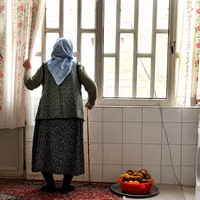
An elderly woman looks out of a window in her home in Iran.
As more Iranians build new lives abroad, many parents back home face a less visible consequence of migration: years without seeing their children, family relationships maintained through phone screens, and growing uncertainty about who will be there for them in old age.
For Maryam, a 68-year-old retiree in Tehran, that distance has become part of everyday life. Her son lives in Canada and her daughter in Germany, and she has not seen either of them in years.
“I know they're building their futures, and I'm happy for them,” she told Iran International. “But sometimes I just wish they were here, even for an ordinary dinner.”
Maryam says regular calls and photographs help her stay connected with her family, particularly her grandchildren. But watching them grow up from thousands of miles away is difficult.
“They know me through the phone,” she says. “I wish I could be more than just a face on a screen in their lives.”
Last winter, Maryam was hospitalized with kidney problems. Her children arranged help through relatives, and a family member accompanied her to medical appointments.
“My daughter was very worried, and I kept telling her everything was fine,” she recalls. “Sometimes, especially when I'm ill, I just wish we weren't so far apart.”
Caring for a spouse without the children nearby
In Karaj, 72-year-old Hamid has spent the past two years caring for his wife after a stroke left her with limited mobility.
Travelers pull their suitcases through an airport terminal in Iran, amid a continuing wave of emigration that has left many families separated across borders.
Their two sons live in Sweden and Australia. Although they call regularly and provide financial support, most daily responsibilities fall on Hamid.
He describes the exhaustion of managing medication, medical appointments and household chores.
“Some people think you're fortunate when your children live abroad,” he says. “But when your wife needs help getting out of bed, what matters is having someone nearby.”
The family has hired a part-time caregiver, but Hamid still handles much of his wife's care.
“Sometimes I want to tell my sons how exhausted I am,” he says. “Then I think about how far away they are and wonder what they could possibly do.”
Hamid does not blame his children for emigrating, but says family life has changed.
“We're still very close, and we talk all the time. But it's different when you can't sit together in the same room.”
Stay in Iran or join the family abroad?
For Nahid, a 64-year-old widow in Tehran, the question is whether she should leave Iran herself.
Her only daughter has lived in London for eight years and has encouraged her mother to move closer.
“My daughter tells me to come and live with her, but I've spent my whole life here,” she says. “My sisters, my friends, all my memories are here. At the same time, every year that passes, I wish I could be closer to her.”
Nahid worries about losing her independence in a country where she does not speak the language fluently or have an established social circle.
But staying in Tehran also means facing old age far from her daughter.
“I don't want to become a burden to my daughter,” she says. “But I don't want to leave behind everything I've built here either.”
The distance that remains
Phone and video calls have helped families separated by migration remain part of one another's lives despite years of living thousands of kilometres apart. They share news, celebrate birthdays and check on each other's health, sometimes communicating more frequently than families living in the same city.
But as parents grow older, that distance takes on a different meaning. A sudden illness, a medical emergency or the growing need for help with everyday tasks can expose the limits of even the closest long-distance relationships.
For children who have emigrated, Iran remains the place where their parents are growing old. For the parents who stayed behind, each passing year brings a difficult reality into sharper focus: the people they may need most are the ones living furthest away.