Israel's Eisenkot praises Trump strikes on Iran, warns of nuclear threat
Former military chief and leader of the Yashar party Gadi Eisenkot delivers a statement to members of the press, near Kibbutz Mefalsim, southern Israel, on October 15, 2026.
Former Israeli military chief Gadi Eisenkot praised US President Donald Trump's decision to launch strikes against Iran alongside Israel and warned that Tehran was seeking to develop nuclear weapons, in an interview with the New York Post.
Eisenkot, a leading challenger to Prime Minister Benjamin Netanyahu ahead of Israel's parliamentary elections on Tuesday, said he supported Trump's approach of achieving peace through military strength.
“Trump’s decision to strike Iran together with Israel, exceeded anything one could have imagined. That military campaign and the operation were courageous.”
Eisenkot, a former chief of staff of the Israel Defense Forces, warned that Iran's nuclear ambitions remained a major concern despite the military campaign.
“The question of what comes next is absolutely critical, as the Iranians seek to break through to nuclear weapons capability and want to become another North Korea,” he said.
The former military chief also expressed support for Washington's economic pressure on Tehran, suggesting that opportunities for reaching an agreement may have diminished.
“I fear we may have moved beyond that point. In fact, the economic pressure Trump is applying is helping, giving the Iranians a sense of defeat,” Eisenkot said.
Eisenkot also proposed establishing a US-backed regional security alliance involving Israel and Arab countries, which he described as a “kind of Middle Eastern NATO,” alongside efforts to expand normalization agreements.
He said the proposed alliance would operate “under an American umbrella, with Israel maintaining a low profile. From there, we can continue advancing normalization and peace agreements.”
Eisenkot, who leads the Yashar party, has emerged as a leading political rival to Netanyahu ahead of the October 27 elections. Both politicians have advocated preventing Iran from acquiring nuclear weapons, although Eisenkot has positioned himself as an alternative to Netanyahu's leadership.
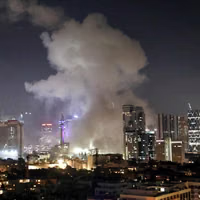
Smoke billows following missile attack from Iran on Israel, at Tel Aviv, Israel, June 13, 2025.
The war with Iran raises a familiar question for Israel: Can battlefield gains produce lasting peace? Its military history offers mixed answers, from unresolved victories to withdrawals and ceasefires that left adversaries armed.
Destroying Iran’s military capabilities and preventing their reconstruction are different objectives, requiring different measures of success.
Since 1948, Israel has fought conventional Arab armies and armed organizations such as Hezbollah and Hamas, and has increasingly confronted Iran directly through missile, drone and air attacks far beyond its borders. These forms of warfare have overlapped, posing different challenges for bringing the fighting to an end.
Their endings show how battlefield outcomes interact with diplomacy, outside pressure and arrangements for security after the fighting.
1948: Survival without peace
Fighting between Jewish and Arab communities followed the UN’s 1947 partition plan. After Israel declared independence in May 1948, neighboring Arab armies entered the conflict. Israel survived and gained territory beyond the boundaries proposed for the Jewish state.
In 1949, it signed separate armistice agreements with Egypt, Lebanon, Jordan and Syria. These established lines separating the forces, rather than permanent political settlements. The Egyptian agreement explicitly envisaged a subsequent peaceful settlement.
Israel’s survival did not resolve the territorial dispute or the displacement of Palestinians. The fighting ended without peace between Israel and its neighbors.
1956: Military gains, withdrawal under pressure
During the Suez crisis, Israel attacked Egypt in coordination with Britain and France, rapidly advancing across Sinai.
Pressure from the United States, the Soviet Union and the United Nations forced a withdrawal, completed in March 1957. Israel could not retain the territory it had captured, despite its battlefield success.
The outcome nevertheless brought security gains: Israel regained access to the Straits of Tiran, while a UN emergency force deployed in Sinai. The US State Department’s historical account distinguishes those gains from the territorial withdrawal.
The episode illustrates why withdrawal is not automatically evidence of military defeat, and why military superiority alone does not determine a war’s political outcome.
1967: Six days of fighting, decades of consequences
Israel’s opening airstrikes devastated Egypt’s air force. Within six days, Israeli forces had captured Sinai, Gaza, the West Bank, East Jerusalem and the Golan Heights. The war ended through ceasefires, without a formal surrender by the defeated Arab states. Israel’s decisive battlefield victory transformed the territorial balance but did not settle the conflict.
UN Security Council Resolution 242 subsequently established a framework linking Israeli withdrawal from occupied territory with an end to belligerency and recognition of states’ right to live within secure, recognized boundaries.
The military result was immediate. Disputes over occupation, borders and Palestinian rights lasted far beyond the fighting.
Egyptian fighter jets are seen after being destroyed by Israel's Air Force. File photo
1973: From surprise attack to a peace treaty
Egypt and Syria attacked Israeli forces in Sinai and the Golan Heights in October 1973, initially making substantial gains. Israel counterattacked and crossed the Suez Canal before US-Soviet diplomacy and UN ceasefire resolutions helped stop the fighting.
The US State Department’s history describes the war as opening the way for Henry Kissinger’s shuttle diplomacy and, ultimately, the Egyptian-Israeli peace treaty. Egypt did not recover all Sinai through military action, but the war helped break the diplomatic stalemate.
The 1978 Camp David accords provided the framework for the 1979 treaty. Israel agreed to withdraw from Sinai in exchange for peace with Egypt. The main withdrawal was completed in 1982; the disputed Taba area was returned in 1989 following arbitration.
Egypt recovered territory through a combination of war and diplomacy. Israel exchanged territorial control for a political agreement with a major adversary.
Israel’s 1982 invasion drove into Beirut, where US-mediated arrangements secured the departure of Palestine Liberation Organization leaders and fighters. This was an evacuation from Beirut, not the elimination of every Palestinian armed presence in Lebanon.
Israel withdrew much of its force in 1985 but retained a southern security zone alongside the allied South Lebanon Army. Its remaining troops left in May 2000, following years of conflict with Hezbollah. UNIFIL’s historical account records both withdrawals.
The withdrawal was unilateral, without a peace treaty or formal Israeli surrender. Hezbollah portrayed it as a victory; Israel ended a prolonged deployment without resolving the underlying confrontation.
The departure of one armed organization’s leadership in 1982 had not produced a lasting end to fighting.
Israeli tanks are positioned near Israel's border with Lebanon, in northern Israel. File Photo
2006: A ceasefire without disarmament
The 2006 war followed Hezbollah’s cross-border attack and capture of two Israeli soldiers. Israel launched extensive air and ground operations, but Hezbollah remained armed and continued firing rockets during the conflict.
Neither side’s survival or military performance alone explains the settlement. The operative mechanism was UN Security Council Resolution 1701, adopted on August 11, followed by a cessation of hostilities on August 14.
It called for Hezbollah to stop attacks, Israel to stop offensive operations, and Israeli forces to withdraw as Lebanese troops and an expanded UNIFIL deployed. It envisaged an area between the Blue Line and Litani River free of armed personnel and weapons other than those of the Lebanese government and UNIFIL.
Hezbollah was not disarmed. Nevertheless, UNIFIL says the arrangements helped sustain almost 17 years of relative calm before the escalation beginning in 2023. An incomplete settlement still had significant practical effects.
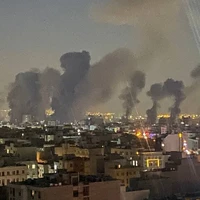
A view shows houses and buildings destroyed in Israeli strikes, in Jabalia in the northern Gaza Strip. File Photo
Gaza: Repeated campaigns and rebuilding
The Gaza wars of 2008–09, 2012, 2014 and 2021 ended without Hamas surrendering or losing all its military capabilities.
Scholars Efraim Inbar and Eitan Shamir described Israel’s approach as “mowing the grass”: periodically degrading an adversary’s capabilities and restoring deterrence rather than expecting a permanent political resolution through force. Their study appeared online in 2013 and in the Journal of Strategic Studies in 2014.
After Hamas’s October 7, 2023 attack, Israel set broader objectives, including dismantling its military and governing capabilities and recovering the hostages. Shamir argued that the attack marked a departure from the previous limited-campaign approach. That was his strategic assessment, rather than proof that eliminating Hamas was achievable.
The ensuing war devastated Gaza. The October 2025 ceasefire did not settle its future: a year later, the UN human rights office was still reporting killings despite the agreement.
Lebanon after 2023: Military damage and state authority
Israel’s 2024 campaign killed Hezbollah leader Hassan Nasrallah and other senior commanders, severely damaging its leadership. The fighting nevertheless moved toward a negotiated cessation of hostilities rather than formal surrender.
The US-French-brokered arrangement took effect on November 27, 2024, and again rested on implementing Resolution 1701, Lebanese state authority and Israeli withdrawal.
Disarmament remained contested. In October 2026, The Wall Street Journal reported that Hezbollah demanded the return of explosives seized by Lebanese authorities, illustrating the continuing struggle over weapons outside state control.
Missiles launched from Iran are intercepted as seen from Tel Aviv, Israel, June 13, 2025.
Iran: Ending operations or preventing reconstruction?
The June 2025 war involved Israeli attacks on Iranian military and nuclear targets and direct US strikes on Fordow, Natanz and Isfahan. US involvement therefore preceded the broader war of 2026.
Israel’s Foreign Ministry described the nuclear threat as “existential and imminent” in its account of the operation. That characterization was Israel’s stated justification, not an independently established finding that Iran possessed nuclear weapons. The same document records Israel’s acceptance of a US-proposed ceasefire on June 24. The broader confrontation in 2026 extended to shipping and energy supplies. By October, the US naval blockade and the standoff over reopening the Strait of Hormuz remained unresolved.
Netanyahu has explicitly advocated moving beyond containment. Addressing military cadets in February 2026, he declared there would be “no more containment of threats” and emphasized preemptive action. This supports describing a shift in his stated approach, without assuming a uniform doctrine across every Israeli institution.
Destroying launchers or facilities has measurable immediate effects. Preventing their reconstruction depends on industrial capacity, supply networks, political decisions and whatever monitoring or enforcement follows.
Possible scenarios
Within the approach of seeking to prevent Iran from rebuilding its military threat, two scenarios can be considered. Neither is a prediction or an exhaustive account of how the conflict might end.
The first is a military defeat sufficiently extensive to destroy much of Iran’s offensive capability and substantially constrain its reconstruction. Lasting results would depend on measures that prevent replenishment, rather than destruction alone. The second combines military defeat with the end of the Islamic Republic and its replacement by a political system that abandons hostility toward Israel and support for armed proxies.
That scenario depends on more than a change of leadership. It assumes a successor government both chooses and can enforce a different policy, including ending financial, military and operational support for allied armed groups. A government’s collapse would not itself establish those conditions.
The scenarios may overlap, but neither guarantees stability. Their outcomes would depend on political authority, security arrangements and the capacity to enforce commitments after combat ends.
Other possible outcomes include a negotiated agreement that constrains Iran’s capabilities without changing its government, or a prolonged armed standoff sustained by deterrence. Neither would necessarily eliminate the underlying hostility, though either could bring the current fighting to an end.
Israel’s earlier wars provide different benchmarks: territorial withdrawal under international pressure in 1956, land exchanged for peace with Egypt, unilateral withdrawal from Lebanon, and ceasefire arrangements that reduced fighting without disarming Hezbollah. Each ended a particular phase of conflict; only some produced a broader political settlement.
Nazanin Sharifian, also known as Devora Sharifian Bachar, an Iran-born Knesset candidate for Gadi Eisenkot’s Yashar party, during an interview with Iran International (October 2026)
Nazanin Sharifian, an Iran-born former Mossad officer running for Israel’s parliament with Gadi Eisenkot’s Yashar party, told Iran International that Israel should step up military and economic pressure on the Islamic Republic’s leaders and work to end their rule.
“We must do everything we can to bring down the leaders of the Islamic Republic, so this regime is gone and the people of Iran are free,” she told Iran International’s Babak Eshaghi.
Sharifian, a Persian speaker who was born in Iran in 1982 and lived there until she was seven, is a candidate for the Knesset in Tuesday’s election. If Yashar joins the next coalition, she could hold a role in government.
‘The last hope of Iran’
Sharifian called the Islamic Republic Israel’s greatest enemy and an enemy of Iranians as well. Iran’s wealth, she said, goes to Hezbollah and the Houthis instead of to the people it belongs to.
Asked what Yashar’s policy toward Tehran would be, she said it would continue the course set by Prime Minister Benjamin Netanyahu, Eisenkot’s main rival.
“We must intensify this pressure on the leaders of the Islamic Republic,” she said. “We do not want to put pressure on the people of Iran. The people of Iran are the last hope of Iran.”
She called for every available means to be used to end the Islamic Republic’s rule. “I have great faith in the people of Iran,” she said.
Her emphasis on pressure differs from her party leader’s. Eisenkot, a former military chief, said this month that the Islamic Republic’s fall is necessary but cannot be achieved by military action, and that it must come from within Iranian society.
From Tehran to the Mossad
Sharifian was born into a Jewish family. After the 1979 revolution, some relatives left for the United States and Israel, but her father, who ran businesses in Tehran and Isfahan, refused at first to leave. The family fled when she was seven.
In Israel she served in the army, then in the Shin Bet internal security service and the Mossad, Israel’s foreign intelligence agency. Her Persian, she said, was one reason she was moved to the Mossad. She has since taught Persian and Middle East strategy to hundreds of Israeli students.
“I am very proud that my being is Iranian,” she said. Representing Iranians in Israel would be a great honor, she said, adding: “I expect to speak Persian in the Israeli parliament in the future.”
She hopes to bring more people of Iranian origin into Israel’s state institutions, she said, and that one day Iran will be returned to its people.
Workers prepare ballot boxes for distribution, at the Israeli Central Elections Commission warehouse, ahead of Israel's national election, in Shoham, Israel, October 14, 2026.
In 1987, with Khomeini still calling for Israel’s destruction, Israel’s defense minister called Iran its best friend. Today every candidate for prime minister wants the Islamic Republic gone. Israel’s leaders have changed their minds about Iran’s rulers, but seldom disagreed.
That is the thread through 47 years of Israeli policy toward the Islamic Republic, and it runs straight into next Tuesday’s election. Whoever wins, the goal will be the same. What changes is how hard, how openly and with whom Israel pursues it.
The Shah’s friend
Before 1979, Iran was Israel’s most important partner in the region. Under David Ben-Gurion’s “periphery doctrine,” Israel courted non-Arab neighbors to outflank hostile Arab states, and the Shah’s Iran was the prize.
Tehran recognized Israel de facto in 1950, sold it oil through a jointly owned pipeline, and let its intelligence services work with Israel’s Mossad. Israeli engineers, farmers and arms dealers worked across Iran. The relationship was discreet, profitable and close.
The revolution ended it overnight. Islamic Republic's founder Rouhollah Khomeini cut ties, and Israel’s mission in Tehran was handed to the Palestine Liberation Organization.
The enemy of my enemy
Israel’s first leaders after 1979 did not try to bring the new order down. They sold it weapons.
When Iraq invaded Iran in 1980, Menachem Begin’s government shipped arms to Tehran, and Israeli sales ran to an estimated $500 million between 1981 and 1983, according to Tel Aviv University’s Jaffe Institute. Saddam Hussein was the threat, and Iran was the counterweight. In 1985 and 1986, under Shimon Peres, Israel was the go-between in the Iran-Contra affair, passing American missiles to Tehran.
Yitzhak Rabin, then defense minister, explained the logic in October 1987. “Iran is Israel’s best friend and we do not intend to change our position in relation to Tehran, because Khomeini’s regime will not last forever,” he said. The expectation that the Islamic Republic would fall was already there. Israel simply did not think at the time that it was its job to hasten it.
The threat is named
Rabin was also the one who turned. Back as prime minister in 1992, he received the first intelligence reports on an Iranian nuclear program and concluded, aides recalled, that only a nuclear Iran could pose an existential threat Israel could not answer. Part of his case for peace with the Palestinians and Jordan was to clear the near front before facing the far one.
Ariel Sharon took the same view further. In November 2002, as the United States prepared to invade Iraq, he told The Times of London that Iran should be put under pressure “the day after” Baghdad fell, calling it a center of world terror.
As prime minister he carried aerial photographs of Iranian sites to George W. Bush and said Israel “cannot accept” a nuclear Iran. Ehud Olmert, his successor, kept the military option on the table while, according to later reporting, the first cyberattacks on Iran’s centrifuges were set in motion with Washington.
None of them spoke of regime change. Their target was the bomb.
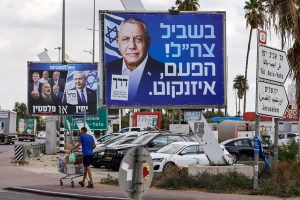
A drone view of an election billboard by Benjamin Netanyahu's Likud Party depicting Iran's Supreme Leader Mojtaba Khamenei, New York City Mayor Zohran Mamdani, Turkish President Tayyip Erdogan and Hezbollah chief Naim Qassem and a text in Hebrew that reads "They Want Netanyahu to Lose, Don't let them Win", in Tel Aviv, Israel August 17, 2026
The man who talked to Iranians
Benjamin Netanyahu made Iran his signature cause. Across 15 years in office before 2021, he drew a cartoon bomb at the United Nations, addressed the US Congress against the 2015 nuclear deal, and displayed an archive of Iranian nuclear documents his agents had smuggled out of Tehran.
He also began speaking past the government to the people. He recorded messages to Iranians, offering water technology during the drought and insisting that Israel’s quarrel was “not with the Iranian people.”
The message was new: the problem is not Iran, it is the people who rule it.
The head of the octopus
Naftali Bennett, prime minister in 2021 and 2022, turned that view into a doctrine. Israel, he argued, had spent decades fighting the arms of the octopus, Hezbollah and Hamas, while leaving the head untouched.
He said he launched about 30 operations against the Islamic Republic with the Mossad and other agencies, not all of them military, and predicted it would collapse like the Soviet Union.
Yair Lapid, who succeeded him for six months, spent his term lobbying against a revived nuclear deal.
Former prime ministers Naftali Bennett and Yair Lapid attend an event for their B'Yachad party, ahead of Israel’s national election, in Haifa, Israel, October 21, 2026.
Saying it out loud
Since returning to power at the end of 2022, Netanyahu has moved from hoping to aiming. In June 2025, as Israeli jets struck Iran in the 12-day war, he told Iranians that “as we achieve our objective, we are also clearing the path for you to achieve your freedom.”
The war that began on February 28 this year, fought with the United States, killed former Supreme Leader Ali Khamenei. Last week Netanyahu went further than any Israeli leader before him: “This regime must fall and I will topple it.”
What the candidates say
Netanyahu, leading Likud, has made bringing down the Islamic Republic his campaign’s primary objective and says he has told the security services to work toward it. He has also said he opposes a preemptive strike before the vote.
Gadi Eisenkot, the former military chief whose Yashar party is Likud’s main rival, says the Islamic Republic’s fall is necessary but cannot be achieved by force. “This must come from within the Iranian people,” he said, and he would strike again only if Tehran raced for a bomb.
Bennett and Lapid, running together on the Together list, want to hit harder, not softer. Bennett says attacks by Tehran’s allies should be answered on Iranian soil. Lapid has called for striking Iran’s energy infrastructure, including the Kharg Island oil terminal.
Avigdor Lieberman of Yisrael Beiteinu has long called for overthrowing the Islamic Republic and says past efforts fell short. Itamar Ben-Gvir of the far-right Jewish Power backs military operations until Israel’s goals are met. Mansour Abbas, whose Ra’am party draws Arab Israeli voters, has set out no position on Iran.
From Rabin’s prediction that Khomeini’s rule would not last to Netanyahu’s promise to end it himself, the conclusion has barely moved. What Israelis will choose on Tuesday is not whether to want the Islamic Republic gone, but how loudly to say it and how much to risk to get there.
Two men speak on Jaffa Street, one of the main shopping streets, ahead of the Israeli parliamentary election in Jerusalem, October 22, 2026.
Court sketch from Woolwich Crown Court. Credit: SWNS/Julia Quenzler
A man accused of plotting attacks on Iran International journalists told a London court on Thursday that his Iranian handlers had instructed him to break one journalist’s arms and legs and assault another to stop him from criticizing the Islamic Republic.
Mostafa Sepahvand told Woolwich Crown Court that he had been asked to attack Iran International journalists Kambiz Hosseini and Mojtaba Pourmohsen, as well as two other people, Alon Farago and Jonathan Turner.
Asked by prosecutor Emlyn Jones what those behind the alleged operation wanted him to do, Sepahvand replied: “To hit them.”
“They asked me to hit Jonathan and scare him off; they asked me to break Kambiz's arms and legs; they asked me to hit Pourmohsen to stop him writing about the regime,” he said.
Sepahvand, 41, is on trial alongside Farhad Javadi Manesh, 46, and Shapoor Qalehali Khani Noori, 57. All three deny charges under Britain's National Security Act.
Prosecutors say the men gathered information for Iranian intelligence in preparation for serious violence against people critical of Tehran.
Sepahvand acknowledges conducting surveillance but says he only appeared to cooperate because of threats against him and his family and never intended to hurt anyone. Instead, he says, he deliberately tried to frustrate the operation.
“I played them,” he has repeatedly told the court.
Prosecutors challenge his account
Cross-examining Sepahvand on Thursday, Jones directly challenged that defense, suggesting his claims that he had been deceiving the Revolutionary Guards were explanations invented after his arrest.
“What I am suggesting is that every time you said ‘I was playing the IRGC,’ you were lying,” Jones said.
“No, that was not the case,” Sepahvand replied.
The prosecution questioned Sepahvand about visits he made to addresses he had been given and photographs and videos taken during the alleged surveillance.
Sepahvand acknowledged going to an address associated with Pourmohsen and taking a photograph, but denied that he was preparing an attack.
“I go there, I get a picture, I go back home,” he said. “They ask me to hit them, I play them.”
Jones argued that Sepahvand's repeated visits, searches and complaints about inadequate information showed that he was carrying out groundwork for the alleged attacks rather than trying to sabotage them.
Sepahvand insisted that he deliberately told his contacts that addresses were wrong, exaggerated the difficulty and expense of finding the targets and repeatedly delayed carrying out their instructions.
He said that had he encountered the journalists, he would have warned them. “If I saw them I'd tell them that IRGC was after them and you have to escape,” he told the court.
£150,000 demand questioned
Jones also challenged Sepahvand over his repeated demands for money, including messages in which he said he would complete the job for £150,000.
Sepahvand said the demands were another delaying tactic because money was a “weak spot” for the people directing him.
“If I wanted to accept the money, I would have accepted £30,000,” he told the court, referring to a smaller payment discussed earlier in the alleged operation.
Jones questioned why Sepahvand would have been in a position to demand payment if, as he maintains, he had agreed to cooperate only because Iranian operatives were threatening him and his family.
Sepahvand said he had told them he would need a team and money to carry out the attacks but maintained that he never intended to do so.
“They wanted to force me and I didn't do it,” he said.
Sepahvand became increasingly agitated during the cross-examination, repeatedly raising the case of Navid Imami, a man he says was connected to the Iranian embassy in London and had supplied information about the targets.
The judge called a break after Sepahvand repeatedly interrupted Jones and later warned him that if he continued shouting or repeating his defense rather than answering questions, the jury could conclude that he did not have answers to the prosecution's case.
Sepahvand testified Wednesday that he had met Imami at the Iranian embassy in February 2025 while the alleged operation was under way.
He maintains that pressure on members of his family in Iran forced him to maintain contact with the people directing the operation and that his apparent cooperation was intended to protect others without carrying out the attacks.
The prosecution's cross-examination of Sepahvand is due to continue when the trial resumes Monday.
Israel has barred a United Airlines pilot of Iranian descent from serving on flights to the country over unverified social media allegations that he supported Iran's government, the Revolutionary Guards and Hezbollah, Ynet reported Wednesday.
Israel's Diaspora Affairs and Combating Antisemitism Ministry alerted security and transportation officials on October 19 to allegations circulating on X about the pilot, Sina Amjadian, according to a ministry letter obtained by Ynet.
The letter included two posts from X. One alleged that Amjadian, who was said to have previously worked for flydubai, had shared content supporting Iran's government, including a video in which he purportedly kissed and saluted its emblem.
The other alleged that he had expressed support for the Islamic Revolutionary Guard Corps and Hezbollah and called on United Airlines to investigate his conduct.
Ynet said it could not independently verify the allegations and that the material submitted to Israeli authorities did not include original statements or social media posts by Amjadian.
The allegations nevertheless prompted a security review and a decision to prohibit Amjadian from serving as a crew member on flights to Israel, senior Transportation Ministry officials told Ynet.
Security review follows flydubai incident
The Diaspora Affairs Ministry said the warning followed an attempted attack aboard a flydubai flight bound for Israel in late September, during which a co-pilot attacked the captain and attempted to seize control of the aircraft.
The incident prompted Israel's National Command and Control Center for Combating Antisemitism to expand its monitoring to people who might pose a threat to aviation security, according to the ministry.
It said the allegations concerning Amjadian warranted security scrutiny because of the responsibilities of an international airline pilot and the potential risks to passengers and crew.
Transportation Ministry officials told Ynet that the ministry did not independently monitor social media or gather intelligence but coordinated with security agencies when information raised aviation safety concerns.
They said preventing a pilot from operating flights to Israel was separate from denying the individual entry to the country, which falls under the authority of border control officials.
Ynet said it remained unclear whether Amjadian had previously flown to Israel, had been scheduled to operate a flight to Ben Gurion Airport or was qualified to fly aircraft used by United Airlines on its Israel routes.
There was no indication that any flight had been canceled or prevented from reaching Israel because of the restriction.