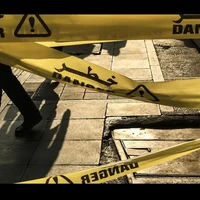
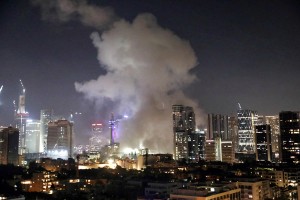
Yellow warning tape cordons off a damaged section of pavement in Tehran.
The prospect of another US-Iran war has fuelled debate over whether Washington is preparing for a prolonged campaign of military and economic pressure or whether diplomacy can still avert a wider conflict.
The debate comes amid continuing attacks on shipping in the Strait of Hormuz, warnings from Tehran that it is better prepared for another confrontation, and fresh revelations about Iran's efforts to circumvent sanctions and the US naval blockade to import military equipment.
Iran's Revolutionary Guards said Thursday that three tankers had struck naval mines in the strait over the previous 24 hours. Vice President Mohammadreza Aref said Tehran was managing the strategic waterway and that its defensive readiness had improved since the 12-day and 40-day wars.
Analyses published in Iranian newspapers in recent days offer differing assessments of the likelihood of another confrontation and the prospects for a negotiated settlement.
The economic daily Donya-ye Eghtesad said war was not inevitable, pointing to continuing backchannel contacts despite deep disagreements between the two sides.
Political analyst Rahman Ghahramanpour told the paper that another conflict would be unlikely to end after only a few days, warning that even limited US military action could become part of a sustained campaign combining strikes and sanctions.
Ghahramanpour described a possible eight-to-twelve-month strategy aimed at weakening Iran's ability to resist US demands.
War: disastrous but not inevitable
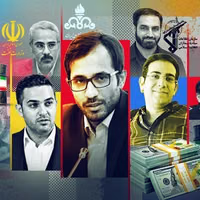
Reuters investigation published Thursday revealed how Iran has used a network of more than 5,000 military-linked agencies to import at least $2 billion worth of equipment, explosives and heavy-duty trucks since January 2025, circumventing Western sanctions and the US naval blockade.
The findings shed light on Tehran's efforts to sustain its military capabilities despite the pressure campaign.
Former diplomat Kourosh Ahmadi challenged predictions that another war was imminent, arguing that the remaining disagreements between Tehran and Washington might not be substantial enough to justify the costs of a new conflict.
Writing in the reformist daily Shargh, Ahmadi said President Donald Trump's statements should not be treated as evidence that he had decided to attack Iran, while warning that another war could have devastating consequences.
He identified three broad options available to Washington: pursue a diplomatic settlement, continue economic and military pressure to weaken Iran, or undertake another military operation.
Diplomacy remained possible, Ahmadi argued, because the dispute concerned the sequencing of concessions more than fundamentally incompatible objectives.
Cost of stalemate
The moderate news website Fararu examined the damage already being inflicted by the prolonged stalemate.
Former diplomat Fereydoun Majlesi argued that Iran's state of “neither war nor peace” was itself becoming a major economic burden, with uncertainty prompting businesses to hold on to cash and avoid investment.
Such decisions weaken production, employment and economic growth over time, he said, even without another military confrontation.
Both sides, Majlesi said, continued to define an acceptable agreement primarily in terms of their own interests while resisting the concessions necessary to bridge the gap.
He warned that prolonged uncertainty could make an eventual settlement more difficult as economic pressure and mutual distrust intensified.
For Ghahramanpour, the question was not simply whether Washington might strike again, but whether military pressure could secure political concessions without triggering a wider war.
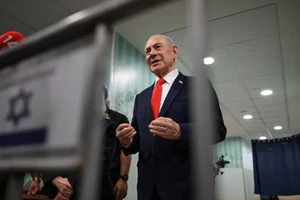
A woman passes by a banner depicting Israeli Prime Minister Benjamin Netanyahu and US President Donald Trump day after the country held a national election, in Jerusalem, October 28 , 2026.
The departure of Israeli Prime Minister Benjamin Netanyahu could benefit Iran even if his successor maintained the same policies toward Tehran, Khorasan, a conservative Iranian newspaper close to Parliament Speaker Mohammad Bagher Ghalibaf, said on Thursday.
The newspaper said a change in Israeli leadership would not necessarily reduce military threats against Iran but could weaken the political and diplomatic networks Netanyahu has built during his years in power.
"Ultimately, Netanyahu's departure is in Iran's interest, not because his successor would necessarily adopt a friendly approach, but because removing one of the main architects of the confrontation with Iran would reduce the accumulated political and diplomatic capacity behind it," Khorasan wrote.
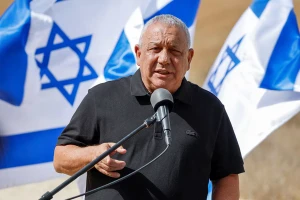
The assessment came after Israel's parliamentary election on Tuesday produced no clear winner, leaving Netanyahu and his main rival, former military chief Gadi Eisenkot, seeking support to form a government.
With nearly 86% of votes counted on Wednesday, Israeli broadcasters projected Netanyahu's right-wing bloc would secure 53 seats in the 120-member Knesset, compared with 48 for Eisenkot's opposition bloc and 19 for Arab-led parties.
Neither main bloc reached the 61 seats needed for a majority, leaving the outcome dependent on coalition negotiations.
Netanyahu's experience seen as key factor
Khorasan said Israeli political groups shared many positions on security matters despite their differences and that Eisenkot, a former military chief, was not opposed to confrontation with Iran.
It argued, however, that Netanyahu had built political and diplomatic networks over many years that a successor could find difficult to replace.
"Netanyahu is not merely a prime minister," the newspaper wrote, adding that he had developed extensive political, regional and international connections and considerable experience influencing US decision-making.
The newspaper said Netanyahu knew how to make Iran a central issue in Washington's foreign policy and connect security developments with political opportunities.
"Removing such a figure from the top of power, even if the basic structure of Israeli policy remains unchanged, means losing part of this accumulated capacity," it said.
"Netanyahu and his allies have built ties over the years between the Israeli government and some opponents of the Islamic Republic, particularly the monarchist movement," the newspaper wrote.
"Netanyahu's departure could weaken part of this political image, although one should not expect all these relationships to disappear with a change in leadership," it added.
It said political divisions within a future Israeli coalition could make decision-making more difficult, although such disagreements would not automatically reduce the risk of military action.
Election leaves Netanyahu and Eisenkot seeking coalition partners
Netanyahu's Likud-led bloc emerged ahead of Eisenkot's opposition in the preliminary results but remained short of a parliamentary majority.
Parties representing Arab Israelis were projected to secure an unprecedented 19 seats following high voter turnout, giving them a potentially important role in determining the next government.
Eisenkot could seek support from Arab-led parties to secure a majority, although several parties within his opposition bloc have opposed such cooperation.
Khorasan said the high turnout among Arab voters was one of the election's most important developments but questioned whether Eisenkot could reach an agreement with Arab parties while maintaining support from his existing allies.
Reuters reported that Netanyahu's electoral performance had strengthened his position in coalition negotiations despite the loss of his previous parliamentary majority.
The prime minister will remain in office in a caretaker capacity while the process of forming a new government continues.
Iran remains central to Israeli political debate
The election took place during the US-Israeli war on Iran, which began in February, with the possibility of further military action remaining an issue in Israeli politics.
Netanyahu has repeatedly emphasized the Iranian threat during the campaign and has received public support from US President Donald Trump.
Eisenkot has criticized Netanyahu's handling of security matters and warned against the political use of military decisions.
Khorasan said Netanyahu's departure would not necessarily bring a change in Israel's approach toward Iran, noting that different political groups shared positions on key security issues.
"Internal disagreements do not necessarily lead to a reduction in military threats," the newspaper wrote, adding that political competition could sometimes result in more aggressive behavior.
It said the removal of Netanyahu would not end the confrontation between Israel and Iran but could reduce the ability of Israeli leaders to coordinate political and diplomatic efforts against Tehran.
"Sometimes removing one player does not, by itself, end the game, but it can make the game more difficult for the opposing side," Khorasan concluded.
US President Donald Trump and Vice President JD Vance point to the stage during Day 1 of the Republican National Convention (RNC), at the Fiserv Forum in Milwaukee, Wisconsin, US.
US President Donald Trump confirmed he approved Vice President JD Vance's outreach to Iran, saying it focused on medical supplies, as Washington weighs a possible week-long military campaign against Tehran after next week's midterm elections.
Trump said on Wednesday that Vance had sought his approval to contact Iranian authorities but denied directing him to restart peace negotiations.
"They need help with medical supplies and various things. He asked me what I thought. I said, 'if you want to do that, that's OK,'" Trump told reporters.
"Basically, it's getting supplies in to help people that are not well," he added.
The Wall Street Journal reported that Vance had sent a letter to Mohsen Rezaei, secretary of Iran's Supreme National Security Council, seeking to restart negotiations between Washington and Tehran.
The diplomatic contacts come as regional mediators led by Qatar seek an agreement to prevent further military action, while US and Israeli officials prepare for possible strikes after the November 3 elections.
Vance seeks discussions on Iran's nuclear program
Vance's letter to Rezaei stressed that any negotiations aimed at preventing further US military strikes would require discussions on Iran's nuclear program, Axios reported, citing a US official.
The official said Vance had proposed contacting Rezaei, who has direct access to Iran's Supreme Leader Mojtaba Khamenei, and that Trump had supported the initiative.
"The President was enthusiastic about the letter," the official told Axios.
The Wall Street Journal reported that the outreach focused on exploring a possible framework for renewed negotiations rather than presenting a detailed peace proposal.
According to the newspaper, Vance had previously expressed reservations in private about prolonging the war, which began in February, while publicly supporting the US military campaign.
The vice president previously led US negotiations with Iranian representatives, but those efforts did not produce a lasting agreement.
A central issue remains Washington's demand for nuclear concessions before economic relief, while Tehran wants the US to lift its naval blockade, release frozen Iranian funds and allow oil exports before negotiations move forward.
Regional mediators led by Qatar, with support from Pakistan, Saudi Arabia, Egypt and Turkey, are working to restart negotiations between Washington and Tehran, according to Axios.
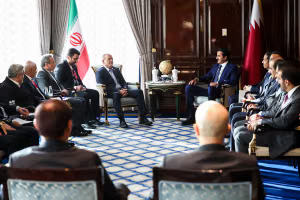
Qatari negotiator Ali al-Thawadi visited Tehran earlier this week to discuss possible terms for an agreement with the Trump administration.
One proposal under discussion would allow inspectors from the International Atomic Energy Agency (IAEA) to visit Iranian nuclear facilities damaged during US and Israeli attacks in exchange for limited sanctions relief.
The arrangement could include waivers allowing Iran to export oil and the release of some frozen funds to purchase food and other humanitarian supplies, Axios reported, citing a regional source familiar with the discussions.
The proposals seek to address differences between Washington's demand that Iran give up its enriched uranium stockpile and Tehran's insistence that the US first ease economic restrictions.
"There is some movement. We are waiting for the Iranian response," the regional source told Axios.
The source said the proposed arrangement could allow Iran to retain its enriched uranium initially while Washington secured steps toward renewed nuclear oversight.
Trump confirmed to Axios on Wednesday that negotiations were taking place through mediators but said their outcome remained uncertain.
"We need to finish the job — either through a deal or another way — we will find out if negotiations can succeed," Trump said.
Qatari mediators also presented Iran with ideas for a seven-day process to address concerns on both sides, Reuters reported on Wednesday, citing an official briefed on the negotiations.
According to the official, the draft calls for daily confidence-building measures from each side, with the process potentially beginning early next week.
Several countries would serve as guarantors of the agreement, the official said, adding that Iran was expected to respond by the end of the week.
However, a senior Iranian official told Reuters that Qatar had not presented a formal peace proposal but had instead put forward ideas Tehran considered unacceptable.
The official said Iran would show no flexibility on the nuclear issue.
Another option under discussion involves reviving a September 2025 agreement between Iran and the IAEA in Cairo that provided a framework for inspections of Iranian nuclear facilities.
The agreement was suspended after the UN Security Council reimposed sanctions on Iran the following month.
IAEA Director General Rafael Grossi told the UN Security Council on Tuesday that reviving the Cairo agreement could provide a basis for restoring inspections at facilities damaged during the war.
US and Israel prepare for possible week-long military operation
US and Israeli officials are preparing for possible renewed military action against Iran after the November 3 midterm elections, according to reports by Axios and the Wall Street Journal.
Axios reported, citing US and Israeli officials, that a potential military operation could involve a week of extensive strikes against Iranian leadership, energy infrastructure, nuclear facilities and other targets.
Israeli military chief Eyal Zamir spoke with US Central Command chief Admiral Brad Cooper on Monday to coordinate preparations for possible attacks, the report said.
The Wall Street Journal separately reported that Washington had warned several Persian Gulf countries to prepare for a possible short, intense military campaign following the elections.
The US military has been strengthening regional missile defenses, relocating personnel from vulnerable bases and replenishing munitions, according to the newspaper.
Additional naval and air forces are also being prepared for possible operations.
Trump has not made a final decision on further military action, the reports said.
Saudi officials have urged Washington to allow more time for negotiations before deciding on further strikes, Axios reported, citing a US official.
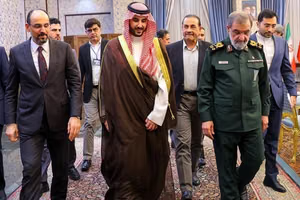
Saudi, Turkish and Pakistani security officials also discussed the situation during recent meetings in Tehran, according to the report.
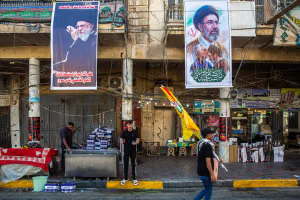
Posters of Iran’s late Supreme Leader Ali Khamenei and his successor, Mojtaba Khamenei, hang above a street in Karbala, Iraq, during funeral proceedings for Ali Khamenei. (ISNA)
A reported order by Iran’s supreme leader to end the state of “neither war nor peace” may signal a turn towards diplomacy. But a closer reading suggests Tehran is offering no concessions, only restating its longstanding demands for ending the confrontation with Washington.
On Tuesday, Iranian state media announced that Supreme Leader Mojtaba Khamenei had received Maj. Gen. Mohsen Rezaei, secretary of the Supreme National Security Council, and ordered an end to “the war and the ‘neither war, nor peace’ conditions.”
Abroad, that was read as Tehran wanting out. It wants nothing of the sort. Read the whole sentence, and the “order” is the same demand the Islamic Republic has made since the shooting stopped in April: the stalemate ends when Washington capitulates.
The news cycle started with a readout released by Mojtaba’s official website, which was reproduced word for word across the domestic press. The item is a summary, not a transcript. Every line attributed to Mojtaba is in reported speech, without a single direct quotation.
He is said to have called for “exerting control over the Strait of Hormuz,” declared the enemy “desperate,” bound Iran’s “interests” to those of its regional allies in the “Axis of Resistance,” and called for an end to the war “through realization of the conditions set out by the country’s officials.”
That last clause is the whole message, and the conditions it refers to are no secret. Rezaei himself set them out in September: an end to the war on all fronts, Lebanon included; the release of Iran’s frozen funds; an end to the US naval blockade of Iranian ports; and guarantees against renewed strikes.
Earlier versions added compensation for war damages, the lifting of sanctions and recognition of Tehran’s control over the strait. In short: Tehran keeps its grip on Hormuz, its regional allies stay in place, and Washington concedes. Then, and only then, the stalemate ends. Not one condition softened, not one position moved.
Now consider what the readout is not. It is not independent evidence that a meeting took place. It carries no date and no place. Under Ali Khamenei, the leader’s office opened such items with “this morning” or “this afternoon” and named the venue, usually the Imam Khomeini Hussainiya in Tehran. That convention has quietly disappeared.
The readout carries no image, either. No independently verified new photograph, audio or video of Mojtaba Khamenei has surfaced since the February strike that killed his father. The same was true of the four earlier meetings state media has reported for him, twice with the president, once with the parliament speaker and once with the chief justice.
Eight months in, the authorities have offered only written accounts of these meetings, without independently verifiable visual or audio evidence. When and where they took place, and whether the official accounts are accurate, remain unverified.
Some have nonetheless read the announcement as significant, on the grounds that Mojtaba called for an end to the war. The record says otherwise: the conditional clause simply restates Tehran’s standing terms.
A call to end the stalemate with no change in terms is the oldest tactic in the Islamic Republic’s repertoire: stall, buy time, rebuild; when the pressure rises, flirt with peace; and when an opening appears, strike.
The readout did not specify when or where the meeting took place. Although it was published Tuesday, a day after Saudi, Turkish and Pakistani envoys visited Tehran, the text does not establish that the meeting occurred that day or that it was connected to the diplomatic visit.
What Tehran is actually telegraphing
What “neither war, nor peace” means in the mouth of a Khamenei, the family’s own usage helps explain.
In August 2018, Ali Khamenei told a public audience that there would be no war and no negotiation with the Trump administration, because talks would end to Tehran’s detriment. The government daily Iran bannered it the next morning: “there will be no war, and we will not negotiate.” In May 2019, he called negotiation “poison” and declared the nation’s choice to be “resistance.” The limbo was Tehran’s own posture, and a boast.
After the twelve-day war of June 2025, he flipped the phrase. Addressing the cabinet on September 7, he said hope and productivity had to prevail over the “neither war, nor peace state that the enemy wants to impose on us” as part of its “psychological war.” His remedy was self-reliance: “don’t wait for external developments.” The limbo was now the enemy’s doing; the answer was still not to talk.
President Masoud Pezeshkian has leaned on that speech ever since, most recently on October 24, when he said, “Many are struggling for their evening bread” because of the war and the stalemate, adding, “One cannot plan in limbo... The martyred Leader ordered us to go and finish the job.”
The IRGC’s press corps answered within a day. Javan headlined that exiting the stalemate “will not come through negotiation” but through “changing the enemy’s calculations.” Fars News presented the phrase as the doctrine of the “martyred Imam,” with negotiation a “strategic trap.”
Tuesday’s readout appears to settle that argument in the IRGC’s favor. The son inherits the father’s phrase and makes it a condition for ending the confrontation: the stalemate is over when the other side accepts Tehran’s terms.
Three uses of one phrase, one underlying position. Refuse talks in 2018. Blame the enemy for the stalemate in 2025. Demand an end to the stalemate on Tehran’s terms in 2026. At no point has “ending neither war nor peace” meant Tehran moving an inch.
Meanwhile, the authorities continue to announce meetings involving a leader who has not appeared publicly in independently verified images or recordings. This is not an order to end the stalemate. It is the stalemate, restated as a demand.
FILE PHOTO: The IAEA logo is displayed in front of the agency’s headquarters in Vienna, Austria, June 5, 2026.
The IRGC-linked Tasnim news agency has set out the case for Iran to withdraw from the Nuclear Non-Proliferation Treaty (NPT), adding to a renewed debate over Tehran's nuclear strategy as the region remains caught between diplomacy and war.
In a commentary published Wednesday, Tasnim argued that the treaty had failed to protect Iran's interests and questioned the benefits of remaining a member after successive wars with Israel and the United States.
The intervention comes as Qatar promotes a diplomatic framework reportedly linking the reopening of the Strait of Hormuz, sanctions relief and efforts to reduce tensions involving Yemen's Houthis.
It also follows signals from Tehran that its leadership wants to end the current diplomatic and military stalemate.
Supreme National Security Council (SNSC) Secretary Mohsen Rezaei said Supreme Leader Mojtaba Khamenei had told him during a meeting on Tuesday that it was time to end the state of “no war, no peace.”
President Masoud Pezeshkian said Wednesday that his government would do everything it could to fulfil the leader's wishes.
Tasnim's commentary, titled “Why Should Iran Leave the NPT?”, highlights divisions over how Tehran should respond to international pressure on its nuclear program.
The case for withdrawal
Hardline politicians have repeatedly raised the prospect of leaving the NPT during periods of nuclear negotiations, arguing that the treaty has failed to protect Iran's interests.
Tasnim identified three central objectives of the treaty: preventing the spread of nuclear weapons, encouraging nuclear-armed states to disarm and protecting members' right to use nuclear technology for peaceful purposes.
The agency argued that the treaty had failed on all three counts.
It accused the International Atomic Energy Agency (IAEA) of abandoning its role as an impartial technical body and becoming politically aligned with the United States and Israel.
The agency had failed to defend Iran's rights when its nuclear sites were attacked, so withdrawal would be a legitimate option for Tehran, Tasnim argued.
Tasnim maintained that withdrawal would not necessarily mean developing nuclear weapons. Some lawmakers, however, have explicitly linked the two.
On Tuesday, MP Abolfazl Aboutorabi called for Iran to withdraw from the NPT and begin building a nuclear bomb.
Other hardline figures, including members of the ultraconservative Paydari Front, have advocated withdrawal, arguing that continued membership has failed to prevent attacks on Iranian nuclear facilities despite their being subject to international safeguards.
Divisions within the establishment
The calls have met resistance from other establishment-aligned media, reflecting disagreements over the potential costs of withdrawal.
Khabar Online, a pragmatic-conservative outlet, sharply criticized the campaign in an October 25 report, singling out the Paydari Front and questioning the political judgment of those advocating departure from the treaty.
Its headline described the proposal as a radical demand dating back two decades, with “neither head nor tail.”
The reformist Arman Melli newspaper has also taken a position against withdrawal, broadly reflecting the Pezeshkian administration's preference for maintaining Iran's existing treaty commitments.
Nour News, which is close to the SNSC, adopted a more cautious approach in its own October 25 analysis.
It argued that neither withdrawal nor continued membership could guarantee Iran's security and that dissatisfaction with the IAEA did not, by itself, justify abandoning the treaty.
The outlet also warned that withdrawal from the NPT would create further political and diplomatic complications, while remaining in the treaty would still allow Tehran to restrict aspects of its cooperation with the IAEA.
Withdrawal, it concluded, should not be considered without a clear plan for what would follow.
A consequential decision
Leaving the NPT would have implications beyond Iran's relations with the IAEA.
Under Article X of the treaty, a state party may exercise its right to withdraw if it determines that extraordinary events have jeopardized its supreme interests. It must give three months' notice to other treaty parties and the UN Security Council, explaining the events behind its decision.
Withdrawal could further complicate Tehran's relations with Western governments and raise questions about the future of international monitoring of its nuclear activities.
Despite the calls from hardline lawmakers and media outlets, Iran has announced no decision to leave the treaty.
The government continues to maintain that its nuclear program is peaceful, and neither the SNSC nor Supreme Leader Mojtaba Khamenei has publicly endorsed withdrawal.
The competing arguments underscore a debate within Iran's political establishment: whether abandoning the treaty would strengthen Tehran's position after repeated military attacks or leave it more isolated and vulnerable as regional powers seek a diplomatic settlement.
People use their mobile phones in a public park in Iran.
Iranian lawmakers are reviewing a new internet regulation bill that could expand authorities' powers to restrict online access, raising concerns over further controls after months of nationwide internet shutdowns.
The proposed Cyberspace Regulation Bill is being examined by a parliamentary committee, but its official text remains unpublished, Iranian news outlet Jamaran reported.
Parliament received the proposal on August 3, but lawmakers reviewing it have declined to disclose its provisions.
"A decision has been made not to publicize the details of the Cyberspace Regulation Bill for the time being," Rouhollah Abbaspour, spokesman for the parliamentary committee, said.
An unofficial 12-article draft circulating online resembles the controversial Internet Protection Bill, known as the Sianat plan, which stalled in the previous parliament. However, a committee member told local media that the version under review differs from the circulating text.
Lawmakers divided over restrictions
The proposal has drawn criticism within parliament, with some lawmakers questioning the need for additional controls when international internet access is already heavily restricted.
Mostafa Pourdehghan, a member of parliament's Industries and Mines Committee, criticized repeated attempts to restrict international connectivity and expand domestic alternatives, citing existing filtering, poor internet quality and rising costs.
Pourdehghan warned that further restrictions during wartime could increase public anxiety, particularly among young people, and predicted the bill would meet the same fate as the earlier so-called Protection Plan.
Lawyer warns of sweeping powers
Lawyer Kambiz Norouzi warned that the proposed legislation could give the Supreme Council of Cyberspace extensive authority while weakening government oversight.
In an editorial published by Shargh newspaper, Norouzi criticized Article 1 of the circulating draft, which designates the council as the highest authority for internet policymaking.
Article 6 would also allow internet access to be suspended or restricted on orders from judicial authorities or other competent bodies, without clearly identifying those additional authorities.
"This provision amounts to creating unlimited and unregulated power to violate fundamental freedoms and is certainly unconstitutional and illegitimate," Norouzi wrote.
Norouzi also argued that the bill would concentrate decision-making in an institution whose proceedings are largely closed to public scrutiny.
The official parliamentary text has not been published, leaving uncertainty over whether these provisions appear in the version under review.
Months of shutdowns and previous restrictions
The proposal follows months of internet disruption affecting millions of Iranians.
Authorities imposed a nationwide blackout on January 8, 2026, during anti-government protests. Connectivity was only partially restored before another near-total shutdown began on February 28 following the outbreak of war involving Iran, Israel and the United States.
The second blackout lasted 88 days, with international connectivity beginning to return on May 26.
Restrictions disrupted businesses, education and communications. Iran's Chamber of Commerce estimated direct economic losses at $30 million to $40 million daily, with indirect losses potentially doubling that figure.
The legislation follows years of attempts to expand state control over online communications.
The earlier so-called Protection Plan sought greater oversight of foreign platforms but stalled following public opposition.
In July 2025, President Masoud Pezeshkian's administration also withdrew a separate cyber censorship bill following criticism over its potential impact on free expression.
Authorities have continued developing the National Information Network, which allows selected domestic services to operate independently of international connectivity.
The Supreme Council of Cyberspace, established by former Supreme Leader Ali Khamenei in 2012, already plays a central role in internet policymaking.
For now, lawmakers remain divided over the proposal's prospects, while the refusal to release its official text has left its scope, legal implications and potential impact on internet access unclear.