IRGC says it controls Strait of Hormuz for as long as Islamic Republic wills it
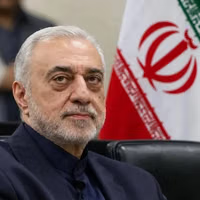
IRGC Deputy Commander Mostafa Izadi said Tuesday the Revolutionary Guards have operational control of the Strait of Hormuz and will maintain it for as long as the Islamic Republic chooses, the IRGC-affiliated Fars news agency reported.
“Control of the battlefield in this strategic region is in the hands of our forces, and this will continue for as long as the Islamic Republic of Iran wills it,” Izadi said.
“The people’s presence on the ground and their support for the country are an important factor in preserving our achievements and thwarting the enemies’ plots,” he added, according to the report.
Pakistan's Chief of Army Staff Field Marshal Asim Munir is welcomed by Iran's Interior Minister Eskandar Momeni in Tehran.
Pakistan’s army chief Asim Munir left Tehran on Tuesday after Iranian leaders reiterated their conditions for negotiations with Washington and ruled out transferring enriched nuclear material abroad, as regional mediators continue efforts to ease the standoff.
Iranian state media reported that a Qatari delegation also visited Tehran after Munir’s departure, extending a flurry of regional visits that included Russian Foreign Minister Sergei Lavrov’s talks in Tehran and US War Secretary Pete Hegseth’s unannounced trip to Israel.
Qatar and Pakistan have played key roles in mediating Iran-US negotiations in recent months. Munir helped broker talks that led to a memorandum of understanding in June.
Iran reiterates conditions
President Masoud Pezeshkian told Munir that Washington must lift pressure, threats and sanctions before any negotiations, according to Iranian state media.
“Our nation does not trust America today and believes that if we negotiate, they will attack us again,” Pezeshkian said, referring to US attacks during earlier negotiations.
He thanked Pakistan for its diplomatic efforts while warning that another war would bring destruction and losses across the region.
Parliament Speaker Mohammad Bagher Ghalibaf separately told Munir that Iran had nothing new to tell Washington, which must fulfill Tehran’s seven conditions presented in New York to regain its trust.
Ghalibaf accused the Trump administration of violating the Islamabad memorandum and said military threats would not change Iran’s strategic decisions.
Supreme National Security Council Secretary Mohsen Rezaei also ruled out sending Iran’s enriched nuclear material abroad.
“Not even a particle of enriched nuclear material will leave Iran,” he told Munir, describing the stockpile as a national asset intended for domestic use.
Rezaei also said negotiations would not begin until Washington took steps to build trust, starting with fulfilling Iran’s conditions.
Mediation efforts continue
Al-Araby Al-Jadeed reported Tuesday that Qatar and Pakistan had proposed giving Iran interest on $6 billion in frozen assets held in Qatari banks in exchange for access to its nuclear facilities.
The outlet’s sources said Washington had approved the proposal and Iran had responded positively, with Munir conveying it during his visit.
Earlier Tuesday, a spokesman for Iran’s parliamentary national security committee had described Munir’s trip as solely focused on bilateral relations and border cooperation, denying it involved a new mediation initiative.
Regional visits amid military pressure
Munir’s visit followed Lavrov’s meetings with Pezeshkian and Foreign Minister Abbas Araghchi on Monday. Pezeshkian said Iran remained ready to resolve regional disputes through dialogue while rejecting attempts to impose terms by force.
Hegseth also met Israeli Prime Minister Benjamin Netanyahu on Monday at Uvda air base in southern Israel.
Netanyahu’s spokesman Doron Spielman told Reuters they discussed regional threats and US-Israeli cooperation in responding offensively and defensively. Hegseth later said he had visited US forces serving under Central Command.
Fox News reported Tuesday, citing two US officials, that a third US aircraft carrier and about 10,000 military personnel were heading to the Middle East, with arrival expected by the end of November.
The diplomatic contacts and military movements come amid mixed signals from President Donald Trump, who told a campaign rally in Kansas on Monday that the United States could already leave the war.
“Somebody said you could leave right now. It’s true. We could leave right now,” Trump said, adding that Iran would not obtain a nuclear weapon.
File photo: U.S. President Donald Trump and Israeli Prime Minister Benjamin Netanyahu greet the media and wave outside the White House on April 7, 2025.
Israeli Prime Minister Benjamin Netanyahu said on Tuesday that toppling Iran’s regime was Israel’s “primary objective,” a day after discussing Iran with US War Secretary Pete Hegseth during an unannounced visit to Israel.
Netanyahu said he had also discussed bringing down Iran’s leadership with US President Donald Trump on Sunday, placing the issue at the center of his latest contacts with Washington.
“We must complete the elimination of the Iranian regime — that is the primary objective,” Netanyahu said at the opening of the academic year at the new Tel Hai University in Kiryat Shmona, near the Lebanese border.
“I have spoken about this with President Trump more than once, including the day before yesterday.”
His remarks did not indicate whether Trump had agreed to pursue that objective or committed to further military action.
Danny Citrinowicz, an Iran specialist and former head of the Iran branch in Israeli Defense Intelligence, told Iran International that while the two leaders might agree on military targets, their strategic objectives could diverge.
"Netanyahu seeks to topple the regime, and Trump seeks to reach a good agreement with the same regime that Netanyahu seeks to topple," he said.
Hegseth discussed Iran with Netanyahu on Monday, three Israeli officials told Reuters. Netanyahu’s spokesman, Doron Spielman, confirmed that they met at Uvda air force base in Israel’s southern Negev desert.
Spielman said the talks covered regional threats and US-Israeli cooperation in confronting them through offensive and defensive measures.
Hegseth also thanked Israel for hosting US forces, which Spielman said numbered in the thousands, and discussed Trump’s support for Netanyahu.
‘Finishing the job’
Speaking on Tuesday, Netanyahu linked his stated objective in Iran to Israel’s campaign against Hezbollah, saying the military had made major progress against the Lebanese group but pledging to “finish the job.”
“Finishing the job means bringing down the terrorist regime in Iran. It is the head of this poisonous octopus. You cut it off, and it will fall. We will also have peace with Lebanon,” he said.
Netanyahu argued that Iran’s leadership, even “battered, wounded and beaten,” would seek to pursue nuclear weapons and rebuild its regional network of allied armed groups.
“Therefore, the only way to prevent this is to bring down this regime, and then the elimination of Hezbollah will follow,” he said.
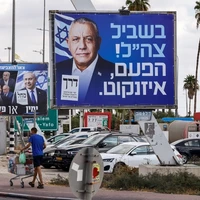
The Hegseth meeting came eight days before Israel’s October 27 election. Trump endorsed Netanyahu on Sunday, ahead of the country’s first parliamentary vote since the October 7, 2023, Hamas attack.
In his endorsement message, Trump praised Netanyahu’s role in confronting Iran and warned that Washington might have to act alone if another leader took office.
US and Israeli forces launched joint strikes against Iran in late February, setting off a wider regional war. The latest consultations come amid renewed tensions between Washington and Tehran over the Strait of Hormuz and intensifying attacks by Yemen’s Iran-aligned Houthis on Saudi Arabia.
Pakistani border guards and officials gather at the Jalgai border crossing between Pakistan and Iran, with cargo trucks lined up in the background.
Trade between Iran and Pakistan remained suspended at two major border crossings on Tuesday, leaving trucks and cargo stranded, with Pakistani authorities citing security and anti-smuggling measures and Iran pointing to technical difficulties.
Commercial traffic through the Gabd-Rimdan and Taftan crossings was halted as of October 20, although passenger movement reportedly continued at Gabd-Rimdan.
Pakistan described the suspension as a temporary measure to strengthen security and combat smuggling, while Iran attributed the disruption to technical issues and precautionary measures.
The two countries remain in contact to resolve the problem, Iranian Foreign Ministry spokesman Esmail Baghaei said on Tuesday.
The closures come as Iran increasingly relies on land routes to sustain foreign trade following restrictions on maritime shipping during the war.
Before the conflict and the US military blockade of Iran's southern ports, more than 80 percent of the country's foreign trade passed through the southern ports of Rajaei and Khomeini.
The diversion of shipments to road networks has increased transport costs and congestion, although land crossings lack the capacity to replace maritime trade.
Thousands of trucks stranded
Iranian media had already reported queues of approximately 3,000 trucks at Rimdan before the latest suspension, with some drivers waiting between 20 and 30 days to cross.
Limited processing capacity on the Pakistani side and requirements to transfer cargo from Iranian trucks to Pakistani vehicles have contributed to the delays.
An industry circular issued in August also described difficulties unloading Iranian trucks in Pakistan and transferring their cargo.
“I urge all truck drivers not to bring cargo toward the borders. The situation is so bad that since last night and throughout October 20, huge queues of trucks have been turning back. The border is closed and is being cleared. Do not come!” a person affected by the disruption told Iran International.
Another person contacted the broadcaster with a similar warning, urging drivers to avoid sending additional shipments until the crossings reopen.
The latest suspension has increased the risk of prolonged vehicle inactivity and financial losses for transport operators and cargo owners.
Talks continue on reopening
Negotiations with Pakistani authorities to remove obstacles at Rimdan were continuing, border market director Abdolsalim Hoot said on October 18, adding that perishable goods were receiving priority.
An official in Pakistan's Balochistan province also described progress in negotiations and the possibility of reopening the crossings soon.
No timetable for resuming commercial traffic had been announced by Tuesday.
Iran and Pakistan had previously set a target of increasing annual bilateral trade to $10 billion, but border disruptions, banking difficulties and limited freight capacity have complicated efforts to reach that goal.
The suspension also coincides with Washington's efforts to increase economic pressure on the Islamic Republic, including warnings of sanctions against countries and companies maintaining financial and commercial dealings with Iran.
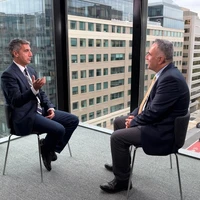
Hussain Abdul-Hussain in an interview with Iran International's Kambiz Tavana (right) in Washington DC
Saudi Arabia should join forces with the United States, Israel and the United Arab Emirates to help bring about political change in Iran, rather than continue policies that have failed to contain Tehran's regional influence, an analyst told Iran International.
The Islamic Republic's support for Yemen's Houthis has exposed the limits of Saudi military power and diplomacy, making a broader coalition against Iran necessary, said Hussain Abdul-Hussain, a research fellow at the Foundation for Defense of Democracies.
“I'm not saying the Marines should land anywhere in Tehran,” Abdul-Hussain said. “I'm just saying push the regime enough so that the other Iranians can take over.”
The proposed strategy, he said, would draw on the US-led coalition that expelled Iraqi forces from Kuwait in 1991, with Saudi Arabia providing regional political support for a campaign aimed at weakening the Islamic Republic and enabling Iranians to determine their country's political future.
Such a coalition could fundamentally alter the regional balance of power and influence the calculations of China and Russia, Abdul-Hussain added.
Iran's Houthi leverage
The Houthis have emerged as one of the Islamic Republic's most effective regional allies, maintaining their military capabilities despite years of Saudi-led operations and pressure on other Iran-backed armed groups.
Their geographical distance from Israel has also made them more difficult to weaken than Hezbollah in Lebanon or Iran-aligned militias in Iraq, according to Abdul-Hussain.
The challenge, he said, has become more pronounced since the withdrawal of Emirati forces from Yemen following divisions within the Saudi-led coalition.
Pro-UAE militias had provided some of the coalition's most effective ground forces, leaving Saudi Arabia increasingly dependent on air power and Yemeni government forces weakened by corruption, inflated troop numbers and divisions, Abdul-Hussain said.
Airstrikes alone cannot defeat an armed group operating from mountainous terrain and fortified positions, he argued, drawing comparisons with Israel's experience fighting Hezbollah in 2006 and 2023.
The absence of reliable ground partners has therefore allowed the Houthis to remain a persistent military challenge despite Saudi Arabia's superior conventional capabilities.
The group's operations also serve Iran's wider regional strategy by placing Saudi energy infrastructure and shipping routes within reach of an Iranian ally.
Recent Houthi advances and strikes on Saudi territory reflect a broader Iranian message that disruptions to its own oil exports could be accompanied by pressure on other regional producers, particularly as Saudi Arabia shifts exports toward the Bab el-Mandeb shipping route, Abdul-Hussain added.
Saudi diplomatic failures
Saudi Arabia's continued diplomatic engagement with the Islamic Republic has failed to reduce the security challenge posed by Iran's regional allies, Abdul-Hussain said.
Maintaining an ambassador in Tehran and inviting Revolutionary Guards officials to Saudi National Day celebrations, even as Saudi energy infrastructure faces missile strikes, sends a message of weakness rather than diplomatic pragmatism, he argued.
Armed Houthi fighters carry rocket-propelled grenade launchers in Yemen.
The UAE, despite its smaller size and closer geographical proximity to Iran, had previously demonstrated greater willingness to sever diplomatic relations with the Islamic Republic, according to Abdul-Hussain.
Saudi Arabia's diplomatic outreach to Turkey and Pakistan has also produced limited practical support against the Houthis and the Revolutionary Guards, he said.
Abdul-Hussain attributed part of the problem to a Saudi leadership structure in which advisers are reluctant to challenge prevailing assumptions, leaving decision-makers without a credible alternative to their existing strategy.
“They have to swallow their pride with the Emiratis and the Israelis,” Abdul-Hussain said. “This is the key.”
Restoring cooperation with Abu Dhabi and establishing open relations with Israel would provide the foundation for a more effective regional alignment against Iran, he added.
Such cooperation would need to be public rather than confined to private security arrangements, particularly because Israeli participation could expose Israeli shipping to additional Houthi operations.
Saudi Arabia's decision to condition normalization with Israel on Palestinian statehood has further complicated the formation of an anti-Iran coalition, Abdul-Hussain said.
The shift, he noted, has moved Riyadh away from Crown Prince Mohammed bin Salman's earlier emphasis on prioritizing Saudi national interests, without producing corresponding security benefits for the kingdom.
Coalition against Iran
A coalition modeled on the international military campaign that expelled Saddam Hussein's forces from Kuwait in 1991 could provide a framework for confronting the Islamic Republic without a US ground invasion of Iran, Abdul-Hussain said.
Saudi Arabia played a central role in assembling regional support for that campaign, lending political legitimacy to a military operation led by the United States.
A similar alignment involving Washington, Riyadh, Abu Dhabi and Israel could apply sustained pressure on Iran's ruling establishment while leaving the ultimate outcome to Iranians themselves, according to the analyst.
“Throw all the chips behind President Trump and the war on Iran, and push for regime change,” Abdul-Hussain said.
The proposed approach would mark a departure from Saudi Arabia's efforts to balance diplomatic relations with Iran against military operations targeting its regional allies.
Rather than continuing to absorb the costs of confronting the Houthis without weakening their principal backer, Saudi Arabia should help organize a broader campaign directed at the Islamic Republic itself, Abdul-Hussain argued.
The central objective, in his view, would not be a foreign occupation of Iran but sufficient external pressure to create an opportunity for Iranians to replace the country's ruling establishment.
Between 30 and 40 of Iran’s operational aircraft were destroyed during the war, while another 70 to 80 were hit, Iran Air chief executive Taher Abdolhai said on Monday.
Abdolhai said Iran had a little over 300 aircraft in total, but only around 130 to 140 were operational before the latest losses, according to Nournews, a media outlet close to Iran’s Supreme National Security Council.
He said the scale of damage varied. Some aircraft were hit by missiles and suffered holes in their fuselages, while one Iran Air aircraft was “completely pulverized.”
Wartime losses cut into an already limited fleet
The figures suggest the war significantly reduced an aviation fleet that was already constrained by sanctions, aging aircraft and difficulties obtaining spare parts.
Abdolhai’s estimate is higher than some earlier figures given by Iranian officials. The secretary of Iran’s Association of Airlines had previously estimated that about 20 aircraft suffered serious damage.
Mohammadreza Rezaei Kouchi, head of parliament’s Civil Commission, had separately said around 50 aircraft were damaged and 10 destroyed.
It remains unclear how many of the damaged aircraft can be repaired and returned to service.
Sanctions have long constrained Iran’s aviation sector
Iran’s commercial aviation industry has for years faced restrictions on buying aircraft, sourcing parts, carrying out maintenance and receiving services at some foreign airports.
Abdolhai said those restrictions had made it harder for Iran Air to maintain its fleet and had also cut the airline off from some profitable markets.
The wartime losses have added another layer of pressure by shrinking the pool of aircraft available for commercial flights and reducing the industry’s ability to preserve routes and revenue.
Final scale of damage remains unclear
Abdolhai did not give a final estimate for the financial cost of the losses or say how many damaged aircraft were beyond repair.
The differing figures offered by Iranian officials also make the full scale of the damage difficult to establish independently.