• العربية
  • فارسی
BrandBrand
  • Iran Insight
  • Politics
  • Economy
  • Analysis
  • Special Report
  • Opinion
  • Podcast
  • Live TV
  • Iran Insight
  • Politics
  • Economy
  • Analysis
  • Special Report
  • Opinion
  • Podcast
  • Live TV
  • Theme
  • Language
    • العربية
    • فارسی
  • Iran Insight
  • Politics
  • Economy
  • Analysis
  • Special Report
  • Opinion
  • Podcast
  • Live TV
All rights reserved for Volant Media UK Limited
volant media logo

IRGC spokesman hints at targeting undersea cables in Strait of Hormuz

Oct 19, 2026, 20:05 GMT+1

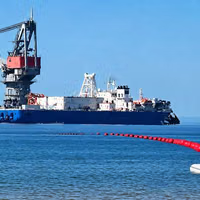
Iran’s Revolutionary Guards spokesman pointed to undersea communications cables in the Strait of Hormuz in a warning to Tehran’s adversaries.

“Seven major cables pass beneath the Strait of Hormuz, and all the world’s internet and commercial data depend on them,” Hossein Mohebbi said on Monday. “We are reminding the enemy of this so they know.”

His remarks came after a series of warnings by senior Iranian officials and hardliners about targeting digital infrastructure across the Persian Gulf.


Most Viewed

Iran signals possible nuclear policy shift, threatens US retaliation
1

Iran signals possible nuclear policy shift, threatens US retaliation

2

Architect of Guards' missiles becomes Iran's defense minister

3

Iran rolls out regional Data Authority amid threats to Mideast tech infrastructure

4

US and Israel threaten renewed Iran strikes, Tehran warns of response

5

Trump says US may ‘soon finish the job’ on Iran, Netanyahu vows to topple regime

Spotlight

  • Ex-president's remarks expose divide over costs of Iran’s Palestine policy

    Ex-president's remarks expose divide over costs of Iran’s Palestine policy

  • Teenager killed by gunshot to eye after arrest in Iran, source says

    Teenager killed by gunshot to eye after arrest in Iran, source says

  • Soaring medical costs and staff shortages strain Iran’s hospitals
    VOICES FROM IRAN

    Soaring medical costs and staff shortages strain Iran’s hospitals

  • Architect of Guards' missiles becomes Iran's defense minister

    Architect of Guards' missiles becomes Iran's defense minister

  • Iran risks losing ground as East-West trade routes expand
    ANALYSIS

    Iran risks losing ground as East-West trade routes expand

  • Tehran’s diplomatic paralysis leaves Iran caught between deal and escalation

    Tehran’s diplomatic paralysis leaves Iran caught between deal and escalation

Banner
Banner
Banner
Banner
Banner
•
•
•

More Stories

Iranians react to French protests with ‘karma’ and memories of 1979 revolution

Oct 19, 2026, 16:56 GMT+1
100%
A person walks as flames rise during civil unrest, the day after a national day of demonstrations against the cost of living and rising fuel prices, in Paris, France, October 18, 2026.

Ongoing protests and unrest in France prompted Iranian commenters to revisit the country’s role in the 1979 Islamic Revolution and criticize Western responses to crackdowns in Iran, with many calling the turmoil “karma” in response to an Iran International Instagram question.

A review of nearly 3,000 comments on the post suggests that many respondents viewed events in France through Iran’s political history and their own experiences, focusing more on Western governments’ policies than on the French protesters’ demands.

Humor and sarcasm featured prominently, alongside anger over France’s hosting of the Islamic Republic’s founder Ruhollah Khomeini before the revolution and frustration with international responses to the suppression of Iranian protests.

Others emphasized the right to protest and the different risks demonstrators face in France and Iran. The comments reflect the views of those who responded, rather than a representative sample of Iranian public opinion.

Memories of the 1979 revolution

One recurring theme was France’s decision to host Khomeini in the months leading up to Iran’s 1979 revolution.

Many respondents interpreted the unrest through that historical experience, arguing that France was now facing the consequences of its past policies toward Iran.

100%
A demonstrator wearing a costume stands in front of burning flames, in Paris, France, October 18, 2026.

One respondent wrote: “France should pay the price for decades of supporting extremist groups, including Islamists, leftists and communists.”

Another drew a direct comparison: “The protests in France are exactly reminiscent of 1979 in Iran.”

Commenters also invoked expressions associated with the revolution, including the refrain “The scent of flowers, lilies and jasmine is in the air,” promises of free water and electricity, and sarcastic suggestions that France should establish its own Islamic Republic.

Unrest viewed as ‘karma’

“Karma” was a recurring word in the responses. Some users described the unrest as France’s past policies coming back to haunt it, while others expressed satisfaction without addressing the protesters’ demands.

One respondent wrote: “The world is round. Now they’ll suffer as we have for the past 47 years.”

Another said: “When responses to the Islamic Republic’s crimes are limited to words, statements and expressions of concern, the whole world should see the consequences.”

These comments linked satisfaction at France’s troubles to accumulated anger over Western governments’ dealings with the Islamic Republic.

‘We are deeply concerned’

Other respondents mocked the diplomatic language Western governments and international organizations have used in response to the killing and repression of protesters in Iran.

Phrases such as “We express concern,” “We call on both sides to exercise restraint,” “We are closely monitoring developments,” and “These are their internal affairs and none of our business” appeared repeatedly.

100%
Bodies of victims killed in Iran’s January protests – Kahrizak, Iran.

One respondent wrote: “We are closely monitoring developments in France. It seems they are not ready for democracy yet.”

Another said: “I’m sure the United Nations has expressed concern about the situation and called on both sides to exercise restraint.”

The sarcasm reflected frustration with what commenters viewed as inadequate international responses to repression in Iran.

Immigration and Islamism

Some respondents linked the unrest to France’s immigration policies and what they described as the growing influence of Islamist movements and extremism in Europe.

Their comments combined concerns about Europe’s future with criticism of the French government’s approach to immigration and religious and political groups. These were commenters’ interpretations, rather than established explanations for the protests.

Different risks for protesters

Other respondents emphasized the differences between protesting in France and Iran.

One user asked: “Why can young people in France return home after protesting?”

Amid the sarcasm and expressions of anger, the question drew attention to the risks Iranian demonstrators face at the hands of security forces.

Protests in Iran over the past decade, including demonstrations over economic hardship and labor grievances, have repeatedly faced violent crackdowns.

Iran International previously reported that at least 36,500 Iranians were killed during the January protests, describing the killings as the largest street massacre in Iran’s history.

Iran threatens stronger response to new US attack as Lavrov visits Tehran

Oct 19, 2026, 14:49 GMT+1
100%
An Iranian ballistic missile launches from a desert test site, sending clouds of dust and smoke into the air.

Iranian military officials warned of a stronger response to any renewed US attack on Monday, as Russia's foreign minister visited Tehran for talks and regional security concerns grew following Houthi attacks on Saudi Arabia.

Russian Foreign Minister Sergei Lavrov met his Iranian counterpart Abbas Araghchi during an official visit, with talks also planned with President Masoud Pezeshkian.

The visit came as Iranian officials discussed the prospect of renewed fighting with the United States and the country's military capabilities.

100%
Russian Foreign Minister Sergei Lavrov (left) and Iranian Foreign Minister Abbas Araghchi hold talks in Tehran on October 19, 2026.

Iran threatens US against new attack

The Revolutionary Guards said that Iran would respond more forcefully to any renewed US military action.

“The US entered the war with all its might, and it is certainly not in a position now to start a new conflict that would bring it any new gains,” Revolutionary Guards spokesman Hossein Mohebi said on Monday.

Mohebi said most US bases in the region were inactive and American forces had moved hundreds of kilometers away from Iran.

Revolutionary Guards deputy commander Mostafa Izadi said US naval forces had moved approximately 700 kilometers away to avoid Iranian missiles, according to the Guards-affiliated Fars news agency.

Senior Guards adviser Mohammadreza Naghdi separately said Iran's missile facilities had survived heavy bombardment and its strategic stockpiles remained intact.

Germany summons Iranian ambassador

Germany summoned Iran's ambassador on Monday over attempted attacks targeting Josef Schuster, head of the Central Council of Jews in Germany, and Volker Beck, chairman of the German-Israeli Society.

  • German court jails two men over spying for Iran's Guards

    German court jails two men over spying for Iran's Guards

“Attacks on Jewish life and on those who defend it are something we will not tolerate - anywhere, and especially not in Germany,” the German Foreign Ministry wrote on X.

The ministry condemned Iran's activities and said the attempted attacks would have legal consequences.

Israeli Foreign Minister Gideon Sa'ar also criticized Araghchi after the Iranian foreign minister accused French President Emmanuel Macron of supporting US military action against Iran.

Sa'ar accused Iran of suppressing protesters at home while criticizing France over its response to unrest.

Regional security concerns grow

Saudi Arabia's Civil Defense said the danger had passed in the southern Najran region after an earlier alert over a potential threat.

The announcement followed a Houthi attack on a Yemeni government military camp in Shabwa province that killed at least 18 people, Reuters reported, citing government and medical sources.

The US State Department urged Americans across the Middle East to exercise heightened vigilance, warning that Houthi attacks could disrupt flights and airspace.

The US Embassy in Riyadh separately warned that Iran and groups supporting it could target American interests overseas.

Economic uncertainty weighs on Iran

The prospect of renewed conflict has also affected economic activity, according to an Iranian lawmaker.

  • Russia gains from Iran war but risks more if it drags on

    Russia gains from Iran war but risks more if it drags on

“When conditions are unstable, no one can make decisions about their life and future; they cannot make a deal, invest or take action,” Mohammadmehdi Shahriari, a member of parliament's national security committee, said on Monday.

Shahriari said proposals for negotiations with Washington had been raised and officials should be allowed to formulate a response.

Another lawmaker, Mohammad Rashidi, rejected suggestions that Iran's economy was approaching collapse under US pressure.

Meanwhile, Iran Air chief executive Taher Abdolhay said the national airline had only six operational aircraft despite employing more than 9,000 people, down from a fleet of 40.

  • US–Israeli strikes test Iran’s partnerships—and their limits

    US–Israeli strikes test Iran’s partnerships—and their limits

Abdolhay cited operational restrictions and air traffic difficulties, adding that the airline had faced obstacles to flights intended to bring medicine into Iran.

The developments featured the competing pressures facing Iran, with officials emphasizing military preparedness and diplomatic engagement as concerns over renewed fighting continue to affect regional security and economic activity.

Teenager killed by gunshot to eye after arrest in Iran, source says

Oct 19, 2026, 12:18 GMT+1
•
Farnoosh Faraji
100%
Amirmohammad Hatami, an 18-year-old mechanic from Shahin Shahr, Isfahan province, who was killed after being wounded and detained on January 9, 2026.

An 18-year-old mechanic was killed by a gunshot to his right eye after being wounded and detained on January 9, according to information obtained by Iran International from a source close to his family.

The family of Amirmohammad Hatami spent 20 days searching prisons, morgues and security facilities before identifying his badly injured body through an old scar on his right shoulder.

Hatami, a young man of Bakhtiari origin, lived in Shahin Shahr in the central province of Isfahan, the source said.

His relatives initially had no information about his detention or where he had been taken after being wounded.

Family's 20-day search

Hatami's relatives began searching for him after his disappearance, visiting intelligence offices, police stations, facilities affiliated with the Revolutionary Guards, forensic medicine centers, prisons and morgues in Shahin Shahr and surrounding areas.

None of the authorities provided information about his whereabouts, according to the family source.

  • How body bags came to symbolize Iran's January killings

    How body bags came to symbolize Iran's January killings

During the search, relatives opened around 100 black body bags each day, hoping to find Hatami among those killed.

After 20 days, the family received a phone call asking one of its members to come and identify a body.

Signs of torture on body

Hatami's body was inside a black bag when relatives were finally allowed to examine it.

"When we went to identify Amirmohammad, his body was inside a black bag. The blood had dried on his body, and he was unrecognizable. His body and face were completely bruised," the source told Iran International.

100%
A woman places flowers on the grave of Amirmohammad Hatami, an 18-year-old mechanic from Shahin Shahr who was killed after being wounded and detained on January 9, 2026.

The account described severe injuries to Hatami's ears, damage to his eyes and multiple wounds across his body.

Marks from beatings with chains were also visible, according to the source, who said the family believed Hatami had been severely tortured before his death.

His injuries were so extensive that relatives could not identify him by his face and instead recognized an old scar on his right shoulder.

A young mechanic known as 'Oosta'

Hatami worked as a mechanic and was known locally as "Oosta," a Persian term for a skilled craftsman or master of a trade.

  • Family told missing teen was alive, then received his body 60 days later

    Family told missing teen was alive, then received his body 60 days later

Despite his young age, he had developed considerable mechanical skills, according to people close to him.

Friends and relatives described Hatami as hardworking, kind and responsible, saying he helped support his family financially and cared about helping working children.

Iranians report mass security warnings over social media activity

Oct 19, 2026, 11:38 GMT+1
100%
Visitors take photos and use their mobile phones at the Anzali Free Trade Zone in northern Iran.

Iran's police intelligence agency has sent threatening text messages warning citizens of possible prosecution over online activity, including people who do not use social media, according to accounts shared with Iran International.

Several citizens told the messages appeared designed to spread fear, with some reporting receiving the warnings multiple times a day.

One message cited several articles of Iran's Islamic Penal Code and warned the recipient that their involvement in approving and sharing "criminal content" online was under investigation.

"They send us 20 of these messages a day," one person told.

Another said they regularly received similar warnings but paid no attention to them.

Warnings reach people without social media accounts

Several said the messages were being sent to people who had no social media presence, raising questions about whether authorities were targeting specific online activities or distributing warnings more broadly.

  • Iranians told to post pro-government content to regain internet access

    Iranians told to post pro-government content to regain internet access

"They send these messages in bulk. My father received one too, even though he doesn't have a social media account at all," one person wrote.

Another citizen said a security guard at their workplace had received a similar message despite using a basic mobile phone and not having Instagram.

One recipient suggested the warnings were being sent randomly because authorities knew large numbers of Iranians were active on social media.

The messages follow previous efforts by Iranian authorities to monitor online activity and warn citizens against publishing content deemed unlawful.

Citizens reject attempts to intimidate social media users

Some recipients responded defiantly, describing the warnings as another attempt by security agencies to discourage public criticism.

100%
A woman checks her mobile phone while walking along a street in Iran.

"They want to create fear. How are you going to frighten people with text messages when they are not afraid of bullets and executions?" one citizen wrote.

Another complained about restrictions on freedom of expression, saying: "We even need permission to breathe. We have no right to protest."

In October 2024, Tehran's prosecutor's office announced legal action against several individuals following online monitoring, citing the publication of "false news" and content allegedly intended to undermine public psychological security.

"If we speak out, our pages are shut down, we are imprisoned, tortured and executed," another wrote.

One citizen pointed to authorities' treatment of memorials for people killed during protests, arguing that a government fearful of the graves of protest victims would also fear social media posts.

Other recipients responded with the phrase "Last days, last desperate measures," expressing their belief that the warnings reflected the authorities' weakening position.

SIM card blocks and security cases add to pressure

Beyond warning messages, some described restrictions on mobile phone services and involvement by security and judicial authorities.

One said their mother's SIM card had been blocked without explanation, and attempts to restore service had resulted in the family's case being referred to the Revolutionary Guards.

  • Iranians report SIM cards blocked over political posts and likes

    Iranians report SIM cards blocked over political posts and likes

"The country's prosecutor's office blocked my mother's phone line for no reason. We tried to get it unblocked, but the matter ended up with the Revolutionary Guards, and they opened a case against us," the person told Iran International.

The citizen said officials had not explained why the SIM card was blocked or identified any alleged offense.

Further attempts to resolve the matter had created serious difficulties for the family, the person added.

Iran International reported on September 24 that SIM cards were being blocked over political Instagram stories and likes, with restrictions previously directed mainly at political activists and journalists increasingly affecting ordinary social media users.

Information received by Iran International on September 12 also pointed to a new wave of SIM card suspensions targeting political and civil activists in several Iranian cities without prior notice.

Soaring medical costs and staff shortages strain Iran’s hospitals

Oct 19, 2026, 11:12 GMT+1
•
Baharan Azadi
100%
A healthcare worker attends to a patient in a hospital ward in Iran.

People in Iran have described deteriorating hospital services, rising treatment costs, shortages of medical staff and equipment, and long waits for care, as healthcare workers struggle with low wages and growing workloads, according to accounts shared with Iran International.

The complaints come as health officials report a growing shift from private to public hospitals because of financial hardship, with the country's nursing workforce at roughly half the national standard.

Rising costs and pressure on public hospitals

Four hospitals refused to admit a patient because they lacked specialist doctors, forcing the patient to seek private treatment at a cost of 200 million rials (about $76) in a single night, according to an account sent to Iran International.

The US dollar is trading at around 2.62 million rials in Iran, reflecting the sharp decline in the national currency's purchasing power.

Iran's minimum monthly base wage stands at around 166 million rials ($63), meaning the patient's single-night medical bill exceeded a full month's minimum wage, even before other living expenses.

  • Iran’s healthcare crunch forces patients to cut treatment

    Iran’s healthcare crunch forces patients to cut treatment

Another patient said an emergency department at a public hospital charged around 100 million rials (about $38), provided no invoice and said emergency expenses were not covered by insurance.

A resident of Shiraz described worsening conditions at hospitals, where shortages of doctors and nurses have disrupted patient care.

Economic hardship and higher medical tariffs have shifted 30 to 40 percent of patient visits from private facilities to public hospitals this year, Yaser Foroughi, deputy for treatment at Iran University of Medical Sciences, said.

Other patients described overwhelmed medical staff struggling to meet growing demand despite efforts to provide adequate care.

Patients face steep bills and demands for unofficial payments

Several citizens described doctors requesting cash or gold coins outside formal hospital payment procedures before performing surgery.

One patient said a doctor at Tehran's Atieh Hospital quoted 4 billion rials for leg surgery alone, with at least two weeks of hospitalization due to an infection and accommodation for a companion expected to cost another 15 billion rials.

Others complained about rising out-of-pocket expenses and insurance coverage that failed to meet their medical needs.

Equipment shortages and long treatment delays

Patients said hospitals were running short of basic supplies, forcing them to purchase items including bedsheets, syringes and gloves themselves.

Healthcare workers and patients had previously told Iran International in September that syringes, sterile gauze, intravenous cannulas and latex gloves were either scarce or subject to rationing.

  • Nearly a third of Iranian general practitioners inactive

    Nearly a third of Iranian general practitioners inactive

Another patient said MRI machines at public hospitals were frequently broken or required waits of up to three months for appointments.

Some private hospitals were also refusing supplementary health insurance, according to accounts submitted to Iran International.

One person said emergency services refused to dispatch an ambulance for their 73-year-old mother, who has cancer, after she fell, because two hours had passed since the fall.

Several patients also complained about declining patience among hospital staff when dealing with patients and their families.

Nurses say they are doing the work of two people

Iran's nursing workforce stands at roughly half the national standard, forcing individual nurses to carry the workload of two people, Ahmad Nejatian, head of Iran's Nursing Organization, said on October 17.

Nurses work an average of 80 hours of overtime each month, Nejatian said.

Healthcare workers linked deteriorating services to severe staffing shortages, exhaustion and inadequate pay.

One nurse said better salaries and living conditions, comparable to those in Persian Gulf countries, Europe and the United States, would improve healthcare workers' ability to care for patients.

A patient hospitalized for 12 days, however, described nurses continuing to treat patients respectfully and work diligently despite severe staff shortages and demanding conditions.

Low wages deepen pressure on healthcare workers

One healthcare worker said medical staff were expected to provide specialized care, particularly in intensive care units, on monthly salaries of just 250 million to 300 million rials ($95–$115), with a housing allowance of 10 million rials (about $4).

Another citizen blamed the government's economic policies for making it increasingly difficult for healthcare workers to concentrate on their duties.

  • Iran’s top medical official warns of looming shortage of pediatricians

    Iran’s top medical official warns of looming shortage of pediatricians

Some nurses have gone months without receiving their salaries, leaving them with little motivation to train new staff, a medical trainee told Iran International in September.

The accounts point to mounting pressure on Iran's healthcare system, with rising treatment costs pushing more patients toward overstretched public hospitals as staff shortages, low wages and equipment shortages constrain the care available to them.