• العربية
  • فارسی
BrandBrand
  • Iran Insight
  • Politics
  • Economy
  • Analysis
  • Special Report
  • Opinion
  • Podcast
  • Live TV
  • Iran Insight
  • Politics
  • Economy
  • Analysis
  • Special Report
  • Opinion
  • Podcast
  • Live TV
  • Theme
  • Language
    • العربية
    • فارسی
  • Iran Insight
  • Politics
  • Economy
  • Analysis
  • Special Report
  • Opinion
  • Podcast
  • Live TV
All rights reserved for Volant Media UK Limited
volant media logo

Who are the Baluch militants taking on Iran rulers, and how far can they go?

Oct 18, 2026, 01:00 GMT+1

A wave of deadly attacks on Iranian security forces in the country’s restive southeast has brought renewed attention to a coalition of Baluch militants seeking to broaden their fight against the Islamic Republic, raising questions about how far the insurgency can spread.

The US-based Human Rights Activists News Agency, HRANA, documented 63 armed incidents across southeastern Iran between March 31 and October 10, with at least 94 people killed and 33 wounded, according to local and unofficial reports.

On October 7 and 8, at least five Iranian military and police personnel were killed and several others wounded in four armed attacks within 24 hours, local rights group Haalvsh reported. On October 14, a women’s Basij commander and a police officer were killed in separate attacks in Mehrastan County.

The People’s Fighters Front, known by its Persian initials JMM, has claimed responsibility for at least six attacks. Most of the incidents documented by HRANA remained unattributed or could not reliably be linked to a particular group.

JMM was formed in December 2025 through the merger of several factions, including Jaish al-Adl, a militant group that emerged around 2012 following the dismantling of Jundallah and Iran’s execution of its leader, Abdolmalek Rigi.

The United States designated Jundallah as both a Foreign Terrorist Organization and a Specially Designated Global Terrorist in 2010, amending both designations in 2019 to include Jaish al-Adl as an alias. Iran also designates Jaish al-Adl a terrorist organization.

What is the People’s Fighters Front?

The coalition brings together Jaish al-Adl, the PADA Baluch Movement, Harakat-e Nasr Baluchistan, the Mohammad Rasulullah group and fighters described in its charter as independently organized Baluch combatants.

100%
Jundallah leader Abdolmalek Rigi following his arrest by Iranian authorities on February 23, 2010.

The coalition’s charter describes PADA Baluch as a cultural movement focused on Baluch identity, while other members have explicitly military or religious origins. Harakat-e Nasr, for example, says it was founded to avenge the death of a Sunni cleric.

The front says its formation followed lengthy negotiations to improve coordination and broaden a struggle previously pursued through what its charter calls traditional and rudimentary approaches.

It advocates political, diplomatic, cultural and media activity alongside what it describes as legitimate defense. Its ultimate objective, the charter says, is “deep political changes in Iran.”

Why has the fighting intensified?

Farzin Nadimi, a senior fellow at the Washington Institute, told Iran International that the merger had helped the militants step up their campaign and adopt more destructive tactics, with attacks becoming more frequent particularly in September and October.

The coalition was seeking to build a broader front against Tehran and connect its campaign to the protest movement that emerged in January, exploiting opportunities presented by protests and war, he said.

“We are seeing some more advanced tactics used,” Nadimi said.

Nadimi said the militants had not yet developed the capability to seize territory, though he believed they were moving toward that level of insurgency.

HRANA reported greater use of mines, rocket-propelled grenades and other heavier weapons, alongside the deployment of drones, artillery and armored vehicles by government forces. Attacks on patrols and military convoys were the most common incidents it recorded, followed by targeted shootings.

The region has experienced major attacks for years. Jaish al-Adl claimed a 2019 suicide bombing that killed 27 Revolutionary Guards and a December 2023 attack that killed 11 security personnel in Rask. Coordinated attacks in Rask and Chabahar followed in April 2024.

Baluch activist and journalist Khalilullah Balochi argues that the groups’ capabilities predate their merger and that earlier restraint reflected their assessment of public interests.

“The activities of these groups are not new; what is new is the intensification of attacks,” he told Iran International.

He attributes armed mobilization primarily to economic deprivation, ethnic and religious discrimination and repression, arguing that militarization has deepened the grievances driving recruitment.

The recent fighting also involves armed actors whose affiliations remain unclear.

On October 13, the Revolutionary Guards said five members of an alleged kidnapping cell and one IRGC member were killed during an operation near Zahedan. The Guards said a kidnapped engineer was rescued, without naming the armed group involved.

Separately, Haalvsh reported that more than 20 members of the Fatemiyoun Brigade, an Afghan fighting force operating under the IRGC’s Quds Force, were killed or wounded during prolonged fighting in Taftan County that day.

Can JMM build a nationwide movement?

JMM’s founding documents combine demands for Baluch rights with appeals for nationwide cooperation against Iran’s clerical rulers.

In its founding video, released alongside its charter in December 2025, masked spokesman Mahmoud Baluch appeals to communities across Iran and describes the country’s resources as captive to the system of velayat-e faqih, or rule by an Islamic jurist.

“The People’s Fighters Front wants an Iran for all Iranians,” he says. The charter identifies religious and cultural beliefs as part of the front’s identity, invoking Islamic principles and describing sacrifice for God’s approval.

A recent statement by JMM calls Iran “our dear homeland” and anticipates the “great nation of Iran” uniting against the ruling system.

The coalition describes its operations as defensive. Its charter says they aim to hold the government accountable for repression and remove obstacles to popular demands.

Political analyst Mehdi Nakhl-Ahmadi told Iran International that Jaish al-Adl’s emphasis on ethnic and religious demands and armed struggle had limited its ability to attract wider public support and cooperate with other opposition groups.

The new front’s national objectives and embrace of political, civil and media activity alongside armed struggle could reflect a strategic shift or a tactical effort to overcome those limitations and gain broader acceptance, he said.

However, he cautioned, changing its charter and political language would not necessarily translate into achieving those objectives.

The experience of Iranian Kurdish parties showed that even movements with long political histories and efforts at coalition-building faced a complex, lengthy process in building lasting cooperation and a nationwide support base, he said.

Whether JMM could broaden its reach would depend on other political groups’ willingness to engage and the front’s ability to build trust and cooperation, he said.

Fate of Baluch civilians

Nadimi expects continued counterinsurgency operations, potentially including more forces and Basij personnel, village raids and public executions. He warned that Baluch civilians would continue to face deaths and detentions, while inadequate services would compound anger toward the government.

Balochi argues that armed resistance could restrain the authorities by raising the cost of repression. He believes crackdowns have encouraged recruitment and that the government increasingly recognizes force alone cannot deter the militants.

“In fact, the most effective factor capable of restraining the Islamic Republic’s behavior is the military activities of this very group,” he said.

Are Iran’s neighbors involved?

Tehran has pressed its neighbors to curb armed groups operating along its eastern borders. Ebrahim Azizi, chairman of parliament’s national security and foreign policy commission, accused Pakistan and Afghanistan of leaving their borders unattended and urged stronger diplomatic engagement.

Balochi identifies neighboring governments’ policies as decisive, arguing that the groups could expand if countries hosting them refrain from tightening restrictions.

Iranian authorities also frequently allege foreign involvement in the violence. Tasnim attributed the October 14 killing of the women’s Basij commander to militants linked to the United States and Israel, without providing evidence.

Foreign Ministry spokesman Esmail Baghaei blamed US and Israeli plans for insecurity along Iran’s borders when asked about allegations that regional countries, including the United Arab Emirates, might be assisting armed groups.

Beyond border security, Nadimi warns that the insurgency could become intertwined with the wider war.

“If it continues to increase in intensity and geographical reach, the two could very well intertwine,” he said.

Most Viewed

Iran speaker says government overstepped on anti-terror finance rules
1

Iran speaker says government overstepped on anti-terror finance rules

2

Iran shipped jet fuel to Myanmar despite US blockade - Reuters

3
ONE-ON-ONE

Iran’s rulers face a reckoning with their own people, former US envoy says

4
PODCAST

Iran cultivated Houthis for years before opening new war front, insider says

5

Iran hangs Iraqi man on Saudi spying charge he denied

Spotlight

  • Iran risks losing ground as East-West trade routes expand
    ANALYSIS

    Iran risks losing ground as East-West trade routes expand

  • Tehran’s diplomatic paralysis leaves Iran caught between deal and escalation

    Tehran’s diplomatic paralysis leaves Iran caught between deal and escalation

  • Iran's January crackdown: Snipers at Friday prayer leader's office, dorm

    Iran's January crackdown: Snipers at Friday prayer leader's office, dorm

  • Iran cultivated Houthis for years before opening new war front, insider says
    PODCAST

    Iran cultivated Houthis for years before opening new war front, insider says

  • After the killings, Iran turned on the families of the dead

    After the killings, Iran turned on the families of the dead

  • Iran’s rulers face a reckoning with their own people, former US envoy says
    ONE-ON-ONE

    Iran’s rulers face a reckoning with their own people, former US envoy says

Banner
Banner
Banner
Banner
Banner
•
•
•

More Stories

Iran's January crackdown: Snipers at Friday prayer leader's office, dorm

Oct 17, 2026, 13:27 GMT+1
•
Mohsen Moheimany
100%
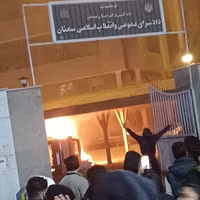
Protesters gather outside the Public and Revolutionary Prosecutor's Office in Semnan, east of Tehran, as a fire burns inside the compound during Iran's January 2026 uprising.

Iran's security forces deployed snipers on the rooftops of the provincial Friday prayer leader's office and a women's student dormitory to fire on protesters during January's deadly crackdown in Semnan, east of Tehran, an Iran International investigation found.

The investigation draws on eyewitness accounts and footage geolocated and verified by Iran International. The identities of the sources are being withheld for fear of reprisals by Iranian authorities.

It also found that hospital officials in Semnan province cooperated with security agencies to identify and arrest wounded protesters, in some cases before they could receive medical treatment.

The findings shed light on the methods used by authorities to suppress protests across the province during January's nationwide uprising.

Snipers stationed on government buildings

On January 8, as demonstrations intensified in Semnan, security forces deployed snipers and military-grade weapons on the rooftops of several prominent buildings.

The locations included the office of the provincial Friday prayer leader, the Maryam women's student dormitory and the provincial headquarters of Iran's state broadcaster, IRIB.

Witnesses described security personnel firing live ammunition at protesters from the elevated positions.

A machine gun was also deployed at the broadcasting building, where forces fired directly at protesters' heads and eyes in an attempt to suppress the crowds, according to the accounts.

On January 9, security forces raided the Kowsar student dormitory in Semnan, beating students with batons, using tear gas and arresting several people.

In the nearby city of Shahroud, witnesses described armed personnel patrolling residential streets on motorcycles and opening fire on residents.

Witnesses also said protesters detained at bases run by the Basij, a paramilitary force affiliated with the Islamic Revolutionary Guard Corps (IRGC), were shot with pellets in the backs of their legs from about one meter away, causing severe injuries, including torn tendons.

Security forces also used drones to identify demonstrators, armored vehicles to block roads and pepper spray against occupants of private vehicles, while widespread internet restrictions disrupted communications.

Hospitals used to identify wounded protesters

Kowsar Hospital in Semnan and other medical facilities were used to identify and arrest protesters during the January 8–12 crackdown, according to the investigation.

Hospital administrators and staff linked to security agencies systematically recorded the identities of patients arriving with pellet wounds or injuries from live ammunition and passed the information to security authorities.

Some wounded protesters were arrested immediately upon arrival, before receiving treatment.

In other cases, security personnel prevented emergency surgery on injured demonstrators, while medical resources were prioritized for government forces, according to accounts obtained by Iran International.

A Kowsar Hospital official who helped security forces identify protesters had previously served on a government election supervisory board.

The hospital also had close ties with IRGC officials and commanders and had hosted religious ceremonies and election-related gatherings.

Detainees subjected to torture, protestors killed

Witness accounts described protesters being transported to IRGC intelligence detention facilities and prisons with sacks covering their heads.

According to witness accounts, some detainees were held overnight alongside bloodied bodies, while others faced severe beatings, torture and verbal abuse targeting their ethnicity or gender.

Eyewitnesses previously told Iran International that at least 200 people were killed by security forces in Shahroud on January 8 and 9, although the figure could not be independently verified.

Iran International identified several of those killed, including Matin Montazerzohur, 31, who was shot in the chest on January 8, and Mahmoud Bijani, 24, who was shot dead outside the city's governor's office the following day.

Soleyman Norouzi, 31, was killed by live ammunition while returning from work on January 9. Hossein Gharib, 32, an electricity department employee and athlete, was also shot dead that day.

In another case documented by Iran International, security forces shot dead Saeed Golsorkhi, a 31-year-old powerlifter, outside his family home on January 11, two days after he was wounded during protests. Sources close to his family said he was killed in front of his mother and young niece.

Iranian authorities also executed Javad Zamani and Abolfazl Saedi, two protesters arrested during January's demonstrations in Shahroud, Semnan province, on June 16, according to the judiciary's Mizan news agency.

Protests spread across Semnan province

The January demonstrations extended across Semnan, Shahroud, Garmsar and Damghan, four counties accounting for more than 83 percent of the province's population and roughly half its territory.

The unrest spread across administrative centers, industrial districts, university communities and agricultural areas, showing that protests were not confined to a single city or social group.

Semnan province, home to approximately 700,000 people, has faced mounting economic and environmental pressures, including severe drought, declining groundwater supplies, land subsidence, industrial stagnation and rising living costs.

Despite numerous industrial estates along the Tehran-Mashhad corridor, the province has struggled with widening economic inequality and housing pressures.

Semnan also witnessed protests during nationwide uprisings in the Iranian calendar years beginning in March 2017 and March 2019, as well as the 2022 Woman, Life, Freedom uprising.

The province has also experienced labor and trade strikes, including those involving railway workers and merchants in Shahroud.

A sharp decline in voter turnout and growing political disillusionment reflect deep dissatisfaction with the continued rule of the Islamic Republic.

Official election figures show turnout in Semnan province fell from 87.82 percent in the 2009 presidential election to 49.11 percent in the first round of the 2024 vote.

After the killings, Iran turned on the families of the dead

Oct 16, 2026, 20:57 GMT+1
•
Omid Keshtkar
100%

A bullet is fired once. For the families of those killed in Iran’s Woman, Life, Freedom uprising, the punishment that followed lasted for years: bodies held hostage, false confessions forced on parents, funerals fired upon and killers set free, Amnesty International has found.

Threats, lies, humiliation and prison were the state’s weapons. Families were forced into silence under threat of having graves dug up, of rape and of execution. Many were denied even the right to mourn.

In a detailed report published four years after the uprising, Amnesty documented the killing of at least 377 people by security forces between September 2022 and early 2023, more than half of them in the first two weeks of protests, and said the true toll is far higher. The report also documents what happened next to the families of the dead.

  • Iran used state machinery to crush 2022 uprising, Amnesty says

    Iran used state machinery to crush 2022 uprising, Amnesty says

  • UN says Iran crackdown amounted to crimes against humanity

    UN says Iran crackdown amounted to crimes against humanity

Immediately after each unlawful killing, Amnesty found, the authorities began a campaign of silencing and cruelty against the victim’s family. The body was the first hostage, returned only once the family accepted the state’s false account of the death.

A wide range of institutions took part: the Intelligence Ministry, the police’s crowd-control units, the Revolutionary Guards’ Intelligence Organization, local Basij units, judicial and provincial officials, governors and local Friday prayer leaders.

‘Rioters,’ accidents and drugs

The pattern of forced narratives was almost identical across the country. A death had to be blamed on “rioters,” “counter-revolutionary groups,” “terrorists” or the opposition Mojahedin-e Khalq, or else on suicide, illness, an accident or drug use.

In Divandarreh, in Kordestan province in western Iran, hours after Fuad Ghadimi was killed on September 19, 2022, officials took his father to the state broadcaster and forced him to make false statements on air, threatening to withhold his son’s body and endanger his other children.

Plainclothes agents watched the grave and repeatedly replaced the headstone to remove the word shahid, martyr, which the family had carved on it.

In Kermanshah, Ardalan Ghasemi was shot on November 10 while writing slogans on a wall. An official at the hospital told his family that if they filed a complaint, his body would stay in the morgue for months, and to make the point, showed them the decomposed body of another person.

  • How Iran shielded forces over 2022 protest killings

    How Iran shielded forces over 2022 protest killings

  • How Iran’s 2022 crackdown was coordinated from the top

    How Iran’s 2022 crackdown was coordinated from the top

The family got Ardalan back only after signing a false statement that he had been killed while stealing a car.

The case of Fereshteh Ahmadi in Mahabad, in West Azarbaijan province, is among the most chilling in the report. Half an hour after she died on October 27, four agents dressed as nurses tried to take her body secretly out of the hospital. When the family stopped them, one agent held a gun to her husband’s head and threatened to kill him.

Her brother, Ebrahim Ahmadi, was arrested and held for 28 days in solitary confinement by the Revolutionary Guards’ intelligence arm in Sardasht. Agents offered him double the usual blood money if he would blame Kurdish opposition groups for her death. He refused.

The denial was even more intense when the victims were women and girls, Amnesty found. The UN Independent International Fact-Finding Mission on Iran also concluded that, compared with men, the deaths of women protesters were routinely blamed on alcohol, suicide, ordinary crime, illness, road accidents, family disputes or falls from windows and buildings. The authorities played down women’s deaths to stop them becoming symbols.

  • Mahsa’s dandelion: step by step through Iran's Woman, Life, Freedom

    Mahsa’s dandelion: step by step through Iran's Woman, Life, Freedom

Funerals under fire

Burials became another front for intimidation. Security forces tried to move bodies to undisclosed locations. In Javanrud, in Kermanshah province, the Revolutionary Guards took the body of Ismail Golanbar to their regional Najaf Ashraf base and returned it only on condition that he be buried outside the town.

Kumar Daraftadeh, a 16-year-old boy killed in Piranshahr on October 30, was given an hour for washing and burial; after repeated pleas, his family was allowed to bury him the next day, in a village 25 kilometers away.

Violence against mourners at times exceeded the violence against protesters. At the funeral of Zanyar Abubakri in Mahabad on October 27, hundreds of mourners carried his body above their heads while police special forces fired on them with assault rifles, birdshot and tear gas.

  • 'They shot on sight': Amnesty details 2022 protest killings in Kurdish areas

    'They shot on sight': Amnesty details 2022 protest killings in Kurdish areas

In Bukan, the brother of Shahriar Mohammadi, killed on November 18, described throwing himself onto his brother’s body to stop agents from seizing it. They beat him repeatedly on the head, kicked the body and shot him in the leg with birdshot at close range.

Hospitals, morgues and death certificates

Another layer of repression ran through hospitals, morgues and the coroner’s office. By forcing hasty burials, often within hours, the authorities sidestepped the legal requirement for an autopsy. When autopsies were carried out, families were usually denied the results.

In Sanandaj, the capital of Kordestan province, the coroner told the family of Hooman Abdollahi, shot directly in the heart on December 7, the cause of death only verbally. The family never received a written report or even a burial certificate.

Police seized the ambulance carrying his body and took it to an unknown location, and the family was made to bury him at night with no one else present.

Minoo Majidi, killed in Kermanshah on September 20, had 167 pellets in her body. A forensic expert told her family so, but no written report was ever issued.

Even the language of death certificates was changed to hide the truth. Phrases such as “impact of hard objects” or “hunting pellets” appeared without any indication of their source.

  • Mahsa Amini and the century-long struggle of Iranian women

    Mahsa Amini and the century-long struggle of Iranian women

For Habibollah Fathi, killed by a live round to the head on November 19, a first certificate gave the cause of death as “unknown.” When the family asked for it to be corrected, a second certificate cited heart disease.

The authorities also kept families from seeing their dead. In Sanandaj, relatives of Peyman Monbari, killed on October 8, were made to sign a document stating they had viewed the body, while what they received at the cemetery was a body already washed and shrouded.

Justice denied

Some families, despite everything, tried to seek justice through the courts. Amnesty was able to gather and examine ten such cases from eight provinces.

In four, prosecutors cleared the killers with a single line citing insufficient evidence. Two were referred to military courts to set blood money, without any investigation.

In two more, the authorities themselves admitted that security agents had fired the shots, but sent the cases not to a criminal court but to a military court to determine compensation, and only on condition that the victim be proven innocent.

One case did end in a sentence of qisas, retribution in kind. Mohammad Jamehbozorg was shot in the face in Malard, west of Tehran, after agents raided his home, where he had sheltered protesters.

A court sentenced the agent to death and the Supreme Court upheld the ruling. Then, after direct intervention by Revolutionary Guards commanders and Malard’s Friday prayer leader, the charge was reduced from intentional to unintentional killing, and the killer received three years in prison.

The cases of Sepehr Beiranvand in Khorramabad and Mehran Samak in Bandar Anzali followed the same course: an initial conviction, then the ruling overturned and the case sent back for review. Samak was shot after honking his car horn in solidarity with people celebrating Iran’s World Cup defeat to the United States.

The Bloody Friday case in Zahedan, the capital of Sistan and Baluchestan province, where security forces killed at least 87 people, most of them Baluch worshippers, on September 30, 2022, ended with prison sentences for a few low-ranking officers. All the commanders were acquitted.

The forces of repression were ready to kill and to intimidate. Security agents were trained to cover up the killings and to threaten families, and the judiciary stood ready to clear the killers and protect the forces behind them.

These accounts are an undeniable part of the Islamic Republic’s crimes against humanity: crimes that began in the streets and continued, for months and years afterward, in the suppression of families.

Gunfire heard as county-naming protest turns violent in central Iran

Oct 13, 2026, 11:00 GMT+1
100%

A protest over the name of a newly created county in central Iran turned violent after security forces moved to disperse demonstrators, with videos sent to Iran International capturing gunfire, tear gas and injured protesters.

The gathering took place on Sunday in Meymeh, a city in Isfahan province, where residents have objected to the new administrative district being named “Meymeh and Vazvan” rather than simply “Meymeh.”

Videos received by Iran International show demonstrators in the streets, tear gas in the area and people with bloodied clothing receiving medical treatment. Gunshots can also be heard, although it was not immediately clear what type of ammunition was used.

The number of people injured or detained remains unclear.

Local dispute over county name

Residents of Meymeh had campaigned for around two decades for their district to be upgraded to county status. The government eventually approved the change but in August 2024 named the new county Meymeh and Vazvan, combining the names of two cities.

Some Meymeh residents argue that their city’s historical identity should be reflected in the county name and have repeatedly called for the decision to be reversed. Officials have said the name should also recognize Vazvan.

The dispute culminated in Sunday’s street protest shortly before the new county administration was due to begin operating.

Footage showed some protesters carrying Islamic Republic flags and portraits of late Supreme Leader Ali Khamenei, underscoring the local nature of the dispute rather than an explicitly anti-government demonstration.

Security presence increases

The protest continued into the evening before security forces intervened and fired tear gas, according to videos and information received by Iran International.

Witnesses told Iran International that several protesters were wounded and detained, including some who were later taken into custody at hospitals. Iran International could not independently establish the number of arrests or verify the circumstances of each reported injury.

Reports from Meymeh on Tuesday indicated an increased security presence following the confrontation.

Over 90 killed in six months as clashes escalate in Iran's southeast - report

Oct 12, 2026, 18:52 GMT+1
100%

Armed attacks and security operations in southeastern Iran have left at least 94 people dead and 33 wounded since March 31, with fighting growing more frequent and involving heavier weapons, US-based human rights group HRANA reported Monday.

The group recorded at least 63 armed incidents between March 31 and October 10, especially in Sistan and Baluchestan province.

The escalation has coincided with the US and Israeli conflict with Iran. HRANA said Iranian authorities had focused much of their attention on western and northwestern Iran while a sustained pattern of armed attacks and security operations developed in the southeast.

Attacks on patrol vehicles and military convoys were the most common incidents, with 17 recorded cases, followed by 14 targeted shootings. Seven of the shootings occurred outside victims' homes or workplaces or along their commuting routes.

HRANA also reported a shift toward heavier weapons and more complex attacks.

On October 2, a vehicle allegedly linked to the IRGC Quds Force's Fatemiyoun Brigade was targeted with a booby trap and gunfire near Zahedan.

Five days later, an attack on a police headquarters in Jalegh reportedly involved mines, rocket-propelled grenades and semi-heavy weapons. On October 9, a roadside bomb struck the route of a police convoy near Zahedan.

The People’s Fighters Front, an alliance formed in December 2025 that includes Jaish al-Adl and smaller Baluch armed groups, claimed six of the attacks documented by HRANA, while Ansar al-Furqan claimed one. Most attacks remained unclaimed or could not be reliably attributed, HRANA said.

Government forces also used drones, artillery, armored vehicles and heavy weapons in several operations, HRANA said. In Jahadabad, Gharibabad and Manzalab, homes and sites of armed confrontations were demolished, blown up or set on fire.

The report warned that the use of such weapons in residential areas increased the risk of civilian casualties and property damage.

The region has a long history of clashes between Iranian security forces and Sunni Baluch militants. Jaish al-Adl emerged around 2012 as a successor to Jundullah and has repeatedly targeted security forces, including in a 2019 suicide bombing that killed 27 Revolutionary Guards.

Iranian security forces face wave of deadly attacks in restive southeast

Oct 9, 2026, 09:07 GMT+1
100%

At least five Iranian military and police personnel were killed and several others wounded in four armed attacks across southeastern Iran within 24 hours, local rights group Haalvsh reported, as violence targeting security forces continued across the area.

Haalvsh, which covers developments in Sistan and Baluchestan, said more than 12 personnel were killed or wounded overall between Wednesday evening and Thursday evening in Nikshahr, Nosratabad, Faryab and Jaleq, but cautioned that the final toll could be higher because some casualties had not yet been identified.

The People's Fighters Front took responsibility for the attacks in Nikshahr, Nosratabad and Jaleq, according to Haalvsh. The alliance, announced in late 2025, includes several Baluch armed groups, among them Jaish al-Adl. The group had not taken responsibility for the killing in Faryab.

Nikshahr and Nosratabad attacks

In the Nikshahr area, Haalvsh said two vehicles carrying military personnel were attacked. Mohammadreza Okati was killed and five others were wounded, according to the outlet, which identified the wounded as Ali Najafi, Mohammadreza Hosseini, Mojtaba Mir and two others identified by the surnames Keikha and Iranmanesh.

Haalvsh said those casualties were taken to Mohammad Rasoulallah Hospital in Nikshahr, while other wounded personnel were evacuated by helicopter to medical facilities in Chabahar, Konarak and Iranshahr. It said it had not established their number or identities.

Iran's army separately confirmed on Thursday that Okati was killed when personnel from its 88th Armored Division came under fire while traveling for a shift change, but said three people were wounded.

In the Nosratabad area near Zahedan, Haalvsh said at least three security personnel were killed and two wounded when gunmen attacked a police commando patrol on the Lakhshak road. It identified two of those reported killed as Vahid Enayat and Abbas Aghaei.

  • Police officer killed in armed attack near Zahedan as violence continues in southeast Iran

    Police officer killed in armed attack near Zahedan as violence continues in southeast Iran

  • Five killed in roadside attack as violence spreads in southeast Iran

    Five killed in roadside attack as violence spreads in southeast Iran

  • IRGC says six gunmen killed in clash in Iran's restive southeast

    IRGC says six gunmen killed in clash in Iran's restive southeast

Iranian police had earlier confirmed only Enayat's death, saying officers returned fire and that several attackers were wounded before fleeing.

Police major killed in Faryab

In Faryab, Haalvsh reported that Major Mehdi Jamshidi was shot dead while traveling in a private vehicle in the center of the county.

The outlet said Jamshidi was struck by seven bullets. It also cited reports that he had been among police personnel present during a confrontation involving women and other protesters in the village of Pashmuki in June.

The People's Fighters Front had not issued a statement taking responsibility for Jamshidi's killing, Haalvsh said.

Jaleq police headquarters attacked

The fourth attack targeted the police command headquarters in Jaleq, the administrative center of Golshan County, on Wednesday evening.

Haalvsh said the People's Fighters Front announced that its fighters had used a mine, rocket-propelled grenades and other weapons in the attack and said six police personnel were hit.

Videos obtained by Haalvsh showed heavy gunfire around the facility and at least one support vehicle being targeted, according to the outlet. Haalvsh said it had not independently established the final number or identities of those killed or wounded. IranWire also reported an explosion and gunfire around the police facility.

Attacks follow weeks of violence

The latest incidents follow a series of attacks on Iranian security forces in the southeast. Earlier this week, gunmen attacked two military vehicles in Bampur, while last week a roadside attack near Zahedan and clashes in Rask and other areas produced further casualties.

Official Iranian accounts and reports from Haalvsh have repeatedly differed over casualty numbers in recent attacks. Haalvsh said the toll from the four latest incidents should therefore be treated as provisional, particularly because some wounded personnel were transferred to hospitals outside the areas where the attacks occurred.